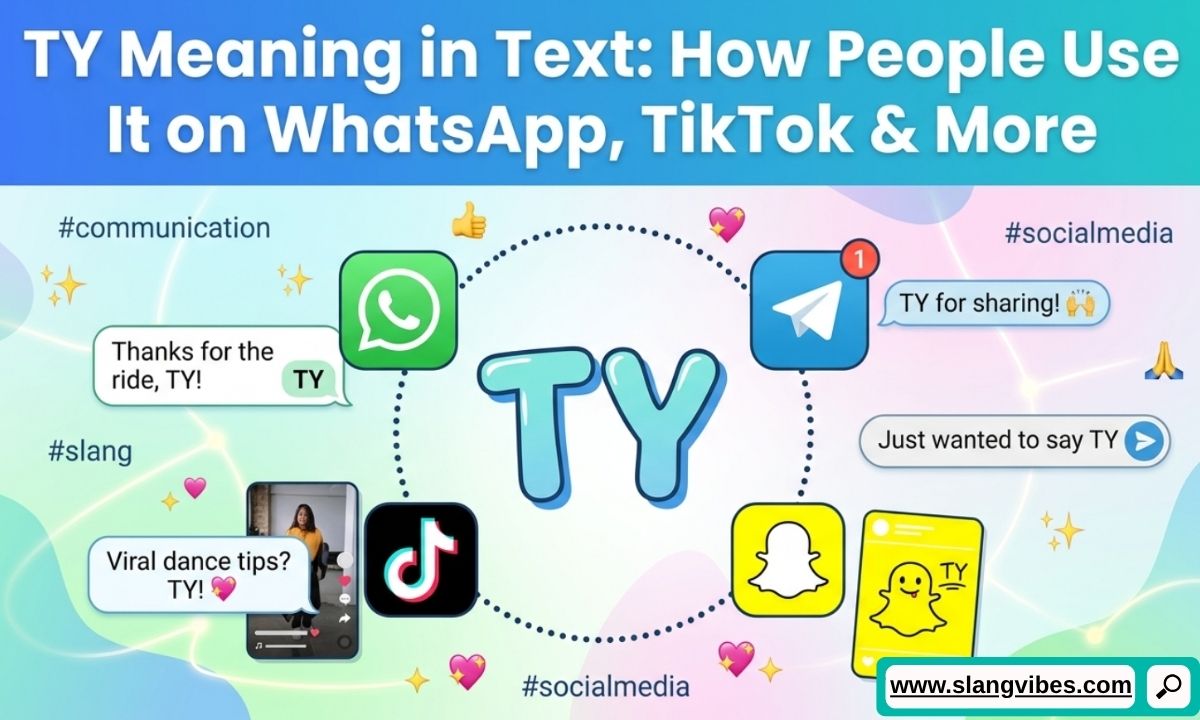
My cousin texted me “ty” after I sent her my old phone charger, and I stared at my screen for a solid ten seconds wondering if she was mad at me. Was she rushing? Did I do something wrong, or was the reply simply short? It turns out I was overthinking a two-letter abbreviation, and TY meaning in text is honestly the simplest thing on this list once you know it. TY means “thank you,” nothing more. No hidden message, no attitude, no secret code. Once you see it enough times, you stop second-guessing it and start using it yourself.
This guide breaks down everything around TY meaning in text, from how it shows up on different apps to when it might come across the wrong way. By the end, you’ll text back with confidence instead of squinting at your screen like I did.
TY Meaning in Text: The Quick Answer
Quick Answer: TY is short for “thank you.” People use it in texts, DMs, and comments when they want to show gratitude without typing the full phrase.
The TY full form in text is simply “thank you,” and this holds true across nearly every platform you’ll run into it on. People started shortening common phrases back when texting plans charged by the character, so abbreviations like TY, BRB, and LOL became second nature. Today, the habit sticks around because it’s quick, friendly, and gets the point across without slowing down a conversation.
So what does TY mean in text exactly? It means someone appreciates what you said or did, even if they only have a second to type a reply. The TY abbreviation meaning stays consistent whether you’re chatting with a friend, replying to a coworker, or commenting on a video. Here’s a quick example:
Friend: “I left the spare key under the mat for you.” You: “ty!! you’re a lifesaver”
Notice how the tone shifts once you add punctuation or extra letters. On its own, TY stands for thank you in a neutral, casual way. With an exclamation point or a repeated letter, it feels warmer. This small detail matters more than people realize, and we’ll get into it next.
Read Also: Ion Meaning in Chat: Snapchat, TikTok, Instagram & WhatsApp
TY vs Ty vs TYY: Does Capitalization Change the TY Meaning in Text?
Here’s something most guides skip entirely. Capitalization and letter repetition change how TY feels, even though the TY meaning in text stays the same underneath. “TY” in all caps often reads as flat or businesslike, almost like a stamp of approval. “Ty” in lowercase feels softer and more relaxed, the kind of reply you’d send a close friend. “Tyy” or “tyyy” adds emphasis, almost like you’re saying it out loud with a smile.
Think of it this way: punctuation and casing work like tone of voice in written form. Since texting strips away facial expressions and vocal tone, people lean on small details like extra letters to fill the gap. A few quick comparisons make this clearer.
| Example / Context | What It Means / How It Feels |
|---|---|
| “TY.” | Polite but distant, almost curt |
| “ty!” | Warm and casual |
| “tyyy 🥹” | Genuinely touched or excited |
| “Ty so much” | Sincere, a bit more formal than lowercase alone |
| “TYSM” | Strong gratitude, often used after a big favor |
So before you panic over a flat “TY” from a friend, check the rest of the message. Context, punctuation, and even emoji choice usually tell you more than the letters by themselves.
Read Also: MHM Mean in Text: What It Really Means in Chats and Social Media (2026)
TY Meaning in Text on WhatsApp, TikTok, Instagram and Discord
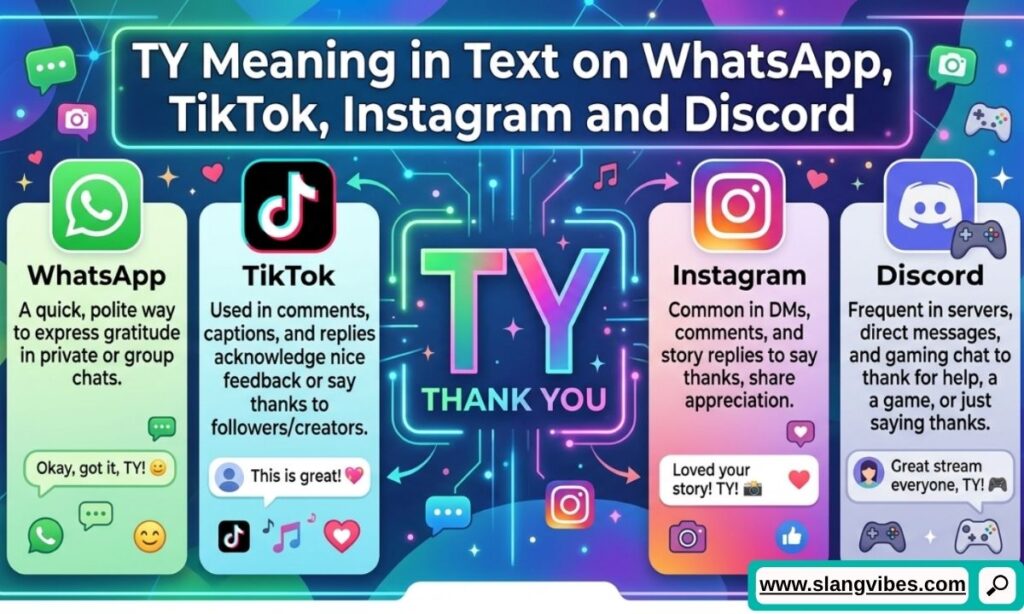
The TY meaning in text doesn’t change much between apps, but the situations where you’ll see it absolutely do. On messaging apps, social platforms, and gaming chats, TY shows up constantly because typing “thank you” every single time feels unnecessary when everyone already understands the shorthand.
TY meaning on WhatsApp usually pops up in group chats or after someone shares a file, location, or favor. For example:
Group Chat: Sara: “Sent the venue address to everyone 📍” Mike: “ty Sara!”
TY meaning on Instagram tends to show up in comments and DMs, especially after a tutorial, recipe, or outfit post. For instance:
Comment under a makeup tutorial: “ty for this, finally got my eyeliner right lol”
TY meaning on TikTok works almost the same way, often left under duet replies or creator tips:
TikTok comment: “ty for explaining this, I’ve been confused for weeks”
On Discord and other gaming chats, TY shows up after teammates share a strategy or hand off an item:
Gaming chat: Player1: “dropped you a health potion” Player2: “ty, needed that”
Across every app, the meaning of TY in social media stays the same: quick, genuine appreciation. The platform mainly decides the pace and the tone around it.
Read New Article: WTV Meaning in Text: What It Really Means on Snapchat, TikTok, Instagram & WhatsApp (2026)
Does TY Sound Rude? The Tone Behind TY Meaning in Text
This is the part most articles leave out, and it’s exactly where people get confused. A bare “TY” sometimes feels cold depending on what came before it. If someone apologizes for showing up late and you reply with only “TY,” it might read as dismissive instead of grateful, since “thank you” doesn’t even fit the moment well.
Tone trouble usually shows up in three situations. After a long, thoughtful message, a one-word “TY” sometimes feels like a brush-off. During an argument, TY sometimes gets used sarcastically, almost like saying “thanks a lot” through gritted teeth. In professional chats, an unpunctuated “TY” with no follow-up might come across as rushed, even when no rudeness was intended.
Compare these two replies to the same message:
Coworker: “Fixed the typo in the slide deck for you.” Reply A: “TY” Reply B: “ty so much, I totally missed that!”
Reply A isn’t wrong, but it’s quiet, Reply B sounds appreciative because of the extra words around it. Gen Z texters tend to read a flat “TY” as completely normal and low-stakes, while some Millennials still read short replies as slightly cold, since they grew up texting in fuller sentences. Neither group is wrong. The gap comes from different texting habits forming at different times.
TY, TYSM, TYVM, Thx, Ta: Comparing TY Meaning in Text Shortcuts
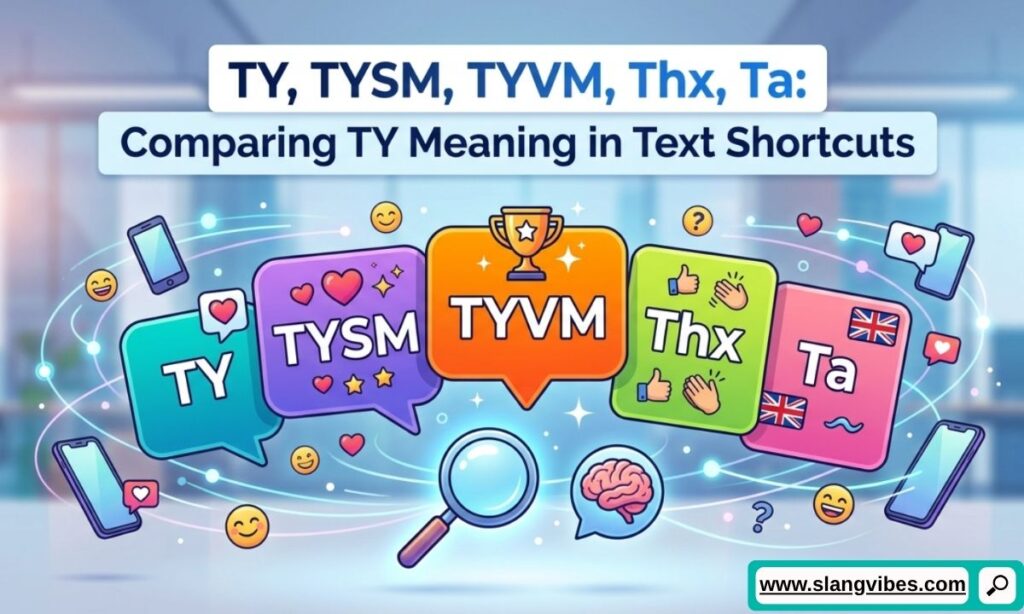
Once you understand TY, the rest of the gratitude shorthand family falls into place fast. Each version carries a slightly different weight, even though they all point back to the same root phrase.
Before comparing them side by side, it helps to know the TY vs thanks difference comes down to formality and effort. “Thanks” feels a notch more polished, while “TY” leans casual and quick. Here’s how the most common versions stack up:
| Example / Context | What It Means / How It Feels |
|---|---|
| TY | Casual, quick thank you |
| TYSM | “Thank you so much,” stronger gratitude |
| TYVM | “Thank you very much,” slightly more formal than TYSM |
| Thx | Extremely casual, almost a typing shortcut |
| Ta | British slang for thanks, common in the UK |
| Thanks | Standard, works in both casual and semi-formal settings |
UK readers will recognize “ta” instantly, while it barely shows up in US texting at all. Meanwhile, American texters lean harder on TYSM when they want to sound extra appreciative without writing a full sentence. Either way, picking the right version comes down to how much warmth you want the message to carry and who’s on the other end of the chat.
Read More Articles: WB Meaning in Text: What It Really Means on Social Media (2026)
Texting Etiquette: When TY Meaning in Text Doesn’t Fit
Even though TY meaning in text works fine for casual chats, a few situations call for the full phrase instead. Job interviews, condolence messages, and formal emails are the biggest examples. If someone offers their condolences, replying with “ty” often feels oddly small for the moment, even when warmth was the intention.
Customer service complaints fall into the same category. If a company resolves a billing issue after a long back-and-forth, writing out “Thank you so much for sorting this out” lands better than a quick “ty,” especially in writing where tone is already hard to read. The same goes for thank-you notes after interviews or recommendation letters. Spelling it out shows you took the moment seriously.
A simple rule helps here: the more formal or emotional the situation, the less room there is for shorthand. TY meaning in informal chat works perfectly between friends, classmates, or casual coworkers. TY meaning in SMS to a close contact rarely causes confusion. Once the stakes go up, though, even a small upgrade to “Thank you” or “I truly appreciate it” makes a noticeable difference.
Read More Articles: HYD Mean in Text: What It Really Means on Snapchat, TikTok & WhatsApp (2026)
How to Reply to TY Meaning in Text Messages
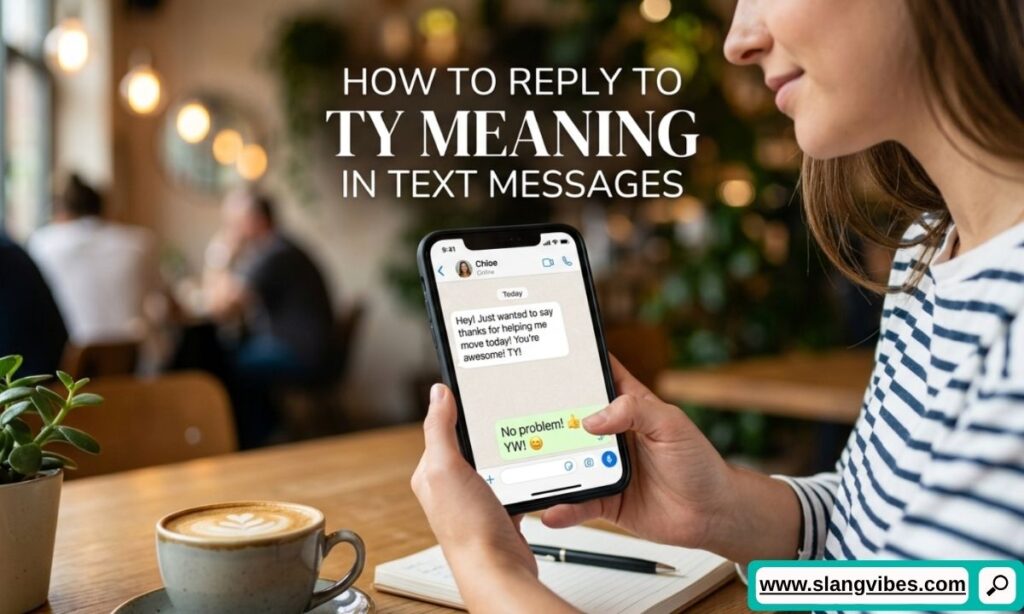
Knowing the TY reply meaning matters as much as knowing what TY itself means, since silence after someone thanks you often feels awkward in a fast-moving chat. Luckily, the options are short and easy to match to the tone of the conversation.
For casual chats, common replies include “np” (no problem), “anytime,” or simply “👍.” For example:
You: “Here’s that article I mentioned” Friend: “ty!” You: “np!”
In slightly more polite or professional settings, “Happy to help,” “Of course,” or “Glad it worked out” all read as warmer without sounding stiff. UK readers often default to “No worries” instead of “No problem,” and both work fine depending on where the conversation started.
Knowing how to use TY in chat naturally also means knowing when to skip a reply altogether. If someone says “ty” after you’ve already wrapped up the conversation, a thumbs-up reaction usually does the job better than typing anything new. Matching energy, rather than overthinking the reply, keeps the exchange feeling natural instead of forced.
Other Meanings of TY Outside of Texting
Outside of digital communication, TY shows up in a few unrelated places, and confusing them with the texting version trips people up more often than you’d expect. The most common mix-up involves names. TY is a frequent nickname for Tyler, Tyson, or Tyrone, so a text like “Ty said he’s running late” has nothing to do with gratitude at all. It’s simply someone’s name.
In niche fields, TY carries other technical meanings entirely, In physics, TY sometimes stands for “terayear,” a unit used for extremely long timescales, In medical shorthand, TY sometimes refers to thyroid-related notes. In aviation, TY occasionally appears as shorthand for taxiway. None of these show up in everyday texting, but they’re worth knowing if you ever see TY in a non-casual context and the “thank you” meaning suddenly doesn’t fit.
This is exactly why context matters more than the letters themselves. A friend’s name, a unit of time, and a thank you all happen to share the same two letters, so the surrounding sentence always does the heavy lifting.
Read New Article: WYLL Meaning in Text: What It Stands for on Snapchat & TikTok
Frequently Asked Questions
It means the same thing regardless of who sends it: thank you. The gender of the sender doesn’t change the meaning, though tone and punctuation around it might hint at how warm or casual the reply feels.
Not exactly. TY is a basic thank you, while TYSM (“thank you so much”) carries stronger appreciation. People often switch to TYSM after a bigger favor or a more meaningful gesture.
Yes. Outside of texting, TY sometimes works as a short name like Tyler, and it also shows up in physics, medical, and aviation terms. In everyday chat, though, it almost always means thank you.
Speed and habit. Typing two letters takes less effort than a full phrase, and since most people already recognize the abbreviation, there’s no real need to spell it out every time.
Not usually, though context matters. A flat “TY” after a heartfelt message or apology sometimes comes across as a bit cold, while the same reply in a fast, casual chat reads completely normal.
Final Thoughts
TY meaning in text comes down to one simple idea: gratitude, shortened for speed. Once you notice how punctuation, capitalization, and platform all shift the tone slightly, the confusion disappears fast. Whether you’re replying on WhatsApp, commenting on TikTok, or texting a friend back, you’ll know exactly when a quick “ty” fits and when the full “thank you” works better.

Alex Carter is a language enthusiast and internet culture expert at SlangVibes. He explains the latest slang terms and text meanings in simple, clear English so everyone stays in the loop.