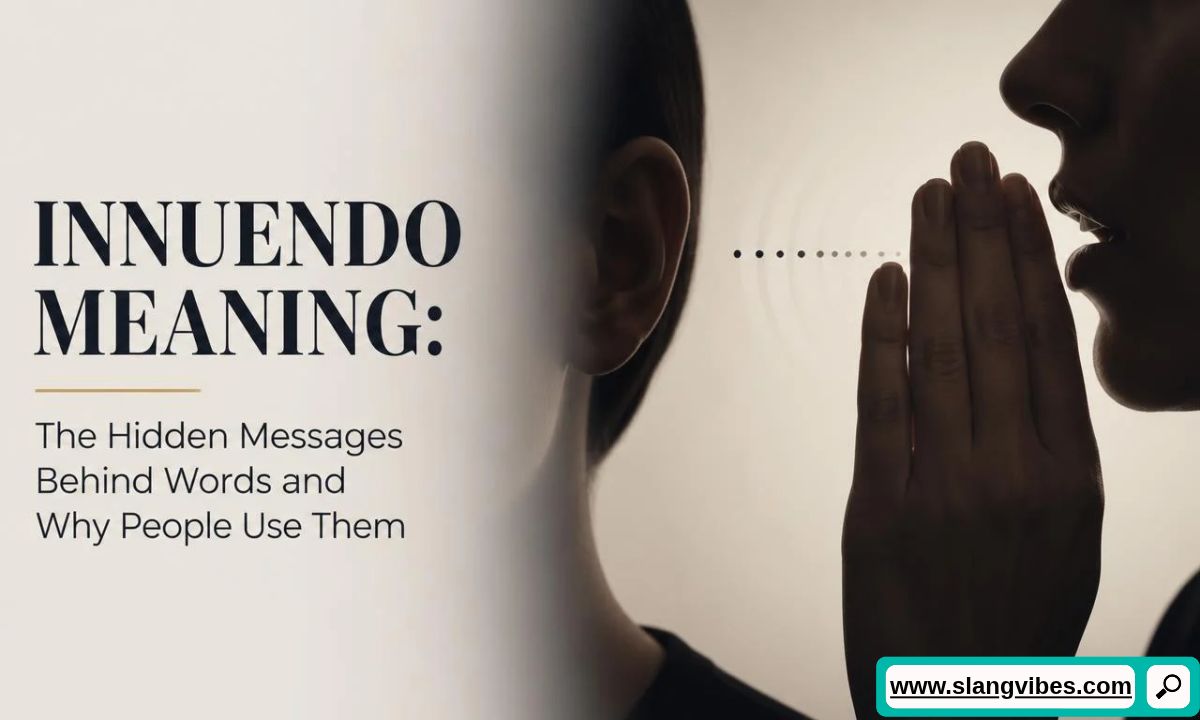
Last month, my friend dropped a comment in our group chat about a coworker’s “long night at the office.” Everyone laughed. I typed “lol” and stared at my screen, completely lost. Later, I searched for the innuendo meaning to figure out what I missed. The joke sat right between the lines. Everyone stayed polite, and everybody understood. Here’s the thing: innuendo works like a wink in sentence form. The words stay polite while the hint carries the real message. This guide explains what innuendo means, where the word comes from, why people use it, and how to reply when someone aims one at you.
Read Also: BBFS Meaning in Slang: Definition, Texting Uses, Examples & More (2026 Guide)
Innuendo Meaning: What It Is in Plain English
Innuendo meaning comes down to one idea. You suggest something without stating it outright. The speaker hints, and the listener fills in the gap.
Think of it this way. A coworker says, “Funny how the manager always picks you for the late projects.” On the surface, the sentence sounds like a casual remark. Underneath, the tone hints at favoritism. This gap between words and intent is the innuendo.
Most people link the word with romance or adult jokes, and many uses do fit there. Still, innuendo covers more ground. It shows up in teasing, gossip, office banter, and polite insults. The hint might be flirty, funny, critical, or sly.
Here are the three traits of a typical innuendo:
- The surface meaning sounds innocent or neutral.
- A second meaning sits underneath.
- The listener needs context to catch it.
Is innuendo slang? No. It’s a standard English word found in any dictionary. People simply use it in casual talk, memes, and comedy. This is why it feels like internet language, even though it’s far older than the internet.
Tone matters more than vocabulary here. One sentence reads as innocent from a stranger and loaded from a close friend. Pauses, emojis, and shared history all shift the meaning. Delivery adds one more layer. A raised eyebrow in person becomes a winking emoji in a text.
Read More: Snowball Kiss Meaning: The Truth You Didn’t Expect 😳
Innuendo Origin: Where the Word Comes From
The word comes straight from Latin. Innuendo is a form of the verb innuere, which means to nod at or to signal. Picture someone giving a quiet nod across the room instead of speaking. This is the original image behind the term.
Early on, lawyers used the Latin word in written court documents. It introduced an explanation of what a statement implied. English speakers later borrowed it for everyday hints and sly remarks.
Did You Know? In defamation law, innuendo is still a formal legal term. It describes a hidden, damaging meaning tucked inside harmless-looking words.
This legal background explains why the innuendo meaning in modern speech still carries a slightly sneaky edge. The speaker avoids owning the claim, so the listener does the work.
Over time, the word moved from courtrooms into novels, newspapers, and stage comedy. Writers liked it because it let them joke about touchy topics without crossing a line. Older film and theater censorship rules also pushed writers toward hints instead of plain statements. Classic Hollywood comedies and British stage farces leaned on this style heavily.
Today the same trick lives on in TV sitcoms, pop songs, and viral posts. Creators hint at an adult joke, and the audience happily connects the dots. Only the delivery method has changed over the centuries.
Read Also: Soft Launch Meaning: Why Everyone Is Doing It on Social Media
Innuendo Meaning in Text Messages and Social Media
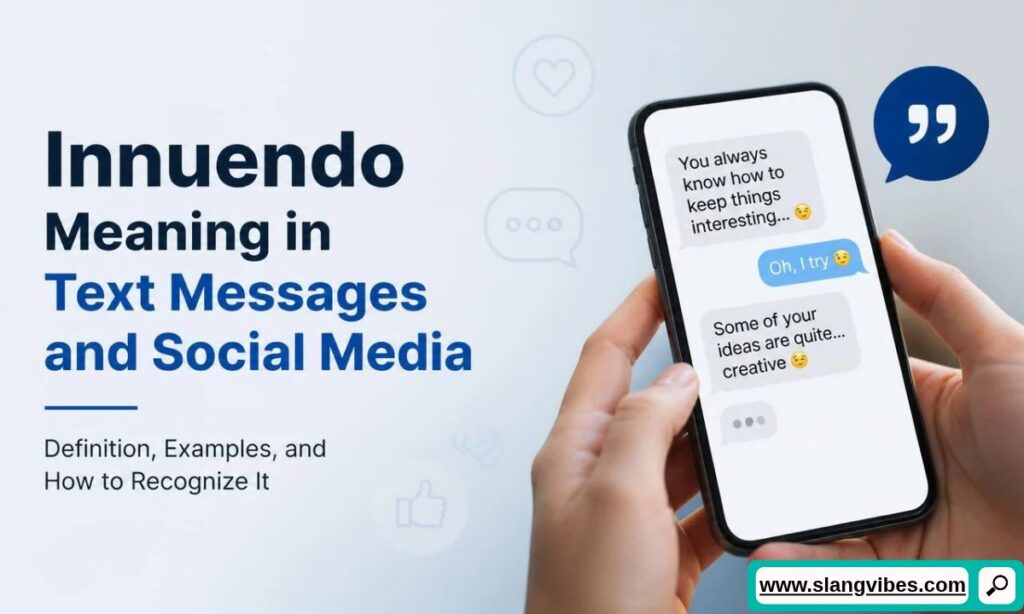
Innuendo meaning shifts a little once you move from speech to screens. Text has no tone of voice, so people lean on punctuation, emojis, and timing to carry the hint.
Look at a simple example. A friend sends “Guess who has plans tonight…” followed by a winking face. Three dots and one emoji turn a plain sentence into a hint. Without them, the message reads as ordinary news.
Each platform has its own habits:
- TikTok and Instagram: a caption or comment hints at a joke through one carefully chosen word.
- X and Reddit: the top reply often points toward the joke without ever stating it.
- Group chats: shared history lets friends hint at things in three words or fewer.
Many creators also use innuendo to avoid automated moderation. A hinted joke slips through filters more often than a blunt one. Based on how the term is typically used online, this is one reason double meanings spread so fast.
Picture a friend texting “Studying at Jordan’s place tonight” with a smirk emoji. The words are clean. The emoji adds the second meaning.
Screens also keep a record. A hint typed in a chat stays there, so many people pick wording they feel comfortable defending. This gives the speaker deniability when someone asks what they meant.
Read New Articles: Sans Meaning in Text: Slang Definition & Examples
Real-Life Innuendo Examples and What They Hint At
Here is the innuendo meaning in action across three everyday situations. Each chat below pairs the words with the hidden message.
Group Chat Between Friends
Maya: Why did Tyler leave the party so early?
Chris: Well, he did get a lot of attention from the girl in the red jacket.
Maya: Ohhh, got it. 😏
What it hints at: Tyler left for a romantic reason, and Chris never says so.
Flirty DM Exchange
Jordan: You’ve been at the gym every morning lately.
Sam: Guess I found some extra motivation.
Jordan: Anyone I know?
Sam: Keep guessing. 😉
What it hints at: Sam is seeing someone and enjoys the teasing.
Coworkers Talking Schedules
Priya: Did you see the schedule for next week?
Dan: Sure did. Funny how Alex always gets the Friday afternoons off.
Priya: Funny how things work out for some people.
What it hints at: Alex gets special treatment, and nobody wants to accuse the boss directly.
Notice the pattern in all three chats. Nobody states the point directly. Each speaker leaves a gap, and the listener fills it. The tone matters as much as the words, so the same lines would read as harmless between strangers.
Pay attention to words like “funny,” “interesting,” and “guess.” Speakers often use them to flag a second meaning.
Read Also: DRS Meaning in Chat: What It Really Means in Text, Snapchat & Social Media (2026)
Why People Use Innuendo

Understanding the innuendo meaning also means understanding the motive behind it. People rarely hint by accident. Most choose indirect words for a reason.
Here are the most common motives:
- Humor: a hint lands better than a blunt joke, because the listener gets to feel clever.
- Flirting: a playful hint tests interest without risking a clear rejection.
- Criticism: an indirect remark voices a complaint without starting an argument.
- Group bonding: shared hints build inside jokes and a sense of belonging.
- Self-protection: if the hint lands badly, the speaker claims it meant nothing.
Imagine you like a coworker but feel nervous. Asking directly feels risky, so you mention a cozy coffee shop downtown, the type of place built for two. The other person either takes the hint or ignores it. Either way, you keep your pride.
Many people also enjoy the playfulness. Hinting feels light. A direct statement feels heavy, while a hint is easy to laugh off. Pairing a hint with a smile keeps it friendly.
It’s common to see innuendo rise in groups with strong shared humor. Friends who know each other well need fewer words to land the same hint. Strangers, on the other hand, often miss it. Many younger users pick up online hints quickly, since memes train the ear for double meanings. Shared context decides who gets the joke.
Read New Articles: GL Meaning in Text: What Does GL Mean in 2026?
Innuendo vs Double Entendre, Sarcasm, and Euphemism
Four terms often get mixed up. Each one involves indirect meaning, yet each works differently.
This table shows the differences side by side.
| Term | Meaning | Example |
|---|---|---|
| Innuendo | A hidden suggestion left unsaid | “Funny how the boss likes you so much.” |
| Double entendre | One phrase with two readings, one often risqué | “Come up and see my etchings.” |
| Sarcasm | Saying the opposite of what you mean | “Great, another meeting.” |
| Euphemism | A softer word replacing a harsh one | “He passed away.” |
The biggest confusion involves innuendo and double entendre. A double entendre is a phrase built with two readings, and the speaker usually plans both. Innuendo leans on context, tone, or a pause, and the speaker never spells it out. Many sentences fit both labels, so a strict line rarely exists.
Sarcasm and innuendo also overlap. Sarcasm flips the meaning, while innuendo hides one under the surface. A sarcastic comment states the opposite. An innuendo stays on topic and points sideways.
Euphemism softens a harsh truth. Innuendo adds a hint. Saying “he passed away” avoids the word “died,” yet nothing hides underneath. People use euphemisms to be polite and innuendo to be sly.
UK comedy has a long tradition of cheeky hints, such as the Carry On film series. US audiences often link the style with sitcom jokes built on double meanings.
Read Here: WBY Meaning in Text: What It Really Means in Chats & Social Media (2026 Guide)
Innuendo Meaning at Work: When Not to Use It
Innuendo meaning matters most when the setting is formal. Workplaces, schools, and family gatherings rarely reward hints. A joke which lands in a group chat sounds entirely different in a meeting room.
Here are the main mistakes people make:
- Assuming everyone shares your sense of humor.
- Hinting in writing, where tone disappears and screenshots last forever.
- Using a hint when a clear sentence would protect everyone.
- Repeating a hint after someone ignores it or looks uncomfortable.
Picture a manager who jokes about a colleague’s “special relationship” with a client. The manager thinks it’s harmless. The colleague hears an accusation. Neither person misheard. They simply read two different meanings.
Workplace hints also carry real risk. A remark with a sexual edge is not a joke to everyone, and many workplaces treat it as a conduct issue. When in doubt, stay direct.
The same caution applies to formal writing. Emails, cover letters, reports, and legal or medical notes need plain language. A hint in those places creates confusion, and confusion costs time.
Family settings follow similar rules. Hints around younger relatives or older relatives often land badly, since people read the humor through different lenses.
A quick test helps. Ask yourself whether you would say the hint out loud in front of the person’s boss, parent, or best friend. If the answer is no, rephrase it.
Read Also: What Does GMT Mean in Text? Social Media and Chat Guide
How to Respond When Someone Uses Innuendo
Knowing the innuendo meaning is step one. Choosing a response comes next, and the right reply depends on who said it and why.
With friends, a playful reply keeps the mood light. Try “I see what you did there,” or “Your imagination is busy today.” Both acknowledge the hint without adding to it.
Leah: Heard you and Marcus are “studying” together again.
Nina: Wow, your imagination is busy today.
Leah: I’m only asking!
Nina: Sure you are. 😄
With acquaintances, stay neutral. A calm “Not sure what you mean” often ends the hint without drama. Silence or a change of subject works too.
When a hint crosses a line, go direct. Clear words protect you and remove any room for doubt.
Chris: Wow, you two are always working late together.
Taylor: What are you saying exactly?
Chris: Nothing, forget it.
Taylor: I’d prefer you say it directly or skip the comment.
Notice how Taylor stays calm. Asking a direct question often makes the hint collapse, because the speaker has to own the words.
If the hint comes from someone you like, a smile and a short line like “Is this an invitation?” keep the door open. If the speaker is a stranger or feels uncomfortable, skip the humor and set a boundary. Trust your gut.
Frequently Asked Questions About Innuendo
What Is the Innuendo Meaning in Simple Words?
The innuendo meaning is an indirect remark hinting at something left unsaid. The real message sits between the lines.
Is Innuendo Always Sexual?
No. Many hints are romantic or adult, but innuendo also appears in teasing, gossip, and criticism.
What Is the Difference Between Innuendo and Double Entendre?
A double entendre is a phrase with two built-in meanings. Innuendo depends more on tone and context.
Is Innuendo Slang?
No. It’s a standard English word, though people use it often in casual talk and online humor.
How Do You Pronounce Innuendo?
Say it as in-yoo-EN-doh, with the stress on the third syllable.
The Bottom Line on Innuendo
Innuendo meaning is easy to describe and tricky to master. It is a hint wrapped in polite words, and the listener supplies the rest. The hidden message might be funny, flirty, critical, or sly. Context and tone decide which one you hear.
You now know where the word comes from and how it differs from sarcasm and double entendre. You also know why people choose hints over plain statements. In texts and comment sections, emojis often carry the second meaning.
The practical side matters most. Read the room before you send a hint. Keep formal settings direct. When someone aims a hint at you, pick the reply you feel good about. Play along, stay neutral, or set a clear boundary.

Alex Carter is a language enthusiast and internet culture expert at SlangVibes. He explains the latest slang terms and text meanings in simple, clear English so everyone stays in the loop.