Last month my cousin helped me carry a couch up three flights of stairs. I texted “thanks, you saved me,” and he sent back one reply: “yw.” No emoji, no exclamation mark. I stared at my screen for a full minute, wondering if he was annoyed. Did I miss something? Two letters shouldn’t cause so much stress. Here’s the thing. The yw meaning in text is simple, because it stands for “you’re welcome.” The tone behind those two letters shifts with punctuation, emojis, and the sender. In this guide, you’ll learn how people use YW, when it sounds cold, and how to reply without overthinking it.
Read Also: Moots Meaning in Text: Simple Explanation for Social Media Users (2026)
YW Meaning in Text: The Short Answer
YW stands for “you’re welcome.” People type it right after someone says “thanks,” “thank you,” or “ty.” The letters come straight from the first letter of each word, so there’s no hidden code to crack.
The YW meaning in text stays the same across apps. You’ll see it in iMessage, WhatsApp, Instagram DMs, and TikTok comments. Because the reply sits right under a thank-you, context does most of the work.
Here’s a quick example between siblings.
Maya: Thanks for picking me up from the airport!
Eli: yw, see you Sunday.
Maya: Perfect.
Eli’s reply is short, yet it sounds warm. The “see you Sunday” part softens it. Without the extra line, a bare “yw” reads as more neutral.
Texters also write it as “YW,” “Yw,” or “yw.” Capitalization doesn’t change the meaning. It only shifts how formal or relaxed the message feels.
The exact origin is unclear. Short forms like LOL, BRB, and TY spread as people looked for faster ways to type. YW follows the same pattern. No reliable record names a first user, so treat any exact date with caution.
Think of it this way: YW is the written version of a friendly nod across the table. It acknowledges the thanks without turning a small favor into a big moment. When YW follows a thank-you, read it as “you’re welcome” and move on.
Read More Articles: Pookie Meaning in Slang: The Cute Word Everyone Is Using in 2026
How Gen Z and Millennials in the US and UK Use YW in Texting
Both generations read the YW meaning in text the same way. The style around it differs. Many Gen Z texters write “yw” in lowercase with no punctuation, matching how they type everything else. Many Millennials lean toward “YW!” or the full “You’re welcome!” with an exclamation mark.
These patterns are common, though plenty of people break them. It’s common to see a Gen Z user write “You’re welcome” with perfect punctuation. A Millennial might send a bare “yw.” Treat style as a hint, never a rule.
US and UK habits overlap heavily. Americans often follow a thank-you with “yw,” “np,” or “no problem.” British texters tend to add “no worries,” “no bother,” or “cheers” to the mix. Based on how these terms are typically used online, YW travels well between both countries because it’s short and neutral.
Picture this. You thank a friend in London for forwarding a train ticket. They answer “yw x,” with a kiss at the end. In New York, a friend answers “yw!!” after you thank them for covering lunch. Both replies mean the same thing, and both feel friendly.
Notice how the extras do the emotional work. An exclamation mark adds energy. An emoji adds warmth. A trailing “lol” adds playfulness. The two letters stay constant while everything around them sets the mood.
So when you read a YW, scan the whole message, not only the letters.
Read Here: YH Meaning in Text Messages, TikTok, Snapchat & More
YW Meaning in Text on Snapchat, Instagram, and Discord
On Snapchat, Instagram, and Discord, the YW meaning in text holds steady. Each app has its own rhythm, though.
Snapchat moves fast. Replies often arrive as quick chats or snaps, so “yw” fits the pace. Many users send it with an emoji and move on.
Instagram DMs lean friendlier. People often add a heart or a laughing emoji after “yw.” Story reactions and shared reels spark many of these replies.
Discord and gaming chats run even more casual. Players thank each other for a revive or a carry, and “yw” comes back in seconds. Here’s a group chat example.
Dani: ty for the revive, I was done for
Kai: yw lol
Rio: he lagged the whole time
Kai: yw again 😂
Notice the second “yw” from Kai. Repeating it signals a joke, not a sincere thank-you reply. Friends tease each other this way all the time.
Comment sections work differently. On TikTok and YouTube, a creator might answer dozens of thank-you comments with the same “yw!” It keeps replies quick, and fans see the creator reading their comments. It also saves them time.
Across all these apps, the rule stays the same. Check the message above the YW, then read the tone from the emoji and punctuation. Short replies fit fast-moving chats, so nobody expects a paragraph. Think of YW as a quick wave, not a speech.
Read New Articles: Huzz Meaning in Slang (2026): What It Really Means on TikTok, Snapchat & Gen Z Culture
When YW Sounds Rude or Sarcastic
Most of the time, YW sounds friendly. A few situations change the feel completely.
Sarcastic “yw” tops the list. Imagine you hold a door open for a coworker, and they walk past without a word. You mutter “yw” under your breath. Texts work the same way. Someone sends “yw.” or “yw?” after you forget to thank them.
In those moments, the YW meaning in text flips from polite to pointed. The words stay the same, but the intent changes.
Common Mistake: Treating every short reply as an attitude. Plenty of people type “yw” in two seconds and send it with zero extra thought.
Other clues point toward a cold tone. A period after a lowercase “yw” feels clipped in a warm conversation. A long delay before a one-word reply sends a similar signal. So does a bare reply to a heartfelt thank-you.
Compare two replies to “Thanks so much for staying late with me.” One person answers “yw 😊 anytime.” Another answers “yw.” Same letters, different feeling. The first sounds open. The second sounds distant, though the sender might be busy.
Before reading anger into “yw,” check the history. Does this person text in short bursts? Did you forget a thank-you earlier? Their normal style tells you more than the two letters do.
When the tone still feels off, ask in a friendly way. A quick “all good?” clears things up.
Read Also: Whipped in Slang: The Real Meaning Behind the Viral Term
Is It OK to Use YW at Work or School?
Yes, in many informal workplaces, YW works fine. The YW meaning in text stays the same on Slack or Teams, where coworkers trade quick abbreviations all day. Here’s a typical exchange.
Priya: Thanks for sending the slides!
Tom: YW 👍
Priya: Sending the budget sheet next.
Tom: Got it.
This works because the two coworkers already text casually. Neither expects formal language, and the thread moves on.
Context decides everything at work. Use the full phrase with a client, a senior leader, or a new customer. Do the same for anyone you don’t know well. “You’re welcome,” “My pleasure,” and “Happy to help” all sound more polished than YW.
School follows the same logic. When you answer a teacher or professor, write the full phrase. Replying to a classmate in a group chat is a different story, and “yw” fits fine there.
Formal writing matters too. In a cover letter, a client email, or a customer support reply, skip abbreviations altogether. Spelling words out signals care.
Try this quick test. Picture saying the reply out loud to the person’s face. If a casual “no problem” feels right, YW works. If you’d choose “my pleasure,” type it out.
When in doubt, spell it out. It costs three extra seconds and never hurts. Remote teams often set the tone in the first few messages, so mirror how your colleagues write.
YW vs. NP, TY, and Other Similar Slang
The YW meaning in text overlaps with a handful of other replies. Here’s how they compare.
| Term | Meaning | Tone |
|---|---|---|
| YW | You’re welcome | Casual, neutral |
| TY | Thank you | Casual, grateful |
| TYSM | Thank you so much | Warm, enthusiastic |
| NP | No problem | Easygoing |
| NW | No worries | Relaxed, reassuring |
| My pleasure | Happy to help | Polite, professional |
| Anytime | Ask again whenever | Warm, open |
YW and TY work as a natural pair. TY says thank you, and YW answers it. NP and NW shift the focus. They tell the person the favor cost nothing.
YW directly accepts the thanks. NP downplays the effort. If a friend drives you across town, “yw” sounds like a polite nod. Meanwhile “np” sounds like “don’t mention it.” Both land well in casual chats.
Be careful with “np” in serious moments. After someone thanks you for emotional support, “np” feels a bit dismissive. It treats the support like a minor chore. A fuller reply fits better there.
NW stands for “no worries,” which tends to appear often in British chats. Americans use it too, though “no problem” and “np” come up more.
Pick the option which matches your relationship. With close friends, any of them works. With new contacts, lean toward the fuller phrases. YW sits in the middle of the pack, friendly without being gushy, which makes it a safe default. No single option wins every situation.
Read Also: ISO Mean in Text: What It Really Means on Facebook, TikTok & Instagram (2026)
How to Reply When Someone Sends YW
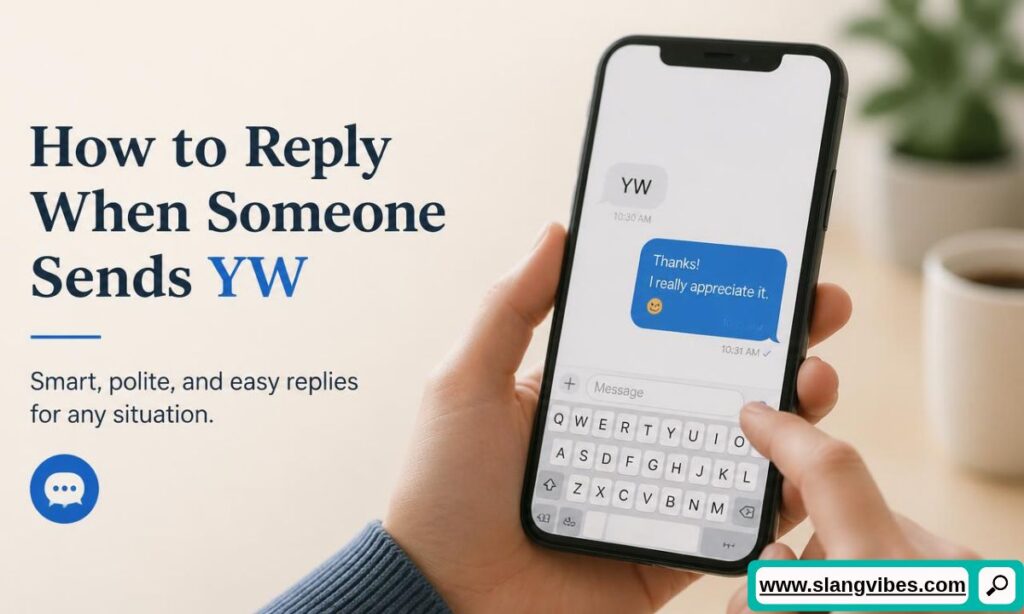
Most of the time, you don’t need to reply at all. The YW meaning in text closes the loop on a thank-you, so the chat ends naturally. A second reply often drags a short exchange. Overreplying is a bigger risk than underreplying.
Still, some moments invite one more message. Here’s a dating example.
Jade: Thank you for the ride home, I owe you one 😊
Noah: yw, text me when you’re inside
Jade: Will do!
Jade answers because Noah asked her to. His request moves the chat forward.
When you want to reply to a plain “yw,” match the tone to the relationship. Here are easy options by style.
- Casual: “Appreciate it!” or “Haha, anytime.”
- Playful: “Okay, we’re even now.” or “Look at us being polite 😂”
- Warm: “Thanks again, you’re the best.” or “That means a lot.”
- Professional: “Much appreciated.” or “Thank you again.”
Thank-you chains deserve a limit. After thanks, YW, and one more thanks, most people stop. Anything longer starts to feel like a loop.
Read the other person’s pace. Fast replies invite a quick follow-up. Slow replies suggest they’ve moved on. Skip the reply when the chat feels finished, and nobody will think twice.
Group chats follow a simple rule. A heart or thumbs-up reaction on the YW message tells the sender you saw it. It ends the exchange without adding clutter.
YW Meaning in Text: Your Questions Answered
What does YW mean in text?
The YW meaning in text is “you’re welcome.” People send it after “thanks,” “thank you,” or “ty.” It works as a quick, casual reply on texting apps and social media.
Is YW rude or sarcastic?
Usually no. YW sounds friendly in most chats. A period after it, a long delay, or a forgotten thank-you makes it sound pointed. Check the surrounding conversation before you decide.
What does YW mean on Snapchat and Instagram?
It means “you’re welcome” on both apps. Users often add a heart, a smiley, or a laughing emoji to keep the tone warm and playful. Replies tend to arrive fast and stay short.
Does YW ever mean something else?
Rarely. Odd cases exist in niche chats, so read the surrounding messages if YW doesn’t follow a thank-you. Context settles almost every question. Ask the sender when the meaning stays unclear.
Is YW OK to use at work?
Yes, in informal chats with coworkers you know well. Use “you’re welcome” or “my pleasure” with clients, managers, and new contacts. When in doubt, spell it out.
The Bottom Line on YW in Texting
The YW meaning in text comes down to two words: “you’re welcome.” Two letters replace the phrase in texts, DMs, comments, and game chats.
Tone is where the real information sits. A lowercase “yw” with no punctuation reads relaxed. “YW!” feels energetic. “yw 😊” feels warm. A “yw.” sent after a forgotten thank-you feels pointed.
Gen Z and Millennials in the US and UK understand YW the same way, even when their writing styles differ. The platform changes the rhythm more than the meaning.
At work or school, switch to the full phrase when you write to someone senior or someone new. With friends, YW does the job in seconds. And when someone sends YW to you, you rarely owe a reply.
Next time a two-letter reply lands in your chat, read the message above it. Check the emoji and punctuation, then match the tone. Then move on, because YW already saved everyone a few seconds. When the stakes feel higher, type out “you’re welcome” and let the words do the work.

Alex Carter is a language enthusiast and internet culture expert at SlangVibes. He explains the latest slang terms and text meanings in simple, clear English so everyone stays in the loop.