My friend Maya texted me last week. “My dinner cost me 400 kroner.” I stared at my phone. Had she flown to Oslo without telling me? Nope. She was sitting in Chicago, eating pasta. Here’s the thing. The kroner meaning splits into two camps, and I had no clue which one she picked. One camp is a real currency from Scandinavia. The other is a playful way to say money online. Once you spot the difference, the confusion fades fast. This guide covers both meanings and the history behind the word. You’ll also learn how to use it without trying too hard.
What Is the Kroner Meaning in Slang?
The kroner meaning in slang is simple. It’s a playful word for money or cash. Think of it this way: kroner works like bucks, bread, or dough, only with a fancier, more international flair.
Based on how the term typically shows up online, people drop it into captions and memes for a laugh. It often carries a wink. Someone who says they’re “swimming in kroner” is usually joking about being rich or broke, not talking about Scandinavian travel.
Here’s the exchange I finally had with Maya after I asked what she meant.
Maya: My dinner cost me 400 kroner 😭
Dev: Wait, are you in Norway?
Maya: I’m in Chicago. I’m being dramatic.
Dev: So kroner means money?
Maya: Yep. Think bucks, but fancier.
The slang use stays niche. You won’t hear it as often as bucks, so many people still read it as a currency first. The word carries no exact amount. The speaker wants to sound playful about money, not precise about it. Readers fill in the rest from context. A short reply like “lol same” or a laughing emoji usually follows.
Context does the heavy lifting. A joke about rent or new sneakers points to slang. A price tag in Copenhagen points to the real thing. Tone matters too. The word sounds casual, a bit flashy, and often ironic.
Read Also: OTW Mean in Text: What It Really Means on Snapchat, TikTok & Instagram (2026)
Kroner Meaning as a Real Currency
The original kroner meaning has nothing to do with the internet. Kroner is the plural of krone, the money Norway and Denmark use every day. In those countries, nobody hears slang. They see the word on price tags, receipts, and bank apps.
The singular is krone, and the plural is kroner. Norway’s currency code is NOK, and Denmark’s is DKK. Both countries often write the symbol kr after a price, like 50 kr. Sweden uses a related word, krona, with the plural kronor. Iceland uses króna.
Here’s how to tell the real currency from the slang. Look for these clues:
- A specific country, city, or trip, such as Oslo or Copenhagen
- A price, a bank, or an exchange rate
- A travel blog, a finance article, or a shopping site
- A number followed by kr
Visitors pick the word up fast on a trip. Prices come in kroner, change comes in kroner, and nobody makes a joke of it. English speakers often say “one krone” for a single unit and “kroner” for several.
If two or more clues show up, the writer means actual money. The slang version rarely comes with a currency code or a plane ticket. It shows up in jokes, captions, and casual chats instead. When in doubt, check where the sentence appears. A travel forum and a meme page read the word differently.
Read More: WSG Mean in Text: What It Really Means on Snapchat, TikTok & Instagram (2026)
Where the Word Kroner Comes From
The history behind the kroner meaning starts with a crown. Krone means crown in Danish and Norwegian, and the word traces back to the Latin corona. Royal imagery has a long history on European coins, so the name fit. Think of the crown as a symbol of trust. A ruler’s face on a coin told everyone the money held real value. Naming a currency after the crown borrowed the same authority for everyday shopping and trade.
In the 1870s, Denmark, Sweden, and Norway linked their money and switched to crown-based currencies. The name stuck in all three countries. Each country then shaped the spelling to fit its own language, which explains why krone, krona, and króna look so alike. Today Norway and Denmark still use the krone, and Sweden uses the krona.
Nobody tracks the exact moment the word jumped into English slang. Many people notice it in memes and gaming chats, where players from many countries swap jokes and currency names. A foreign money word sounds fresh next to plain old dollars. The novelty gives it staying power as a joke.
Here’s a travel example between siblings.
Ella: Oslo is wild. A coffee costs 60 kroner.
Noah: Is it expensive?
Ella: My wallet cried.
Noah: So kroner means real money there, not slang?
Ella: Right. Real money, real tears.
Kroner Meaning on TikTok, Instagram, and Reddit
Kroner meaning shifts a little with each platform, and the tone shifts with it. Here are a few typical scenes.
On TikTok, a creator posts a payday video. The caption reads “POV: you got paid, kroner secured.” The mood runs flashy and playful. Emojis like 💸 or 🤑 often follow.
Instagram leans the same way. Someone shares photos of new sneakers and writes “worth every kroner.” The post brags a little and winks a little.
Reddit runs drier. A commenter jokes about a pricey gadget. “Spent 200 kroner on a coffee machine, no regrets.” The mood turns sarcastic.
On X, a user quote-posts a screenshot of a pricey sandwich and writes “this many kroner for lunch?” The mood is a groan. Replies pile on with their own price complaints.
In Discord and gaming chats, players sometimes borrow the word for in-game cash. One player asks how many kroner a rare skin costs. Everyone understands the joke. Each platform has its own rhythm, yet the joke stays familiar.
Notice the pattern. The word rides on a joke about money, not a serious financial point. If a post sounds like a bank statement, the writer likely means the literal currency. If it sounds like a flex or a groan, expect slang. Short captions work best, because the word looks a bit unfamiliar on screen.
Read Also: MK Mean in Text: What It Really Means on Snapchat, TikTok & Instagram (2026)
What Kroner Means to Gen Z and Millennials
The meaning of kroner leans ironic with Gen Z. Younger posters tend to use it as a bit, a way to say money while poking fun at money talk. It’s common to see it next to memes about rent, groceries, and impulse buys.
Gen Z humor loves odd, exaggerated word choices, so a foreign currency name fits the style. Posters rarely explain the bit. They trust followers to catch it.
Millennials often know the real currency from travel, so they use the word with a knowing smile. They might say “bring your kroner” before a group dinner. Both groups treat it as a joke first and a definition second. Older millennials sometimes bring the word into work chats, where it lands as office humor.
US readers usually hear it as a quirky stand-in for dollars. UK readers might compare it with quid, a classic British word for pounds. Either way, the word signals humor, not a formal statement of cost.
Here’s a coworker exchange.
Priya: Spending review at 3. Bring your kroner reports.
Luis: My what?
Priya: Money reports. Don’t ask.
Luis: Got it. I’ll bring the spreadsheet.
Luis needed a second to catch on, and the pause is normal. Slang this niche rarely comes with a built-in explanation, so asking is fine. Nobody minds a quick question.
Read New Article: OP Meaning in Text: What It Really Means on Snapchat, TikTok & Instagram (2026)
Kroner vs Kronor vs Krone: Common Mistakes
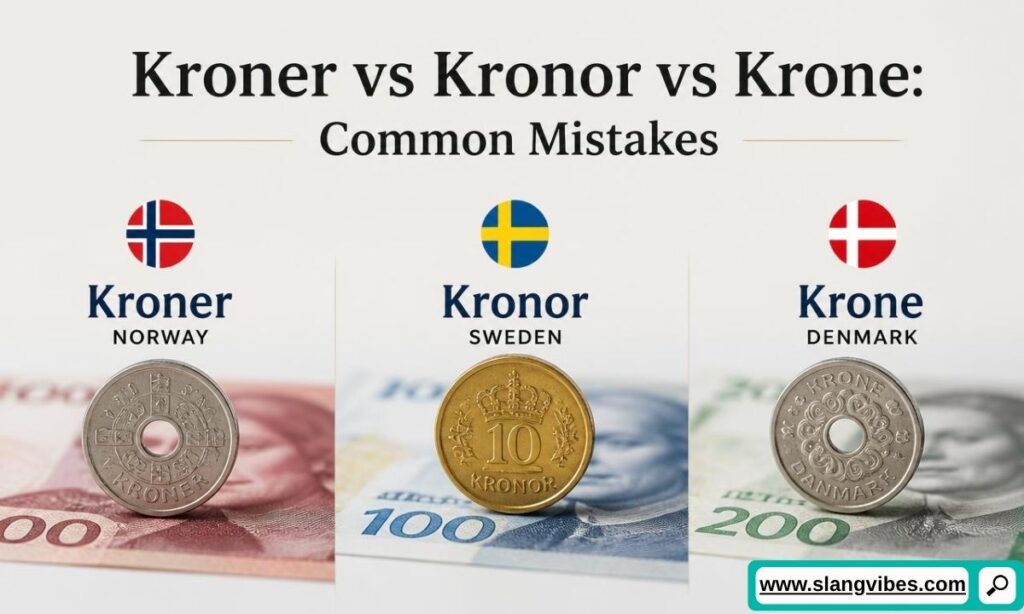
The kroner meaning gets muddy when spellings collide. Four words float around, and people swap them all the time. Here’s the breakdown. Krone is the singular in Norway and Denmark, and kroner is its plural. Swedes say kronor, the plural of krona. Icelanders write króna.
Common Mistake: Adding an s to kroner. The word already ends in a plural form, so “50 kroner” is correct. “50 kroners” shows up online anyway, but it’s not standard.
Picture this. You post “Spent 50 kroners in Stockholm” under a vacation photo. A Swedish follower smiles, then replies with a gentle correction. Sweden uses kronor, not kroner. You mixed two currencies in one caption.
Another common slip involves treating every use as slang. Someone writes “I paid 300 kroner for the ferry” in a travel blog. The sentence names a plain price. Reading it as slang makes the whole post sound odd.
Pronunciation adds another layer. English speakers say the word their own way, so spoken versions vary from person to person. Text keeps things simple, since the spelling stays fixed.
Because the slang is playful, nobody polices the spelling in memes. Still, the standard plural helps you look informed. Use “kroner” for the plural, keep “krone” for one coin, and save “kronor” for Sweden. Small details like this separate a confident caption from a confusing one.
Similar Money Slang: Bucks, Bread, Bands, and Cheddar
The kroner meaning sits close to a whole family of money slang. This table compares kroner with four everyday terms.
| Term | Meaning | Tone |
|---|---|---|
| Kroner | Money or cash | Playful, ironic |
| Bucks | Dollars | Neutral, everyday |
| Bread | Money | Casual, a bit retro |
| Bands | Thousands of dollars | Flashy |
| Cheddar | Money | Jokey, older |
Bucks wins on everyday use. Everyone understands it, and nobody blinks. Bread and cheddar feel older, and many people hear them as throwback jokes. Bands points to a specific amount, usually in the thousands, so it signals a flex.
Kroner stands apart because of its foreign flavor. It names no amount and shows no age. It simply adds a wink. If you want to sound neutral, say bucks. If you want to joke around, pick kroner or bread.
Another quick comparison helps. Quid works as a British cousin, since it swaps a short, funny word in for pounds. Kroner plays the same trick for dollars, with a Scandinavian twist. Bucks and quid name a unit. Bread and cheddar name the stuff itself. Kroner sits somewhere in between.
Serious settings call for plain money talk. These words live in captions, chats, and group jokes. Pick one to match your crowd. A gamer friend might love kroner, while your grandmother still prefers bread. Test a word on one friend first, and watch the reaction.
Read New Article: SFS Meaning in Text: What It Really Means on Snapchat, TikTok & Instagram (2026)
Kroner Slang: When to Use It and When to Skip It
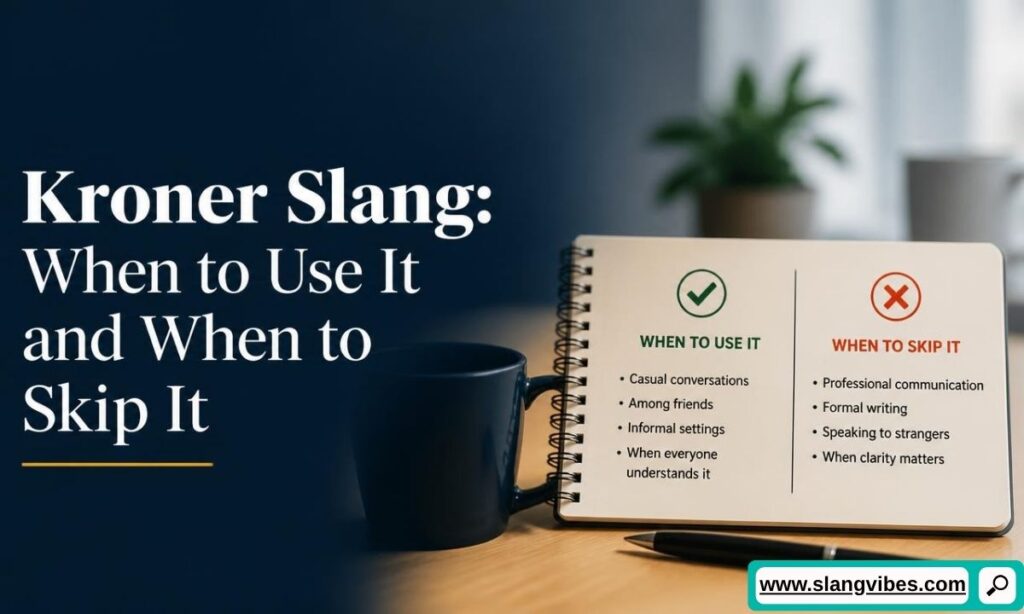
Knowing the kroner meaning solves half the problem. Timing solves the rest. Casual spaces welcome the word. Formal ones don’t. Audience matters most, so ask yourself who reads the message and whether they’d get the joke.
Use it in these spots:
- Captions and comments about a purchase or payday
- Group chats with friends who love internet humor
- Gaming servers, where odd currency jokes land well
- Memes about rent, bills, or broke weeks
Skip it in these spots:
- Job interviews, work emails, and school papers
- Conversations with someone from Norway or Denmark, who might read it as the real currency
- Any message where the exact amount matters
For tone, pair it with emojis. 💰 and 💸 signal a flex, while 😭 signals a broke week. Add a 😂 to show you’re joking.
If someone sends the word your way, try one of these replies:
- Match the joke: “Same, my kroner vanished too.”
- Ask directly if the kroner meaning isn’t clear from context.
- Say bucks, to keep things neutral.
Here’s a group chat example.
Tara: Who’s paying for pizza tonight?
Cole: Not me. I’m out of kroner 😭
Tara: You got paid Friday.
Cole: Rent ate my kroner.
Tara: Fine. Pizza’s on me. Pay me back later.
Keep the word in text. Said out loud in the US or UK, it sounds staged to some listeners.
Frequently Asked Questions
Is kroner slang or a real currency?
Both, but the real currency came first. The kroner meaning in slang is money or cash, mostly in memes and captions.
Is it kroner or kroners?
Kroner is already plural, so “50 kroner” is correct. People add an s online, but the standard form skips it.
Does kroner mean the same as bucks?
In slang, yes. Both mean money, though bucks is far more common.
Which countries use kroner?
Norway and Denmark use kroner. Sweden uses kronor, and Iceland uses króna.
Does it sound odd to say kroner out loud in the US or UK?
Often, yes. It works best in text.
The Bottom Line on Kroner
Kroner has two lives. In Norway and Denmark, it’s the plural of krone, the everyday currency on every price tag. Online, it’s a playful, slightly ironic word for money, closer to bucks or bread than to a banking term. Context tells you which one you’re reading. Look for travel details, prices, and currency codes for the real thing. Look for jokes, captions, and memes for the slang. The kroner meaning in slang stays niche, so many people still read the word as a currency first. Here’s the bottom line. Use it with friends who enjoy internet humor, keep it out of formal writing, and skip the extra s. Spelling it right shows you know the difference between krone, kroner, and kronor.

Alex Carter is a language enthusiast and internet culture expert at SlangVibes. He explains the latest slang terms and text meanings in simple, clear English so everyone stays in the loop.