My friend sent me three letters at 11:47 PM on a Tuesday. Just “MYF.” No context, No emoji, No follow-up. I stared at it for a solid thirty seconds, typed “lol same” and hoped for the best. Turns out, I got it right — but purely by accident. If you’ve ever received MYF meaning in text and felt that tiny flash of “wait, what does that mean exactly,” you’re not alone. This guide breaks it all down: what it means, where it came from, when to use it, and how to reply without accidentally sending the wrong vibe.
What Does MYF Meaning in Text?
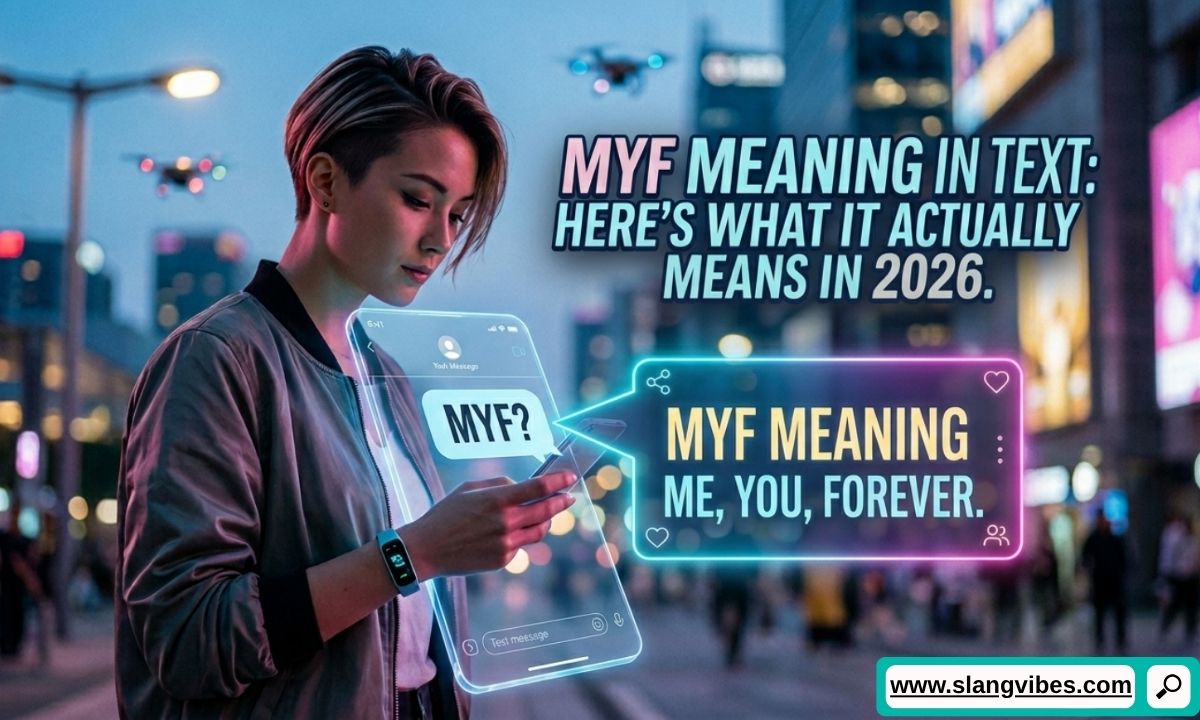
The short answer is: MYF stands for “Miss Your Face.” It’s a warm, casual expression people send when someone crosses their mind and they want that person to know it — without writing a paragraph about their feelings.
Quick Answer: MYF = Miss Your Face. It’s an affectionate abbreviation used in personal texting between close friends, long-distance pals, and people reconnecting after a gap in contact.
Think of it this way. You’re scrolling Instagram, you see a meme that reminds you of your best friend from college, and you want to reach out but a full text feels like too much pressure. MYF does the job in three letters. It says “I thought of you, I miss you, no need to make it weird.”
Some people do use it as “Miss You Friend,” and that alternate version works just as well emotionally. The meaning is nearly identical. The “Face” version is more common in personal texting and social media DMs, while “Friend” shows up slightly more in group chats where “face” would feel a bit awkward directed at multiple people at once.
What makes MYF stick is exactly how much it says without saying much. Affectionate abbreviations like this one pack a full emotional statement into a small format, and that efficiency is the whole point. Nobody needs to write an essay to tell someone they matter
Where Did MYF Come From?
Slang like MYF doesn’t get launched on a specific date. It doesn’t have a founding moment. It spread the way most affectionate shorthand does — quietly, through personal messages between people who knew each other well enough to skip the formality.
The broader culture of emotional abbreviations in texting grew through the early 2010s alongside the rise of messaging apps. WhatsApp, iMessage, and later Snapchat created spaces where people maintained real friendships through typed words instead of phone calls. As those conversations got faster and more frequent, people needed shorter ways to express genuine feeling. “I miss you” became IMY. “Miss your face” became MYF.
By the mid-2010s, MYF was circulating consistently in close friend groups across platforms. It wasn’t a viral trend. It traveled person to person, the way a good phrase does when it fits a feeling that people already have but didn’t have a quick word for.
Gen Z picked it up and kept it going. The directness of MYF fits naturally with how that generation communicates — no preamble, no softening, straight to the point of the feeling. By 2026, it’s fully embedded in everyday personal texting across age groups.
Read Also :EMP Meaning in Text: Platform-by-Platform Guide
All the Different Meanings of MYF
Here’s the thing — MYF doesn’t mean the same thing in every context. The primary meaning dominates personal texting, but a few alternate meanings exist in different spaces. Knowing them helps you read the room immediately.
The most important thing to understand is that context resolves the meaning almost instantly. A message that starts with “hey stranger, MYF” is not about entrepreneurship. A church bulletin using MYF is not telling anyone they miss their face.
Here’s a clean breakdown:
| MYF Meaning | Where You’ll See It | What It Signals |
|---|---|---|
| Miss Your Face | Personal texts, DMs, group chats | Warm affection, missing someone |
| Miss You Friend | Group chats, reconnection messages | Same warmth, slightly more group-friendly |
| Make Your Future | Motivational content, business coaching | Encouragement, personal agency |
| Methodist Youth Fellowship | Church bulletins, faith-based programs | Institutional, zero personal meaning |
| Manage Your Feelings | Rare wellness spaces, advice forums | Emotional self-regulation reminder |
The MYF meaning in text that you’re most likely to encounter in your personal messages is “Miss Your Face” — and surrounding context makes that clear within seconds of reading the full message.
MYF in Romantic vs. Platonic Conversations

This is the section nobody talks about but everyone needs. The same three letters read completely differently depending on who sent them and what your history is with that person.
Between close friends, MYF is zero-pressure. It’s the text equivalent of spotting someone’s name in your phone and smiling. There’s no subtext. No hidden ask. It’s purely “you crossed my mind and I wanted you to know.” Platonic MYF messages don’t need a big response. A simple “MYF too, we need to actually hang” covers it.
When MYF comes from someone you’ve dated, almost dated, or have complicated history with, the emotional weight shifts. It’s not necessarily romantic — but it opens a door. The person sending it knows you’ll feel something when you read it. That’s often the point. In a situationship or a post-breakup silence, MYF from the other person lands somewhere between “I’m thinking about you” and “I’m not ready to say more than this.”
You might be wondering: is sending MYF flirty? It depends entirely on the relationship. Between two people who are clearly just friends, it reads as warm and simple. Between two people with unresolved feelings, it reads as a deliberate reach. The letters don’t change. The relationship does.
The safest approach when you’re unsure of the sender’s intent: match their energy. If they kept it casual, keep your reply casual. If they sent something more layered alongside it, respond to the full message, not just the three letters.
When to Use MYF and When to Skip It
MYF works brilliantly in the right situations and feels slightly off in the wrong ones. Here’s what the unwritten social rules around it actually look like.
Use MYF when:
- You haven’t spoken to a close friend in weeks and want to reconnect without making it heavy
- You pass somewhere that reminds you of someone and want to share that moment
- A group chat has gone quiet and you want to gently revive it
- You’re in a long-distance friendship and communication gaps are normal
- You want to say something warm without starting a full conversation
Skip MYF when:
- You’re texting someone you’ve met twice and don’t know well
- You’re reaching out to a professional contact or colleague
- There’s unresolved conflict between you and the other person
- You’re trying to reopen a connection that ended badly and MYF alone won’t carry that weight
- The relationship doesn’t have the emotional foundation to support affectionate abbreviations
The MYF meaning in text only lands warmly when there’s an existing warmth to land on. Sending it to a near-stranger reads as presumptuous. Sending it to someone you genuinely miss reads as exactly what it is.
Read Also :GNG Meaning in Text Explained with Real Chat Examples
How Gen Z and Millennials Use MYF Differently
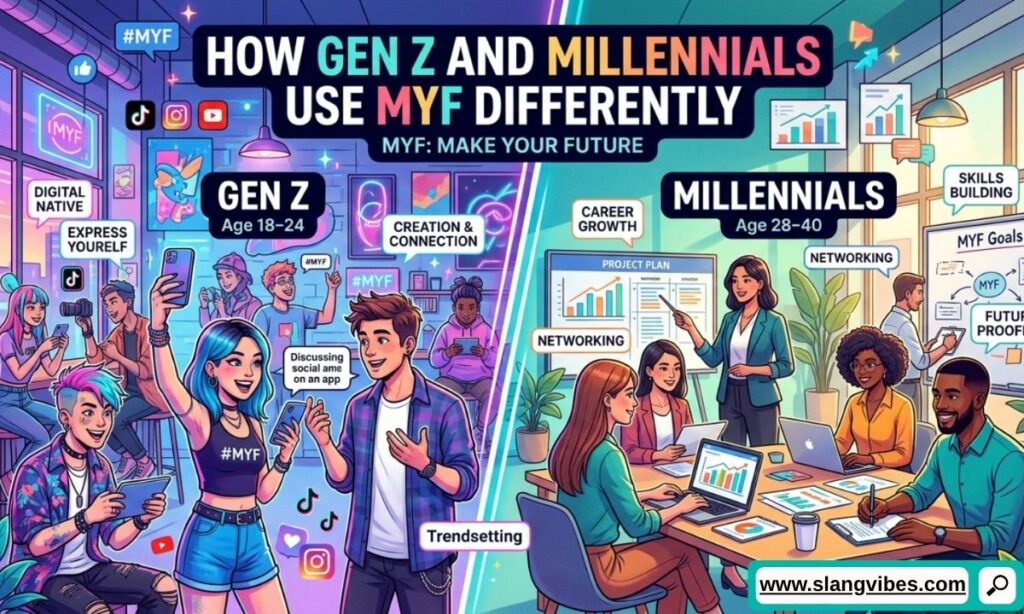
Both generations use MYF, but they’re not doing the same thing with it.
Millennials reach for MYF when the nostalgia hits. It shows up after a long communication gap, when someone sees an old photo, or when a location triggers a specific memory of a person they haven’t talked to in months. The emotional intent is sincere and a little wistful. Millennial MYF usually comes with context: “Just drove past your old apartment. MYF.”
Gen Z uses it with a wider tonal range. The sincere version exists — Gen Z absolutely sends genuine MYF messages to people they miss. But Gen Z also uses it with deliberate exaggeration for comedic effect. “It’s been four hours. MYF already.” is a joke that only works because the underlying affection is real and everyone knows it. The irony layer doesn’t erase the warmth; it sits on top of it.
Gen Z slang tends to compress emotional honesty into fast, direct formats, and MYF fits that pattern perfectly. Where older communication styles might soften a feeling with extra words, Gen Z names the feeling and sends it. Three letters. Done.
What both generations share: MYF is a low-stakes emotional check-in that doesn’t require the other person to drop everything and respond with a novel. That accessibility is why it works across age groups despite the different flavors each generation adds to it.
Real Conversation Examples of MYF in Action
Seeing MYF in real conversation context makes it click faster than any definition. Here are five scenarios that show how it actually plays out in personal texting.
Example 1: Long-Distance Best Friends
Sam: “MYF. It’s been way too long.” Jordan: “MYF so much honestly. We’re doing a call this weekend, no excuses.”
What it means: Straightforward reconnection. Both people feel the gap. The warmth is mutual and the response moves toward making something happen.
Example 2: Old College Roommate
Priya: “Walked past our old dining hall. MYF and those terrible Tuesday pasta nights.” Alex: “Oh no why did you make me feel this. MYF too. Those were genuinely the best bad meals.”
What it means: A memory triggered the message. The shared reference makes the MYF land harder than it would on its own.
Example 3: Complicated Situationship
Marcus: “Random but MYF.” Dev: “This is not fair lol. MYF too I guess.”
What it means: Both people know there’s more under the surface. The “I guess” signals awareness of the complexity without opening a full conversation about it.
Example 4: Group Chat Revival
Keisha: “MYF all, when did we stop talking every day??” Group: “WE MISS YOU TOO” / “This week, dinner, someone pick a place.”
What it means: One message reactivated an entire friend group. MYF in a group chat acts as a low-pressure signal that the connection still matters.
Example 5: Late-Night Random Check-In
Nadia: “11pm and I’m thinking about how you always made everything funnier. MYF.” Teo: “This made my whole night. MYF. Call me soon.”
What it means: Unprompted, genuine, and perfectly timed. The other person needed to hear it without knowing they needed it.
Read Also :HG Mean in Text: What It Really Means in Messages (2026)
How to Reply When Someone Sends You MYF
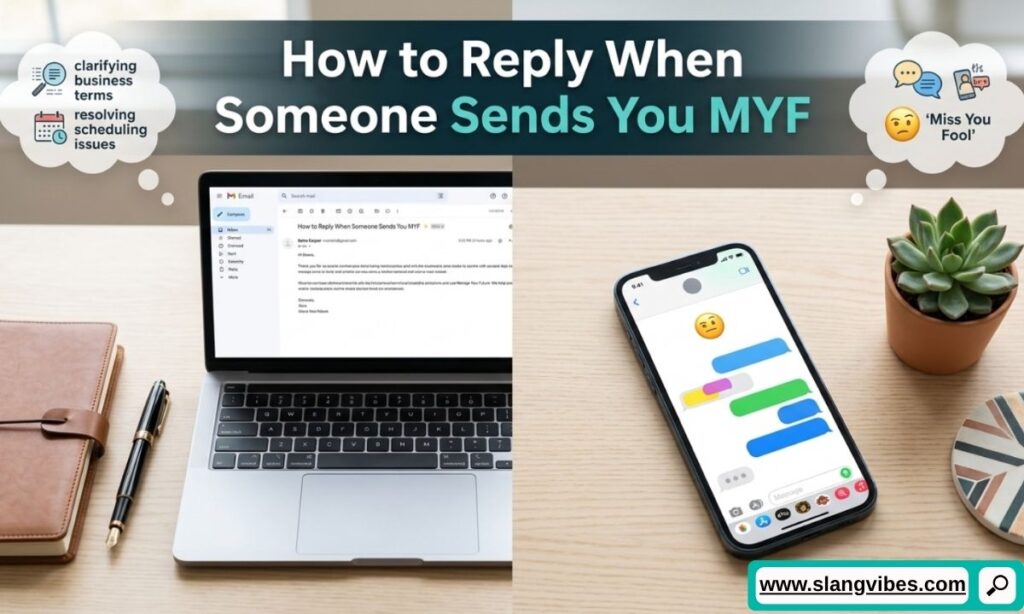
When someone sends you MYF, always consider the context. Knowing the MYF meaning in text helps you decide whether to reply seriously or casually. For example, if a friend uses MYF in a lighthearted way, a funny or relaxed reply works best. Understanding MYF meaning in text also helps you follow proper texting etiquette.
According to online communication trends, people who know the MYF meaning in text respond more confidently and naturally. Whether on WhatsApp, Instagram, or Snapchat, the MYF meaning in text stays consistent — and so should your reply style.
| Situation | Reply That Works |
|---|---|
| Close friend you genuinely miss | “MYF so much — let’s fix this, what does your weekend look like?” |
| Friend you’ve been bad at texting | “I’m the worst, but MYF too. Let’s actually catch up.” |
| Someone with complicated history | “Good to hear from you. Hope things are going well.” |
| Group chat MYF | “WE MISS YOU TOO — someone pick a date right now.” |
| Late-night MYF from a close friend | “This made my night honestly. Talk soon?” |
MYF vs. Similar Slang You Might Confuse It With
MYF meaning in text sits near several other abbreviations that people sometimes mix up. Here’s how they actually differ.
The most important one to know is MYB. “Mind Your Business” uses the same M and Y, and if you misread MYF as MYB in the middle of a warm reconnection message, you’ll be very confused about why someone is being aggressive. The letters are close. The meanings are completely opposite.
| Slang | Full Meaning | Emotional Tone |
|---|---|---|
| MYF | Miss Your Face | Warm, affectionate, personal |
| MYB | Mind Your Business | Dismissive, boundary-setting |
| HYB | How You Been | Casual check-in, slightly more conversational |
| WYD | What You Doing | Casual, often conversation starter |
| IMY | I Miss You | Direct, slightly more intense than MYF |
| ILY | I Love You | Deeper affection, used between closer connections |
MYF sits between HYB and IMY on the emotional scale. More feeling than a casual check-in, slightly lighter than a direct “I miss you.” That middle space is exactly why it works for reconnection messages where you want to say something real without making it heavy.
Frequently Asked Questions
MYF from a guy means “Miss Your Face.” Whether it’s platonic or has a romantic edge depends entirely on your relationship history with him — the letters themselves don’t carry a hidden meaning.
MYF started as a friendship expression and stays primarily platonic. It takes on a different weight in romantic or complicated contexts, but the abbreviation itself doesn’t signal attraction.
HYB (“How You Been”) is a question that opens a conversation. MYF is a statement that expresses a feeling. HYB asks for an update. MYF tells someone they matter. Both are reconnection tools but they work differently.
In personal texting, MYF means “Miss Your Face.” The “Mind Your Feelings” variation exists in some online wellness spaces but it’s rare and the context always makes it obvious which one applies.
MYF predates Gen Z’s dominance of internet slang. It grew through early messaging app culture in the 2010s and Gen Z adopted and continued it. Both Gen Z and Millennials use it comfortably today.
The MYF meaning in text is one of those things that feels obvious once you know it, and slightly embarrassing to have missed before. Three letters. One genuine feeling. No complicated subtext required.
Next time you see MYF in a text, you’ll know exactly what to say back.

Alex Carter is a language enthusiast and internet culture expert at SlangVibes. He explains the latest slang terms and text meanings in simple, clear English so everyone stays in the loop.