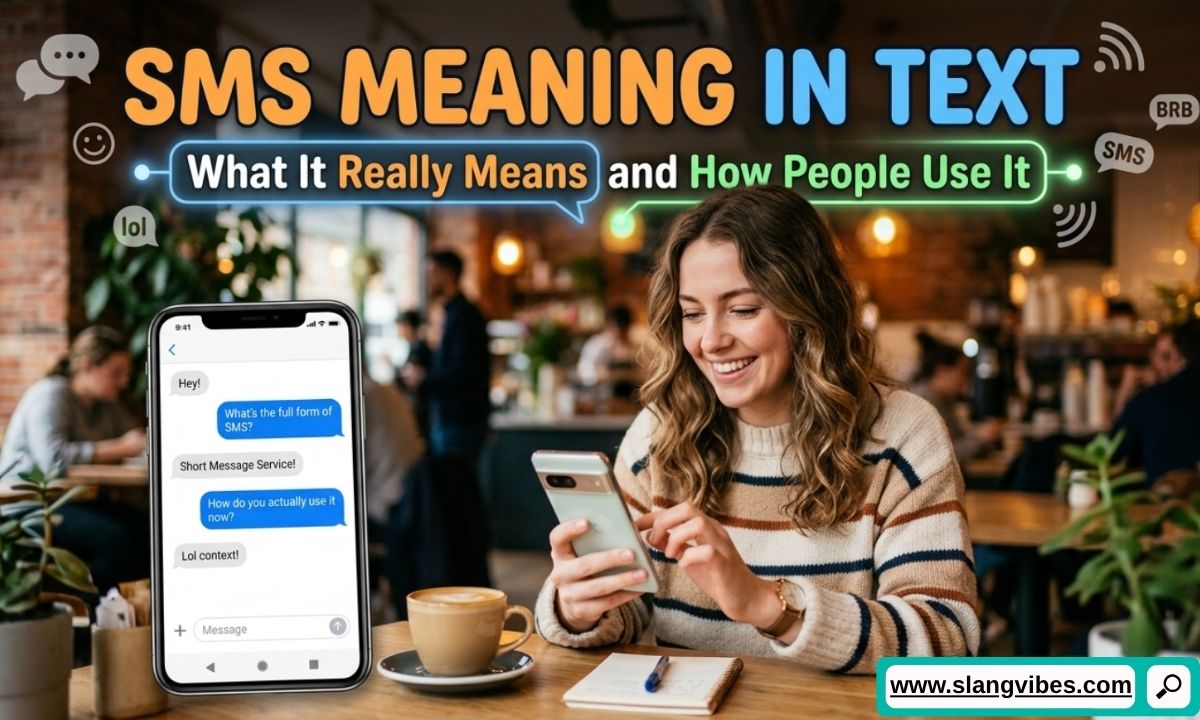
A while back, my aunt sent me a message that said, “I SMS’d you the details last night. Did you get it?” I stared at my phone for a second, confused. I had three different messaging apps, a carrier inbox, and honestly no idea which one counted as an “SMS.” I checked them all. Turns out she sent a plain old text through her carrier network, and I’d been waiting in WhatsApp like a fool. That moment made me realize most people throw around the term without knowing what it means. So if you’ve ever wondered about SMS meaning in text, you’re in the right place, and this guide covers everything from the basics to the stuff no one else bothers to explain.
What Does SMS Meaning in Text Actually Stand For?
The short answer is that SMS stands for Short Message Service. It’s the technical name for the standard text messages sent over a cellular network, with no internet access needed whatsoever. When your phone sends an SMS, it travels through your mobile carrier’s network, not through Wi-Fi or a data connection. So even when your phone shows “No Internet,” you can still send and receive SMS messages as long as you have signal.
Here’s the thing though: most people use “text” and “SMS” like they mean the exact same thing. In casual conversation, they do. But technically, SMS meaning in text refers specifically to carrier-based messages, while a “text” could mean anything from a WhatsApp message to an Instagram DM. The distinction matters more than people think, especially when you’re troubleshooting why a message didn’t deliver.
One more thing worth knowing: SMS messages have a character limit of 160 characters per message. That limit dates back to the 1980s when engineers designed the system around existing telecom signaling channels. Anything longer gets split into multiple messages and stitched back together on the receiving end.
Read more : ATM Mean in Text: Understanding the Real Meaning in WhatsApp, TikTok & Instagram
Quick Answer: SMS meaning in text = Short Message Service. It’s a standard text sent through your phone carrier, not the internet.
The Origin of SMS: Where This Term Came From
Understanding SMS meaning in text gets a lot clearer once you know where it came from. SMS was developed as part of the GSM (Global System for Mobile Communications) standard back in the early 1980s. The first actual SMS was sent on December 3, 1992, by engineer Neil Papworth. He typed “Merry Christmas” from a computer to a colleague’s mobile phone. That 22-character message launched an entire global communication culture.
So why 160 characters? The engineers behind SMS studied how long postcards and telex messages tended to be. They found 160 characters covered most short communications comfortably. Because of that, an entire generation learned to write shorter, punchier messages. In many ways, the character limit shaped texting slang as we know it today. Words got shortened, punctuation got dropped, and abbreviations took over because people needed to fit thoughts into tight spaces.
By the late 1990s and early 2000s, SMS had become a global phenomenon. Teenagers especially adopted it fast because it was cheaper than calling and felt more private. That cultural shift is still visible today in how Gen Z and Millennials communicate, preferring written messages over phone calls in most situations.
SMS vs Text Message: Are They the Same Thing?
This is one of the most searched questions around SMS meaning in text, and the answer surprises a lot of people. Yes and no. When your friend says “I’ll text you,” they probably mean they’ll send an SMS. But when your iPhone shows a blue bubble instead of a green one, that message went through Apple’s iMessage system, not SMS. Same physical action, completely different technology under the hood.
Here’s a simple breakdown of how the two differ in practice:
Read New Article: TIA Meaning in Text: Snapchat, TikTok, Instagram & WhatsApp Slang Explained
| Situation | What’s Actually Happening |
|---|---|
| Green bubble on iPhone | Standard SMS over carrier network |
| Blue bubble on iPhone | iMessage over internet/data connection |
| WhatsApp message | Internet-based, not SMS |
| Bank OTP code arriving | SMS through carrier network |
| Instagram verification text | SMS through carrier network |
The green bubble vs blue bubble debate is a big deal in the US especially. Many iPhone users see green bubbles as a signal that someone is on Android, which has turned into a whole cultural conversation about phones and status. But what it really means technically is that the message traveled as a standard SMS rather than through Apple’s servers.
So when you’re thinking about SMS meaning in text in everyday life, the easiest rule is this: if it works without Wi-Fi and without a messaging app, it’s an SMS.
Read Also: NM Mean in Text: What It Really Stands For (2026)
SMS vs iMessage vs RCS: What Your Phone Is Really Sending
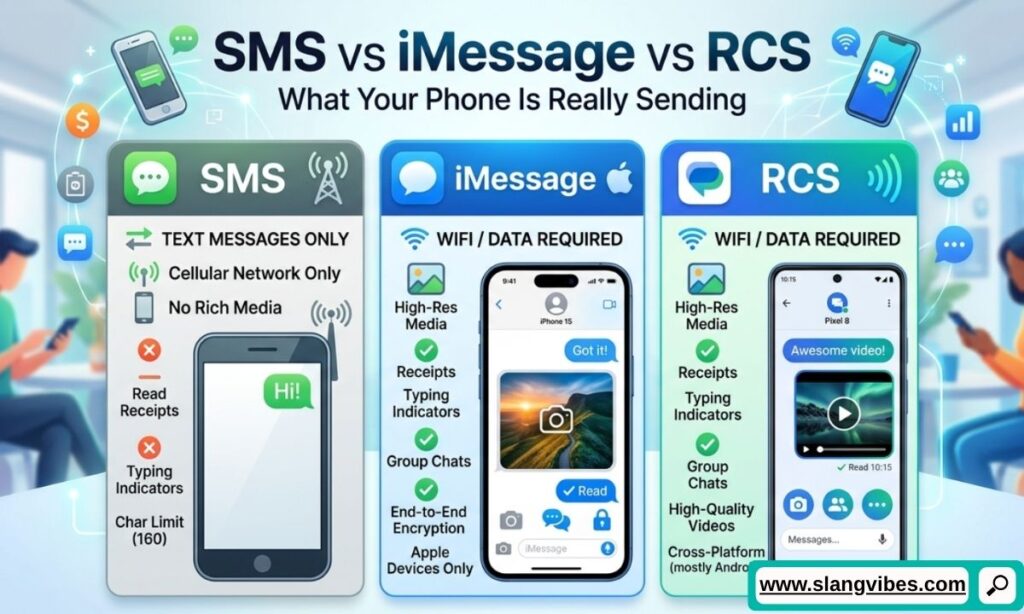
Most articles on SMS meaning in text completely skip this part, which is honestly where a lot of confusion lives. There are now three main systems handling what people loosely call “texts,” and understanding them helps you figure out why some messages deliver instantly while others sit on “Sent” forever.
SMS is the original. It works on every phone, on every carrier, in almost every country. No internet needed, no app required. MMS (Multimedia Messaging Service) is the close cousin that lets you send images and videos through the same carrier network.
iMessage is Apple’s system. It works between Apple devices over a data connection. When both people have iPhones and internet access, messages go through iMessage automatically. When one person is on Android or has no data, the phone falls back to SMS.
RCS (Rich Communication Services) is Google’s answer to iMessage for Android users. It supports read receipts, high-quality image sharing, and typing indicators, all over a data connection. Think of it as a serious upgrade to SMS, though it still falls back to standard SMS when RCS isn’t supported.
Read More Article: LMS Meaning in Text: What It Really Means on Snapchat, TikTok & Instagram (2026)
| Feature | SMS | iMessage | RCS |
|---|---|---|---|
| Internet needed | No | Yes | Yes |
| Works cross-platform | Yes | Apple only | Android focused |
| Read receipts | No | Yes | Yes |
| Encryption | No | Yes | Yes (on Google Messages) |
| Character limit | 160 | None | None |
Knowing these differences makes SMS meaning in text a lot clearer. SMS is the universal fallback, the one thing that works regardless of what phone someone has.
How SMS Meaning in Text Shows Up in Real Everyday Life
SMS meaning in text isn’t just a definition exercise. It shows up constantly in ways most people don’t notice. Here are five real-world text conversation examples that show exactly how SMS works in practice:
Example 1: Bank Alert
Bank: Your account ending in 4821 had a transaction of $47.00 at Target. Reply STOP to unsubscribe.
That message arrived as an SMS through a 5-digit short code, not an app.
Example 2: Appointment Reminder
Doctor’s Office: Hi Sarah, this is a reminder of your appointment tomorrow at 2:30 PM. Reply C to confirm or R to reschedule.
Again, pure SMS. No internet needed on either end.
Example 3: Login Verification
Instagram: Your security code is 847291. Don’t share this with anyone.
Even though Instagram is an app, it sends verification codes via SMS because it works on every phone.
Read New Article: What Does WSP Mean in Text? Real Meaning in Chat & Social Media
Example 4: Friend Switching Apps
Jake: Hey why are my texts to you green now? You: Oh I switched to Android. Just SMS me normally, it still works fine.
Example 5: International Texting Confusion
Mom: I tried to WhatsApp you but it didn’t go through. I SMS’d you instead. You: Got it! SMS always works, even when data is slow over here.
Did You Know: Over 23 billion SMS messages are sent every single day worldwide, even with messaging apps dominating casual conversation.
SMS Meaning in Text on Social Media and Dating Apps
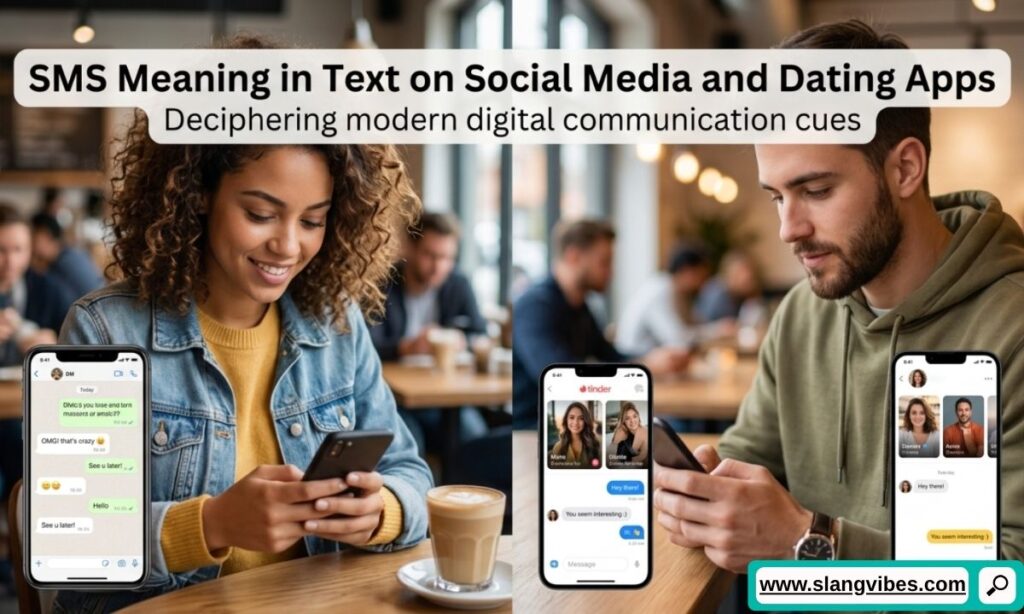
Here’s where SMS meaning in text gets a bit more layered. Platforms like Instagram, TikTok, Snapchat, and most dating apps don’t use SMS for their in-app messaging. Their chat systems run entirely over the internet. So when you DM someone on Instagram, that’s not an SMS.
But SMS still plays a crucial role behind the scenes on every one of those platforms. When you sign up, reset your password, or enable two-factor authentication, the verification codes come through SMS. That’s because SMS reaches any phone without requiring the person to be logged into an app first.
On dating apps specifically, SMS carries a social signal. When two people move from in-app messaging to exchanging phone numbers for SMS, it typically means the connection has progressed. It feels more personal and direct than staying in the app’s chat system.
Generationally, there’s a clear split in how people feel about SMS on social platforms. Gen Z tends to see an SMS from someone new as oddly formal, almost like getting a typed letter in a world full of voice notes. Millennials, on the other hand, treat SMS as the default comfortable option, something reliable they grew up with. Neither view is wrong; they just reflect how differently these generations came to communication technology.
Read More Article : PFP Meaning in Text: What It Means on Social Media
SMS Meaning in Text and Texting Etiquette: When to Use It
Most guides on SMS meaning in text cover what it is but skip the unspoken rules around when to use it. So here’s what those rules actually look like in practice.
Send an SMS when you’re reaching someone who doesn’t have a smartphone, when you’re in a low-data area, or when you need to send a quick, direct message without expecting a long back-and-forth. SMS is also the right call for professional quick confirmations like “I’m on my way” or “Got your message, calling you in 10.”
Use a messaging app when you’re sharing photos, having a long conversation, or messaging within a group. Apps handle media better, offer more features, and don’t split long messages into weird fragments.
The unspoken social rule around SMS is that it feels slightly more “official” than an app message. Getting an SMS from someone you only know from Instagram feels different from getting a DM from them. It signals they have your number, which adds a layer of directness. For some people that’s welcome; for others it’s a boundary question worth thinking about.
Read New Article: Moots Meaning in Text: Simple Explanation for Social Media Users (2026)
| When to SMS | When to Use an App |
|---|---|
| Quick one-liner confirmations | Long back-and-forth conversations |
| Messaging someone without a smartphone | Sharing photos or videos |
| No Wi-Fi or data available | Group chats with multiple people |
| Business or formal quick messages | Casual ongoing chats with close friends |
SMS Spam, Marketing Texts, and How to Handle Them
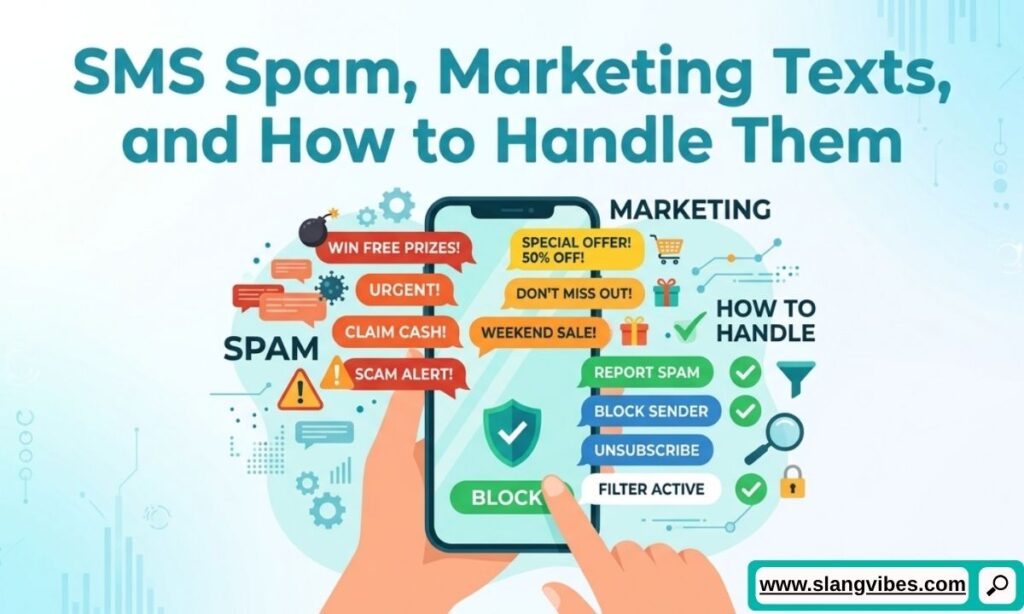
This section is something competitors on SMS meaning in text completely leave out, and it’s one of the most practically useful things to understand. A huge portion of SMS messages people receive today are from businesses, not personal contacts.
Those texts often come from short codes, which are 5 or 6-digit numbers instead of regular phone numbers. Brands use short codes for appointment reminders, promotional texts, shipping updates, and marketing campaigns. They choose SMS over email because open rates for SMS messages sit around 98%, compared to about 20% for email.
Here’s how to tell a legitimate business SMS from a scam:
Legitimate business texts come from consistent short codes, include the company name, and have a clear opt-out option (usually “Reply STOP”). Scam texts often contain misspelled words, suspicious links, a sense of extreme urgency, and requests for personal information or payment.
Read More : What Does JP Mean in Text? Popular Meanings and Real Examples
Common Mistake: Replying STOP to a spam SMS doesn’t always unsubscribe you. With sketchy senders, replying actually confirms your number is active, which leads to more spam. Block the number instead.
If you want to reduce unwanted SMS messages, contact your carrier about spam filtering options. Most US carriers offer free spam blocking tools built right into the messaging settings on your phone.
FAQ
It means they’ll send you a standard text message through their phone’s carrier network, not through an app like WhatsApp or iMessage.
It depends on your phone plan. Most US and UK plans include unlimited SMS messages. Without a plan, carriers charge per message, typically a few cents each.
SMS is for plain text messages up to 160 characters. MMS (Multimedia Messaging Service) kicks in when you send images, videos, audio files, or messages longer than the character limit.
Yes, and that’s one of the biggest advantages. SMS travels over your carrier’s cellular network, so as long as you have mobile signal, your messages go through without any internet access needed.
No. Standard SMS messages are not encrypted, which means your carrier and potentially others can access them. WhatsApp uses end-to-end encryption, making it more secure for private conversations.
The Bottom Line on SMS Meaning in Text
SMS meaning in text comes down to one simple idea: it’s the universal language of mobile communication. Apps come and go. Platforms change their features. But SMS keeps working because it doesn’t need the internet, doesn’t need a specific app, and reaches almost every phone on the planet.
Whether it’s a two-factor login code, a “running late” text from a friend, or a promotional message from your favorite store, SMS is quietly powering more of your daily communication than you probably realized. Now that you know exactly what SMS meaning in text covers, from its origin to its role in modern messaging culture, you’ll recognize it everywhere.
Next time you see a green bubble, a short-code number, or a friend asking “did you get my SMS?”, you’ll know exactly what’s happening and why.

Alex Carter is a language enthusiast and internet culture expert at SlangVibes. He explains the latest slang terms and text meanings in simple, clear English so everyone stays in the loop.