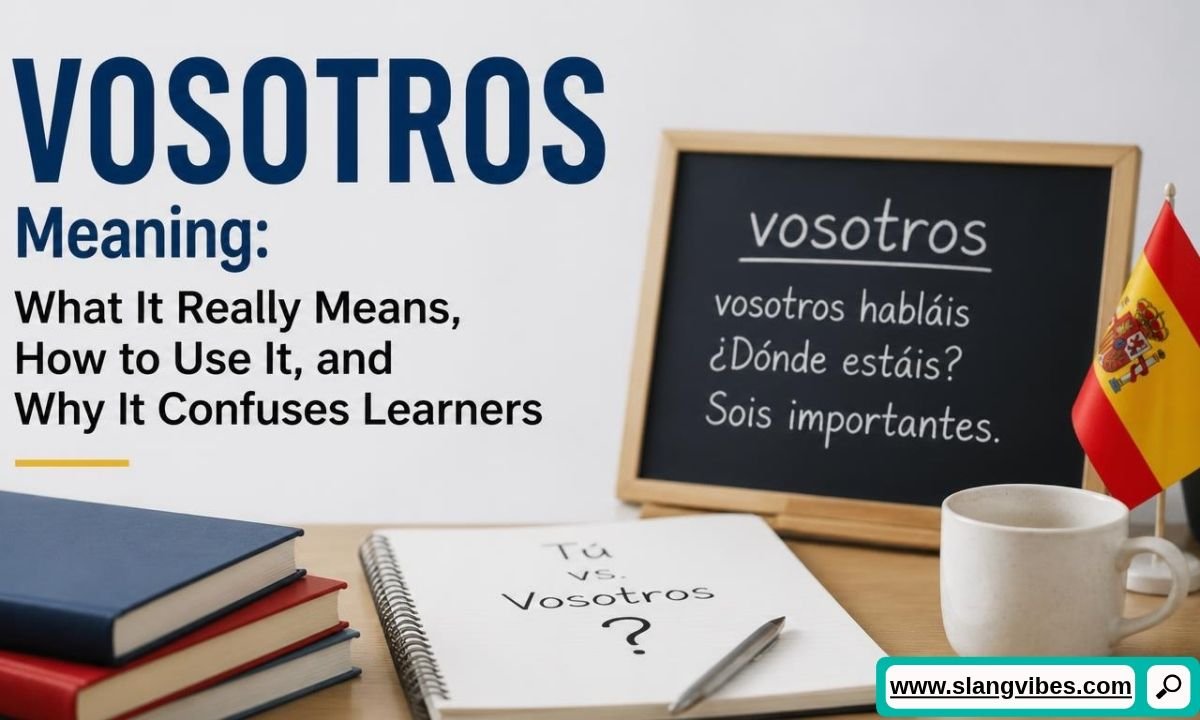
My first week in Madrid, a waiter stopped at our table and asked, “¿Qué queréis tomar?” I froze. My app had taught me ustedes and nothing else. I smiled, nodded, and said “sí” to a question I didn’t understand. Later that night I searched for the vosotros meaning and felt a bit silly. I wasn’t alone, since many learners hit the same wall in Spain. Vosotros is how people in Spain say “you all” to friends and family. This guide explains who uses it, who skips it, and whether you need it. By the end, the next “¿Qué queréis?” won’t catch you off guard.
Read Also: SN Mean in Text: Popular Meanings on Snapchat, TikTok, and More
Vosotros Meaning in English: The Short Answer
The vosotros meaning in English is “you all” or “you guys,” used for a group you know well. It’s a second-person plural pronoun. Spain uses it every day. It carries a friendly, informal tone, much like “you guys” does in American English. English has no perfect match, though “y’all” comes close. Vosotros belongs to standard Spanish grammar, so you’ll hear it in homes, schools, and offices across Spain.
Think of it this way: vosotros is the plural of tú, the friendly word for one person. Three quick scenarios show how it sounds.
A group of friends sits at a bar in Seville. One asks the table, “¿Vosotros queréis otra ronda?” This means “Do you all want another round?”
A mom stands at the door with her two kids. She says, “Vosotros sois mi mundo.” This means “You two are my world.”
A teacher in Valencia looks at her class and asks, “¿Vosotros entendéis esto?” This means “Do you all understand this?”
Notice the pattern. Each speaker talks to a group, and each one knows the group well. For a single friend, Spanish uses tú, For a single stranger or a boss, it uses usted. For a group of strangers or a formal setting, Spain uses ustedes. So vosotros fills one slot in a four-part system, and the next sections show how the other slots fit.
Where Vosotros Comes From
The vosotros meaning makes more sense once you see how the word is built. It joins two older pieces, “vos” and “otros.” Here’s the quick breakdown.
- vos: from the Latin word for plural “you”
- otros: “others”
- vosotros: “you others,” meaning a group
Spanish used the same trick for “we.” Nosotros joins “nos” and “otros,” so it works like “us others.” Both words put a group ahead of a single person.
Old Spanish used “vos” in several ways, including as a respectful form. Over time, polite titles took over the respect slot. “Usted” grew out of “vuestra merced,” which means “your mercy” or “your grace.” “Ustedes” grew from the plural version. Once those two words held the formal slots, “vosotros” settled into the informal plural slot in Spain.
Latin America went a different way. Most countries there use “ustedes” for every plural “you,” formal or friendly. Some regions also kept “vos” for one person, and the mistakes section covers this twist.
How the split happened is a long story, and linguists tell it in different ways. The result is easy to see today. Spain says “vosotros” to friends. Mexico, Colombia, and most of the Americas say “ustedes.” Both choices are correct Spanish.
Read Also: WSG Mean in Text: What It Really Means on Snapchat, TikTok & Instagram (2026)
Vosotros vs Ustedes: How Spain and Latin America Differ
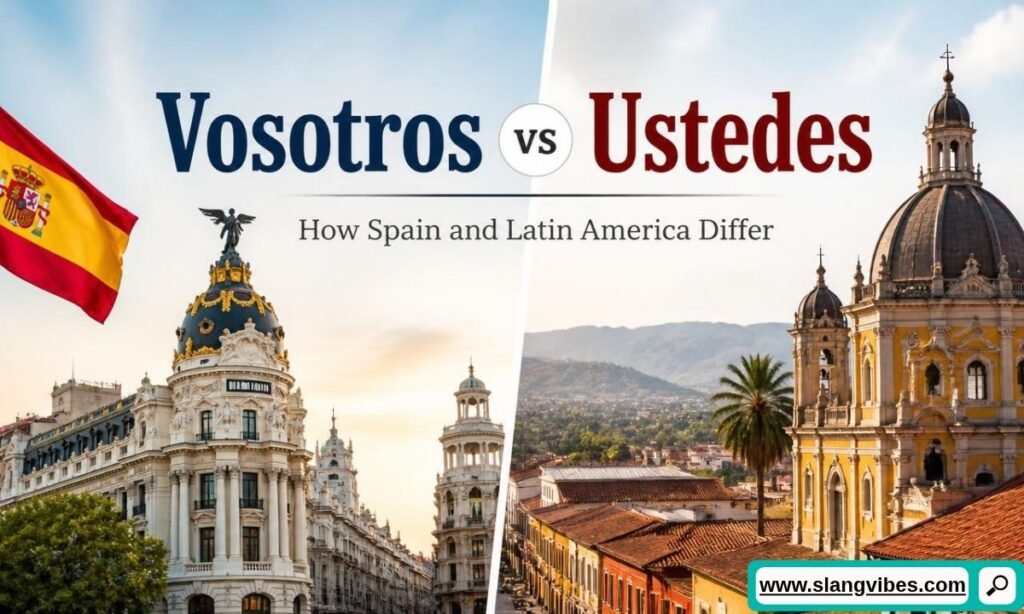
Spanish has four ways to say “you,” and the choice depends on number and closeness. Spain uses all four. Most of Latin America uses three, because “ustedes” replaces “vosotros.” Here’s the full map.
- tú: one person, informal
- usted: one person, formal
- vosotros: a group, informal, used in Spain
- ustedes: a group, formal in Spain, any group in Latin America
Many learners hear “ustedes” called the plural of “usted.” This is true, but the stretch varies by country. In Mexico, a person says “ustedes” to a table of close friends. In Madrid, the same word at a friendly dinner sounds stiff.
Here’s how the contrast sounds in a chat between two friends.
Lucía: ¿Vosotros venís a la cena? (Are you all coming to the dinner?)
Diego: Aquí en México decimos “¿ustedes vienen?” (Here in Mexico we say “are you all coming?”)
Lucía: En España, “ustedes” suena formal entre amigos. (In Spain, “ustedes” sounds formal among friends.)
Did You Know: Parts of Andalusia and the Canary Islands use “ustedes” with friends, much like Latin America does. Even inside Spain, the rule shifts by region.
So the vosotros meaning depends on the map. If you plan to travel to Spain or follow Spanish creators, learn it. If your friends live in Mexico City or Bogotá, “ustedes” is your word.
Read Here: CMP Meaning in Text: Popular Uses Across Social Media
Vosotros Conjugation Made Simple
Knowing the vosotros meaning is step one. Using it means learning a new set of verb endings. The good news is a clear pattern. Take the infinitive, drop the ending, and add -áis, -éis, or -ís. The table below shows how it works.
| Verb type | Example | Meaning |
|---|---|---|
| -ar verbs | vosotros habláis | you all speak |
| -er verbs | vosotros coméis | you all eat |
| -ir verbs | vosotros vivís | you all live |
| Irregular: ser | vosotros sois | you all are |
| Irregular: ir | vosotros vais | you all go |
Most verbs follow this pattern without surprises. Stem-changing verbs behave nicely here. Querer and poder change their stems in many forms, but vosotros keeps the original stem. You get “queréis” and “podéis,” with no extra changes. Irregular verbs deserve a quick look. “Ser” becomes “sois,” and “ir” becomes “vais.” Both are short and worth memorizing early.
Commands have their own form too. For “hablar,” the command is “hablad.” For “comer,” it’s “comed,” and for “vivir,” it’s “vivid.” Negative commands switch to the subjunctive, so you say “no habléis.”
Watch the accent marks. In “habláis,” the accent keeps the stress on the last syllable. Without it, the stress shifts, and the word sounds wrong. The pattern is regular enough to feel manageable. Practice comes from hearing it in Spanish shows, podcasts, and chats from Spain.
Vosotros, Vosotras, Os, and Vuestro: The Related Forms
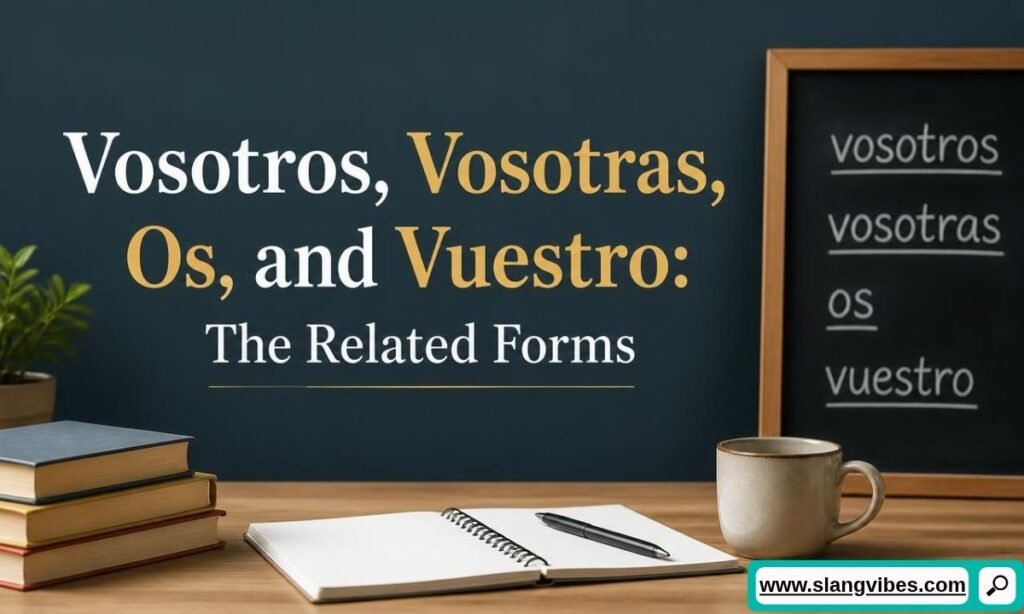
Vosotros brings a few relatives along, and learners meet them fast. Here are the forms worth knowing.
Vosotras is the feminine form. Use it for a group made up only of women. A mixed group takes vosotros, even with one man in it.
Imagine I’m texting my three cousins, all women. I’d write “¿Vosotras venís el sábado?” If their brother joins the chat, I’d switch to “¿Vosotros venís el sábado?”
Next comes “os,” the object and reflexive pronoun for vosotros. “Os llamo mañana” means “I’ll call you all tomorrow.” “¿Os vais ya?” means “Are you all leaving already?”
Then you meet “vuestro,” the possessive. It means “your” for a group, and it changes with gender and number: vuestro, vuestra, vuestros, vuestras. “Vuestra casa” means “your house,” owned by several of you. With ustedes, speakers say “su casa” instead.
One more point helps explain what you hear. Spanish drops subject pronouns most of the time. The verb ending already shows who’s talking. So “¿Venís mañana?” works without vosotros. Speakers add the pronoun for emphasis or contrast. “Nosotros pagamos, vosotros cocináis” means “We pay, you all cook.”
This explains why you hear “os” and “vuestro” more often than the pronoun itself. Spotting these small words tells you the speaker is addressing a friendly group, even when vosotros never appears. Learners who skip these forms often understand the pronoun but miss half the sentence.
Read Also: OTW Mean in Text: What It Really Means on Snapchat, TikTok & Instagram (2026)
Vosotros Meaning in Real Spanish Chats and Social Media
The vosotros meaning stays the same online, but the tone gets more playful. Spanish creators and group chats use it to speak to a whole audience or friend circle. On TikTok, a creator from Spain might caption a video, “Vosotros sabéis de lo que hablo.” It means “You all know what I’m talking about.” YouTube comments from Spain often read “Vosotros sois los mejores,” meaning “You all are the best.”
Group chats show the word at its most natural. Here’s a WhatsApp exchange before a movie.
Paula: ¿Vosotros ya habéis llegado? (Have you all arrived yet?)
Iván: Casi, estamos en el metro. (Almost, we’re on the subway.)
Paula: Pues daos prisa, que empieza la peli. (Hurry up, the movie is starting.)
Iván: Vale, vamos corriendo. (Okay, we’re running.)
Siblings use it too, usually in a complaint. Here’s a family chat about chores.
Nuria: Vosotros nunca recogéis la mesa. (You two never clear the table.)
Hugo: Mentira, ayer la recogimos. (Not true, we cleared it yesterday.)
Nuria: Ayer la recogí yo. (I cleared it yesterday.)
Hugo: Vale, tienes razón. (Okay, you’re right.)
Notice the tone in both chats. The word signals “you and me are on the same team,” even during a small fight. Laughing emojis often follow it.
Common Vosotros Mistakes Learners Make
Most learners grasp the vosotros meaning fast. The mistakes show up later, in the verbs and on the map. Here are four to watch.
First, the ustedes ending. Picture a learner who writes “Vosotros hablan español.” The verb “hablan” belongs to ustedes. The vosotros form is “habláis.”
Second, the vos mix-up. Argentina, Uruguay, and parts of Central America use “vos” for one person, as in “vos hablás.” Spain uses “vosotros” for a group, as in “vosotros habláis.” The forms look alike, which makes the confusion easy. For -ir verbs, the two systems match exactly, so “vivís” works in both.
Third, the missing accent. Writing “vosotros hablais” drops the mark and shifts the stress. Keep the accent in every -áis, -éis, and -ís form.
Fourth, the wrong audience. Imagine a learner who greets Mexican coworkers with “¿Vosotros venís?” The coworkers will understand, but the phrase sounds foreign. “¿Ustedes vienen?” fits better there.
A quick fix helps with most of these. Ask where your listeners live, then pick one system and stay with it. Mixing both systems in one sentence is a frequent slip, and it’s easy to avoid once you notice it.
Read New Articles: NVM Meaning in Chat: WhatsApp, TikTok, Snapchat & More
When to Skip Vosotros and How to Reply
Knowing when to skip it matters as much as the vosotros meaning. Here are the moments where “ustedes” or “usted” fits better.
- Formal emails and business letters
- Conversations with Latin American friends, clients, or audiences
- Talks with older people you just met
- Speeches, announcements, and presentations
Classrooms depend on the course. Some teach Spain Spanish, and others teach Latin American Spanish. If you’re unsure, ask your teacher.
When someone says vosotros to you, a short reply works best. For a casual answer, try “Sí, claro” or “Tenéis razón,” For a playful one, try “Vosotros siempre igual,” For a warm one, try “Gracias a todos.” Match the energy of the chat. Here’s a team exchange in a relaxed Spanish office.
Elena: ¿Podéis revisar el informe mañana? (Would you all review the report tomorrow?)
Raúl: Claro, lo tendréis antes de las diez. (Sure, you’ll have it before ten.)
Elena: Genial, gracias a todos. (Great, thanks everyone.)
With a client, the same team would switch to ustedes. Same people, different setting.
Read More Articles: YH Meaning in Text Messages, TikTok, Snapchat & More
Frequently Asked Questions
What does vosotros mean in English?
The vosotros meaning in English is “you all” or “you guys,” used for a group of friends or family in Spain.
What’s the difference between vosotros and ustedes?
Vosotros is the informal plural in Spain. Ustedes is the formal plural in Spain and the everyday plural across Latin America.
What’s the difference between vosotros and vosotras?
Vosotras is for all-female groups. Vosotros covers all-male and mixed groups.
Do I need to learn vosotros?
Learn the vosotros meaning if you plan to visit Spain, watch Spanish media, or take a Spain-focused course. Otherwise, ustedes covers most needs.
Is vosotros the same as vos in Argentina?
No. Vos is a singular “you” in Argentina and Uruguay. Vosotros is a plural “you” in Spain.
Final Thoughts on Vosotros
Vosotros is the friendly way to say “you all” in Spain. It comes from “vos” and “otros,” it has its own verb endings, and it sits beside tú, usted, and ustedes in a four-part system. Latin America uses ustedes for every plural “you,” while Spain keeps vosotros for friends and family. The vosotros meaning is easy to learn, and the verb endings take a little practice. Related forms like vosotras, os, and vuestro round out the picture.
Here’s the practical side. If you’re headed to Spain, use vosotros with friends and ustedes with strangers or in formal settings. If your friends live in Latin America, stick with ustedes and still recognize vosotros when you see it. Spanish music, shows, and social media from Spain use it constantly, so recognition pays off quickly.

Alex Carter is a language enthusiast and internet culture expert at SlangVibes. He explains the latest slang terms and text meanings in simple, clear English so everyone stays in the loop.