My roommate once texted me, “Wallahi, I didn’t eat your leftovers.” I stared at my phone for a full minute. Was he swearing? Joking? Hiding crumbs? I had no clue, and asking felt awkward. Later I learned the wallahi meaning traces back to an Arabic oath, and the tone depends on who says it. Here’s the thing: you’ll see this word in group chats, TikTok comments, and workplace banter. The short answer is “I swear by God.” This guide covers what it means, where it comes from, how people use it in daily conversations, and how to reply without stepping on toes.
Read Also: RN Meaning in Text: What It Really Means on Snapchat, TikTok & Instagram (2026)
Wallahi Meaning in Plain English
The wallahi meaning is simple: “I swear by God.” People say it to show they’re telling the truth or to stress how strongly they feel about something. Break the word apart and you get two pieces. “Wa” means “by,” and “Allah” means “God.” Together, they form “by God.” Arabic has long used oath phrases like this to back up a claim, a promise, or a denial.
Why does it matter in a text message? Swearing by God raises the stakes. A plain “I promise” sounds mild next to it. When someone writes wallahi, they’re asking you to believe them without doubt. Sometimes the claim is serious. Other times, it’s a joke about who ate the last cookie. Think of it as a verbal handshake, with the speaker putting their word on the line.
Here’s a quick example between two coworkers:
Maya: Did you send the report before midnight?
Noor: Wallahi, I hit send at 11:40.
Maya: Okay, I believe you. I’ll check the inbox.
Noor wants Maya to trust her, and one word does the job. This is the core purpose of the term, in religious settings and in casual chats alike. Tone and setting decide how heavy it feels. The rest of this guide shows you how to read both, so you never have to guess like I did.
The Meaning of Wallahi: Where It Comes From
Wallahi comes straight from Arabic. The word “Allah” means God, and the small prefix “wa” works as an oath marker, so the whole phrase reads as “by God.” Arabic speakers use this structure when they want to back up a statement, a promise, or a denial.
In Islamic teaching, swearing by God is a serious act. A sworn oath is binding, and breaking one calls for an act of expiation known as kaffarah. For many Muslims, this background shapes how they hear the word. A person who says wallahi in a religious setting means every syllable.
Then the word traveled. Arabic-speaking and Muslim communities brought it into everyday speech across Europe and North America. In the UK, it’s common to hear it in urban multicultural speech, often called Multicultural London English. Friends who grew up around it started using it daily, and social media pushed it further. TikTok, Instagram, and X turned it into a quick way to say “no joke.”
Over time, the wallahi meaning stretched. It still points back to an oath. Yet in many group chats, it works as an intensifier, much like “for real” or “on God.” Based on how the term is typically used online, you’ll see it attached to everything from exam stress to fast food reviews. Knowing both sides helps you read the room.
Read More: MK Mean in Text: What It Really Means on Snapchat, TikTok & Instagram (2026)
Wallahi Meaning in Texts and Social Media
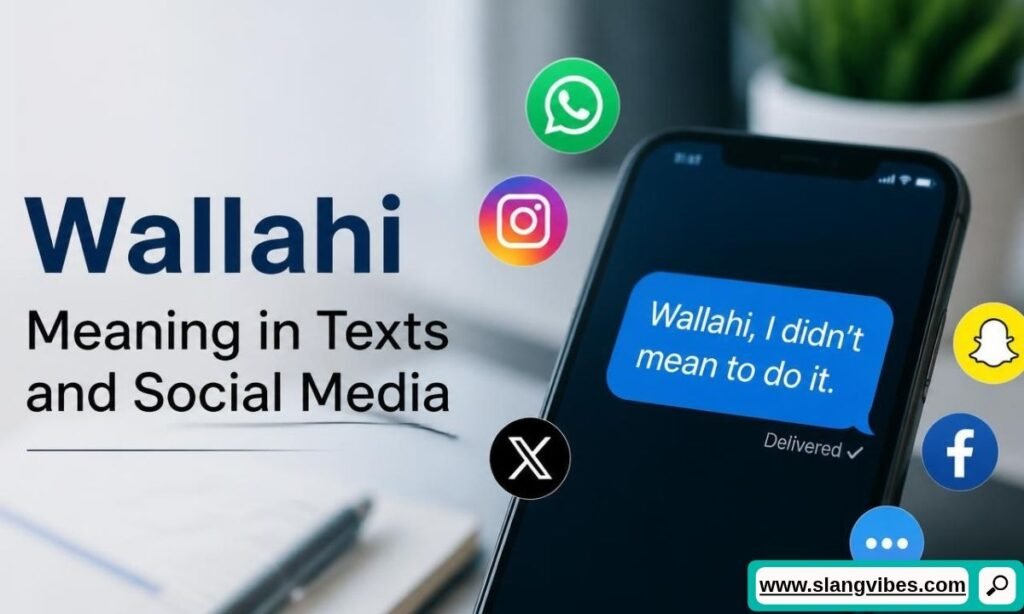
The wallahi meaning shifts a little depending on the app. In texts and DMs, people use it to add weight to a claim. On TikTok and Instagram, it often shows up as a punchy reaction to a video or a hot take. You’ll also see it used for comic effect, as in “wallahi I’m finished,” which usually signals dramatic, joking exhaustion.
Tone cues help you decode it. A laughing emoji beside the word signals a joke. A flat sentence with no emoji signals real seriousness. Capital letters often point to frustration or disbelief.
Short add-ons change the flavor too. “Wallahi bro” sounds friendly and relaxed, “Wallahi, no joke” pushes the seriousness up, “Wallahi, I swear” doubles the emphasis, which usually shows up when someone feels doubted.
Here’s a friendly exchange between two friends:
Jordan: You ate my last slice, didn’t you?
Sam: Wallahi, I didn’t touch it 😂
Jordan: Sure. The crumbs say otherwise.
Now try a more serious one between siblings:
Layla: Did you tell Mom about the car?
Omar: Wallahi, I said nothing. Please believe me.
Layla: Okay. I’m sorry I asked.
Both texts use the same word. The first plays it for laughs, and the second means it. Spotting the difference takes about two seconds once you watch emojis, punctuation, and topic. Reactions in the chat help too.
What Wallahi Means to Different Generations and Regions
The wallahi meaning stays steady across regions, but the feel changes from place to place. Think of a Gen Z college student in Chicago. She might type wallahi in a group chat the same way she’d type “fr,” as a quick stamp of honesty. A Millennial in Manchester might use it with a wink, aware of its roots but comfortable with the casual version.
Picture a different scene. A grandmother in Birmingham, who speaks Urdu at home, says “Allah ki qasam,” the Urdu way to swear by God. Her tone carries full religious weight, and no one around her treats it as slang. Urdu speakers also use “wallah” directly, borrowed from Arabic, with the same serious meaning.
Age shapes the feel too. Many younger users pick up the word from friends and videos before learning its background. Older speakers often hear it as a real oath, so a casual wallahi from a teenager sometimes surprises them.
Region matters as well. Many people in the US see the word as part of online slang. UK speakers often hear it in everyday talk among friends from many backgrounds. Across Arabic-speaking and Muslim communities worldwide, it keeps its religious roots, and elders often expect people to use it with care.
You don’t need a rulebook. Notice who’s speaking and who’s listening, then adjust your tone.
Read Also: STG Meaning in Text: What This Popular Acronym Really Means 📱💬
Wallah, Wallahi, and Billahi: Spelling and Pronunciation

The wallahi meaning holds across spellings. People type the word several ways because Arabic sounds don’t map neatly onto English letters. Wallahi ends with a short “i” vowel, which is the fuller form. Wallah drops its last vowel in casual speech. Both mean the same thing.
Say wallahi as “wah-LAH-hee.” Say wallah as “wah-LAH.” The stress lands on the second syllable. The “h” is a soft breath, so avoid hitting it hard.
This table shows the common forms and where you’ll meet them.
| Spelling | Where You’ll See It |
|---|---|
| Wallahi | Texts, captions, and fuller oath speech |
| Wallah | Casual talk and quick comments |
| Walla | Fast typing and informal posts |
| Billahi | Religious or formal phrasing |
| Tallahi | Rare, mostly classical or religious texts |
Billahi and tallahi are related oath forms. Arabic places different small particles in front of “Allah” to say “by.” Wallahi uses “wa,” billahi uses “bi,” and tallahi uses “ta.” Most English-language chats stick with wallahi or wallah, so you’ll rarely need the others.
Texting adds more variety. Spellings like “walahi,” “wallahy,” and stretched versions such as “wallahiii” all show up in comments. They carry the same oath, and the extra letters add emotion the way a raised voice would. Arabic script writes the word as والله, which you’ll sometimes spot in captions. Don’t stress over perfect spelling. Context matters far more than letters.
Read Here: Mean Mean in Text: What It Really Means in Messages (2026)
When Saying Wallahi Goes Wrong
The wallahi meaning gets lost when people use the word carelessly. Since it invokes God, some listeners treat it as a true oath, even in a casual chat. These are the spots where it goes sideways.
Imagine you tell your manager, “Wallahi, the file is ready,” and it isn’t. A coworker who grew up hearing the word as a solemn promise now sees a broken oath, not a small slip. Your intent was casual. Their reading was serious. You might mean well and still land badly. Awkward apologies usually follow.
Skip wallahi in these situations:
- Formal emails and job interviews
- Legal or official statements
- Jokes about death, illness, or other heavy topics
Many Muslims find a joke built on an oath disrespectful, so read the room first.
Common Mistake: Using wallahi as a filler word, like “um” or “like.” Overuse drains its weight, and listeners who take the oath seriously often feel uneasy.
Saying wallahi to back up something false is the biggest misstep of all. Islamic teaching treats a false oath as a serious matter, and friends who know the word’s roots will remember it long after the chat ends.
Ask yourself two questions before you type it. Do I mean this? Will my listener take it lightly? Honest answers keep you out of trouble and keep friendships steady.
Read New Articles: What Does HMJ Mean in Text? What It Really Means on Social Media (2026)
How to Respond When Someone Says Wallahi
Knowing the wallahi meaning makes replying easier, because your answer should match the weight of their words. A joking wallahi deserves a joking reply. A serious one deserves respect.
For a casual moment, keep it light. “Okay, I believe you,” “Say less,” and “Fair enough” all work. Here’s a quick exchange in a group chat:
Tariq: Wallahi, I’m not late. Traffic was too much.
Jess: Okay, okay. I believe you. Grab a seat.
Tariq: Thank you. Pizza’s on me next time.
When the tone turns serious, drop the jokes. Show the person you heard them clearly. Try “Thanks for telling me,” “I trust you,” or “I hear you.” Here’s a dating example:
Ben: Did you talk to your ex last night?
Amira: Wallahi, no. I’d never lie to you.
Ben: Thanks for telling me. I trust you.
Text and face-to-face replies differ a little. In chat, a thumbs-up or a short “got it” keeps things moving along. In person, eye contact and a small nod show respect without extra words.
One more thing: don’t tease someone who writes it with a flat, serious tone. You’ll know the difference by the setting, the topic, and the punctuation. If you’re unsure, ask a gentle question like “Want to talk it through?” This keeps the door open without turning the moment into a debate.
Wallahi Meaning vs On God, Deadass, and Swear Down
The wallahi meaning sits close to several slang phrases, yet each one carries its own flavor. Some come from US slang, others from UK speech, and wallahi brings its Arabic roots along.
This table shows how they compare.
| Example | Meaning | Tone/Vibe |
|---|---|---|
| Wallahi, I saw him | I swear by God | Strong, serious or playful by context |
| On God, I saw him | I swear, invoking God | Casual, popular in US slang |
| Deadass, I saw him | Seriously, no exaggeration | Casual, New York flavor |
| Fr, I saw him | For real | Light, quick, text-friendly |
| Swear down, I saw him | I swear it’s true | Casual, popular in UK speech |
Wallahi stands out because it names God directly and has deep religious roots. “On God” borrows the same idea, though most people treat it as pure slang. “Deadass” and “fr” skip the religious layer and simply add emphasis. “Swear down” sits in the middle, with a promise feel but no religious tie.
One more difference: wallahi often arrives with emotion attached. People say it when they feel doubted, hurt, or excited, so the feeling behind the word matters as much as the word itself.
Pick the phrase which fits your audience and the mood. If you’re talking with friends who grew up with wallahi, use it with care. With a mixed group, “fr” keeps things light.
Read Also: FYE Meaning in Text: What It Really Means in Messages (2026)
Frequently Asked Questions
What is the wallahi meaning in English?
It means “I swear by God.” People use it to confirm a truth or stress seriousness.
Is wallahi the same as wallah?
Yes. Wallah is the shorter, casual form. Both carry the same meaning.
Is it okay for non-Muslims to say wallahi?
Many people do, especially friends who grew up around the word. Know its religious weight first.
Is it disrespectful to say wallahi as a joke?
Some people feel it is, since the word invokes God. Read your audience first.
What does wallahi bro mean?
It’s a friendly way to say “I swear, my friend.” The “bro” softens the oath.
Final Thoughts
The wallahi meaning boils down to a simple idea: “I swear by God.” It started as an Arabic oath, and Islamic teaching still treats it as a binding promise. Today, friends also toss it around in texts and group chats as a stamp of honesty.
Tone does most of the work. Emojis, punctuation, topic, and the person speaking all tell you how heavy the word is meant to be. A joking wallahi about pizza and a serious wallahi about trust look identical on paper, yet they land differently.
Wallahi, wallah, and billahi all point back to the same oath idea. When someone uses one with you, match their tone and reply with care.

Alex Carter is a language enthusiast and internet culture expert at SlangVibes. He explains the latest slang terms and text meanings in simple, clear English so everyone stays in the loop.