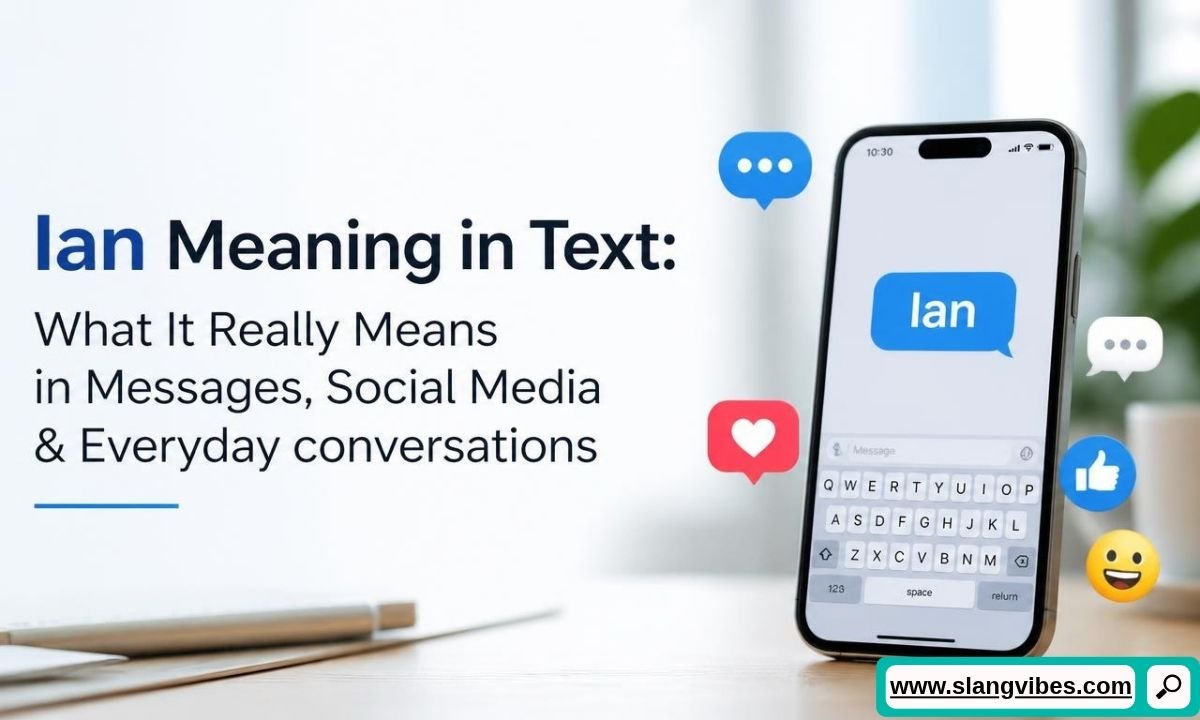
My friend Dana texted me last month: “ian going tonight.” I stared at my screen. Who was Ian? Why was he skipping the party? I typed back, “Wait, who’s Ian?” She sent three crying-laughing emojis. I felt silly for about ten minutes. Then I learned plenty of people hit the same wall. Here’s the thing. Ian meaning in text has nothing to do with a guy named Ian in this case. Dana was typing “I ain’t” the way she says it out loud. This guide walks through where the term shows up, how to read it, and how to reply without feeling lost.
Read Here: Mexican Slang for Homie (2K26 Guide): 19 Real Words Mexicans Actually Use for “Friend”
Ian Meaning in Text: The Short Answer
Ian meaning in text comes down to two words, “I ain’t,” typed the way people say them. Some readers take it as “I am not” instead. The spelling copies casual speech, where “I ain’t” melts into one quick sound. Based on how the term is typically used online, it works as a plain negative. It’s a fast way to say no, deny something, or push back.
Here’s how it looks in a real chat.
Jordan: you coming to game night?
Sam: ian sure yet, work might run late
Jordan: ok text me when you know
Sam’s “ian sure” reads as “I ain’t sure.” The word after ian shapes the meaning. “Ian going” means “I ain’t going.” “Ian ready” means “I ain’t ready.” You’ll also see “ian saying” or “ian doing” in casual replies.
Think of it this way. Typing ian copies the sound of speech, the same way people type “gonna” or “wanna.” Nobody needs a formal definition to follow along. Context does the work.
A quick test helps. Swap ian for “I ain’t” in your head. If the sentence still makes sense, you’ve read it right.
A real name usually comes with a helper word, as in “Ian is going.” The slang skips it, as in “ian going.” Lowercase letters and a missing helper word are your best clues.
Where Ian in Text Comes From
Ian meaning in text starts with a word people have said for centuries. According to Grammarly, “ain’t” dates back to the late 1600s and began as a short form of “am not.” Over time, it spread to other uses, like “is not” and “do not.” Spoken English kept it alive in songs, movies, and everyday talk. Many people hear it so often, typing it feels natural.
Typing ian is the next step in this chain. Someone hears “I ain’t” in their head and types the sounds. No formal source tracks the first use of ian in text, so treat any exact date with caution. Formal dictionary coverage of ian as slang looks thin, so real usage tells the story better than any official entry.
A close cousin gives helpful context. Dictionary.com describes ion as a spelling based on the casual pronunciation of “I don’t.” It notes the pronunciation is especially common in Black English and shows up in internet writing from the 2000s. Ian follows the same habit of spelling a spoken phrase the way it sounds.
Picture a group chat on a Friday night. Someone types “ian cooking tonight, order food.” Nobody asks for a translation. Three people reply with a laughing emoji, and the plan moves on. A quiet moment like this shows how fast a spelling settles into everyday texting.
Read More Articles: TBC Meaning Uncovered: The Full Definition and Examples in Online Chats
How Ian Shows Up on Social Media

Ian meaning in text stays the same across apps, but the tone shifts by platform. It’s common to see shortened spellings in comment sections, captions, and quick replies. Here’s how each space tends to use it.
On TikTok, a comment like “ian even mad” fits the style, On Instagram, it shows up in captions and story replies, On X, it suits the fast, short-reply format, On Snapchat, it fits quick back-and-forth chats. Group chats and DMs use it most casually. Friends type it without thinking, often with no punctuation at all. Replies move fast in these spaces, so shorter spellings save a few seconds and match the way people talk.
Here’s a short Instagram DM exchange.
Maya: did you post the beach pics yet
Chloe: ian posting anything until i edit them
Maya: lol you said the same thing last week
Chloe: ian lying this time 😂
Chloe’s first “ian” works as a firm refusal. Her second works as a playful promise. Same word, two moods. Tone comes from the words around it, the emoji, and the friendship between the two people.
One more habit worth knowing. People often drop capital letters and punctuation when they type ian. A fully capitalized IAN looks stiff, so the lowercase version feels more natural to most readers.
Read Also: TBH Meaning in Chat: Examples, Uses, and Smart Replies
Ian Meaning in Text Across Generations and Regions
Ian meaning in text shifts a little with age and place. It’s common to see younger texters shorten words by sound. Many Millennials stick to full words or standard abbreviations like idk. Neither group owns the term, and readers of any age pick it up fast once they’ve seen it.
Here’s a quick table of common patterns.
| Example | Meaning | Vibe |
|---|---|---|
| ian going | I ain’t going | Casual, firm |
| ian sure | I ain’t sure | Relaxed, unsure |
| ian mad | I ain’t mad | Playful, teasing |
| ian hungry | I ain’t hungry | Plain, direct |
Region matters too. In the US, “ain’t” shows up in songs, movies, and everyday speech, so the spelling often clicks fast. UK readers know “ain’t” as well. Still, readers on both sides of the Atlantic who haven’t seen ian before often mistake it for a name.
Picture a Gen Z student texting a Millennial cousin: “ian going to the reunion.” The cousin pauses, then replies, “Who’s Ian?” The student laughs and explains. A mix-up like this is harmless, and a quick explanation clears it up.
If you’re unsure about a reader, type “I ain’t” or “I’m not” instead. Clarity beats style, especially with new contacts. Misreading a message in a group chat costs little. Misreading one in a work thread costs more.
Ian vs. Ion, Ain’t, and Other Look-Alike Spellings
Ian sits close to a few other spellings, and mixing them up is easy. Here’s how to tell them apart.
- Ian vs. ion: Dictionary.com calls ion a spelling of “I don’t.” Ian points to “I ain’t.” One letter changes the whole meaning.
- Ion in capitals: ION also means “in other news,” a way to switch topics, according to Dictionary.com.
- Ian vs. ain’t: Ain’t is the full word. Ian already includes the “I,” so “I ian going” would look like a typo.
- Ian vs. idk: Idk is an acronym for “I don’t know,” typed letter by letter. Ian is a spelling, typed by sound.
Here’s a short chat where two of these meet.
Alex: ion know where my keys are
Riley: ian touching your keys lol
Alex: ok ok i’ll check the car
Alex says “ion know,” meaning “I don’t know.” Riley says “ian touching,” meaning “I ain’t touching.” Both spellings copy speech. They aren’t interchangeable, though. Swapping them changes the message, so read each one with its next word in mind.
A good habit helps here. Check the vowel and the next word before you reply. Ion often pairs with words like “know” or “care.” Ian pairs with states or actions, like “ready” or “going.” Both spellings turn up in lowercase, so the vowel is your main clue.
Read New Articles: ASL Meaning in Chat: Popular Uses, Examples, and Hidden Meanings
Common Mistakes When Reading Ian in Messages
Ian meaning in text trips people up in a few predictable ways. Knowing them saves awkward replies. Here are the mistakes worth avoiding.
- Reading it as a person. A lowercase ian before a verb or adjective usually isn’t a name.
- Swapping it with ion. One means “I ain’t,” the other means “I don’t.”
- Mixing it up with the “-ian” ending in words like Italian or Canadian. Those endings need a root word in front.
- Assuming a hostile tone. Ian often signals a casual refusal, not anger.
- Treating it as workplace-safe. It belongs in friendly chats.
Capital letters add another trap. Phones often auto-capitalize the first letter of a message. This makes “Ian going” look like a name even when the sender means the slang.
Tone causes slips too. Short messages with no punctuation feel blunt in print, yet the sender is often relaxed. Someone who types in lowercase all day sends every message this way. Before you reply with worry, check the sender’s usual style.
Common Mistake: Replying “Who’s Ian?” to a text like “ian going tonight.” Check the words around it first. If no helper word follows, you’re likely reading slang.
Short messages make confusion worse. When a text feels odd, say it out loud. If “ian going” sounds like “I ain’t going,” you’ve found the meaning.
How to Respond When Someone Texts You Ian

Ian meaning in text calls for a reply, and your reply should match the mood. A refusal needs acknowledgment. A joke needs a joke. Here are a few easy replies.
- “Fair enough.” Works for firm refusals.
- “Got it, no worries.” Works when plans fall through.
- “Why not?” Works when you want the reason.
- “lol okay.” Works for playful posts.
- “Okay, I’ll cover it.” Works when the refusal leaves a gap.
Here’s a quick exchange showing a good reply.
Taylor: ian doing the group project alone
Casey: fair, i’ll take the slides
Taylor: ty 🙏
Tone matters too. A laughing emoji after ian usually signals teasing. A flat period reads firmer, and many people notice it. An eye-roll emoji signals annoyance. Match the energy of the sender. A thumbs-up or a quick “okay” also closes the loop.
You don’t need to type ian back. Replying “same” or “I’m not either” works fine. Mirroring the spelling is optional, and plain words always land safely.
If the meaning feels unclear, ask. A short question beats a wrong guess. Something like “so you’re not coming?” confirms the plan without making things awkward. This matters most when the message affects plans, money, or a shared task. Voice notes help too, since hearing the phrase makes the meaning obvious.
Read Also: SYFM Meaning in Slang: What Does It Stand For?
When Ian Meaning in Text Doesn’t Fit
Ian meaning in text belongs in casual chats, and formal spaces call for something else. Think of it as a dress code for your words.
Picture an email to a manager: “ian available Friday.” It reads as a typo, and the manager has to guess. Compare it with “I’m not available Friday.” Same message, zero guesswork.
Picture a message to a professor: “ian understanding the assignment.” The professor might read this as careless. “I don’t understand the assignment” sounds clear and respectful.
Picture a text to a grandparent. They know “ain’t,” yet the spelling ian looks like a name. A full “I ain’t” or “I’m not” saves a call asking who Ian is.
Social posts sit in between. A personal caption with ian feels natural, while a business account usually sticks to standard spelling. Group chats with mixed audiences need care too. A message sent to friends and coworkers together reaches readers with different habits. Pick the clearest wording for the whole group.
Here are safe swaps by setting.
- Work: “I’m not” or “I am not”
- School: “I am not”
- Friends: ian is fine
- Family: “I ain’t” or “I’m not”
Bottom line. Ian fits friends, group chats, and casual comments. Anything with a boss, client, or teacher deserves full words. When in doubt, spell it out.
Quick Answers About Ian in Messages
What does ian mean in text?
Ian meaning in text is usually “I ain’t,” typed the way it sounds. Some readers also take it as “I am not.”
Is ian the same as ion?
No. Dictionary.com describes ion as a spelling of “I don’t.” Ian points to “I ain’t.”
Is ian a name or slang?
Both. Ian is a common given name. A lowercase ian before a verb or adjective usually signals the slang.
Is it okay to use ian in a professional message?
Skip it. Write “I’m not” or “I am not” in work emails, school messages, and client chats.
Does ian mean the same thing on TikTok as in private texts?
The meaning stays the same. Tone changes, since public comments often sound more playful than private chats.
What to Remember About Ian in Chats
Ian meaning in text is simple once you hear it out loud. It stands for “I ain’t,” and some readers see “I am not” instead. The spelling copies speech, the way “gonna” and “ion” do. Context tells you whether a message is about a person named Ian or a quick denial.
Remember the clues. A lowercase ian before a verb or adjective usually signals the slang. A name tends to come with a helper word like “is.” Social platforms keep the tone playful, and private chats keep it relaxed. Work and school messages call for full words.

Alex Carter is a language enthusiast and internet culture expert at SlangVibes. He explains the latest slang terms and text meanings in simple, clear English so everyone stays in the loop.