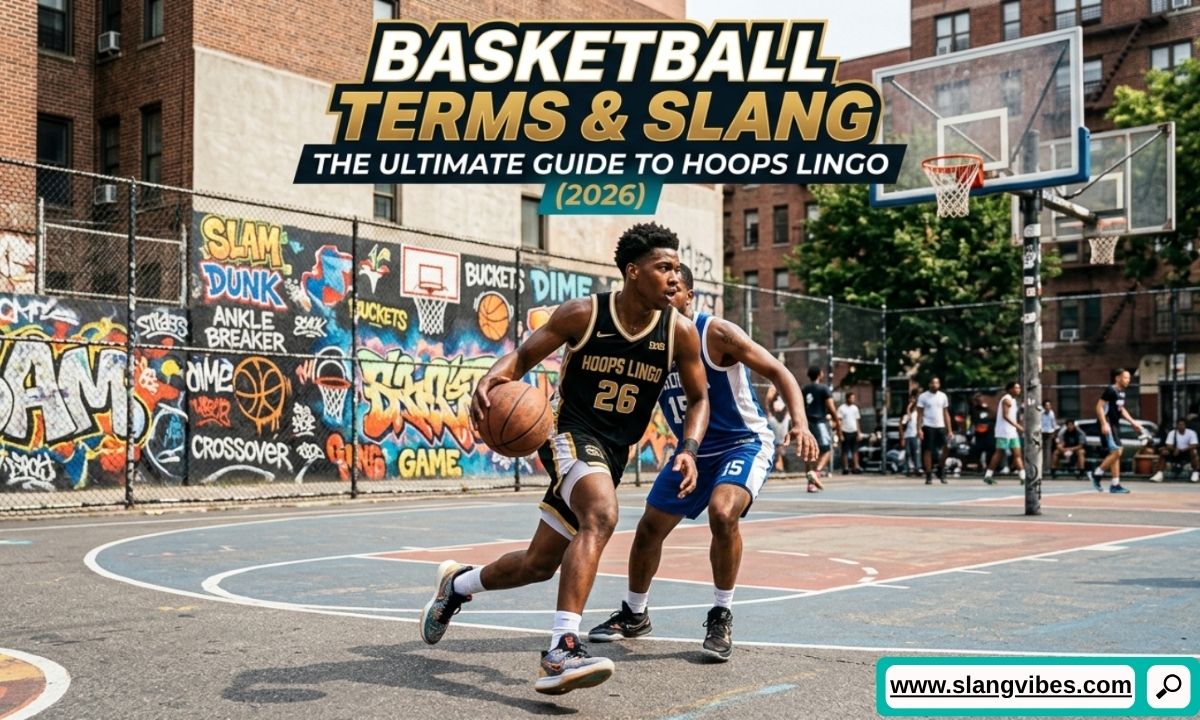
Picture a pickup game at your local park on a Saturday morning. Someone drives the lane and dishes a no-look pass to the corner. The shooter buries it, and the sideline erupts. “Ohhh, what a dime!” Seconds later, someone crosses up another player so hard he nearly falls. The crowd yells “Ankle breaker!” If none of this makes sense, welcome to the world of basketball terms slang. This is the informal language hoopers, fans, and commentators use to describe everything happening on the court. This guide breaks down where the words come from and what they mean. You’ll also learn how to use them without sounding like you learned English from a highlight reel.
What Is Basketball Terms Slang, and Where Does It Come From?
Basketball terms slang covers the shorthand words players and fans use instead of plain descriptions. Instead of saying “he made a difficult shot,” someone says “he splashed one” or “money.” The habit goes back decades. Playground and streetball culture built this habit, long before ESPN cameras showed up.
Pickup games, YMCA gyms, and inner-city courts turned ordinary plays into small stories. The language stuck. Once college and NBA commentators picked up on this vocabulary, hoop slang moved from local courts into national broadcasts. Now social media speeds up the whole process. Someone coins a term on a playground in Brooklyn, and it spreads through TikTok clips and YouTube highlight reels within days. It reaches fans who’ve never touched a basketball court.
What makes this version of sports slang stand out from other sports is how visual it stays. Nearly every term paints a picture. A “brick” looks like a real chunk of concrete bouncing off the rim. Getting “cooked” looks exactly like it sounds. This is basketball culture in word form. The people who play and watch the game build it; no rulebook hands it down.
Basketball Terms Slang for Scoring: Buckets, Dimes, and Heat Checks
Scoring produces more slang than any other category, since scoring is the whole point of the game. “Buckets” means made baskets, and calling someone “a buckets guy” praises their scoring ability overall. “Dime” describes a slick, perfectly timed assist, the type of pass making a score look effortless.
Did You Know: “Dime” traces back to pay-phone days. Someone giving you a dime meant they were helping you make an important call. Passing a “dime” carries the same feeling: a player helping a teammate score.
Beyond dimes and buckets, hoopers describe a clean shot as a “swish” or “splash.” Hoopers call an ugly miss which clangs off the rim a “brick.” A “downtown three” or “deep three” describes a shot from way behind the arc. A “fadeaway” is a jump shot where the shooter leans backward for space. When a player hits several shots in a row, announcers call this a “heat check.” The term tests whether the hot streak continues. A shot which ends the game for good is a “dagger” or a “game winner.”
Read More: NVM Meaning in Chat: WhatsApp, TikTok, Snapchat & More
| Term | Meaning |
|---|---|
| Buckets | Made baskets or a strong scorer |
| Dime | A perfectly placed assist |
| Splash | A clean three-point shot |
| Brick | A badly missed shot |
| Heat check | Testing a hot shooting streak |
Group chat: Jordan: Bro did you see the game Sam: Yeah he had 30 points, straight buckets all night Jordan: And the no-look dime in the 4th Sam: Dagger too lol game over after this one
Basketball Terms Slang for Defense: Clamps and Lockdown Mode
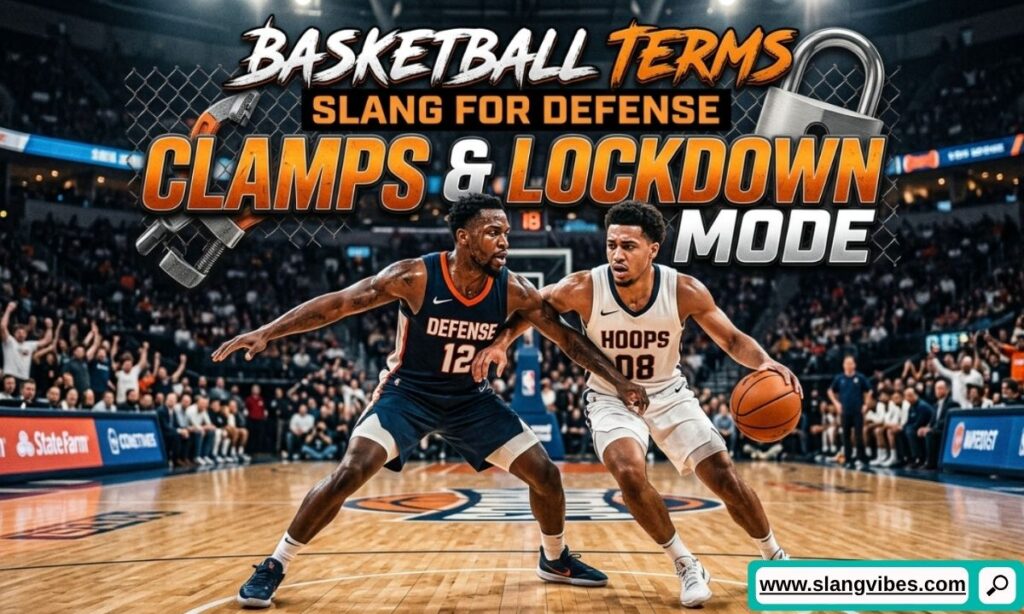
Defense-focused slang flips the spotlight onto the players stopping the ball instead of scoring it. “Clamps” describes tight, physical defense, the type where an offensive player rarely shakes free for a clean look. Announcers say a defender “put the clamps on” someone after a tough possession. The ball handler struggled the whole time.
“Lockdown defense” takes this a step further. It describes a player who shuts down the best scorer on the other team, night after night. “D-up” works as both a command and a description. Teammates shout it from the bench to remind everyone to tighten up.
Away from the ball, “box out” describes fighting for rebounding position. Players shorten this to grabbing a “board.” “Deny” means a defender refuses to let their matchup receive a pass at all. A “closeout” happens when a defender sprints out to contest a shooter who caught the ball beyond the arc.
Group chat: Mike: Their point guard is cooking us tonight Dre: Coach needs to put the clamps on him next possession Mike: Fr he’s been in iso all quarter with nobody stopping him Dre: Lockdown defense starts now or we lose this
Handles and Dribbling Slang: Crossovers, Ankle Breakers, and Snatch Moves
Good handles separate the players who look comfortable with the ball from the ones who look nervous holding it. “Handles” itself refers to dribbling skill overall, and saying someone “has handles” is high praise on any court.
An “ankle breaker” happens when a dribble move causes a defender to lose balance or stumble. Sometimes the defender falls down entirely. A “crossover” switches the ball quickly from one hand to the other to create space. An “in-and-out” fakes a crossover without ever finishing it. This freezes the defender for a split second.
Streetball culture brought extra flavor into this category. “Putting someone on skates” describes a move so smooth the defender looks like he’s sliding on ice. A “wiggle” refers to quick, low dribbling that shakes a defender loose. A “snatch” move pulls the ball back hard and fast, usually setting up a step-back jumper.
Sibling text thread: Amir: bro I broke his ankles at the park today Zara: no way send the clip Amir: crossover then in-and-out, he fell straight down Zara: put him on skates lol embarrassing for him
Basketball Slang for Dunking: Posterized, Alley-Oop, and Jelly
Dunks bring the loudest reactions in any gym, and the slang around them matches the energy. Getting “posterized” means an opponent dunks on a defender so hard the moment looks worthy of a poster. For the defender, it’s a moment nobody wants to relive. An “alley-oop” describes a lob pass a player throws near the rim for a teammate to catch mid-air. The catch usually ends with a dunk.
“Jelly” describes a smooth, wobbly-looking layup style. Fans often call it a “jelly layup.” The name grew through streetball and highlight culture. It comes from how the shot seems to wiggle in the air before dropping in. A “putback” happens when a player grabs their own missed shot and scores again immediately. This often happens off a fast break or a quick offensive rebound.
Fans yell “and-one” after a player scores while a defender fouls him. The free throw which follows gives them a chance at an extra point. Add a dunk to an and-one, and the moment ranks among the loudest a gym gets.
Basketball Slang for Positions: Big Man, Sixth Man, and Stretch Four
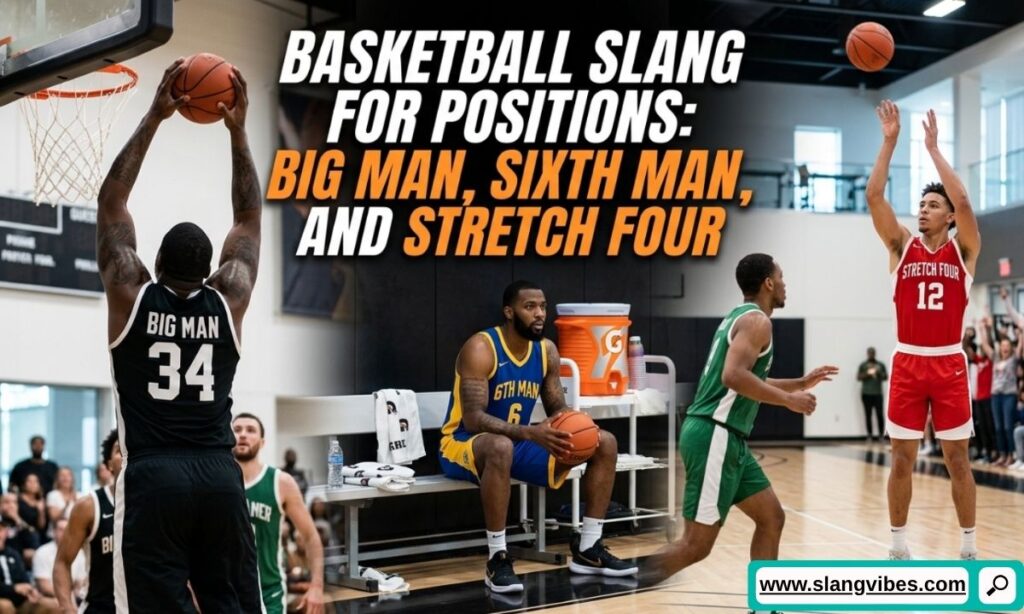
Every position on the court carries its own nicknames. A “big man” plays center or power forward. This player usually handles work near the rim: rebounding, shot blocking, and finishing close shots. A “stretch four” flips this expectation. This player lines up at power forward but shoots three-pointers well. This range pulls defenders away from the basket.
A “combo guard” plays comfortably at both point guard and shooting guard. He handles the ball one possession and spots up for a shot the next. The “floor general” title usually goes to a point guard running the offense. This player calls plays and keeps teammates organized during a game.
Coming off the bench, the “sixth man” holds a special place in basketball culture. Rather than starting the game, this player enters early. The scoring or energy boost often runs strong. It’s enough for the NBA to hand out its own Sixth Man of the Year award. None of this language shows up in a rulebook, yet every serious fan knows exactly who these labels describe.
Read New Article: HYD Mean in Text: What It Really Means on Snapchat, TikTok & WhatsApp (2026)
Stats and Game-Situation Slang: Double-Doubles, Daggers, and Garbage Time
Stat-driven slang gives fans a shorthand for tracking big performances without listing every number. A “double-double” happens when a player reaches double digits in two categories during a single game. Points and rebounds are the most common pair. Reach double digits in three categories instead, and this becomes a “triple-double.” It’s one of the rarest lines a stat sheet shows.
“Garbage time” describes the final stretch of a lopsided game, when the result is no longer in doubt and coaches empty the bench for reserve players. “Cherry picking” calls out a player who hangs near their own basket instead of playing defense. He waits for an easy transition score. Neither term sounds flattering, and fans use both constantly during blowout games.
The scoring section already covered “dagger,” and the term doubles as a stats-adjacent word too. It often ends a team’s final push at a comeback. Commentators lean on this vocabulary constantly. Raw box scores rarely capture the emotional weight of a fourth-quarter double-double or a backbreaking dagger three.
Trash Talk Slang: Chucker, Scrub, Buster, and Getting Cooked
Hoop slang gets sharper and more competitive once trash talk enters the picture. A “chucker” shoots constantly regardless of shot selection or accuracy, often frustrating teammates who never touch the ball. A “scrub” describes a player fans see as weak or replaceable. Fans use “buster” for someone who talks a big game but folds under real pressure.
Calling a teammate a “ball hog” points out someone unwilling to pass, no matter how open a teammate stands. None of these terms belong in a locker room speech or a coaching report. They carry a sharp, sometimes disrespectful edge that fits friendly competition, not formal settings.
Getting “cooked” describes the flip side of great defense: an opponent scores on a player so easily and repeatedly that the moment turns almost comedic. Friends toss this word around constantly during pickup runs. It stings a little more when a coworker brings it up the next morning at the office.
Coworker text thread: Priya: you got cooked at lunch run today ngl Devon: nah my guy was hitting everything, nobody’s stopping him Priya: he had you on skates twice lol Devon: whatever, rematch tomorrow
NBA 2K and Gaming Slang: Green, Cheese, and Sweats
Basketball terms slang stretches beyond real courts into gaming culture, especially through NBA 2K and mobile basketball apps. Hitting the “green” window means timing a jump shot perfectly. The shot meter lands directly on the green zone for a guaranteed make. Players call an overpowered or unrealistic build “cheese,” since certain combinations of moves feel unfair against regular opponents.
A “sweat” describes someone playing far too intensely for a casual pickup game or online match. This player sprints hard and trash-talks over a match that should stay relaxed. The term jumped from gaming lobbies straight into real-court pickup games. Calling someone a sweat still lands as a lighthearted insult there.
This corner of hoop slang grew fast through TikTok clips, YouTube gameplay videos, and Twitch streams. It spread among Gen Z fans fast. Many spend as much time in NBA 2K’s park mode as they spend watching real games. Esports culture blended smoothly into basketball culture here. Many young fans learned plays and terminology through a controller before ever touching a basketball.
Dating app text thread: Leah: wait you play 2K too Ryan: yeah park mode mostly, you good at it Leah: decent, I hate playing against sweats though Ryan: same, and don’t get me started on green window cheaters
Old-School vs New-School: How Hoop Slang Changed From Streetball to TikTok
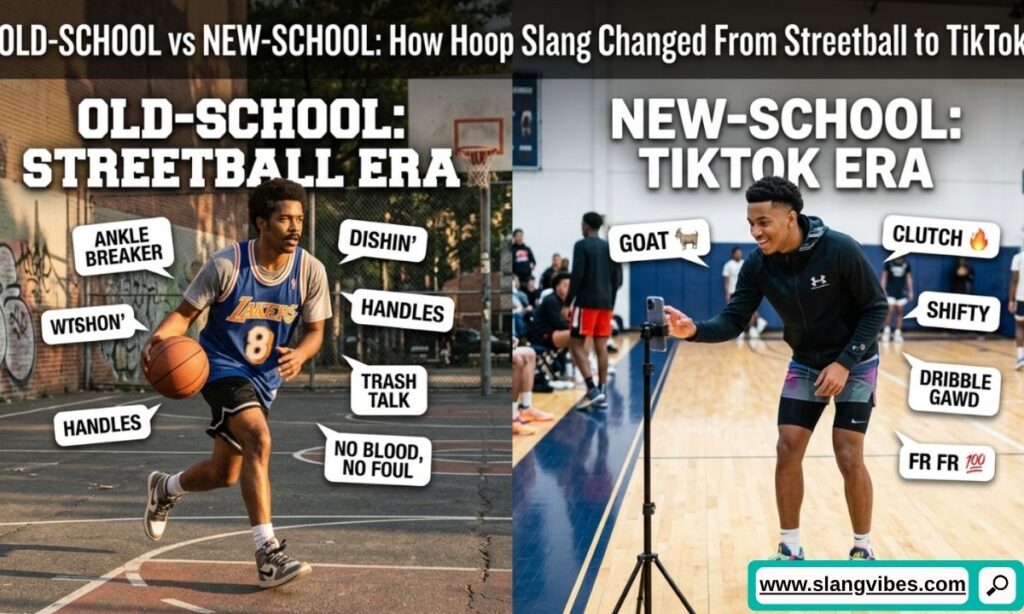
This slang shifts noticeably across generations, and comparing eras shows how much the game’s language keeps moving. Older fans grew up on simpler, technical words like “fast break” and “fadeaway.” These terms tied closely to broadcast commentary rather than street culture. Millennials came up during the height of streetball influence. Terms like “posterized,” “ankle breaker,” and “dime” spread through mixtapes, early YouTube clips, and playground legends.
Gen Z fans blend basketball vocabulary directly with internet culture. They mix terms like “cooked,” “green,” and “clamps” with gaming slang from NBA 2K and TikTok highlight edits. Women’s basketball adds its own layer too. WNBA broadcasts and players introduce fresh phrases which spread through the same social platforms.
None of these generations use the exact same words the same way. Yet the shared thread stays constant. Basketball slang exists so fans have a livelier, more expressive way to talk about the game. Plain, formal language falls flat by comparison.
Read Also: Trade Gay Slang Meaning: What “Trade” Really Means in LGBTQ+ Culture
Frequently Asked Questions
A dime is a smooth, well-timed assist, a pass setting up an easy score for a teammate.
A brick hits the rim or backboard hard and misses. An air ball misses everything, including the rim entirely.
Yes, clamps almost always describes tight, physical defense, not offense or scoring.
Green refers to hitting the shot meter’s perfect timing zone, resulting in a guaranteed make.
Streetball roots, fast-paced action, and a strong highlight culture all play a part. Together, they give the sport more room for creative, visual language than most other sports allow.
Conclusion
Basketball terms slang keeps growing every season. Playgrounds, broadcasts, video games, and social media all shape it at once. Learning the words in this guide won’t turn anyone into a professional commentator overnight. The next pickup game, group chat, or NBA broadcast will still make a lot more sense. Try dropping one or two terms naturally. Call a nice pass a dime, tell a friend they got cooked, or point out a defender playing lockdown defense.
Hoop culture rewards people who pay attention and speak the language, even loosely. Start small, listen for these words during real games, and the rest sticks fast. Basketball slang isn’t a test to pass. It’s only a livelier way to talk about a game already full of energy and style.

Alex Carter is a language enthusiast and internet culture expert at SlangVibes. He explains the latest slang terms and text meanings in simple, clear English so everyone stays in the loop.