Ever gotten a text that read “he’s not my type” and felt a small sting? Or scrolled past a caption like “my type of energy” over a coffee-and-rain photo, and wondered what it meant? Type meaning in slang splits into three separate jobs. One is a dating preference. Another is a grammar trick borrowed from African American Vernacular English. And a third is a whole separate phrase, “type shit,” mixed up with both. If a text, a TikTok caption, or a group chat joke left you confused, here’s the full picture. It’s explained the way a friend would explain it.
What Does Type Meaning in Slang Look Like in Text?
Type meaning in slang covers more ground than most people expect. At its core, the word points to a preference, the specific look, personality, or energy someone finds attractive. “He’s not my type” means he doesn’t match what you’re drawn to. “You’re exactly my type” means the opposite: they check every box.
Quick Answer: In slang, “type” mostly means personal preference: my type versus not my type. It also works as an AAVE-rooted intensifier, where “type funny” means extremely funny. And it shows up in the unrelated phrase “type shit,” which signals agreement rather than attraction.
Texting culture stretched the word into two more directions beyond dating. Speakers use it as an intensifier, so “it’s type cold outside” means extremely cold outside. Separately, “type shit” (often spelled “type shi” online) expresses agreement or a shared vibe. It has no connection to attraction at all.
A quick sibling text shows the dating sense in action.
Zoe: mom’s setting me up with her coworker’s son again. Emma: is he your type at least? Zoe: he’s sweet but so not my type, I need someone funnier.
This exchange uses “type” the way most people expect: as a stand-in for attraction and personal preference. Notice how punctuation carries part of the meaning too. Zoe’s flat delivery, no emoji, no exclamation point, signals something casual. It’s a low-stakes comment, not a real dig at the coworker’s son.
Type Slang Meaning: Where This Word Came From
The slang meaning of type didn’t appear overnight. Cambridge Dictionary listed phrases like “my type of guy” as casual, non-slang English decades ago. Back then, it simply meant someone matching a general category, like “the outdoor type” or “the sporty type.” This usage stayed mild and fairly formal for most of the 1900s.
Two separate paths pushed the word toward its current slang life
The Dating-Culture Path
. The first ran through dating culture. Songs, movies, and eventually dating apps leaned on the idea of an ideal type. The phrase shifted from a plain description into shorthand for attraction. By the 2010s, Tinder, Bumble, and Hinge largely ran on the concept. “My type” turned into standard dating-app vocabulary.
The second path runs through African American Vernacular English, and it’s the piece most guides skip entirely. In AAVE, “type” works as an intensifier placed before an adjective, doing the same job as “so” or “hella.” “It’s type funny” means extremely funny. “She’s type thick” means noticeably curvy. This use predates the dating-app version. It shows up in documented citations going back years. Southern hip-hop and everyday Black speech used it long before TikTok picked it up.
Social media didn’t invent either meaning. It sped both of them up and mashed them together, which explains why the word feels confusing today. A caption might lean on the dating sense, while a comment underneath leans on the intensifier sense. Neither poster realizes they’re using two different grammatical patterns. Even dictionaries reflect this split. Formal entries still define “type” as a category or classification. The intensifier use rarely makes it into a standard dictionary, since it behaves more like grammar than vocabulary. This gap is part of why the word confuses people searching for a single, tidy definition.
Read Also: What Does BM Mean in Text? What It Really Means on Facebook, TikTok & Instagram (2026)
Type Shit vs My Type: Two Slang Terms People Confuse
Not my type meaning and type shit meaning get tangled together online constantly. They share only one overlapping word, though, and nothing else.
“My type” and “not my type” describe attraction or preference. “Type shit,” sometimes written “type shi” or paired with a poop emoji, works as a stand-alone expression. It signals agreement, approval, or a shared vibe. It traces back to African American Vernacular English and gained wide visibility through hip-hop. A well-known 2024 Future and Metro Boomin track is even titled “Type Shit.”
| Phrase | Meaning | Tone/Vibe |
|---|---|---|
| My type | Matches what I find attractive | Flirty, complimentary |
| Not my type | Doesn’t match my preference | Neutral to blunt |
| Type shit | I agree, same energy, that’s the vibe | Casual, affirming |
| Type funny / thick / slow | Extremely funny, curvy, or slow | Descriptive, AAVE intensifier |
A group chat exchange shows the difference clearly.
Maya: matched with a guy who’s 6’2, loves hiking, plays guitar. Priya: okay that’s your type fr. Maya: tacos and a good playlist type shit tbh, I’m simple.
Priya used “type” to describe Maya’s preference. Maya used “type shit” to describe a mood instead. She’s agreeing with the general vibe of the chat, not naming a dating preference. Same word, two unrelated jobs, one sentence apart. “Type shit” carries a mild profanity and roots in a specific cultural community. Using it thoughtfully matters more than tossing it into every sentence for effect.
Type Meaning on TikTok, Snapchat, and Instagram
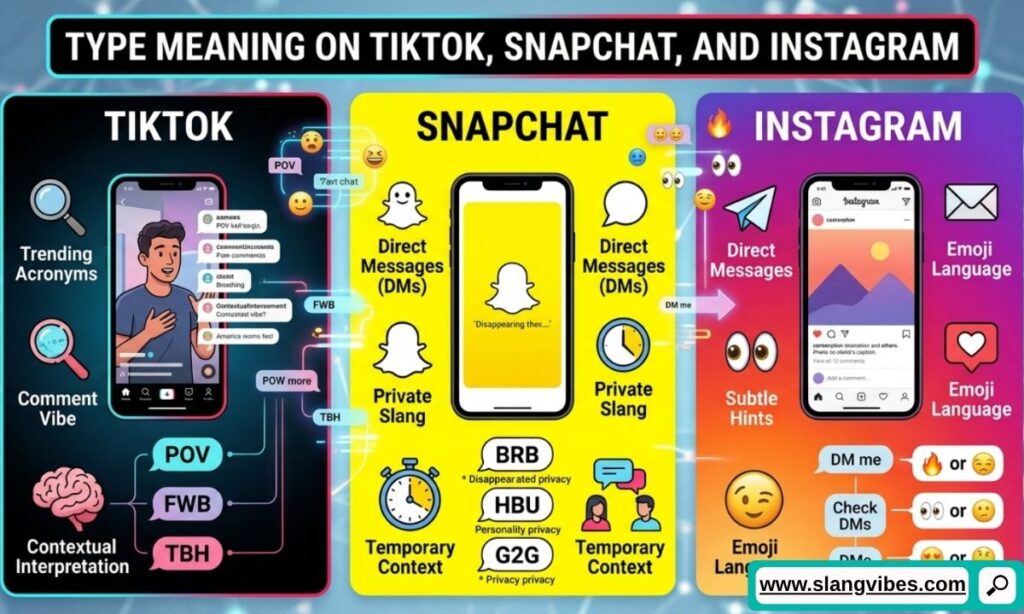
Type meaning on TikTok looks a little different from type meaning on Snapchat or Instagram. Mostly, it comes down to what each platform rewards.
On TikTok, “type” shows up in captions and comment sections built around confident, half-joking self-description. Think “your type could never,” or a slideshow captioned “pov: you’re exactly my type.” The intensifier version lives here too, especially in comments reacting to a clip: “this is type funny.”
On Instagram, “type” leans toward aesthetic captions more than direct flirting. A photo of a rainy window and a coffee cup often gets captioned “my type of afternoon.” It describes a preferred mood instead of a person.
On Snapchat, conversations move fast and stay private. “Type” tends to show up in one-on-one exchanges instead of public posts.
Jordan: ok not to be weird but ur exactly my type. Sam: lol how do you even know already? Jordan: vibes. Also, you have a dog.
Texting overall, iMessage, WhatsApp, group chats, treats the word more loosely than any single app. There’s no caption format shaping it. People switch between the dating meaning and the intensifier meaning in the same conversation without a second thought. Tone and context carry the meaning more than the platform does.
Emoji choice tends to follow the meaning too. The dating sense usually pairs with hearts, wink faces, or the 👀 eyes emoji. The intensifier and “type shit” senses pair more with laughing emojis, skulls 💀, or nothing at all. They work more like verbal punctuation than a statement needing decoration.
When Type Meaning in Slang Doesn’t Apply
Type meaning in slang works fine in texts, captions, and casual chat. It reads oddly, or unprofessional, almost everywhere else.
A coworker won’t appreciate hearing “not my type” about a client. And “type shit” dropped into a work email lands as strange at best.
Work Slack, tone gone wrong.
Alex: new hire seems cool. Priya: not my type of energy on this team tbh.
A manager scrolls past minutes later. This message reads fine among friends. In a work channel, it reads unprofessional fast, even though nothing about it was rude.
Tone also decides whether the word reads as a compliment or a dig. “You’re exactly my type” with a heart emoji reads as flirting. “Not exactly my type” delivered flatly, with no emoji and no follow-up, reads as a soft rejection. Sometimes it reads as a sharp one, depending on the relationship. The same three words carry opposite emotional weight depending on punctuation, emoji, and who’s saying it.
One more spot where the word misfires: using “type shit” as filler in every sentence. It works as an occasional agreement marker, not a verbal habit. Sprinkling it constantly tends to read as trying too hard, especially for someone outside the communities where the phrase started.
Bottom line: read the room before using either version of this slang. A close friend’s group chat gives plenty of room to be casual. A boss, a teacher, or someone met an hour ago gives a lot less.
Read More Articles: GC Mean in Text: What It Really Means on Snapchat, TikTok & Facebook (2026)
How to Respond When Someone Calls You Their Type
Getting called someone’s type in a text puts a lot of people on the spot. There’s an unspoken pressure to respond with equal confidence.
If there’s mutual interest, mirroring the energy works well.
Crush: not gonna lie, you’re exactly my type. You: same energy tbh, glad you said something.
A short reply like this keeps things light while confirming interest without overthinking it. A simple “😏” or “stop” (in the flattered sense) also gets the message across.
If there’s no interest, a warm deflection keeps things kind. Try “you’re sweet, I appreciate it” or “it means a lot, I’m not looking for anything right now.” Either one closes the door without making the moment awkward.
If the feelings are still unclear, buying time works fine too. Try “haha we’ll see,” or shift the subject naturally without ignoring the comment outright. Either way keeps the conversation open.
What doesn’t work well: silence. Leaving someone on read after a compliment like this tends to sting more than an honest, gentle no would. A short reply, even a noncommittal one, respects the moment more than ghosting it.
A first-date follow-up shows the mutual-interest version in a slightly longer form.
Alex: had a good time last night, ngl you’re pretty much my type on paper. Sam: same, didn’t expect the guitar thing though, that sealed it. Alex: knew the guitar would win someone over eventually.
Notice neither person overexplains. A short, warm confirmation carries the same weight as a longer paragraph. It keeps the tone matching the original text, instead of turning a casual compliment into a big moment.
Gen Z vs Millennial Slang: How Type Meaning Shifts by Generation
Gen Z slang type usage leans heavily on the intensifier and “type shit” versions, alongside the dating meaning. Millennials tend to stick closer to the original preference sense, “he’s not my type.” They reach for the AAVE-rooted intensifier less often.
Older Millennials and Gen X mostly use the word the way Cambridge Dictionary has defined it for decades. It’s plain, treated as a category. “She’s the outdoor type” or “he’s not the marrying type” sound natural coming from someone in their 40s or 50s. Neither carries the flirtier or filler-word layers attached to younger usage.
Regionally, US and UK texting habits diverge slightly here too. American slang leans on “type shit” and the intensifier form more heavily. This comes largely from how directly hip-hop culture shaped US internet slang. UK slang keeps “my type” and “not my type” mainly in the dating sense. The intensifier form shows up far less in British group chats. Still, British TikTok comment sections borrow it from American creators now and then.
None of this means one generation uses the word correctly and another doesn’t. Slang shifts by community and platform, not by a rulebook. Type meaning in slang stands as a solid example: one word, several lives, depending on who’s typing it. A parent might ask “what’s your type” at family dinner. A friend might type “type shit” under a meme. Both are drawing from the same three-letter word, and almost nothing else connects them.
Read New Article: SMD Mean in Text: What It Really Means on Facebook, TikTok & Twitter (2026)
Frequently Asked Questions
It means you match what he finds attractive, whether it’s your look, personality, or overall energy. It’s a compliment, though the conversation afterward matters more than the label itself.
Not inherently. Tone decides it. Said gently, it reads as honest. Said bluntly or in front of others, it reads as dismissive.
“My type” describes attraction or preference. “Type shit” expresses agreement or a shared vibe and has nothing to do with dating.
It grew out of an old, plain phrase, “my type of guy,” through dating culture. Separately, an African American Vernacular English intensifier use, “type funny,” predates the dating-app boom by decades.
It’s still common across texting, TikTok, and dating apps. In a lot of Gen Z conversations right now, though, “type shit” gets used more than the plain dating sense.
Conclusion
Type meaning in slang boils down to three overlapping ideas. One is a dating preference. Another is an old AAVE-rooted intensifier. The third is a separate phrase about agreement, sharing only a word with the other two, not a meaning. Once those three uses get separated, confusing texts start making sense fast. A “not my type” message stops feeling mysterious. A “type funny” comment stops feeling like a typo. And “type shit” stops getting lumped in with either one.
Slang moves fast, and this word already carries decades of history behind it. It runs from a plain early-1900s phrase, to a dating-app staple, to a hip-hop-rooted expression of agreement. The short answer: figure out which of the three jobs “type” is doing in the message. Then read the room around it.

Alex Carter is a language enthusiast and internet culture expert at SlangVibes. He explains the latest slang terms and text meanings in simple, clear English so everyone stays in the loop.