I remember scrolling through a Drag Race recap on X a while back and seeing someone comment, “okay but she was trade this season.” I read it three times. Was it a compliment? An insult? Some inside joke I’d missed the memo on? I texted a friend who’s spent years in queer nightlife, and he laughed at me for a solid minute before explaining it. If you’ve had this same moment of confusion, you’re not alone. Trade Gay Slang Meaning is one of those things people toss around constantly in queer spaces without stopping to explain it, which is why so many people end up nodding along with no idea what was said.
This guide breaks it down properly: where the word came from, what it means today, and how to avoid using it the wrong way.
What Does Trade Gay Slang Meaning Mean?
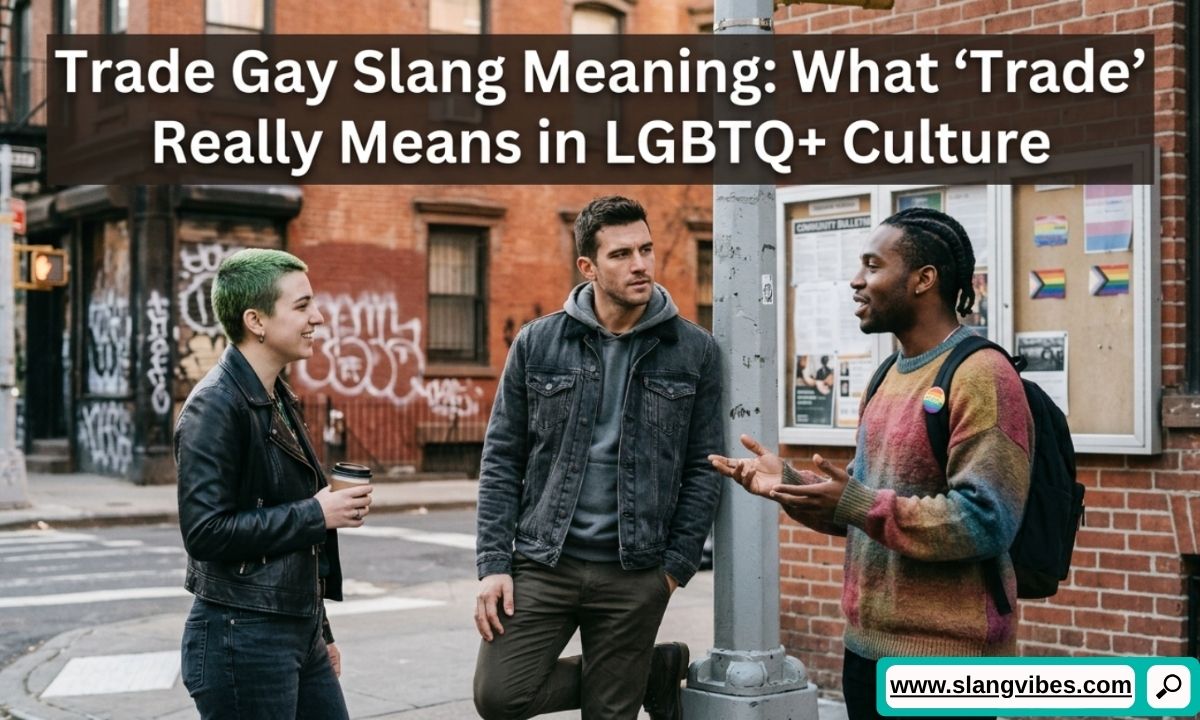
Quick Answer: In modern gay slang, “trade” describes a masculine, straight-passing, or straight-identifying man considered sexually attractive to gay and queer men. People use it as both a noun (“he’s trade”) and an adjective (“so trade”).
This is the short version people usually want. But the trade meaning gay slang carries isn’t quite this simple, because the word holds two layers stacked on top of each other.
Layer one is the modern, casual layer: a hot, masc guy who reads as straight, whether or not he is. This is the version you’ll hear in group chats, on TikTok, or in Drag Race recaps.
Layer two is older and heavier: a term rooted in real sex work, class dynamics, and closeted men navigating a world where being openly gay might get them arrested or worse. Most people using the word today have no idea layer two exists. This isn’t their fault. Slang naturally smooths words down over decades until only the surface meaning survives in everyday queer slang.
Understanding both layers matters if you want to use the term with real awareness, not simply repeat it because you heard it on TikTok.
Read Also: TTYL Mean in Text: What It Really Means on Social Media (2026)
The Real History Behind the Trade Gay Slang Meaning
This is the part most slang guides skip entirely, and it’s honestly the most interesting piece of the whole thing.
The word traces back to Polari, a coded slang used by gay men, sailors, circus performers, and theater workers in Britain, largely because homosexuality was illegal and people needed a way to talk without outing themselves in public. Within Polari, “trade” originally meant simply a casual sex partner, full stop, regardless of who the partner was or how they identified.
By the 1930s in London, the word had picked up a sharper edge. Wealthier gay Englishmen would partner with poorer, working-class men, often Cockney laborers, in arrangements blurring the line between romance and survival. The poorer man got money, gifts, or a meal. The wealthier man got a partner who plausibly denied being gay at all. One theory for the word itself is straightforward: these men often held actual “trade” jobs, plumbing, construction, dockwork, and used the blue-collar identity as cover.
There’s also a military thread running through this history. In Victorian and Edwardian England, certain regiments of guardsmen developed a reputation, fair or not, for taking on trade-style arrangements with wealthier men. It wasn’t official or spoken about openly, but it added another layer to how the word got used and who it got applied to.
Read Also: TMI Meaning in Text: How Gen Z Uses It on Social Media
From London to American Gay Culture
The term eventually crossed the Atlantic and took on new life in American gay culture, especially within Black gay and ballroom communities, where it described masculine men who either identified as straight or simply presented this way. This is also where the phrase started shifting away from strict sex work and toward something closer to a type or an aesthetic.
None of this history gets mentioned in most online slang dictionaries, but it explains why older gay men sometimes react differently to the word than someone who only knows it from a reality show. For them, “trade” isn’t simply a cute compliment. It’s tied to a specific era where survival, money, and desire were tangled together in a way most younger queer people never had to navigate firsthand.
Rough Trade vs. Trade: What’s the Difference
Once the trade gay slang meaning clicks, the natural next question is how “rough trade” fits into the picture. If you’ve seen it floating around and assumed it was simply a more intense version of the same word, you’re partly right, but there’s more nuance to it than this.
“Rough trade” refers specifically to trade with an added edge of danger, class, or physicality: think truck drivers, laborers, or military men with calloused hands and a rougher demeanor. Some men leaned into the stereotype deliberately, since it played into the appeal. The word “rough” pointed to two things at once: the working-class background of the men involved, and the genuine unpredictability of the encounters. Historically, some of these situations carried real risk, since a partner’s own discomfort with being seen as gay sometimes turned volatile.
Regular “trade” doesn’t carry the same weight of danger. It simply describes a masculine, straight-passing man someone finds attractive. Rough trade is a specific, historically loaded subset of the broader idea, not a casual synonym for it.
Read New Article: Slang for Awesome: 17 Popular Words to Say Something Is Amazing (2026)
| Term | Core Meaning | Modern Tone |
|---|---|---|
| Trade | Masculine, straight-passing man seen as attractive | Casual, often complimentary |
| Rough Trade | Working-class, hyper-masculine trade with an edge of risk | Historical, rarely used casually today |
| DL Trade | Straight-presenting man with secret sexual contact with men | Loaded, tied to secrecy |
How the Trade Gay Slang Meaning Changed on Drag Race and Social Media
RuPaul’s Drag Race is a big reason this word crossed over from ballroom and ordinary gay slang into the mainstream. Every so often, fans crown a queen “trade of the season,” meaning she’s considered the hottest, most desirable competitor of the run, based on either her out-of-drag look or her general appeal to fans.
This usage is a lot lighter than the term’s original meaning. On the show, “trade” mostly means sexy and masc-leaning, with none of the sex-work or class history attached. Some longtime members of the community aren’t thrilled about the shift, since, to them, the show smoothed over a heavier history to make the word bite-sized and TV-friendly.
Social media picked up the show’s lighter version and ran with it. On TikTok and X, you’ll see “trade” used as a quick compliment in comment sections, often paired with a fire emoji or a simple “omg he’s trade.” People rarely write it out in full explanation, since everyone using it assumes their audience already knows.
Read More Articles: STSU Meaning in Text: What It Really Means on Facebook, TikTok & Instagram (2026)
Group chat example:
Person A: “Bro I saw the new guy from the gym” Person B: “??” Person A: “he’s SO trade, I’m done”
Dating app bio example:
“Into trade, into gym rats, into guys who don’t take themselves too seriously.”
Drag Race recap comment:
“Not me calling it now, she’s trade of the season.”
Notice how none of these examples spell out what the word means. This is part of the culture around it: it’s shorthand, and explaining it kind of defeats the point.
When NOT to Use Trade (Context Matters More Than You’d Think)
, Knowing the trade gay slang meaning is one thing, Knowing when to use it is another. “Trade” isn’t a slur, but it’s also not a neutral, use-it-anywhere word.
Common Mistake: People outside queer spaces sometimes hear the word and start using it about random men they see in public, treating it like a harmless compliment. This is usually where it goes wrong. “Trade” was built inside gay and ballroom culture, shaped by a specific history of secrecy and survival. Using it casually about a stranger, especially for someone outside the community, risks coming across as borrowing language without understanding what it carries.
A few situations where it’s genuinely risky:
- Labeling someone as trade to their face, especially when they don’t identify with queer culture at all
- Using it in professional or formal writing, where it’ll simply confuse people anyway
- Applying it to someone who might read the term as reducing them to their looks rather than seeing them as a full person
- Using it outside LGBTQ+ spaces without context, since it risks landing as odd or even inappropriate
It’s also worth remembering “trade” is almost always a label put on someone by other people. It’s rarely a term someone chooses for themselves the way “gay” or “bisexual” might be. This one detail changes how carefully people should use it.
Formal writing is another easy line to draw. This word belongs in texts, comment sections, and casual conversation among friends. It doesn’t belong in a work email, a resume, or anything meant for a general audience. If you wouldn’t say it in front of a manager, this is usually a decent sign it stays in the group chat.
Read More Article: Ice Slang Meaning: What “Ice” Really Means in Text, Rap & Street Culture (2026)
Trade vs. Masc vs. DL: Similar Slang Compared
Part of what makes the trade gay slang meaning confusing is how often people mix it up with other gay slang terms sounding similar but meaning different things.
Trade vs. Masc: “Masc” simply describes someone’s presentation, how masculine they look or act. It says nothing about attraction or how others perceive their sexuality. “Trade” adds a layer on top of masc: it implies the person reads as straight, and the straight-passing quality is part of the appeal.
Now Trade vs. DL: “DL” (down low) describes a man who publicly presents as straight while privately having sex with men, usually keeping this part of his life hidden from friends, family, or a partner. Trade doesn’t require secrecy. A trade guy might be openly gay and simply have a masc, straight-coded look. DL is about concealment. Trade is about presentation and appeal.
DL Trade: This is where the two terms combine. It specifically describes a man who’s straight-presenting and secretive about his same-sex activity, making it a much more loaded term than “trade” on its own.
Getting these three straight, no pun intended, saves a lot of awkward mix-ups in queer slang conversations, especially since people use them interchangeably online even though they shouldn’t.
How to Respond When Someone Calls a Guy Trade

If you’re new to hearing the term, you don’t need to overthink your reaction. A simple “oh he’s cute” or a laugh usually works fine in casual conversation. Nobody expects a lecture on Polari history in a group chat.
Coworker text exchange:
Coworker: “The new hire is so trade, right?” You: “Lol I see it”
Sibling texting about a mutual friend:
Sibling: “Wait is Jake trade now? He got so buff” You: “Girl he’s always been trade”
Friend asking you to clarify:
Friend: “Wait what does trade even mean” You: “Simply hot and masc, like straight-passing hot”
If someone uses the word in a way feeling off, like labeling a stranger or using it dismissively, it’s fair to gently push back or steer the conversation elsewhere. You don’t need to make it a whole debate. A simple “this feels a little reductive” gets the point across without turning it into a fight.
Read New Article: TTYL Mean in Text: What It Really Means on Social Media (2026)
Frequently Asked Questions
It describes a masculine, straight-passing man considered attractive within gay and queer culture, used as a noun or an adjective.
No. Rough trade is a specific, historically rooted subset involving working-class, hyper-masculine men, often tied to real risk, while trade is the broader, more casual modern term.
Yes, to an extent. The show popularized “trade of the season” as a lighter compliment, stripping away most of the term’s original sex-work and class history.
It’s generally safer to avoid it unless closely connected to queer spaces. Using it casually outside this context risks coming across as borrowing terminology without understanding its background.
Trade is about presentation and appeal, masc, straight-passing, attractive, while DL is about secrecy, a man hiding his same-sex activity from his public life. The two sometimes overlap, though they aren’t interchangeable.
Conclusion
So next time someone drops “he’s trade” in a comment section or a group chat, you’ll know exactly what’s going on. The trade gay slang meaning isn’t simply a throwaway compliment. It’s a word with real history behind it, shaped by decades of coded language, class dynamics, and a community finding ways to talk safely long before being able to talk openly. Using it casually is fine in the right spaces. Using it thoughtfully, with some sense of where it came from, is even better.

Alex Carter is a language enthusiast and internet culture expert at SlangVibes. He explains the latest slang terms and text meanings in simple, clear English so everyone stays in the loop.