Last year, a coworker texted our group chat after our manager quit. She wrote two words: “good riddance.” I read it as cold, so I asked a friend why anyone would say something so harsh. My friend laughed and explained the tone. This small moment sent me searching for the good riddance meaning, and I’m glad it did. The phrase sounds blunt, but the feeling behind it is relief. People say it when something unpleasant finally leaves their life. This guide covers the definition, the history, real text examples, and the moments when you should keep it to yourself. You’ll also see how to reply when someone aims it at you.
Read Also: OF Page Meaning Explained: What It Really Means in 2026
Good Riddance Meaning in Plain English
Good riddance is an expression of relief. People say it when someone or something unpleasant leaves their life. It works as an exclamation, so you will often see it standing alone in a text or a caption. Think of it this way: the speaker is glad something is gone and doesn’t plan to miss it.
Dictionaries define it as a welcome relief or deliverance from something. The word riddance means the act of getting rid of an unwanted thing. Add “good” in front, and you get a cheer for the removal.
Here are three examples in a sentence:
- The old printer finally died. Good riddance.
- He quit the team after weeks of complaints. Good riddance.
- Winter is over, so good riddance to the ice.
The good riddance meaning stays the same whether the target is a person, a habit, or a broken appliance. The tone shifts with the target, though. Aimed at an object, it sounds playful. Aimed at a person, it sounds sharper and more personal. Most speakers choose it when they feel done with the topic and want everyone to know it.
Grammar stays simple. Writers add an exclamation point for energy or a period for a flat, cool delivery. Speakers also extend it with “to” and a target, as in “good riddance to bad habits.” You’ll see the longer version in the comparison section below.
Good Riddance Origin and Word History
The good riddance meaning took shape slowly over several hundred years. Start with the root word, rid. It shows up around the year 1200 and meant to clear a space or set something free. Etymology references link it to Old English or to a Scandinavian word, and they don’t settle which one.
By the 1530s, English speakers used riddance for a cleaning out or a removal. Around the 1590s, the word took on the sense of deliverance from something unwanted. This shift matters because it turned a chore word into an emotional one.
Next came the phrase itself. Etymonline dates good riddance to the 1650s. Shakespeare used gentle riddance in the 1590s, and Middleton wrote fair riddance in the 1610s. Some sources point to Troilus and Cressida, around 1606, as an early use of the exact words. Sources disagree here, so treat the first date as open.
Fun Fact: The longer form, good riddance to bad rubbish, grew out of an older wording, good riddance of bad rubbish. Speakers swapped one small word and kept the rest.
The takeaway is simple. The phrase is several hundred years old, and it started as a way to describe removing something unwanted. Today it describes the feeling afterward. This gives you a handy fact for the next time a friend asks where the phrase comes from.
Read More Articles: Stud Meaning in Slang: What It Really Means in 2026 (With Examples)
How People Use Good Riddance in Texts and Online
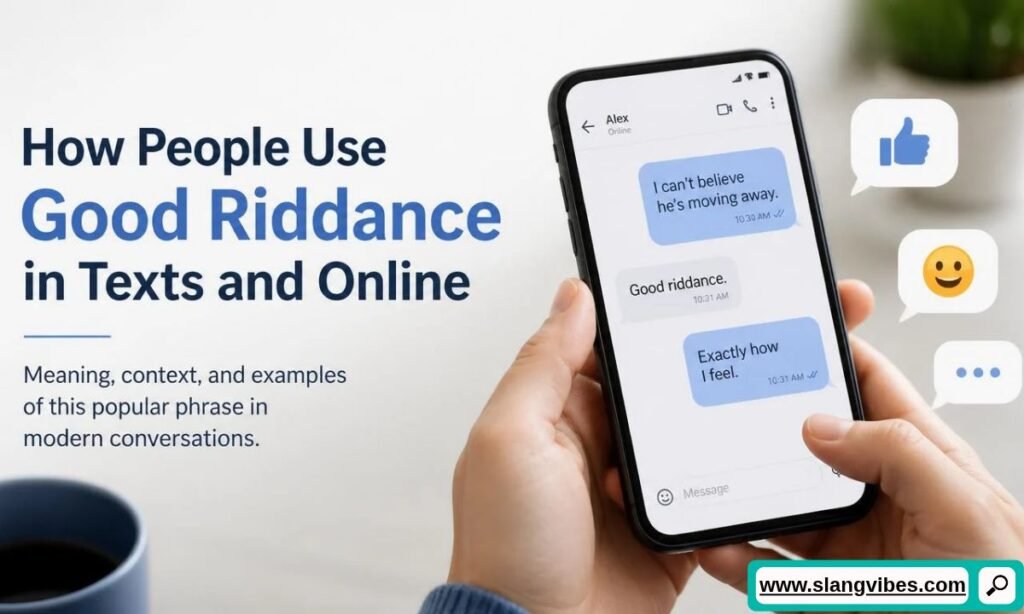
Good riddance shows up in group chats, comment sections, and captions. It is short, punchy, and easy to type. The good riddance meaning travels well across platforms, since relief needs no explanation. People choose it when a long story feels unnecessary.
Based on how the phrase is typically used online, younger users often type it in lowercase with an emoji. Older users tend to write it with a period or an exclamation point. Both styles deliver the same quick relief.
Here’s a breakup text between friends:
Jordan: I finally blocked him after months of mixed signals.
Sam: Good riddance. You deserve a calm weekend.
Jordan: Honestly, I feel lighter already.
Work chats sound lighter. Coworkers use the phrase when a stressful project ends.
Priya: The client contract is officially over.
Marcus: Good riddance to those midnight edits.
Priya: Pizza on Friday to celebrate?
Marcus: Yes, I’m in.
On social media, the phrase often sits in a caption beside a photo of a fresh start. A haircut, a new apartment, or a cleared desk all fit. It’s common to see TikTok comments run short and playful, while Instagram captions lean reflective. Text threads sit in the middle, honest but warm, and rarely harsh. Strangers in comment sections also drop it under news posts or celebrity exits. In those spaces the tone leans more toward sarcasm.
Good Riddance Meaning by Tone: Funny, Cold, or Relieved
Good riddance changes color with delivery. The same two words sound playful, icy, or tender, depending on punctuation and emoji. Sarcasm adds another layer, so read the whole message before you judge it.
Here is how three tones look in a text:
- Funny: “Our blender finally quit. Good riddance 😂”
- Cold: “He lied for months. Good riddance.”
- Relieved: “Last day at the old job. Good riddance 😌”
Funny works best on objects, habits, and shared annoyances. Imagine friends cheering as a noisy neighbor moves out. Nobody feels hurt, since the joke targets a nuisance.
Cold needs care. Picture someone ending a friendship after repeated betrayals. The period at the end signals a closed door. Without an emoji, the message sounds final. Many people notice this version lands hardest in a group chat, where everyone sees it.
Relieved is the softest tone. Think of someone leaving a draining job on a Friday afternoon. The feeling is closer to a deep breath than a slammed door.
Emoji do heavy lifting here. A laughing face softens the message. A shrug or a peace sign adds calm. A bare period adds bite. When in doubt, add a friendly emoji to keep the mood light.
Pop culture shows the gentle side too. The Green Day song “Good Riddance (Time of Your Life)” pairs the phrase with a wistful goodbye. The good riddance meaning does not demand anger.
POS Meaning in Text: What It Really Means on Snapchat, TikTok & More
Good Riddance vs. Similar Phrases
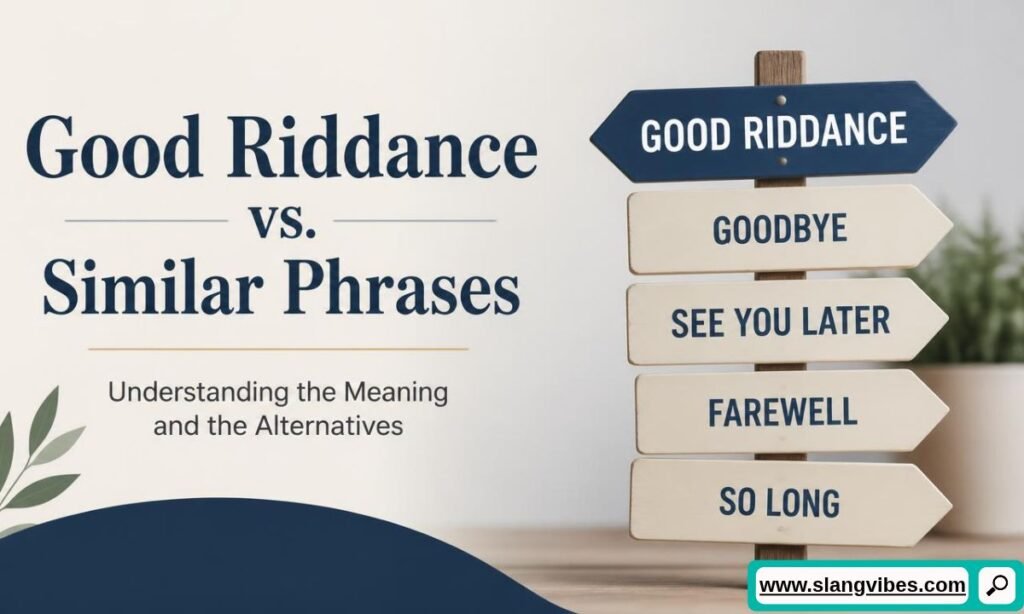
Good riddance has several cousins, and each one carries a different temperature. The table below helps you pick the right match.
| Phrase | Meaning | Tone/Vibe |
|---|---|---|
| Good riddance | Glad something unpleasant is gone | Relieved, sometimes sharp |
| Good riddance to bad rubbish | Same idea, aimed at something worthless | Dismissive, often playful |
| So long | A casual goodbye | Neutral and friendly |
| Glad to see the back of | Relief after someone leaves | Dry and common in UK English |
| Don’t let the door hit you | A pointed send-off | Harsh and sarcastic |
| Thank goodness it’s over | Relief after a hard stretch | Warm and mild |
Good riddance to bad rubbish is the extended form. It adds a verdict, because “rubbish” says the thing had no value. Speakers often aim it at objects, trends, or old habits, and the mood stays playful. Aimed at a person, it sounds harsh.
Looking for a good riddance synonym? Match the tone first. “So long” fits a neutral exit. “Glad to see the back of” works well in British English when you want dry humor. “Don’t let the door hit you” belongs to arguments, so skip it in friendly chats.
The good riddance meaning sits between a polite goodbye and an insult. This middle spot explains why the phrase feels so versatile. Pick the closest match for your audience, and your message lands the way you intend.
Read Also: FN Mean in Text: Popular Uses on Snapchat, TikTok & Instagram
When Not to Say Good Riddance
Good riddance feels great in private and risky in public. Some moments call for a quieter reply. Reading the room matters more than the words themselves every time.
The biggest rule involves death. Never use it about someone who has died, because grief makes the words land like a slap. Family and friends hear cruelty, even when the speaker feels relief about a painful history. Choose a neutral line like “I’m thinking of you” instead.
Work comes next. A manager leaving, a rival changing teams, or a layoff all tempt people to cheer. Saying the phrase in a shared channel still carries risk. Screenshots travel fast, and tone gets judged harshly.
Here’s an office moment gone wrong:
Dana: Heard Rob got transferred to Denver.
Chris: Good riddance. He never listened to anyone.
Dana: He’s on this thread, Chris.
Chris: Oh no. Deleting it now.
Formal writing is the last zone. Emails to clients, cover letters, and school essays need a polished tone. The good riddance meaning signals a strong feeling, and formal settings reward calm wording.
Mixed feelings deserve a pause too. If a friend leaves a relationship but still hurts, your cheer might feel dismissive. Let them lead, and match their tone before you celebrate.
When in doubt, ask one question: would I say this with the person standing beside me?
Common Mistakes With the Good Riddance Meaning
Slips with good riddance often start with the sound of the word. Riddance looks like a cousin of “ridden,” and the meaning is easy to blur. Five mistakes show up again and again:
- Misspelling it. Writers type “good ridden” or “good riddence.” The correct spelling is riddance, ending in a-n-c-e.
- Using it as a send-off blessing. Someone writes “Good riddance, have a safe trip” to a friend. Readers hear a jab, so “Safe travels” works better.
- Reading it as praise. Someone who says “good riddance” is happy about the departure, so the target never receives a compliment.
- Aiming the long form at someone you love. A joke like “good riddance to bad rubbish” stings when the target is a friend or family member.
- Overusing it. If every ending earns the phrase, the phrase loses its punch.
Placement matters too. Point the phrase at the problem, not the person, when you want to stay kind. “Good riddance to the stress” sounds light. “Good riddance to Alex” sounds personal. Both versions are grammatical. Only one keeps the peace in a group chat. Small shifts like this save a lot of awkward apologies later.
One quick check helps with the good riddance meaning: ask whether you’d say “I’m glad it’s gone” and mean it. If yes, the phrase fits. If not, pick a softer line.
Read New Articles: GTS Meaning in Text: What It Stands for in Online Chats
How to Respond When Someone Says Good Riddance
Good riddance invites a reply, and the right one depends on your role. You might be the supporter, the joker, or the target.
When a sibling or friend says it, match their energy. A warm reply keeps the mood bright.
Mia: Last day at the old apartment. Good riddance to the landlord.
Leo: Congrats, big sis. Dinner is on me.
Mia: You’re the best.
Humor works with close friends. Replies like “Peace has entered the chat” or “The trash took itself out” keep things light. Skip jokes when the person still sounds shaky.
Now the harder case: someone aims the phrase at you. Stay calm, since a heated answer feeds the drama.
Ava: I saw your story. You posted good riddance after we broke up.
Noah: I did, and I regret how it sounded. Want to talk?
Ava: Not today. I need space.
Noah: Fair. I’ll be here when you’re ready.
A calm reply, an honest apology, or a quiet exit all work better than a comeback. You owe nobody a debate, and silence is also an answer.
Whatever the situation, the good riddance meaning helps you read the emotion before you reply. Ask yourself whether the speaker sounds relieved, hurt, or joking. Then pick words to match. A short, honest line beats a clever one in text almost every time.
Good Riddance FAQs
What does good riddance mean?
The good riddance meaning is simple: relief when something unpleasant leaves. People say it about a person, a habit, or an object.
Is good riddance rude?
It sounds rude when aimed at a person, especially in public. Aimed at an object or a bad situation, it sounds playful.
Is it okay to say good riddance about someone who died?
No. Grief changes how words land, so choose a kinder line even when the relationship was painful.
What does good riddance to bad rubbish mean?
It’s the longer form, and it labels the lost thing as worthless. It often carries a joking tone.
Is good riddance formal or informal?
It’s informal. Save it for friends, private texts, and casual posts, and use calmer wording in formal writing.
Final Takeaways on Good Riddance
The good riddance meaning comes down to relief. Someone says the phrase when a person, a habit, or an object finally leaves and nobody plans to miss it. The tone ranges from playful to icy, so punctuation, emoji, and audience matter. The word riddance dates to the 1530s. The phrase has traveled from old books to modern group chats with its punch intact.
Keep three habits in mind. Aim the phrase at problems, not people. Skip it after a death and in formal writing. Match the tone of anyone who replies to you.
Good riddance works best when the feeling is honest and the audience is safe. Language keeps moving, but relief stays a common feeling. Next time a message ends with two blunt words, you will know what sits behind them. Before you send your own, picture everyone who might read it. Then decide if the moment calls for a cheer or a quiet nod.

Alex Carter is a language enthusiast and internet culture expert at SlangVibes. He explains the latest slang terms and text meanings in simple, clear English so everyone stays in the loop.