Last year, my friend sent me a message that said, “ISTG if you cancel on me one more time, I’m done.” I stared at my phone for a solid ten seconds. Was she joking? Was she actually done with our friendship? I had no clue about the ISTG meaning in text, and I was too embarrassed to ask. So I typed something vague back and hoped for the best.
If that feels familiar, you’re not alone. The ISTG meaning in text confuses a lot of people, especially when it shows up mid-conversation with zero context. This guide breaks down exactly what it means, where it came from, and how to use it or respond to it without looking lost.
What Does ISTG Mean in Text? The Simple Answer
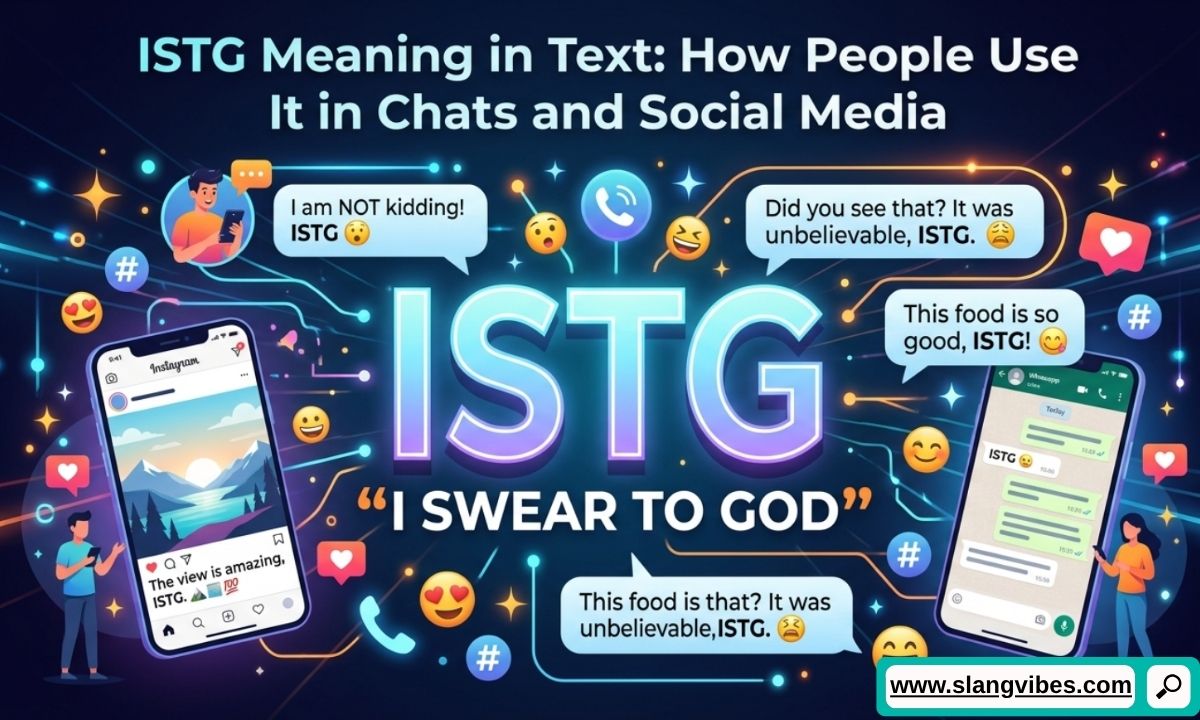
ISTG stands for “I Swear To God.” It’s one of those slang terms that sounds intense but gets used constantly in everyday digital conversations. People drop it to stress that they’re being serious, to vent frustration, or sometimes to hype something up dramatically.
Quick Answer: ISTG = I Swear To God. It signals strong emotion, whether that’s frustration, disbelief, or genuine emphasis.
The ISTG meaning in text doesn’t change much across platforms. What does change is the energy behind it. Here are a few quick examples to show the range:
| Example Text | What It Feels Like |
|---|---|
| “ISTG this pizza is life-changing.” | Playful, excited, exaggerated |
| “ISTG if he’s late again, I’m leaving.” | Genuine frustration, a real warning |
| “ISTG I can’t stop laughing at this.” | Enthusiastic, light, funny |
| “ISTG I told you this would happen.” | Mild “I told you so” energy |
You type four letters instead of fifteen, and everyone reading it immediately understands the emotional weight behind it. That’s the whole appeal of this kind of online slang in digital communication.
Read Also : NTY Meaning in Text (2026): What It Means and How to Use It ⭐
Where Did ISTG Come From? A Quick History of the Slang
ISTG didn’t appear out of nowhere. It grew out of the early internet era, back when people were typing on AIM, MSN Messenger, and early SMS with limited characters and even more limited patience.
The 2000s gave us a whole wave of abbreviated phrases. OMG, LOL, BRB, and SMH all became part of everyday casual communication around the same time. ISTG followed that same path. It took a phrase people already used in spoken conversation and compressed it into a fast, four-letter punch.
What pushed ISTG into wider use was social media. Tumblr carried it heavily in the early 2010s, where emotional expression was basically a sport. Twitter picked it up next. Then TikTok turned it into something you’d see in nearly every comment section.
One thing worth noting: swearing phrases used as emphasis have always existed in spoken language. “I swear to God” has been a verbal intensifier for generations. ISTG is just that same expression moving into texting and online conversations. The slang didn’t create a new behavior. It just gave it a faster form.
Gen Z adopted it with more frequency than Millennials did, treating it almost like a reflex reaction word. Millennials tend to use it more deliberately. Either way, ISTG meaning in text has stayed consistent across both groups.
The Two Completely Different Ways People Use ISTG in Texting
This is where most guides get it wrong. They treat ISTG like it has one mood. It doesn’t. ISTG operates in two emotionally opposite ways, and mixing them up leads to real misunderstandings in online conversations.
Mode 1: Serious and Frustrated
This is ISTG as a genuine warning or declaration. The person means what they’re saying. There’s no joke behind it. You’ll usually see it in all caps, sometimes followed by a period or no emoji at all.
“ISTG I’m about to lose my mind with this project.” “ISTG if they change the plan one more time, I’m out.”
The tone is flat and direct. It’s the texting equivalent of someone looking you dead in the eye.
Mode 2: Playful and Exaggerated
This is ISTG used for dramatic effect with zero actual frustration behind it. It’s hyperbole. People use it to hype something up, react to something wild, or just add flavor to a message. Emojis almost always show up here.
“ISTG this show is the best thing I’ve ever watched 😭😭” “ISTG my dog looked at me like I was the problem 💀”
The key difference comes down to punctuation, emojis, and context. A message that ends with crying-laughing emojis isn’t a threat. A message with no emojis and a period usually means the person’s genuinely fed up.
Here’s a quick comparison so you know which mode you’re reading:
| Signal | Serious ISTG | Playful ISTG |
|---|---|---|
| Emojis present | Rarely | Almost always |
| All caps | Common | Sometimes |
| Follows bad news | Yes | No |
| Tone of prior messages | Tense | Casual or excited |
ISTG Meaning in Text Across Snapchat, TikTok, Instagram, and Twitter/X
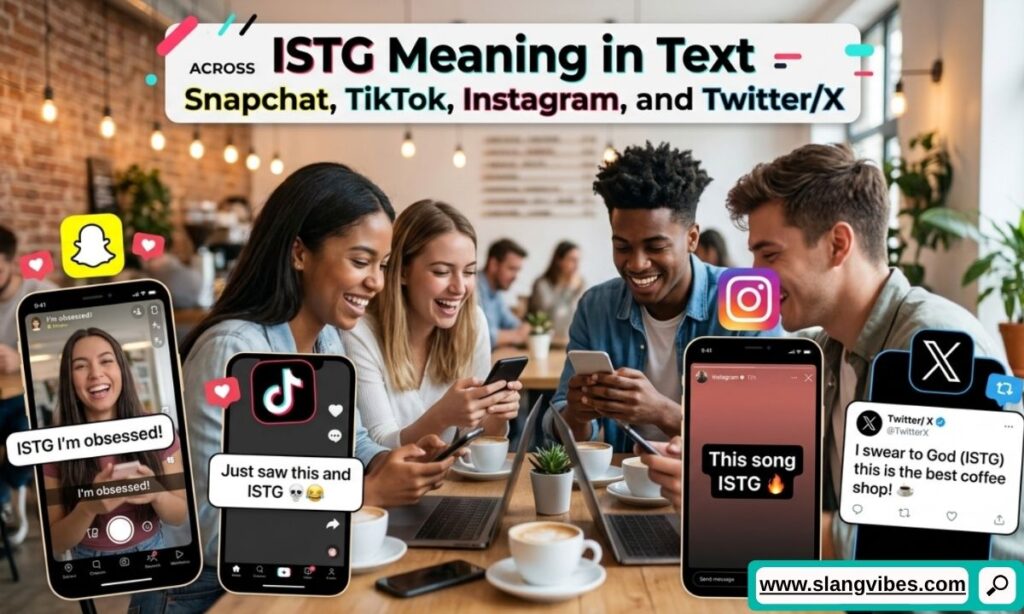
The ISTG meaning in text stays the same everywhere, but each platform gives it a slightly different personality.
On Snapchat, ISTG shows up in private conversations where people are more raw and unfiltered. It’s the platform where someone’s most likely to send “ISTG I can’t deal with school today” and actually mean it. The one-on-one format makes it feel more personal.
On TikTok, ISTG lives in the comments. Someone posts a video of their dog doing something ridiculous and the top comment is “ISTG animals are the only thing keeping me going 😭.” It’s reactive, emotional, and usually affectionate. TikTok captions also use it heavily for comedic timing.
On Instagram, you see ISTG split between DMs and public comments. In DMs, it’s used like Snapchat, more genuine and direct. In Instagram comments, it tends to lean more performative and funny, especially on meme pages or influencer posts.
On Twitter/X, ISTG lives in strong opinion territory. “ISTG the discourse on here gets worse every day” is a classic Twitter sentence. It’s used to emphasize takes, vent about news, or react to something absurd that just happened online.
What ties all these uses together is the same core ISTG meaning in text: the person is putting emphasis behind what they’re saying. The platform just shapes the flavor.
ISTG in Real Conversations: Text Examples You’ll Recognize
Reading isolated examples helps, but seeing ISTG inside a real conversation is what makes the slang click. Here are five text exchanges that show ISTG in actual use.
Read Also: PFP Meaning in Text: What It Means on Social Media
Example 1: Frustration with a friend
Alex: Hey are you still coming tonight? Jordan: ISTG if you cancel I’m never inviting you anywhere again Alex: I’m coming I’m coming, relax 😭
2: Reacting to wild news
Sam: Did you hear what happened at work today? Riley: No what?? Sam: They moved the whole meeting to 7am Riley: ISTG I would’ve quit on the spot
3: Hyping something up
Casey: Have you tried that new ramen place on Fifth? Morgan: YES ISTG it was the best thing I’ve eaten all year 😭 Casey: Okay now I need to go
4: The “I told you so” moment
Priya: He flaked again Dev: ISTG I told you this would happen Priya: I know I know ugh
Example 5: Comedic exhaustion
Taylor: How was your Monday? Jamie: ISTG I aged ten years today 💀 Taylor: Same honestly
Each one of these shows a different emotional register. That’s what makes ISTG so flexible in text messaging and online messaging across every platform.
How to Respond When Someone Texts You ISTG
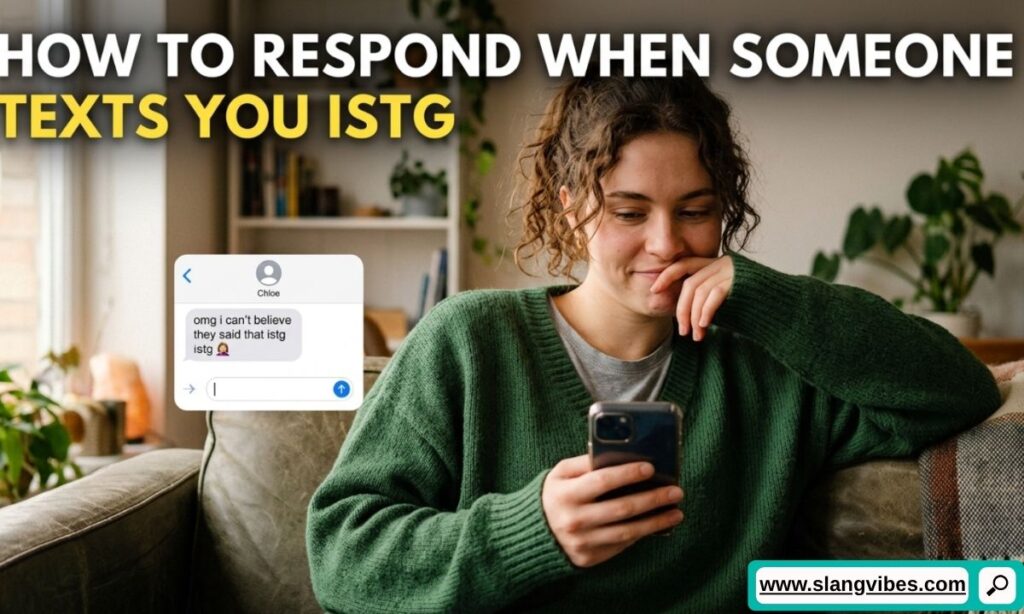
Knowing the ISTG meaning in text is one thing. Knowing how to respond is another. Getting the response wrong, especially when someone’s genuinely frustrated, has caused more than a few unnecessary arguments.
The first step is reading the energy. Go back to that two-mode framework. If the ISTG is serious, treat it seriously. If it’s playful, match the vibe.
When it’s genuine frustration:
Don’t dismiss it or joke your way past it. Acknowledge what they said first. “That sounds genuinely stressful, what happened?” lands much better than a laughing emoji when someone’s actually venting.
When it’s playful or hyperbolic:
Match the energy. Respond with enthusiasm, humor, or agreement. “ISTG same, I’ve been obsessed” or “okay now I HAVE to try it” keeps the conversation flowing naturally.
When you genuinely can’t tell:
Ask. It’s okay to say “wait are you actually annoyed or is this the funny kind?” People appreciate that you cared enough to check instead of guessing wrong.
Here’s what to avoid: responding with “lol” to someone who’s seriously frustrated, or over-explaining a joke when someone’s being funny. Both kill the conversation instantly.
Who Uses ISTG? Gen Z, Millennials, and the Generation Gap
ISTG meaning in text gets interpreted very differently depending on who’s reading it. And that gap matters more than people realize.
Gen Z uses ISTG almost automatically. It functions like punctuation at this point, something you drop into a message without much thought. For Gen Z, it’s not dramatic. It’s neutral emphasis with a bit of flair.
Millennials use it, but with slightly more intention. A Millennial texting “ISTG” is usually making a deliberate point. It carries a bit more weight in their vocabulary.
Then there’s everyone else. Gen X and Boomer parents who receive a message saying “ISTG I’m going to lose it” sometimes read it as genuinely alarming. The religious framing of swearing to God reads as serious to people who grew up before internet slang normalized it as a casual intensifier.
This gap creates real friction. A teenager texting their parent “ISTG this traffic is killing me” and getting a concerned phone call back is a completely predictable outcome.
In workplace settings, ISTG doesn’t belong. Even in casual Slack channels, it reads as unprofessional to anyone outside Gen Z’s frame of reference. Stick to actual words with coworkers unless you know them well enough to be sure they’ll get it.
Read Also: What Does GMT Mean in Text? Social Media and Chat Guide
ISTG vs. Other Slang: What Makes It Different from OMG, IKR, and SMH
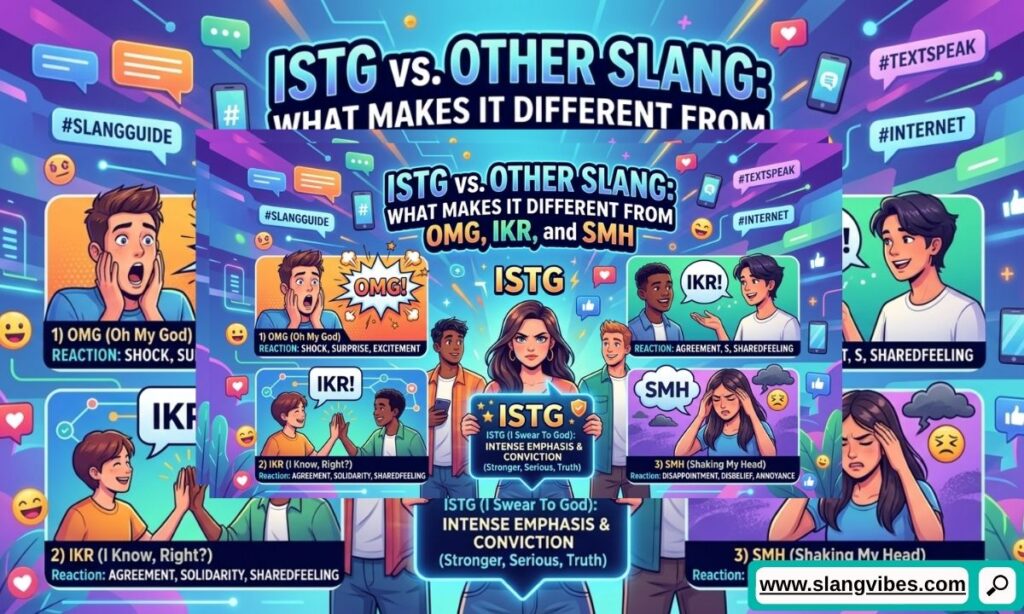
A lot of internet slang covers similar emotional ground, but each term does a slightly different job. Understanding those differences helps you pick the right one and read others more accurately.
Here’s how ISTG compares to the slang it gets grouped with most often:
| Slang | Full Form | Emotional Job |
|---|---|---|
| ISTG | I Swear To God | Emphasizes seriousness or strong feeling |
| OMG | Oh My God | Expresses surprise or shock |
| IKR | I Know, Right | Agrees with shared frustration or observation |
| SMH | Shaking My Head | Shows disappointment or disbelief |
| NGL | Not Gonna Lie | Signals honesty, often before an opinion |
| FR | For Real | Reinforces that something is true or serious |
The clearest difference between ISTG and FR is intensity. FR is low-key confirmation. ISTG carries more heat. “FR that was good” is a calm endorsement. “ISTG that was the best concert I’ve been to” puts genuine emotion behind it.
ISTG and OMG are often confused but operate differently. OMG is reactive, something that happens to you. ISTG is assertive, something you’re pushing forward with conviction.
A simple swap guide:
Use ISTG when you want to stress that you mean something seriously or feel something strongly., Use OMG when something surprises you, Use SMH when something disappoints you, Use FR when you’re just confirming something is real. Use IKR when someone else said the thing you were already thinking.
Frequently Asked Questions
ISTG stands for “I Swear To God.” People use it in text messaging to emphasize that they’re serious, frustrated, or genuinely excited about something.
It depends on the audience. Among friends and in casual online conversations, it’s completely normal. In formal settings or with people unfamiliar with internet slang, it reads as unprofessional or aggressive.
FR is a mild confirmation that something is true. ISTG carries stronger emotional weight and implies the person feels very strongly about what they’re saying.
No. ISTG belongs in casual digital communication with people you know well. It doesn’t fit in professional emails, formal group chats, or school communication with teachers or administrators.
Not at all. ISTG meaning in text covers a wide emotional range. It shows up in playful hype messages, funny reactions, and dramatic exaggerations just as often as it does in genuine frustration.

Alex Carter is a language enthusiast and internet culture expert at SlangVibes. He explains the latest slang terms and text meanings in simple, clear English so everyone stays in the loop.