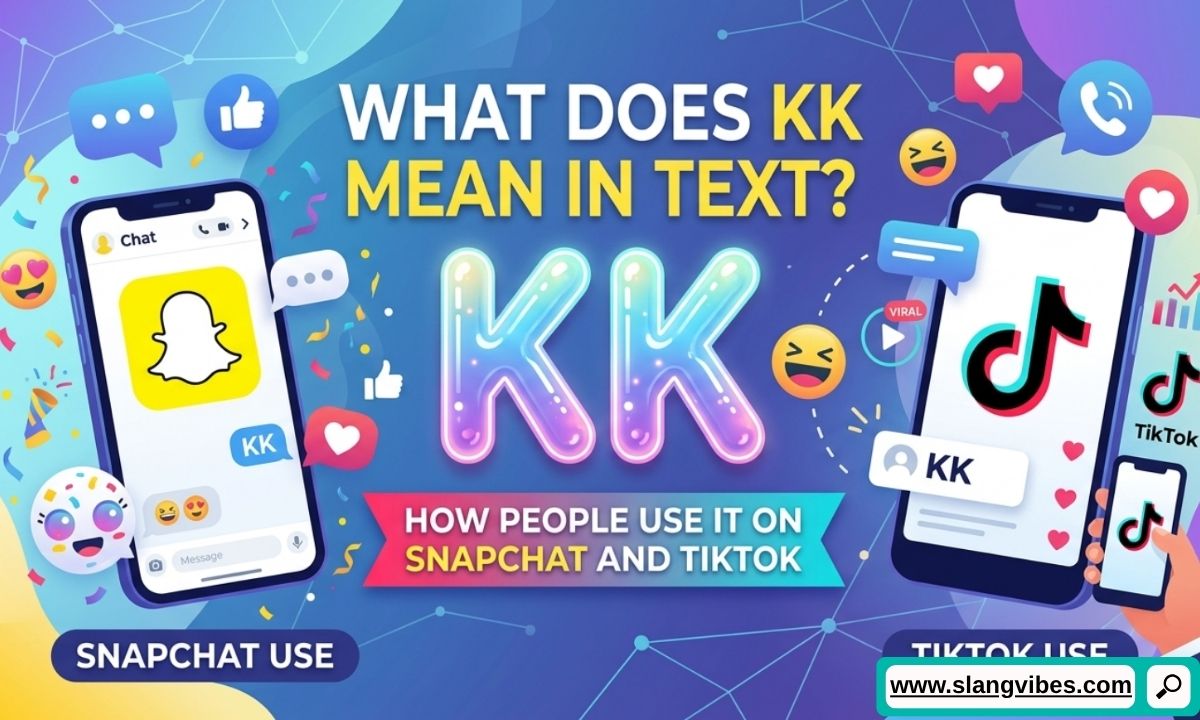
Last summer, my cousin sent me a three-paragraph message about a family drama situation. I poured my heart into that reply. Explained everything. Took my time. Her response? “kk.” Two letters. I genuinely thought she was mad at me for a full hour. Turns out she was driving and her passenger typed it for her. That moment is exactly why understanding what KK mean in text matters more than people think. It’s one of those texting abbreviations that looks simple on the surface, but carries real emotional weight depending on who sends it and when. So if you’ve ever stared at those two letters wondering what they really mean, keep reading.
What Does KK Mean in Text? The Simple Breakdown
When you get right down to it, KK mean in text is just a casual way of saying “okay” or “got it.” Think of it as a friendly digital nod. You’re not excited, You’re not upset, You’re simply confirming you received the message and everything is fine.
Quick Answer: KK = a relaxed, friendly way to say “okay” in online messaging. It’s warmer than a lone “K” and far more laid-back than typing out “Okay!”
Here’s the thing: the double K is what gives this chat slang its particular social feel. A single “K” can read as cold or even slightly hostile. “Okay,” on the other hand, can feel overly formal depending on the context. KK, however, hits a comfortable middle ground. It communicates: I heard you, we’re good, no need for a whole conversation about it.
Since this is such a quick reply, it works best in low-stakes exchanges. Here’s a basic example:
Alex: “Hey, running five minutes late.” Jordan: “KK no worries!”
No drama. No overthinking. Just smooth, easy digital communication. That’s precisely why this messaging shorthand has survived over two decades of constantly shifting internet culture and still shows up everywhere today.
Where Did KK Come From? The Origin of This KK Mean in Text Slang
KK didn’t appear out of nowhere. In fact, its roots trace all the way back to early internet chat culture, specifically AIM (AOL Instant Messenger) and MSN Messenger in the late 1990s and early 2000s. People were typing fast, screens were tiny, and nobody wanted to pause mid-conversation to type out “Okay” in full.
So “OK” became “K,” and “K” eventually became “KK.” The doubling happened organically. When you type at speed on a keyboard, your fingers sometimes hit a key twice by accident. Over time, though, that double-K stopped feeling like a typo. It became intentional, and with intention came its own distinct social tone.
Doubling letters was already a widespread habit in early internet slang. “Lol” stretched into “lolol.” “Haha” became “hahahaha.” As a result, the pattern made digital communication feel warmer and more expressive, closer to how people actually talk in real life. KK followed that same natural evolution.
By the time SMS texting went mainstream in the mid-2000s, KK was already deeply embedded in digital culture. It then moved from instant messaging to mobile texts, then to WhatsApp, and later to Snapchat, Instagram, and TikTok. Each platform carried it forward because the core need never changed. People always want a quick, low-effort acknowledgment that doesn’t come across as rude or dismissive.
Read Also : ISTG Meaning in Text: How People Use It in Chats and Social Media
How KK Mean in Text Works on Snapchat (Real Examples)
Snapchat is built entirely around speed. Messages disappear after viewing, streaks demand daily check-ins, and long paragraphs feel completely out of place on the platform. Because of this design, KK mean in text fits Snapchat’s energy like a glove.
When someone sends you a plan, a reminder, or even a random life update on Snapchat, “KK” is the go-to response that keeps the streak alive without weighing down the conversation. It signals: received, all good, no need to say more.
Here’s how it plays out in three realistic Snapchat exchanges:
Riley: “Come over after school, my mom made pasta” Sam: “KK omg yes”
Taylor: “Don’t forget we’re meeting at the mall at 3” Cam: “KK see u there”
Jordan: “Heads up I’m running 10 mins late” Alex: “KK no worries at all”
Notice how none of those feel rude or dismissive. The KK is warm, especially when paired with something after it. On Snapchat, the context surrounding KK matters a lot. For instance, sending just “KK” to a close friend feels entirely different from sending it cold to someone you barely know.
One thing regular Snapchat users pick up on quickly: lowercase “kk” reads even more casual and effortless than uppercase “KK.” It’s a small distinction, but in instant messaging culture, those tiny signals accumulate fast and shape how a conversation feels overall.
What KK Mean in Text Looks Like on TikTok (Comments and DMs)
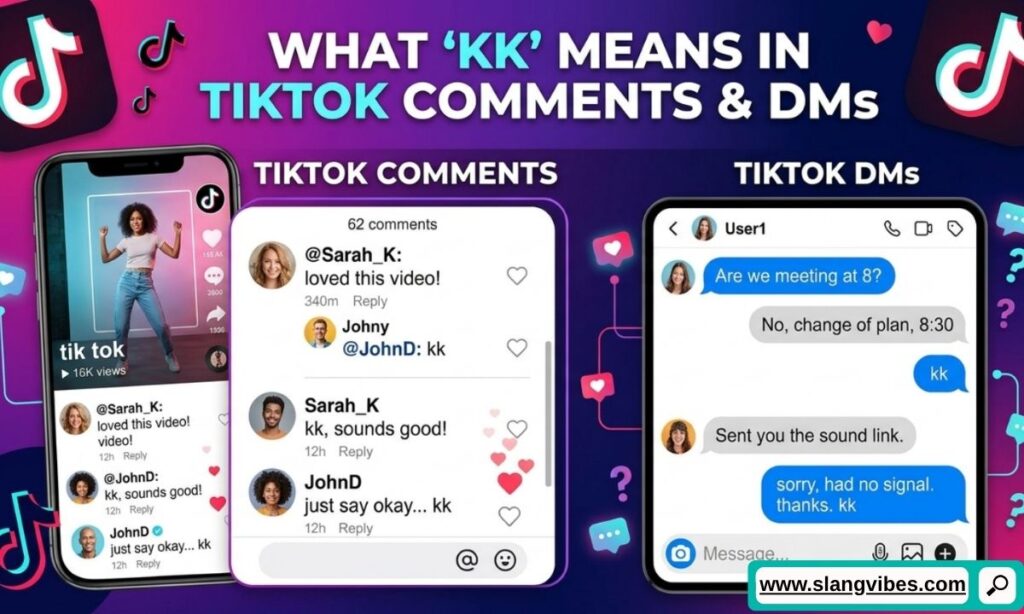
TikTok is where KK mean in text takes on a slightly different personality. The platform moves at an overwhelming pace and comment sections are loud and crowded, so short affirmations naturally dominate. Typing a full thoughtful sentence under a video feels like unnecessary effort when three billion other comments are flooding in simultaneously. “KK” handles acknowledgment in exactly two keystrokes.
In TikTok comment threads, “KK” generally means the commenter agrees with what was said, whether by the creator or by another commenter. It functions as a low-stakes confirmation signal in online conversations that are moving far too fast for full sentences.
Here’s how it looks in a real comment exchange:
Creator’s caption: “POV: you finally stop explaining yourself to people who won’t listen anyway” Top comment: “kk this one genuinely hit”
In TikTok DMs, the tone shifts noticeably. Because DMs are more private and personal, “KK” functions much more like standard texting: quick acknowledgment, no tension, let’s keep moving forward. It’s especially common among younger users who treat the DM inbox as an extension of their group text.
On top of that, TikTok introduced a new ironic dimension to this chat slang. Sometimes “kk” appears as a deadpan joke reply to something obviously absurd. Someone drops a wild take in the comments, and the most-liked response is simply “kk.” It’s the internet equivalent of a slow blink. As always with TikTok, context is absolutely everything.
Read Also: NTY Meaning in Text (2026): What It Means and How to Use It ⭐
Is KK Passive-Aggressive? How to Read the Tone Correctly
Here’s where things get genuinely interesting. Most people who search for KK mean in text aren’t confused about the dictionary definition. Instead, they’re quietly panicking, trying to figure out whether the person who sent it is actually mad at them.
The short answer: KK is not automatically passive-aggressive. However, it can absolutely feel that way in the right circumstances, and understanding why is the key to reading it correctly.
Common Mistake: Assuming “KK” always means the person is completely unbothered. Sometimes it signals mild frustration, particularly when it follows a long emotional message and arrives with nothing else attached.
Here’s a side-by-side tone comparison that puts it all in perspective:
| Response | What It Feels Like |
|---|---|
| “KK!” | Friendly, warm, clearly no issue |
| “KK” | Neutral, quick, fine either way |
| “kk” | Casual, chill, maybe slightly distracted |
| “K” | Cold, possibly annoyed |
| “Okay.” | Formal or subtly irritated |
| “Okay!” | Genuinely cheerful and enthusiastic |
So “KK” sits comfortably in the friendlier half of that scale. The tension only arrives when someone sends “KK” after a long emotional message or a vulnerable question. The mismatch between the effort you put in and the two-letter response you received is where the passive-aggressive feeling comes from. It’s not the word itself causing the discomfort. It’s the energy gap between what was sent and what came back.
What Does KK Mean from a Girl or a Guy You’re Texting?
People search this particular angle more than you’d expect, and honestly it makes complete sense. When you’re texting someone you like or someone you’ve only recently started talking to, every single word carries extra weight. Receiving “KK” from a crush lands completely differently than receiving it from your roommate.
The truthful answer is that KK mean in text is technically the same regardless of who sends it. However, the emotional reading of it shifts entirely based on the relationship and the surrounding conversation.
Here’s how it breaks down across different texting and social contexts:
| Situation | What KK Likely Means |
|---|---|
| Close friend sends “KK” | We’re good, zero reason to stress |
| New friend sends “KK” | Acknowledged, keeping it easygoing |
| Crush sends “KK” to your plans | They’re in, just responding low-key |
| Crush sends “KK” to something personal | Worth paying more attention to the full vibe |
| Dating app match sends “KK” | Could be relaxed or slowly disengaging |
On dating apps specifically, “KK” from someone you’ve just matched with is where overthinking kicks into overdrive. One “KK” in isolation doesn’t reveal much at all. A consistent pattern of one-word replies across the whole conversation, though, tells you considerably more. Look at the full thread rather than fixating on a single two-letter message before drawing any conclusions about this messaging shorthand.
The bottom line: KK from anyone is generally fine. It only becomes a meaningful signal when it shows up repeatedly where actual engagement would normally be expected.
KK Mean in Text vs. K vs. OK vs. Okay: What’s the Real Difference?
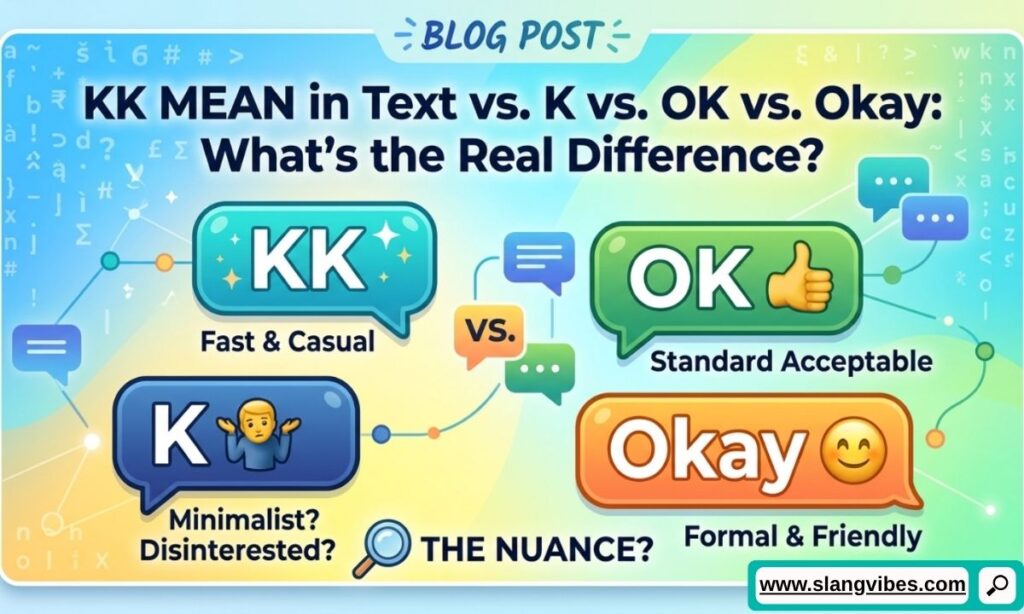
This comparison trips people up more than almost any other online messaging slang question. All four responses technically mean “yes” or “understood,” but they land in very different emotional places once they hit someone’s screen.
Here’s a clear side-by-side breakdown to help you choose correctly:
| Term | Tone | Best Used When |
|---|---|---|
| KK | Friendly, warm, casual | Texting friends, Snapchat, social DMs |
| K | Brief, can feel cold or annoyed | Risky; save it for very close friends only |
| OK | Neutral, slightly formal | Works across most everyday situations |
| Okay | Formal or mildly expressive | More thoughtful or weighted contexts |
| Okay! | Enthusiastic, upbeat | When you’re genuinely excited |
“K” is the one to avoid unless you know the person extremely well. It reads as sharp and dismissive in most digital communication contexts. KK, by comparison, is what “K” aspires to sound like. Same brevity, but without the cold, clipped edge that makes people anxious.
When you’re genuinely unsure which version to send, go with KK or “Sounds good.” Both are safe and friendly, and both work comfortably across almost any casual online conversation without creating unnecessary friction.
Read Also : What Does GMT Mean in Text? Social Media and Chat Guide
How KK Mean in Text Shows Up in Gaming, Group Chats, and Memes
Most articles about KK mean in text stop at Snapchat and TikTok. What they consistently miss, however, is that gaming culture has been using this term just as long, possibly even longer, and for entirely practical reasons.
In online multiplayer games, players drop “KK” in team chat to confirm a strategy, agree to a plan, or acknowledge a teammate’s instructions. Voice chat gets chaotic fast during live gameplay. As a result, typing “KK” in the text channel is far more efficient than trying to shout “understood” between rounds.
Here are two quick gaming examples:
Teammate: “Push left flank, I’ll cover right” You: “KK”
Squad leader: “Fall back and regroup at the north marker” You: “KK rotating now”
It’s clean, fast, and efficient. That’s also precisely why “KK” thrives in Discord servers and large group chats. When a dozen people are all talking at once, “KK” confirms you’ve read a message without drowning the thread in unnecessary text.
Meme culture, meanwhile, added yet another dimension to this slang. “kk” (always lowercase in meme contexts) gets deployed as a dry, ironic response to something obviously absurd or ridiculously overstated. Someone posts an extreme take, and the top comment is simply “kk.” It’s the internet’s version of a slow, unimpressed nod.
The lowercase versus uppercase distinction is genuinely worth paying attention to here. Uppercase “KK” feels deliberate and conscious. Lowercase “kk,” on the other hand, reads as effortless and almost indifferent, which is exactly why meme culture adopted it so naturally and quickly.
When NOT to Use KK and What to Say Instead
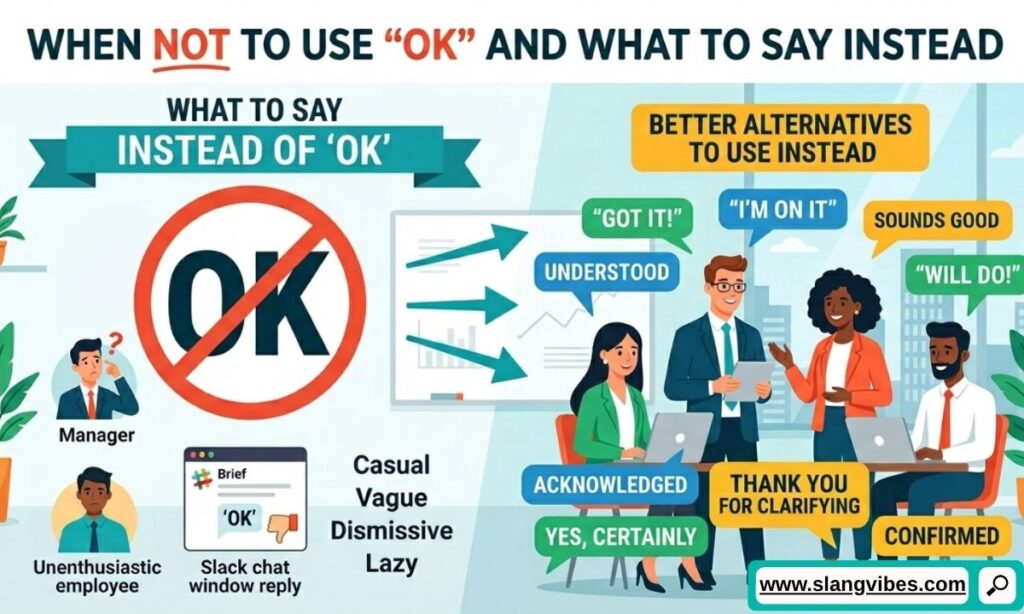
KK mean in text works brilliantly across casual digital communication, but there are specific situations where it genuinely doesn’t belong, and sending it in those moments creates problems.
Sending “KK” to a professor, a manager, or a client creates an instant credibility issue. Even when your intentions are friendly, the informal shorthand signals a lack of professionalism in formal messaging contexts. A simple “Got it” or “Sounds good” accomplishes exactly the same acknowledgment without any of the risk.
Here’s a practical swap guide for those situations:
| Situation | Don’t Send | Send Instead |
|---|---|---|
| Replying to your boss | KK | “Got it, thanks” |
| Responding to a client | KK | “Understood, I’ll handle it” |
| Texting a professor | KK | “Thank you, I’ll check it out” |
| Responding to a parent’s concern | KK | “I hear you, we can talk about it” |
The other situation where KK falls completely flat is when someone shares something emotionally heavy or vulnerable with you. Replying “KK” to “I’ve been really struggling lately” is the kind of response that damages trust almost immediately. In those moments, match the emotional energy of the message rather than just the speed of your reply.
For everything else, between close friends, in group chats, on Snapchat streaks, and in TikTok DMs, KK is perfectly appropriate. Use it freely where it fits naturally, and skip it cleanly where it doesn’t.
Frequently Asked Questions
KK mean in text is a casual, fast way of saying “okay” or “got it.” It’s a friendly confirmation that tells the other person you’ve read and understood their message without making a big deal out of it.
KK isn’t rude by default. However, it can feel dismissive when it follows something emotional or serious. In most casual online conversations, though, it reads as warm and completely unbothered.
It means she acknowledged your message. One “KK” on its own doesn’t reveal much. Look at the overall tone of the entire conversation rather than reading too deeply into a single two-letter reply.
“K” often reads as cold or mildly annoyed, while “KK” feels friendly and relaxed. They’re technically rooted in the same word, but their social meaning in instant messaging is noticeably different from each other.
In formal professional communication, it’s better to skip it entirely. Stick with “Got it,” “Understood,” or “Sounds good” in any workplace chat where first impressions and professionalism matter.
The Takeaway
KK mean in text is one of those pieces of digital slang that seems almost too simple to think about. But beneath those two letters sits a surprisingly rich layer of social meaning. It’s been part of online messaging since the early internet era, and it’s still going strong across every platform from Snapchat streaks to TikTok comment threads to Discord gaming servers. The word itself is neutral and friendly by nature. What shifts the meaning entirely, though, is who sends it, what was said right before it, and whether the energy of the reply actually matches the moment.
Next time you see KK in a text, you’ll know exactly what to say back.

Alex Carter is a language enthusiast and internet culture expert at SlangVibes. He explains the latest slang terms and text meanings in simple, clear English so everyone stays in the loop.