Ever gotten a text from your best friend saying only, “good morning, pookie”? No warning. No context. Only pookie. Perhaps it showed up in a TikTok comment section. Or your partner started using it out of nowhere. Now you’re sitting there wondering what’s going on. You’re not alone. Thousands of people search for the pookie meaning every single week, from teenagers to confused parents scrolling their kid’s phone. The confusion makes sense. This tiny word carries a lot of weight. It changes shape depending on who says it and where. Here’s the full breakdown, with no fluff and no guessing.
Pookie Meaning: The Simple Definition
Quick Answer: Pookie is an affectionate nickname people use for someone they love or find adorable. It works as a term of endearment for a partner, a close friend, or even a pet. The tone shifts based on who’s saying it.
At its core, the pookie slang meaning is warm and playful. People reach for it the same way they’d reach for honey, babe, or sweetheart. It only sounds softer, and a little more childlike.
So what is pookie, exactly? It’s a loving nickname. It isn’t a formal word with one fixed rule. Someone might call their boyfriend or girlfriend pookie in a good morning text. A friend group might use it as an inside joke. A pet owner might whisper it to a sleepy cat.
Picture this exchange between two roommates:
Priya: pookie left dishes in the sink again Priya: i love her but come on Dana: lol classic pookie behavior
Notice the nickname doesn’t even need romance attached. It’s simply a cute way to address someone you’re fond of, roommate chaos included. This flexibility is exactly why the pookie definition keeps growing instead of settling into one narrow meaning.
Age plays a part too. Gen Z tends to use pookie loosely, tossing it at friends, crushes, and pets with equal ease. Millennials often learned the word later, through TikTok or through a partner. So they sometimes use it more carefully, saving it for people they’re genuinely close to. Neither approach is wrong. Two generations are simply arriving at the same word from different directions.
Read Also: NF Meaning in Text: What It Really Means in Chats, TikTok, Snapchat & Instagram (2K26 Guide)
Where Did the Word Pookie Come From?
Slang origins rarely have one clean starting point, and pookie is no different. The word has roots as a name and nickname going back close to a century. This is long before social media gave it a second life.
A few moments in its path stand out. A mid-century children’s book featured a winged rabbit named Pookie. This gave the word an innocent, storybook feel. Around the same decades, a puppet character on American television carried the name too. This helped it stick in casual speech.
By the 1960s, print records show pookie being used as a general term of endearment. It wasn’t only a specific person’s nickname anymore. Garfield’s teddy bear added another layer of nostalgia a bit later. It made the word feel cozy to an entire generation of comic readers.
The internet did what it always does. Once pookie landed on Urban Dictionary in the mid-2000s, it moved from family slang into wider pop culture. TikTok picked it up hard in the 2020s. Creators and commenters used it toward anyone they admired, genuinely or as a joke.
Slang trackers and meme archives document this TikTok wave in detail. They point to specific viral clips and comment threads where the word spread fast among younger users. A single popular video is often enough to push a nickname like this into daily rotation. This reach often hits millions of people within days.
This long stretch, from a storybook rabbit to a TikTok comment section, explains something important. It’s part of why the pookie meaning feels both old-fashioned and current at once. Few slang words carry this kind of range. Even fewer manage to stay sweet the entire way through.
Pookie Meaning on TikTok, Instagram, and in Texts
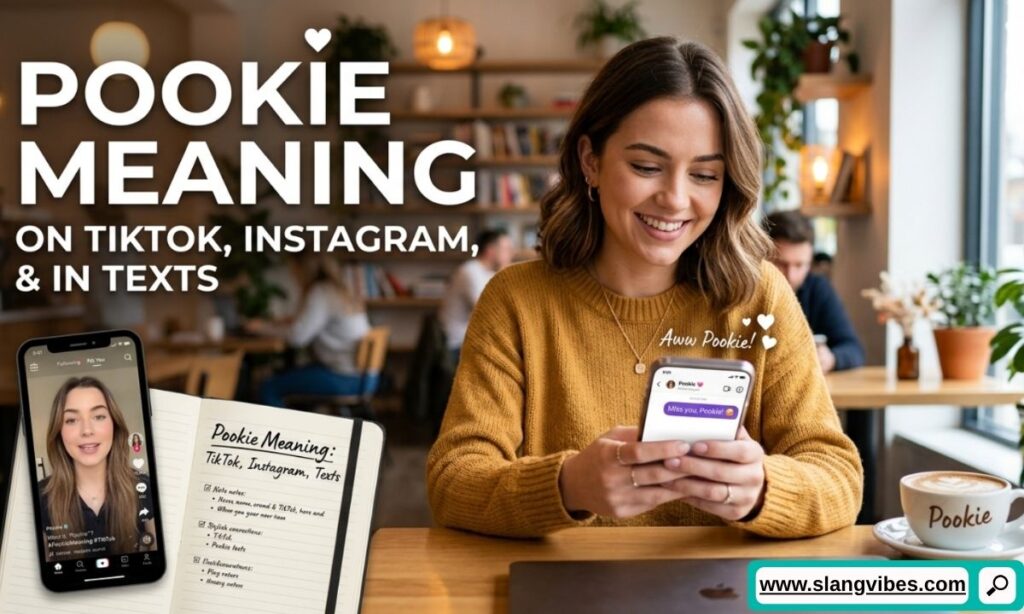
Where the word shows up changes how it lands. A caption is public. A DM is private. Reading the room means reading the platform too.
On TikTok and Instagram
On TikTok, pookie often shows up in comment sections. People use it to show love for a creator, sincerely or with a wink of irony. It’s common under duo videos, couple content, or clips of someone being ridiculously charming. A comment section full of “pookie” replies usually means one thing. The creator did something the audience found endearing.
On Instagram, pookie meaning on social media leans toward captions and comments on cute or funny posts. A caption like “my pookie” under a couple’s photo signals affection without needing extra words. This is internet slang doing its job. It compresses a feeling into one syllable pair. Story replies work the same way. A quick “pookie 🥹” under a friend’s post says more than a full sentence would.
In Texts and Group Chats
Pookie meaning in text tends to feel more personal than public posts. Texting is a one-on-one space, after all. Here’s how it might play out between a couple:
Marcus: made it home safe, pookie Ana: good!! text me when you’re settled Marcus: already on the couch, pookie is tired Ana: same energy honestly
In this exchange, pookie meaning in chat works as a soft, low-effort way to close out a conversation with warmth. No big declaration needed. It’s casual conversation doing quiet emotional work.
Group chats bend the word further. Someone might open a message with “ok pookies” to address the whole group at once. The nickname turns into a plural instead of a name for one person. This small shift shows how far the word has stretched beyond its original one-on-one use.
Read More: PMO Meaning in Text: What It Really Means in Chat, TikTok & Snapchat (2K26 Guide)
What Pookie Means Beyond the Cute Nickname
The Sweet Side, Confirmed
Most of the time, pookie nickname meaning stays firmly in affectionate territory. It works for a romantic partner, a close friend, a sibling, or a pet. The emotional core stays the same: closeness, warmth, and a little playfulness.
The word isn’t as common as babe or baby, so some people choose it on purpose. Using pookie as a nickname tends to feel more personal. It hasn’t been worn down by overuse the way some older pet names have.
It also works well for objects people are attached to. A favorite hoodie, a childhood blanket, or a stubborn houseplant might all end up named pookie. The word stretches to cover love for a person and love for a thing. Neither use sounds strange next to the other.
The Meaning Most People Skip
Here’s the part worth knowing. In some older and regional slang, pookie has been used as a term for a glass pipe tied to drug use. In certain communities, it has carried other unrelated meanings entirely. This use is far less common in everyday conversation. Most people online mean the affectionate version.
Context still matters here. A stranger might not read it the same way a TikTok-savvy friend would. Neither might an older relative unfamiliar with the trend. When in doubt, a quick “it’s a term of endearment” clears things up fast.
A good rule of thumb: tone gives it away. A message full of hearts, soft emojis, or gentle teasing points to the affectionate meaning almost every time. The rarer, unrelated meaning tends to show up in older regional speech, not in a casual text from a friend.
Read More: Whipped in Slang: The Real Meaning Behind the Viral Term
Does Pookie Mean the Same Thing in the US and the UK?
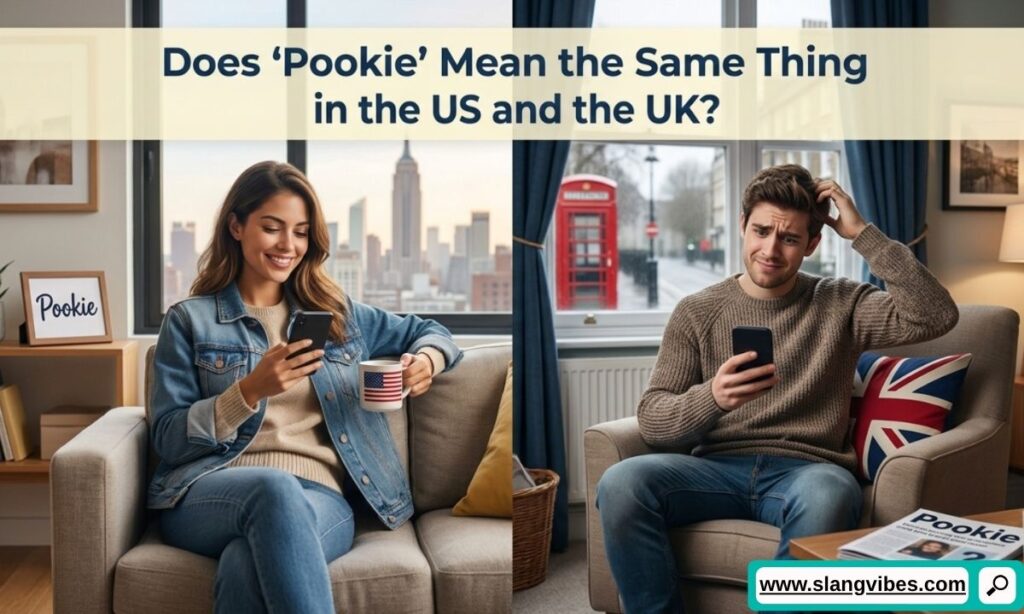
Short answer: mostly, but not perfectly.
In the US, pookie meaning on TikTok and in daily texting feels fully mainstream. It crosses age groups. It shows up in Gen Z slang and millennial slang alike, and rarely raises an eyebrow. American internet culture pushed the word hard through memes, comment sections, and viral audio clips. Most US readers already have context loaded in before they even look up the definition.
In the UK, the word travels a familiar path. It spreads through TikTok and Instagram first, everyday speech second. British users tend to recognize pookie from online content before hearing it face-to-face. It tends to read as slightly more “internet,” a bit less woven into offline conversation, at least for now.
Here’s a text exchange between a US-based worker and their UK colleague, off the clock:
Jordan (US): happy friday pookie, enjoy your weekend Freya (UK): lol wait did you call me pookie Jordan (US): it’s affectionate i promise, it’s a TikTok thing Freya (UK): omg okay, makes sense, love it for us
Freya’s reaction is a fairly typical UK response. She’s amused, a little surprised, and quick to catch on. Give it time, and regional gaps like this tend to close fast online.
Older British slang already had its own soft nicknames. Think “love,” “pet,” or “duck,” depending on the region. Pookie is landing in a country with no shortage of cute words already. It isn’t replacing those. It’s simply adding one more option, mostly among younger, terminally-online speakers.
Read Also: BBL Slang Meaning (2K26 Guide): What BBL Really Means in Text, TikTok & Social Media
Pookie vs Babe, Bae, and Boo: What’s the Difference?
Pookie belongs to a whole family of cute nicknames. Each one carries a slightly different vibe. Picking the right one changes how a message feels.
| Word | Vibe | Best Fit |
|---|---|---|
| Pookie | Soft, playful, a little silly | Partners, close friends, pets |
| Babe | Classic, romantic, direct | Romantic partners mostly |
| Bae | Casual, trendy, shorthand | Romantic partners, close friends |
| Boo | Warm, flirty, low-key | Romantic partners, flirty friendships |
Babe leans more formal and exclusively romantic. Bae reads as a shortcut version of “before anyone else,” so it carries priority energy. Boo sits somewhere between friendly and flirty, depending on tone.
Pookie stands apart because it stretches furthest. It works for a partner, a best friend, a sibling, or a pet. None of those settings feel out of place for it. Among affectionate nicknames, this range is rare. It’s a major reason the word keeps trending.
Want a word which always reads as romantic? Babe or boo does the job more reliably. Want a playful nickname with room to grow into different relationships? Pookie is the more flexible pick. Bae sits in the middle, casual but still leaning romantic more often than not.
Switching between these words sends its own small signal. Someone who usually says babe and suddenly switches to pookie might be softening the tone on purpose. Perhaps they’re easing into a joke, an apology, or a moment of extra affection. Small word swaps like this carry more meaning than people often realize in day-to-day texting.
What It Means When a Guy or a Girl Calls You Pookie
Pookie meaning from a guy usually points toward comfort and closeness. Guys tend to use it once a relationship or friendship already feels secure. It’s a nickname signaling ease rather than formality. From a boyfriend, it often shows up in low-stakes moments. Think a goodnight text, a reaction to something funny, a way of checking in without sounding heavy. Some guys use it as their default nickname for anyone close to them, romantic or not. This is worth keeping in mind before reading too much into a single message.
Pookie meaning for a girl, and the same nickname from a girl toward someone else, tends to work the same way. It often shows up earlier in a friendship, though. Many women use pookie freely with close friends, long before any romantic context enters the picture. Among girl friend groups specifically, it often functions less like a romantic hint. It works more like a group password, a word saying “you’re one of us.”
In romantic relationships specifically, this nickname often signals a stage where the connection feels settled. It’s not usually a word people use on a first date. It shows up once nicknames in general start feeling natural. This is somewhere after the early, careful-with-your-words phase of a new relationship ends.
One useful way to read it: pay attention to tone and setting rather than assuming intent. This matters most if someone new to your life calls you pookie fast. Between couples, the nickname usually builds gradually, the same way any nickname does. If it feels sudden, it’s fine to simply notice it. See how the relationship develops from there, without reading too much into one word.
How to Respond When Someone Calls You Pookie
There’s no wrong way to respond to pookie. A few options tend to land better than others, though, depending on the relationship.
Mirroring the energy is the easiest move. If a friend calls you pookie, calling them pookie back keeps the tone light. It shows you’re on the same page. If a partner starts using it, a simple “hi pookie” back signals you like it.
Here’s how this might play out between siblings:
Theo: pookie left the group chat again 💀 Lena: I’m right here Theo Theo: exactly, pookie Lena: fine. hi pookie.
If the nickname feels unfamiliar or a little too soon, it’s fine to respond warmly without adopting the word yourself. Something like “aww, I love this” keeps things friendly. It also gives you room to decide if it fits.
Silence isn’t a great option if the message clearly wants a reply. Staying quiet often reads as awkward rather than neutral. A short, warm response, matched or not, keeps the exchange feeling natural instead of stiff.
Timing matters too. A pookie sent first thing in the morning usually wants a quick, easy reply, not a long one. Save a bigger response for later in the day. This tends to fit the low-effort, low-pressure spirit the nickname carries in the first place.
In more formal settings, like a work chat outside close colleagues, skip mirroring the word entirely. A friendly “haha love it” or a simple thumbs-up keeps things warm. It won’t pull a casual nickname into a professional space where it might not fit.
Frequently Asked Questions
What does pookie mean in slang?
Pookie is an affectionate nickname for someone you care about, similar to babe or sweetheart, though softer and more playful in tone. It works across relationships, from romantic partners to close friends.
What does it mean when a guy calls you pookie?
It usually signals comfort and closeness. It’s common once a friendship or relationship already feels secure rather than brand new. Some guys use it broadly for anyone in their close circle, so tone and history with this person matter more than the word alone.
Is it okay to call a friend pookie?
Yes. Pookie works well between close friends, not only romantic partners. It’s a common way to show playful affection in a friend group. It rarely reads as romantic unless the surrounding context suggests otherwise.
Is pookie a romantic word?
Sometimes, but not always. It works for romantic partners, friends, family members, and pets. Romance is one option among several rather than the default setting.
Why is pookie popular on TikTok?
It’s short, warm, and flexible enough to sound sincere or funny depending on the caption. This makes it easy for creators and commenters to reuse constantly, across comment sections, captions, and duo videos.
Conclusion
Pookie is one small word carrying a lot of range. Most of the time, it’s simple: an affectionate, playful nickname for a partner, a friend, or a pet. The tone shifts with the relationship, the platform, and the moment. Reading those signals is the real skill here, more than memorizing one fixed definition.
From its storybook and TV origins to its current life in TikTok comments and late-night texts, the word has stayed remarkably soft through decades of change. This is rare for internet slang. Most slang fades within a season instead of building a decades-long history.
Whether it shows up from a guy, a girl, a best friend, or a sibling roasting you in a group chat, the pookie meaning rarely strays far from warmth. Next time it shows up in your messages, there’s no need to overanalyze it. Look at who sent it. Notice how they usually talk to you, and whether the moment feels warm. This is all the decoding it needs.

Alex Carter is a language enthusiast and internet culture expert at SlangVibes. He explains the latest slang terms and text meanings in simple, clear English so everyone stays in the loop.