You’ve seen “WFH” pop up in a text, a Slack channel, or a caption under someone’s home office setup. Most people scroll right past it without a second thought. But do you know exactly what it signals, or when it’s appropriate to use yourself? WFH meaning sounds simple on the surface: three letters, one obvious idea. The details underneath get more interesting though. The term shifts tone depending on who sends it and where it shows up. This guide breaks down what WFH communicates. It covers how people use it across different platforms, and where it tends to trip people up.
WFH Meaning: The Core Definition
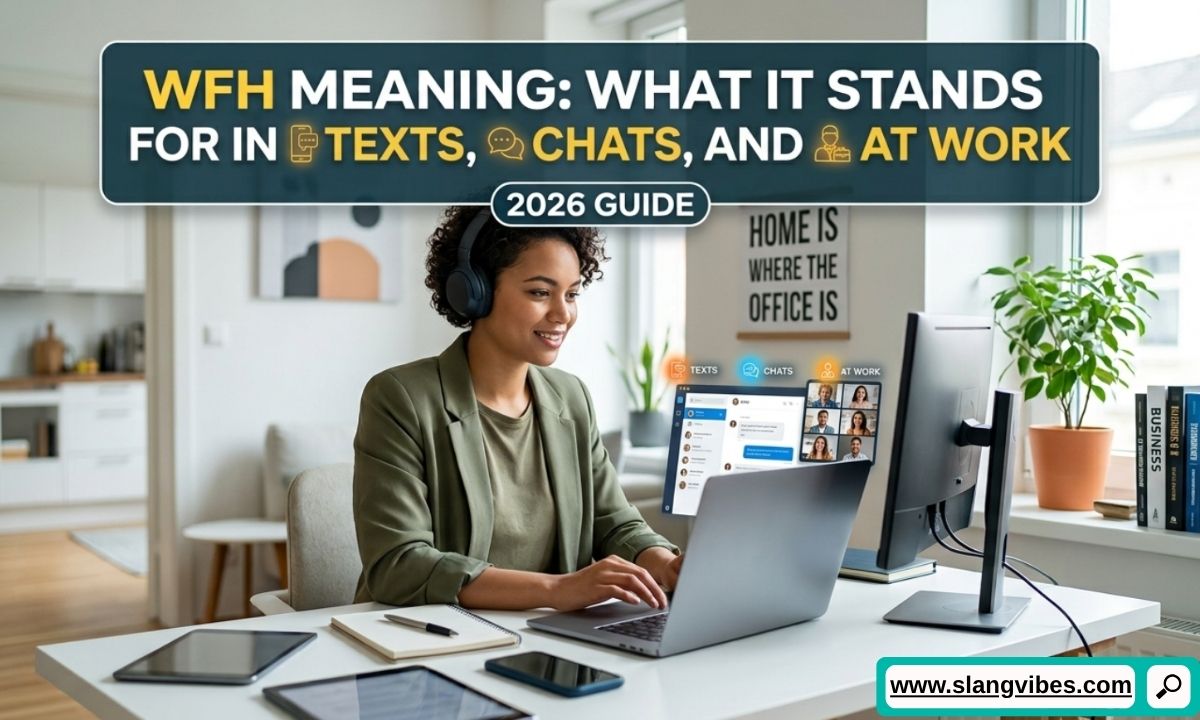
WFH stands for Work From Home. It tells someone your location for the day, nothing more. When a coworker types “WFH,” they’re working, only somewhere other than the office.
The abbreviation functions as a quick label. People drop it into a calendar block, a Slack status, or a one-line text. It works as an adjective, like “I’m WFH Thursday.” Sometimes it stands in for the whole setup, like “our WFH days.”
WFH meaning stays steady across most settings. Home instead of office, work still happening. The tone around it shifts though, depending on where you see it. A formal email makes it read like professional shorthand. A text to a friend makes it read closer to slang.
Lowercase “wfh” shows up often in casual texting too, the same way “omw” or “brb” rarely get capitalized. The meaning doesn’t change with the letter case. It stays a location update dressed up as an acronym.
One detail worth flagging: the definition hasn’t drifted much since the term caught on. Plenty of slang picks up new meanings over time, taking on layers the original word never had. WFH has stayed narrow and literal instead, tied specifically to home-based work.
Part of the reason it works so well as shorthand is how little room it leaves for confusion. Three letters, one location, one clear picture in the reader’s head. Few workplace acronyms manage this kind of instant clarity without a caption or an explanation attached. Most people never need to ask a follow-up question after seeing it.
Read More: IYKYK Slang Meaning: The Internet Phrase You Need to Know
Formal vs Informal: Where WFH Fits Best
WFH slides easily between formal and informal writing, but the phrasing around it changes with the setting.
In an internal email to a manager, WFH usually stands alone fine. “WFH tomorrow, reachable by phone” reads as normal, professional shorthand. Nobody expects more explanation in a routine internal message.
In a client-facing email or a cover letter, the abbreviation reads less polished. Spelling it out, “I’ll be working from home,” signals more care. It gives the sentence a more deliberate tone. Job applications and formal proposals call for the fuller phrase almost every time.
Texting sits at the opposite end. Between friends, coworkers you know well, or a group chat, WFH works without any setup at all. Nobody spells it out or adds context. It gets typed the same way you’d mention the weather.
Social captions land somewhere in the middle. A caption like “WFH mode, coffee number three” reads playful and casual, fitting for Instagram or TikTok. The same phrasing dropped into a company newsletter would feel out of place.
The rule of thumb: match the abbreviation to the formality already present in the message. If everything else in the email or text sounds relaxed, WFH fits right in. If the rest of the writing already sounds buttoned up, spell it out instead. Reading the rest of the message first usually settles the question without much thought.
WFH Across Generations: Gen Z, Millennials, and Beyond
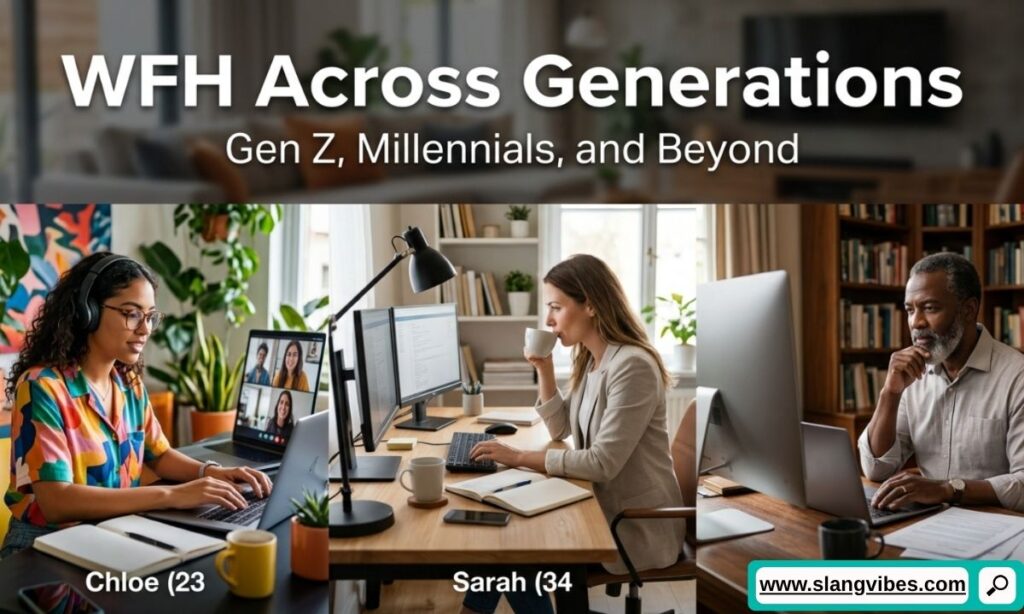
WFH gets used by pretty much every working generation now, though the tone shifts a little depending on who’s typing it.
Millennials, many of whom watched the shift from office-only jobs to home offices firsthand, tend to use WFH in a fairly straightforward way. It shows up in scheduling messages and calendar invites, doing the job of a quick status update.
Gen Z workers grew up texting in shorthand already, so WFH fits naturally alongside terms like “lowkey,” “no cap,” or “ngl.” It shows up in captions, group chats, and even dating app bios, often paired with a laptop or coffee emoji for extra flavor.
Gen X and older workers tend to spell the phrase out more often in professional settings, leaning toward “working from home” in full rather than the abbreviation. WFH still gets used, only less often in casual writing outside of work tools like Slack or email. Handwritten notes and formal memos from this group also lean toward the fuller phrase, a habit carried over from years of more formal workplace writing.
No single generation owns the term. WFH crosses age groups easily because the concept behind it, working outside a central office, applies to nearly everyone in a modern workplace. The generational differences show up mostly in tone and platform, not in the core WFH meaning.
What does shift across age groups is pairing. Younger workers tend to stack WFH next to other shorthand and emoji in the same message. Older workers tend to let it stand alone, treating it as a complete update rather than one piece of a longer string of abbreviations.
Read Also: BBG Meaning: Slang Definition, Text Uses & Examples (2026)
WFH vs Remote, Hybrid, and Other Terms: What Each One Means
WFH gets mixed up with a handful of neighboring terms. Here’s a quick side-by-side.
| Term | What It Means |
|---|---|
| WFH | Working from home for a day, a week, or an ongoing basis |
| Remote Work | Working outside a central office, from any location |
| Hybrid Work | Splitting time between home and office on a set schedule |
| WFA | Work From Anywhere, with no fixed home base required |
| Telecommute | An older, formal term for working outside the office |
| WFO | Work From Office, the direct opposite of WFH |
| OOO | Out of Office, meaning not working at all |
The mix-up people run into most is OOO. WFH and OOO look similar in a fast glance at a status message, but they carry opposite meanings. WFH signals active work from a different location. OOO signals no work at all, whether it’s vacation, illness, or a personal day.
WFH vs remote work causes some confusion too. Every WFH day counts as remote work, but not every remote day happens at home. A freelancer working from a co-working space or a cafe is remote. Calling it WFH wouldn’t be accurate, though.
Hybrid work sits above both terms as a broader schedule pattern, mixing WFH days with office days across the week. Someone on a hybrid schedule might describe Tuesday as “WFH” and Thursday as “in office.” No separate term is needed for the whole arrangement.
Telecommute shows up less in everyday texting these days, though it still appears in formal contracts and older HR documents. Job postings sometimes use it interchangeably with remote work, even though the two terms grew up in different eras of workplace language.
How to Respond When Someone Texts You WFH meaning
WFH doesn’t usually call for a big response. Most of the time, a short acknowledgment covers it.
Nora: hey, WFH today, ping me if you need anything Theo: sounds good, I’ll message on Slack instead of stopping by
This is the standard pattern. One person states their status, the other confirms and adjusts plans if needed. No explanation gets requested, and none gets offered.
With friends or siblings, the response often turns more casual, sometimes even a little teasing.
Zoe: WFH again? living the dream Malik: don’t hate, I’m still in three meetings before lunch
A response also carries a small favor request sometimes, since WFH signals more flexibility during the day for some people.
Harper: I’m WFH, mind if I swing by around 2? Jules: works for me, door’s open
The main thing to avoid: treating a WFH update like an invitation to chat all day, or assuming the person has less to do. A simple “sounds good” or “noted, let me know if you need anything” covers most situations without overstepping.
Formal responses follow the same logic, only with more polish. A reply like “Understood, I’ll loop you in by email” works fine for a manager or client. Matching the tone of the original message is usually the safest bet, staying short and casual or slightly more formal depending on the sender.
Read Here: Poignant Slang Meaning: What It Really Means in Text and Chat
Common WFH Meaning Mistakes to Avoid
A few mix-ups come up often enough to flag directly.
Common Mistake: Treating WFH like a day off. It means the workday continues, only somewhere other than the office.
The biggest one: WFH does not mean time off. Someone who’s WFH still answers messages, joins calls, and hits deadlines. Treating a WFH day like the person went quiet for good reason tends to cause more confusion than it solves.
Tone slips are common too. WFH reads fine in a work chat or a text to a close friend. It tends to land oddly in a message to someone new, like an early conversation on a dating app. The shorthand assumes a shared context the other person doesn’t have yet.
Another mistake: pairing WFH with an unrelated status without separating the two ideas. A message like “WFH, feeling a bit off today” mixes a location update with a health note. The reader ends up unsure whether to expect full availability. Splitting the two into separate lines avoids the mix-up entirely.
Overusing WFH outside of actual work hours trips people up as well. WFH specifically signals active work from home, not simply being home. Texting “WFH” on a Sunday afternoon while relaxing sends the wrong signal, since it implies you’re on the clock when you’re not.
Capitalization mistakes are minor but worth a mention. Writing “Wfh” with one capital letter looks like a typo rather than intentional styling. Sticking with either “WFH” or the lowercase “wfh” keeps the abbreviation looking deliberate instead of accidental.
Read Also: Chopped Meaning in Slang (2026): What It Really Means in Text & Social Media
A Quick Look at Where WFH Came From
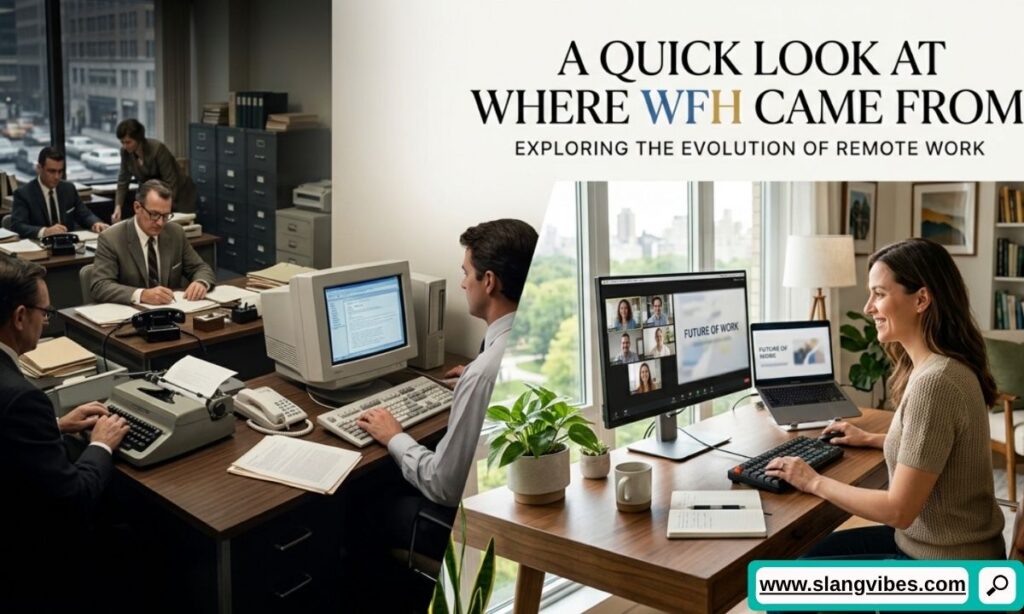
WFH existed as internal shorthand long before most people had heard of it. HR memos and internal scheduling tools used it to flag exceptions, things like a snow day or a one-off home repair appointment. It rarely left those internal documents, and most employees outside HR never saw it written out at all.
The term stayed mostly inside company paperwork for years. Then 2020 changed everything almost overnight. Offices closed, and WFH shifted from an occasional exception into a daily reality for millions of workers across nearly every industry.
Texting picked up the abbreviation fast around this time, since everyone needed a quick way to explain their new routine to friends and family. Social platforms followed close behind. Hashtags like #WFH started showing up next to home office photos, pets interrupting video calls, and makeshift standing desks built from stacked books.
By the mid-2020s, WFH settled into something calmer and more routine. Hybrid schedules became standard at plenty of companies, and the term stopped signaling anything dramatic. These days, mentioning WFH carries about as much weight as mentioning a dentist appointment, a small planning detail rather than a major announcement. What started as niche HR shorthand now sits comfortably in everyday chat, right next to slang which has nothing to do with work at all. A term built for internal memos ended up living happily inside a text to a friend.
How People Use WFH in Texts, Slack, and Email
WFH shows up a little differently depending on the app or platform. Getting comfortable with WFH meaning across each one helps it come out naturally, wherever you’re typing.
In group chats, it often appears as a quick aside rather than a full sentence.
Sam: brunch Sunday? Ben: I’m WFH tomorrow, so tonight works better for me Sam: tonight it is
Slack and Teams statuses trim it down even further, often an emoji plus the three letters, like “🏠 WFH” or “WFH, back online at 9.” Calendar invites follow the same pattern, favoring short labels over full sentences.
Email tends to stay a step more polished, even in casual workplace cultures. A sign-off like “WFH today, reachable by phone” gets the point across without extra explanation.
Dating apps and early conversations handle WFH a little differently, since the person on the other end doesn’t share the same context yet.
Priyanka: what’s your week looking like? Devon: pretty packed, WFH most days so I get breaks between calls at least Priyanka: same, WFH has been a nice change of pace
Notice how the second example spells things out a bit more than the group chat version. This is typical for early conversations, where a little context goes further than a bare abbreviation. Once familiarity builds, the shorthand tends to shrink right back down to three letters, no extra words needed.
Read New Article: BBFS Meaning in Slang: Definition, Texting Uses, Examples & More (2026 Guide)
Frequently Asked Questions about WFH meaning
What Does WFH Meaning in a Text Message?
It means the sender is working from home right then, not taking time off. The shorthand works as a quick location update inside a longer conversation, without needing any further explanation.
Is WFH Appropriate for a Professional Email?
Usually, yes, for internal messages to people who already know your schedule. For client-facing emails or job applications, spelling out “working from home” tends to read more polished and deliberate.
What Does WFH Mean on Instagram or TikTok?
The same core idea, styled more casually. Captions often pair it with a coffee mug, a laptop, or a pet, turning a work update into a lifestyle post rather than a status report.
When Did WFH Become Popular?
The abbreviation existed in workplace shorthand for years, but it spread into everyday texting and social media around 2020, when home-based work became common almost overnight across most industries.
What’s the Difference Between WFH and OOO?
WFH means active work from home. OOO means no work at all, covering vacation, illness, or any day off entirely away from the job, with no expectation of a reply.
The Bottom Line
WFH meaning boils down to one simple idea: work continuing from home instead of an office. The shorthand fits almost anywhere. Think a work Slack channel, a text to a sibling, or a caption under a home office photo.
What shifts is tone and context, not the meaning itself. A coworker reads WFH as routine scheduling. A new connection on a dating app might need a little more explanation folded in. A formal email usually calls for the fuller phrase instead of the abbreviation, especially in a cover letter or a client message.
Getting comfortable with those small adjustments makes WFH one of the easiest pieces of shorthand to use well. It travels across generations, platforms, and both sides of the Atlantic without losing its core meaning along the way. Whether it lands in a Gen Z group chat or a Gen X email thread, the three letters still point to the same simple fact.

Alex Carter is a language enthusiast and internet culture expert at SlangVibes. He explains the latest slang terms and text meanings in simple, clear English so everyone stays in the loop.