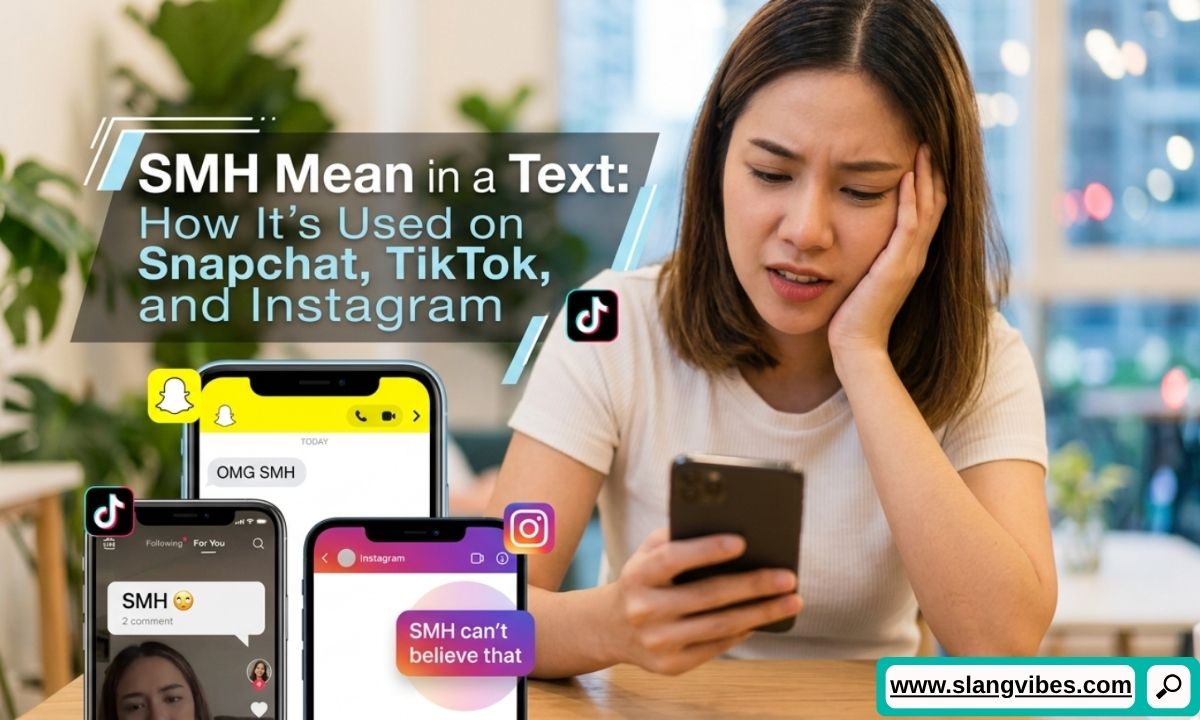
Last year, my coworker forwarded me a screenshot of her teenage daughter’s group chat. The daughter had done something embarrassing at school, and sure enough, every single friend in the thread had replied with the same three letters: “smh.” My coworker leaned over my desk and whispered, “Is she in trouble? Are they making fun of her?” She genuinely had no idea what it meant. And honestly, before I figured out what SMH mean in a text actually is, I probably would have asked the same question. So if you’ve ever stared at those three letters and felt completely lost, you’re not alone. By the end of this guide, you’ll know exactly what SMH means, where it came from, and how to use it confidently.
What Does SMH Mean in a Text? Start Here
When people search for what SMH mean in a text, the answer is actually pretty simple: SMH stands for “shaking my head.” That’s it. Three letters, one familiar physical gesture, and one very clear emotional signal. When someone types SMH in a chat message or social media comment, they’re expressing disbelief, disappointment, frustration, or quiet disapproval, all without typing a single complete word.
To understand it better, think of it this way. Imagine watching someone trip over absolutely nothing on a flat sidewalk. Your natural, instinctive reaction is to slowly shake your head. You’re not furious, You’re not laughing out loud either. You’re somewhere in between, just reacting. That’s precisely the feeling SMH captures in online communication.
Quick Answer: SMH = Shaking My Head. It signals disbelief, disappointment, or mild frustration in text messages and across social media platforms.
What’s worth noting is that SMH works so well because it’s efficient. Instead of typing “I genuinely cannot believe you did that” or “honestly, that’s so disappointing,” you simply drop SMH and the message lands instantly. It’s one of those rare slang terms that communicates tone, emotion, and judgment all at once, without any extra explanation needed.
Here’s the thing, though: what makes SMH mean in a text especially interesting is that it shifts slightly depending on context. Sometimes it’s heavy and deeply sincere. Other times, it’s completely lighthearted and playful. The words surrounding it tell you everything you need to know. For example, “my dog ate my homework smh” feels completely different from “he broke up with her over text smh I’m speechless.” Same letters, totally different energy.
Read Also : TS Meaning in Text: What It Means on TikTok, Instagram & Snapchat
Where Did SMH Come From? The Real Origin Story
Understanding SMH mean in a text gets a lot easier once you know where it actually came from. To start with, SMH didn’t appear overnight. It grew organically out of early internet chat culture, specifically the message boards, forums, and chatrooms of the early 2000s, where users needed fast, efficient ways to express emotions without typing out entire paragraphs.
Before reaction GIFs existed, and before emojis were available on every keyboard, people in online forums developed their own digital shorthand to show how they felt in real time. SMH was a natural part of that movement. It filled a specific emotional gap: the need to express quiet, head-shaking disapproval in pure text form, with no visuals needed.
By the late 2000s and well into the 2010s, SMH had spread widely through Black Twitter, where it became a go-to reaction to frustrating news stories, absurd public behavior, and everyday situations that simply made no sense. From there, it moved steadily into mainstream texting, Tumblr threads, and Vine videos. Then, once TikTok launched and Instagram Reels took over short-form content, SMH was already deeply embedded in the vocabulary of an entire generation.
Here’s what truly sets SMH apart from most internet slang, though: it didn’t fade. Trends like “on fleek” or “YOLO” had their moment and then disappeared almost as fast as they arrived. SMH, on the other hand, kept going. The reason is simple: the feeling behind it, that slow, quiet, disbelieving head shake at something ridiculous, never goes out of style. People will always do things worth shaking your head at, so the slang stays relevant.
How SMH Mean in a Text Shows Up on Snapchat, TikTok, and Instagram
Read New Article: IMR Meaning in Text: What It Really Means on Snapchat, TikTok & Instagram (2026)
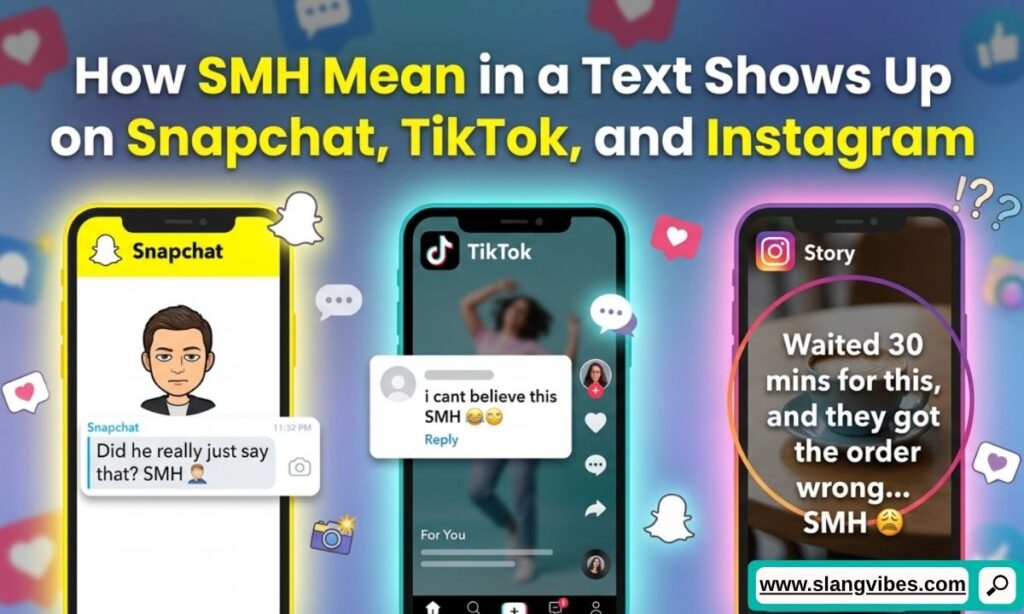
This is where SMH mean in a text gets genuinely platform-specific, and the differences are absolutely worth understanding. The core meaning stays consistent across all platforms, but the way people actually use it shifts noticeably depending on where the conversation is taking place.
On Snapchat, for instance, SMH shows up mostly in fast DM exchanges and quick story replies. Because Snaps disappear after viewing and conversations move at high speed, reactions tend to stay short and punchy. Someone posts a story about doing something embarrassing, and the replies fill up almost immediately with “smh” paired with a crying-laughing emoji. It’s immediate, casual, and perfectly suited to Snap’s fast format.
On TikTok, by contrast, SMH lives primarily in the comment section. Scroll through virtually any video where someone makes a questionable life decision and you’ll spot “smh” sitting near the top comments. It’s also common in duet and stitch videos, where creators respond directly to other people’s content. Notably, the tone on TikTok leans more ironic and humorous than genuinely upset, so SMH often functions as playful commentary rather than real frustration.
On Instagram, meanwhile, SMH appears in DMs, caption reactions, and reel comments. Instagram users tend to pair it with a bit more context and explanation. A phrase like “this honestly has me smh, I don’t understand people” is very typical Instagram energy. It’s slightly more expressive compared to TikTok’s stripped-down short-form style.
Below are five realistic conversation examples showing exactly how SMH mean in a text looks in actual exchanges across different platforms:
Example 1 — Snapchat Story Reply:
Kayla’s story: “Just showed up to work on my day off smh” Jess replies: “smh babe please go HOME right now”
2 — TikTok Comment:
Video: A guy tries to cook pasta without boiling the water first Top comment: “@user smh this is exactly why we don’t let him near the kitchen”
3 — Instagram DM:
Priya: “Did you see what he posted on his story last night?” Dani: “YES oh my god smh he has absolutely zero self-awareness”
4 — WhatsApp Group Chat:
Marcus: “I missed the bus again because I was watching one more episode” Tyler: “SMH Marcus we literally talked about this yesterday” Bree: “lmaoo smh every single time without fail”
Now Example 5 — Dating App Conversation:
Match: “Okay so I accidentally liked a photo from 2017 on her profile” You: “smh how deep were you even scrolling”
The Different Tones of SMH Mean in a Text
One of the most important things people miss about SMH mean in a text is that it doesn’t always carry the same emotional weight. The three letters look identical every single time, but the feeling behind them changes completely depending on tone, the relationship between people, and the situation at hand.
Here’s a clear breakdown of the most common tones SMH takes on in everyday texting:
Read Now: GNG Meaning in Text Explained with Real Chat Examples
| Example / Context | What It Means / How It Feels |
|---|---|
| “He forgot our anniversary smh” | Genuine hurt or deep disappointment |
| “You ate my leftovers again smh” | Playful teasing between close friends |
| “She showed up 3 hours late smh queen behavior” | Sarcastic humor, ironic admiration |
| “Forgot my own email password smh” | Self-directed, lighthearted embarrassment |
| “SMH at this entire week honestly” | General exhaustion and quiet exasperation |
| “He replied after 4 days smh the audacity” | Frustrated disbelief, subtle shade |
As you can see from the table above, the same three letters carry completely different emotional weight depending on what surrounds them. Genuine SMH, for example, usually arrives without any humor attached. Playful SMH, on the other hand, comes with laughing emojis or joking language right beside it. Sarcastic SMH, meanwhile, often pairs with words like “king,” “queen,” or “iconic” used in a clearly ironic way.
Common Mistake: Assuming SMH is always negative or confrontational. Between close friends, smh is often warm and genuinely affectionate, more like a fond eye-roll between people who care about each other than actual harsh judgment. Always read the tone first before you react.
One more subtle but important detail: lowercase “smh” generally feels softer and more casual, while uppercase “SMH” often signals stronger or more genuine frustration. It’s a small distinction, but experienced texters pick up on it surprisingly fast.
Read More Articles: SYBAU Meaning in Text: What It Really Means and How People Use It (2026)
What Does “SMH My Head” Mean? The Redundant Version Explained
If you’ve ever come across “smh my head” and done a confused double-take, you’re in very good company. This phrase is, technically speaking, completely redundant. Since SMH already stands for “shaking my head,” the full phrase “smh my head” translates literally to “shaking my head my head.” It makes no logical sense whatsoever.
And that, of course, is precisely why the internet loves it.
“SMH my head” started out as a joke, originally poking fun at people who use acronyms without actually knowing what the individual letters stand for. But as with most internet jokes that gain momentum, it took on a life entirely its own. Now, people use it deliberately and intentionally, as a way to signal extra emphasis, deep irony, or the kind of over-the-top disbelief that a standard SMH simply doesn’t fully capture anymore.
Fun Fact: “SMH my head” follows the exact same pattern as saying “ATM machine” (Automated Teller Machine machine) or “PIN number” (Personal Identification Number number). The difference is that the internet decided to make the redundancy funny on purpose.
You’ll spot “smh my head” most often on TikTok, Twitter, and inside meme captions, where exaggerated, self-aware humor is already a core part of the culture. So if someone sends it to you, rest assured they’re being completely playful. They know exactly what they’re doing.
When to Use SMH in a Text and When to Leave It Out
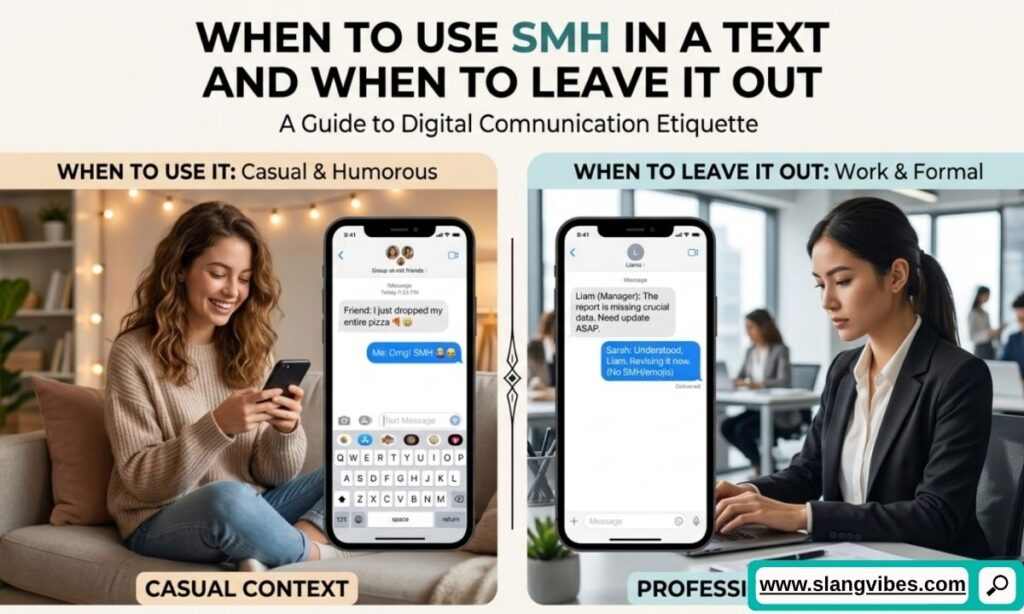
Knowing what SMH mean in a text is genuinely only half the picture. Knowing when to use it, and just as importantly when not to, matters every bit as much. Drop it in the wrong context and it comes across as dismissive, passive-aggressive, or simply confusing to the person on the receiving end.
Generally speaking, SMH works best in casual, comfortable, already-established conversations. Think close friend group chats, sibling texts, familiar social media comment threads, and DMs with people you already share genuine rapport with. In those spaces, SMH feels completely natural and appropriately expressive.
Here’s a straightforward guide to when SMH lands well and when it’s better left out:
Read Also: DW Meaning in Text: What It Really Means on Snapchat, TikTok & Instagram (2026)
| Situation / Context | Use SMH? |
|---|---|
| Friend does something harmlessly silly | Yes, perfect fit |
| Group chat reacting to shared news | Yes, totally natural |
| Texting a close coworker you’re friendly with | Depends on your specific dynamic |
| Messaging your manager or boss | No, avoid it entirely |
| Comforting someone going through something difficult | No, it feels dismissive |
| First message to someone new on a dating app | No, it’s too familiar too fast |
| Reacting to a wild TikTok comment | Yes, fits perfectly |
The bottom line here is straightforward: SMH belongs in spaces where you’re already genuinely comfortable with the other person. It’s informal, expressive, and works best when both sides of the conversation understand the tone. Beyond that, overusing it significantly weakens the effect. If every third message ends with SMH, it stops reading as a real reaction and starts feeling like empty filler
SMH vs. Other Reaction Slang: Knowing the Real Difference
SMH is, of course, just one of several reaction acronyms that float around constantly in text messages and digital conversations. Each one expresses something slightly different, and swapping them carelessly changes your meaning far more than most people realize.
Here’s a direct comparison showing how SMH stacks up against similar terms you’ll regularly see in online communication:
Read More Article : GPI Meaning in Text: Everything You Need to Know in 2026
| Slang / Term | Core Feeling | Emotional Intensity |
|---|---|---|
| SMH (Shaking My Head) | Disappointment, quiet disbelief | Medium |
| SMDH (Shaking My Damn Head) | Strong frustration, extra emphasis | Medium-High |
| Facepalm | Embarrassment, second-hand shame | Medium-High |
| IKR (I Know Right) | Agreement, shared frustration | Low-Medium |
| OMG (Oh My God) | Shock, surprise, disbelief | High |
| WTF | Anger, confusion, strong disbelief | High |
| Sigh | Mild exhaustion, quiet disappointment | Low |
As the table shows clearly, SMH sits comfortably right in the middle of that emotional range. It’s not nearly as explosive as WTF, and it’s not as neutral or passive as a simple “sigh.” When someone types SMH, they’re registering a clear, readable reaction without tipping into an extreme. That balance is, in fact, a big part of why it fits so many different situations and why it’s stayed genuinely relevant across so many platforms and years.
Additionally, SMDH, the stronger and more emphatic version, is worth keeping in your vocabulary too. If someone sends you SMDH instead of standard SMH, they feel considerably more strongly about whatever just happened. The extra word carries real, noticeable weight.
Common Misconceptions About SMH Mean in a Text
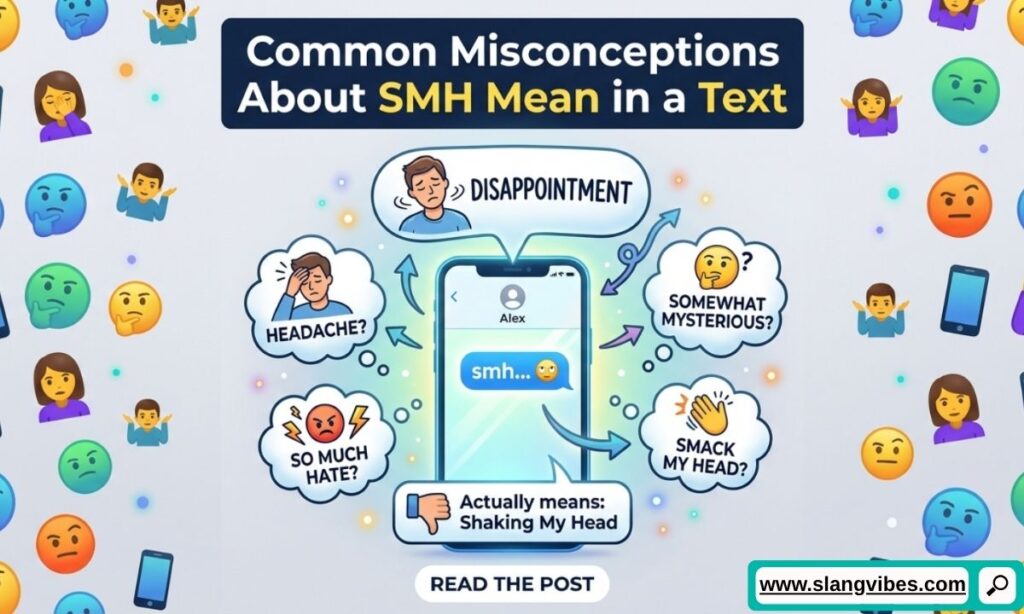
Even though SMH is so widely used across social media and text messages today, several stubborn common misconceptions still circulate, particularly among people encountering it for the very first time.
The most frequent mistake, by far, is assuming SMH means something positive. Some people guess it stands for “so much happiness” or even “shake my hand.” Neither interpretation is remotely correct. SMH is always rooted in some form of disapproval, disbelief, or frustration, even when the surrounding tone is playful and light.
A second misconception worth addressing is that SMH is always aggressive or insulting. In reality, though, the intensity varies very widely depending on context. Between friends, SMH is often gentle and even affectionate. It only becomes genuinely sharp when the surrounding message carries real frustration behind it.
A third false interpretation is that SMH is outdated, old-school slang. In professional contexts especially, people sometimes assume it’s a Gen Z-only term that has already passed its peak. That assumption is incorrect. SMH remains active and natural-sounding across age groups and platforms in 2026, and it shows absolutely no signs of fading from everyday use.
Finally, and importantly, some people confuse SMH with SHM, which is a completely different acronym. SHM stands for “simple harmonic motion” in physics contexts. It’s also occasionally used in informal texting to mean “someone hit me,” or simply as a typo for SMH. As always, context tells you exactly which one you’re dealing with.
FAQ
SMH carries the same exact meaning regardless of who sends it. It still means shaking my head in disbelief or disappointment. The tone, whether playful or genuinely frustrated, comes entirely from the context of the conversation, not from the sender’s gender.
SMH isn’t inherently rude, but context absolutely shapes how it lands. Between close friends, it’s usually harmless or even warmly affectionate. Sent to someone you barely know, or in response to something emotionally serious, it can feel dismissive or passive-aggressive.
On Snapchat, SMH works exactly the same way it does in any other text: it expresses disbelief or mild frustration. Because Snap conversations move fast and disappear quickly, SMH often appears as a short, punchy reaction to a story or snap reply, usually paired with an emoji to set the tone clearly.
Absolutely. SMH has moved well past trend status and become a genuinely standard part of everyday digital communication. People across multiple generations use it freely in text messages, social media comments, and casual chats. It’s not going anywhere anytime soon.

Alex Carter is a language enthusiast and internet culture expert at SlangVibes. He explains the latest slang terms and text meanings in simple, clear English so everyone stays in the loop.