GPI meaning in text stands for Gracias Por Invitar, a Spanish phrase meaning thanks for inviting me… Last Friday night, my friend posted a photo on Instagram. Six of us, laughing at some rooftop restaurant downtown. Except I wasn’t there. I wasn’t even asked, I found out the same way everybody finds out about things they weren’t invited to: through a phone screen at 11 PM while eating cereal alone. I opened the group chat and typed exactly three letters. GPI. Everyone knew what I meant immediately.
If you’ve ever stared at those three letters and had no idea what just hit you, you’re in the right place. GPI meaning in text stands for “Gracias Por Invitar,” a Spanish phrase that translates to “thanks for inviting me.” Nobody sending it actually means thank you. That’s the whole point. It’s a sarcastic thank-you delivered in three letters, and it lands every single time.
This guide covers everything: where GPI came from, how people use it across different platforms, real conversation examples, and what to say when someone sends it your way.
Quick Answer: GPI stands for “Gracias Por Invitar,” which means “thanks for inviting me” in Spanish. People use it sarcastically when they find out plans happened without them. Three letters. One very pointed complaint wrapped in fake gratitude.
What Does GPI Mean in Text? The Short Answer
The GPI meaning in text is simple on the surface and loaded underneath. Gracias Por Invitar is a Spanish phrase, and “invitar” means to invite. Put it together: “thanks for inviting me.” Now add sarcasm. That’s GPI.
You send it when your friends went out without you. When a group photo shows up on your feed and you weren’t in it. When someone says “oh we went to that concert last night, it was so good” and this is the first you’re hearing about a concert. GPI is the response that says “I noticed I wasn’t included” without starting an actual argument about it.
The phrase works because the Spanish origin adds a layer of ironic flair that a plain “wow thanks for the invite” just doesn’t carry. It feels sharper, more deliberate, and a little funnier. That combination is exactly why it stuck.
Here’s what GPI is not. It’s not a genuine thank-you. It’s not used when someone actually appreciated an invitation. If someone says “thanks for inviting me to your party, I had so much fun,” they’re not using GPI slang. That’s just regular English politeness. The sarcasm is non-negotiable in GPI texting.
The tone sits somewhere between passive complaint and genuine humor. Most people who send GPI are a little hurt and a lot amused, which makes it the perfect social exclusion phrase for anyone who’d rather laugh about being left out than cry about it.
Read Also : GNG Meaning in Text Explained with Real Chat Examples
Where Did GPI Come From? The Real Origin Story
GPI didn’t appear out of nowhere. It grew out of Spanish-speaking online communities where sarcastic expressions of social frustration were already common cultural currency. “Gracias por invitar” works the same way “thanks a lot” works in English sarcasm. The words say one thing and the delivery says the opposite. That’s been true in Spanish-language communication long before it became an online slang term.
The abbreviation made its jump into English-dominant spaces through the bilingual communities that move constantly between languages on social media. Latino and Hispanic Gen Z users on Twitter and TikTok were already using it naturally, and because Spanish phrases cross cultural lines faster than most people realize, GPI started showing up in group chats and comment sections where the majority of users didn’t speak Spanish at all.
TikTok was the accelerant. Once GPI appeared in comment sections under videos showing friend groups, parties, and gatherings, the phrase spread through sheer repetition. You don’t need to know Spanish to understand sarcasm when you see it used consistently in the same context. By 2024, GPI was mainstream Gen Z communication across both the US and UK.
What made it stick beyond the initial spread was the universality of the feeling it describes. Social exclusion isn’t a cultural experience. Being left out of plans is something every generation understands. GPI just gave everyone a three-letter shorthand for it that felt fresher than anything English had on offer.
GPI Meaning Across Different Platforms in 2026
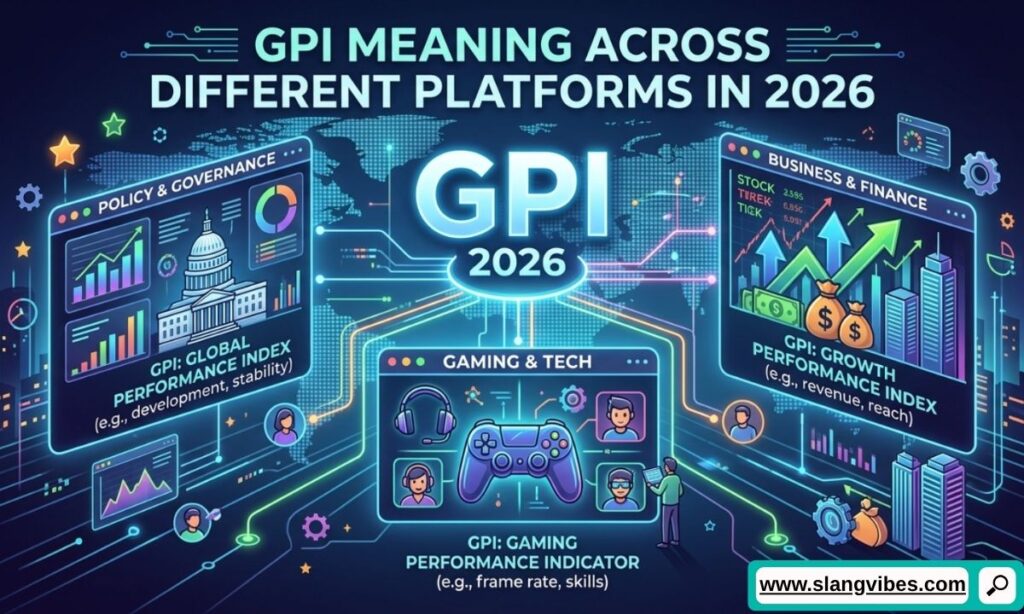
GPI gpi texting shows up differently depending on where you encounter it. The meaning stays the same, but the delivery and the stakes shift based on the platform.
Here’s how it breaks down across the main places you’ll see it:
| Platform | How GPI Gets Used |
|---|---|
| TikTok | Comment reactions under group content or event videos the sender wasn’t part of |
| Posted in comments under group photos, or sent in DMs when someone sees a story from an event | |
| Snapchat | Reactions to group Snaps or Stories showing hangouts the sender missed |
| iMessage Group Chats | Dropped into the chat when someone finds out plans happened without them |
| BeReal | Reactions to real-time posts showing gatherings the sender wasn’t invited to |
| Used in social and relationship threads discussing being left out of plans | |
| Twitter/X | Public commentary on exclusion, often semi-joking and performance-for-audience |
The most common home for GPI is the private group chat. That’s where it carries the most weight because the people receiving it actually know you. A GPI in a comment section is public performance. A GPI in the group chat is personal accountability.
Snapchat and iMessage deserve more attention here than most articles give them. On Snapchat, GPI often follows someone watching a Story from a gathering they weren’t at. On iMessage, it shows up in group threads where plans got made in a separate chat and the sender somehow ended up outside the loop. Both situations have that same flavor: you found out after the fact, and three letters say everything.
Read Also: IFG Meaning in Text Messages and Social Media Explained
Real Text Conversation Examples of GPI in Action
Reading about GPI in the abstract only goes so far. Here’s what it actually looks like in a conversation:
Example 1: The Post-Photo Drop
Mia: [posts group photo from Friday dinner] Jordan: wait when did this happen Mia: Friday night! It was so fun Jordan: gpi 🙃
Tone: Playful but pointed. The emoji does a lot of heavy lifting.
Example 2: The Pre-Emptive GPI
Alex: hey we might do something Saturday, not sure yet Sam: okay gpi ahead of time just in case Alex: lmaoo you’re literally invited Sam: prove it
Tone: Fully joking. Sam is using it as a joke threat before any exclusion happens.
Example 3: The Group Chat Callout
Group Chat: The Crew Tyler: that show last night was incredible btw Priya: omg it was insane Marcus: gpi to the group chat that planned this without me
Tone: Mildly salty. Marcus knows it was an oversight but he’s going to make them feel it.
Example 4: The Instagram Comment
[Photo: four friends at a birthday dinner] Comment from @devyn_k: gpi btw 😊 Reply from @jess: DEVYN I told you!! come to the next one
Tone: Lighthearted accusation in public. The smile emoji keeps it from reading as genuinely angry.
Example 5: The Morning-After Discovery
Kezia: you guys went to the arcade last night??? Bri: oh my god I thought someone texted you Kezia: yeah no. gpi everyone Leo: we are SO sorry
Tone: The “everyone” makes it land harder. This one has a little more genuine hurt under the joke.
When Is GPI meaning in text Playful vs. When Is It Passive-Aggressive?
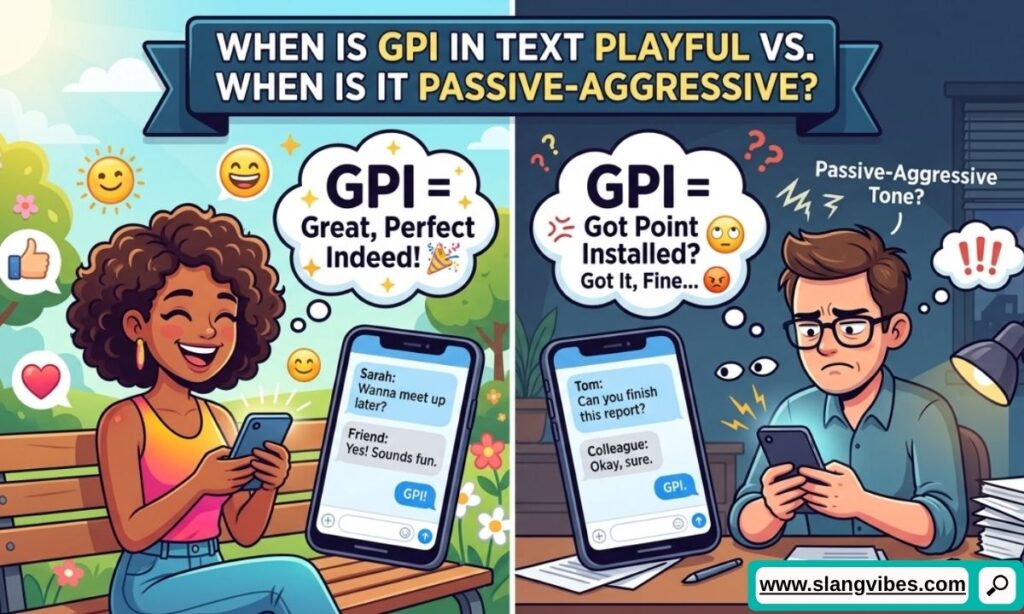
Not every GPI hits the same way. The word choice around it, the punctuation, and the relationship context all signal where on the spectrum it lands.
A GPI from your best friend in the group chat after a last-minute dinner you forgot to mention is almost always a joke. You know each other well enough that one text resolves it. Conversely, a GPI from someone you’ve been quietly drifting from, sent with no emoji and no follow-up, is a different thing entirely. Same three letters. Different emotional weight.
Here are the signals that tell you which version you’re dealing with:
| Signal | Playful GPI | Passive-Aggressive GPI |
|---|---|---|
| Emoji included | Almost always | Rarely, or a pointed one like 🙂 |
| Sent in group vs. DM | Often in the group | Often in a private message |
| Follow-up message | Quick and jokey | Silent after sending |
| Relationship closeness | Very close friend | Acquaintance or drifting friend |
| Word add-ons | “lol,” “btw,” “ahead of time” | None. Just GPI. |
The sarcastic thank-you spectrum in GPI is wide. Most of the time, it’s a pointed joke that everyone laughs at and moves past. Sometimes it’s a signal that someone genuinely felt overlooked and chose humor as the softer delivery. Reading the context around it matters more than the letters themselves.
Other Meanings of GPI You Should Know
GPI meaning in text has one dominant reading in casual conversation. But the abbreviation shows up in other contexts with completely different definitions. You won’t confuse them once you know what to look for.
General Purpose Interface is a technical term used in electronics, hardware, and software engineering. It describes a standardized communication port or protocol. You’ll see it in product documentation, technical specs, and engineering discussions. Zero connection to social media slang.
Global Peace Index is a formal research abbreviation used in journalism, political science, and international policy. It refers to an annual ranking of countries by stability and peace levels. Academic and institutional in every way.
Gross Profit Index shows up in business and finance contexts. It’s a metric used to measure profitability. If someone asks about GPI meaning in a business meeting, this is probably what they want.
Genuine Positive Interaction appears occasionally in psychology, education, and social work literature. It describes constructive, affirming exchanges in therapeutic or educational settings.
Context resolves any confusion instantly. Someone dropping GPI in a group chat after seeing a party photo isn’t talking about profit indices. And an engineer writing about GPI in documentation isn’t sending a sarcastic thank-you. The settings are so different that overlap never actually happens in practice.
When You Should NOT Use GPI (And What to Send Instead)
GPI works when the recipient understands sarcasm, knows the phrase, and has a relationship with you where a pointed joke lands softly. Take away any one of those three things and GPI stops working the way you intended.
Don’t send GPI to people who won’t recognize it as online slang. Parents, older relatives, and anyone outside the bilingual Gen Z communication world might read it as a genuine thank-you, which defeats the purpose entirely and leads to a deeply confusing exchange.
Don’t use it in situations where you’re genuinely hurt. GPI is a humor wrapper. If the exclusion actually stung, if this is part of a pattern, if you need a real conversation, GPI gives the other person permission to laugh it off. When the feeling underneath is real, the joke gets in the way.
Don’t drop GPI in professional or semi-professional group chats. A work chat where a colleague mentions a lunch meeting isn’t the space for sarcastic ironic gratitude phrases, even if you do feel left out.
Here’s what to send instead depending on the situation:
- Genuinely hurt: “Hey, I saw you all went out. I wish I’d been included. Can we talk?”
- Unsure if it was intentional: “Oh wow, I didn’t know that was happening. Next time loop me in?”
- Older relative who won’t get it: Just skip it. Or use plain English: “Thanks for the invite, lol” works fine.
Words and Phrases That Live in GPI’s World
GPI meaning in text belongs to a broader family of ironic gratitude phrases that Gen Z uses to express social frustration through humor instead of direct complaint. Understanding where GPI sits in that family helps you use it better.
The emotional strategy behind all of these phrases is the same: acknowledge a negative feeling but deliver it wrapped in something funny enough that it doesn’t escalate into conflict. It’s passive complaint as a communication style, and it’s one of the most distinctive patterns in Gen Z communication.
Here’s how GPI compares to the phrases closest to it:
| Phrase | Tone | When It’s Used |
|---|---|---|
| GPI | Sarcastic gratitude | Being left out of plans |
| FOMO | Anxious longing | Fear of missing something good |
| “It’s fine” | Ironic acceptance | When something is clearly not fine |
| “No worries” | Mild passive dismissal | Letting someone off the hook while keeping score |
| “Glad I wasn’t invited” | Dry reverse sarcasm | Pretending you didn’t want to go anyway |
| “Thanks for the heads up” | Pointed sarcasm | Finding out something late |
GPI is unique in that it borrows from Spanish to add cultural texture. The other phrases are all plain English irony. GPI’s bilingual nature gives it an extra layer that social media users across communities find appealing, whether or not they speak Spanish at all.
Read Also :CYC Meaning in Text: Complete Guide to This Popular Texting Slang
How to Respond When Someone Sends You GPI
The right response to GPI depends on whether you were the one who forgot to invite someone or you’re just watching the GPI land in a group chat where someone else dropped the ball.
If you’re the person who forgot to include them, acknowledge it directly. Don’t over-explain. “My bad, you were absolutely supposed to be there” handles it cleanly. Then follow with a specific invitation: “Next time is on me, I’ll text you personally.” That combination shows the person their absence was noticed and will be fixed. Most GPI senders want acknowledgment, not a detailed explanation of why logistics got complicated.
If the GPI comes into a group chat and you weren’t the one who planned things, a warm group response is enough. “Come next time, we missed you” or “you would have loved it, you’re coming next time” addresses the complaint publicly and keeps it light.
If the GPI feels heavier than usual, if there’s no emoji and no follow-up joke, step out of the group and check in privately. A quick “hey, are we good?” goes a long way when the sarcasm might be carrying more genuine hurt than usual.
What you should never do: ignore it, laugh it off in a way that minimizes it, or respond with “we didn’t think you’d want to come.” All three make the situation worse.
FAQ
GPI means the same thing regardless of who sends it: “Gracias Por Invitar ,” or “thanks for inviting me,” used sarcastically when someone was left out of plans. The gender of the sender doesn’t change the meaning.
In texting and social media contexts, GPI is almost always sarcastic. A genuine thank-you for an invitation would be written out in plain language. The abbreviation exists specifically for the ironic version.
On TikTok, GPI shows up in comments under videos or group photos where the sender wasn’t present. It works as a public sarcastic call-out: “I see you all had a great time, and I wasn’t there.” Same meaning, public delivery.
Acknowledge the miss directly and offer a specific next time. “You should have been there, my bad” followed by “you’re coming next time” is the cleanest response. Skip the long explanation and go straight to the fix.
GPI meaning in text is three letters doing the emotional work of a whole conversation. It calls out social exclusion without starting a fight, delivers a genuine complaint through a sarcastic thank-you, and lands with exactly the right amount of irony to keep things from getting genuinely awkward.
Now that you know what it means, where it came from, and how to read the tone behind it, next time you see GPI in a text, you’ll know exactly what to say back.

Alex Carter is a language enthusiast and internet culture expert at SlangVibes. He explains the latest slang terms and text meanings in simple, clear English so everyone stays in the loop.