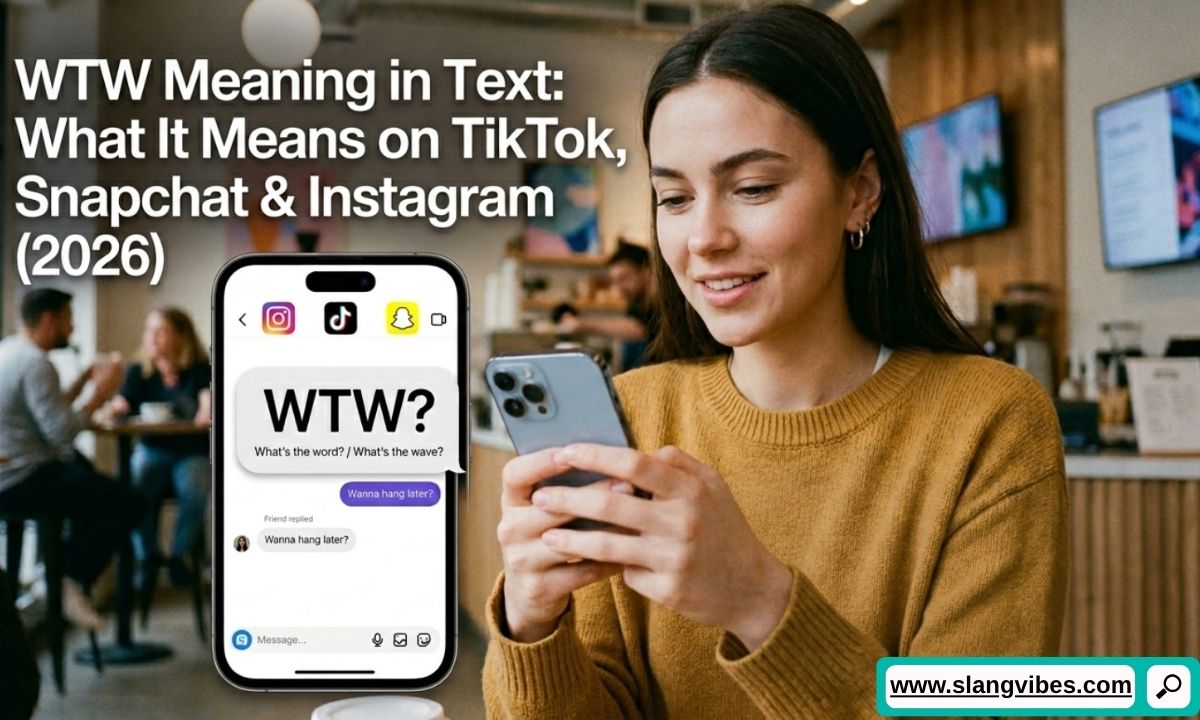
My cousin texted me “wtw” last week, and I just stared at my phone like it owed me money. I’d seen the letters before, scattered across comment sections and DMs, but I’d never actually stopped to figure out what they meant. So I did what anyone does now: I asked a few younger friends, scrolled through some threads, and pieced it together. If you’ve landed here because someone sent you those three letters and you’re not sure how to respond, you’re in good company. The WTW meaning in text comes down to one simple idea: someone wants to know what’s going on with you right now. This guide walks through every version of that meaning, plus how it shifts depending on whether you’re seeing it on TikTok, Snapchat, or Instagram.
Quick Answer: What Does WTW Mean in Text?
Did You Know? WTW usually stands for “What’s the word?” or “What’s the wave?” Both phrases ask the same basic question: what’s happening, what’s the plan, or what’s up with you?
Here’s the short version before we go deeper. WTW text meaning is almost always casual, friendly, and low-pressure. Someone sends it when they want an update, not when they’re trying to start drama. So if a friend texts “wtw” out of nowhere, they’re checking in, not interrogating you.
That said, context still shapes the tone. A few quick examples make this clearer:
| Example / Context | What It Means / How It Feels |
|---|---|
| “wtw” with no punctuation | Casual check-in, low effort, no rush to reply |
| “WTW tonight?” | Asking about plans, slightly more urgent |
| “wtw 👀” | Curious or a little flirty |
| “wtw, haven’t heard from you” | Genuine concern or mild annoyance |
| “WTW with the group chat lol” | Asking for updates on a shared situation |
Once you see the pattern, the WTW meaning in text becomes second nature. It’s less about decoding a secret code and more about reading the room the same way you would with any text.
Where WTW Text Meaning Came From (And Why It Took Off)
Slang rarely appears out of nowhere, and WTW is no exception. The phrase “what’s the word” has roots in everyday spoken English long before smartphones existed, often used as a casual way to ask for news or updates. As texting became the default way people talk, that spoken phrase naturally got chopped down into something faster to type.
This pattern isn’t unique to the WTW meaning in text that we use today. Think of it this way: BRB became shorthand for “be right back,” and WYD became shorthand for “what are you doing.” WTW followed the same path, sliding into group chats and DMs because it saves time without losing the friendly tone of the original phrase.
What pushed the WTW meaning in text into mainstream use was social media. Once short-form platforms exploded, users leaned into compressed language everywhere, from captions to comments to quick replies. Consequently, WTW spread fast among Gen Z users first, then crossed over into millennial texting habits too.
Music and online culture also played a role. The “what’s the wave” version picked up steam through youth slang and crept into how people describe a vibe or a trend. As a result, WTW now carries two overlapping meanings that both point back to the same idea: what’s happening right now.
Understanding this background helps explain why the term feels so natural in casual chats. It didn’t appear overnight. It evolved the same way most digital slang does, through repetition, convenience, and a shared sense of tone among the people using it.
Read Also : RLS Meaning in Text: What It Really Means on Social Media (2026)
WTW Meaning on TikTok: Comments, Captions & Duets
TikTok comment sections move fast, and WTW fits right into that rhythm. People drop it under videos when they want to know the backstory behind a clip, or when a trend leaves them genuinely curious about what’s going on.
The WTW meaning on TikTok shows up in a few specific ways:
- In comments, asking “wtw with this” usually means someone wants context for a confusing or chaotic video.
- In captions, creators sometimes use it to tease an update, almost like a hook to get people watching.
- In duet or stitch responses, WTW can signal genuine confusion about the original creator’s situation.
Here’s a real example of how that plays out in a comment thread:
User1: wtw is going on in this video 😭 User2: girl watch till the end it gets intense
Notice how casual that exchange feels. Nobody’s asking for a formal explanation; they just want the gist, fast. Similarly, captions like “wtw happened to my plants” function as a quick attention-grabber rather than a literal information request.
Because TikTok thrives on short bursts of text, WTW meaning on TikTok leans heavily toward curiosity and reaction rather than planning. You won’t usually see “wtw tonight?” under a video the way you would in a private DM. Instead, it’s reserved for moments when someone genuinely wants the full story behind whatever they just watched.
WTW Meaning on Snapchat: Streaks, Snaps & Chat
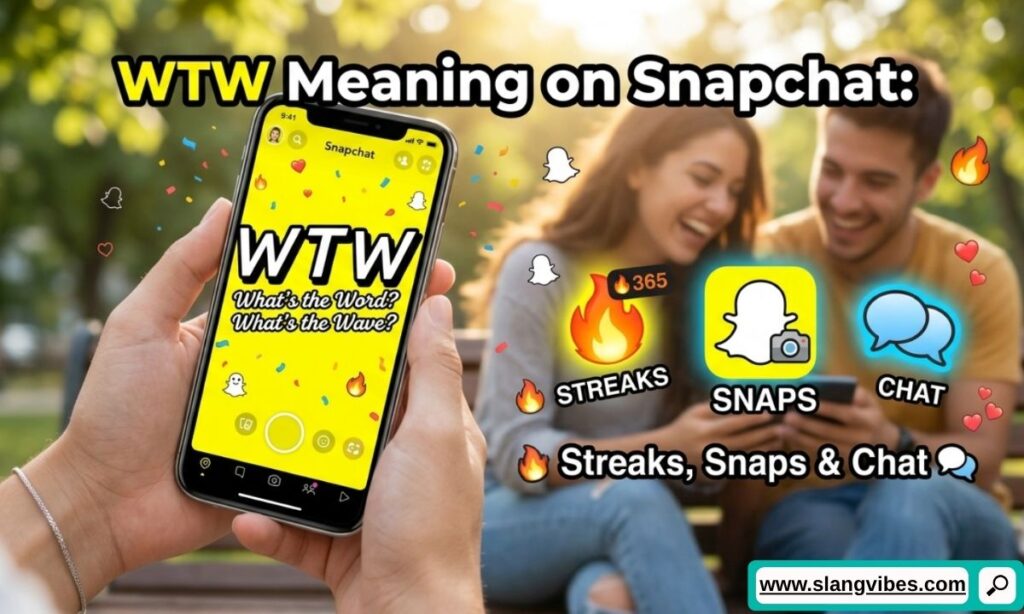
Snapchat’s whole vibe is built around speed and spontaneity, and that shapes how WTW gets used there. Messages disappear, snaps come and go, so the tone tends to feel even more immediate than on other apps.
The WTW meaning on Snapchat splits into two common situations. First, it shows up as a caption on a snap itself, almost like a mini status update asking friends what’s happening on their end. Second, it appears in chat as a quick way to restart a conversation that’s gone quiet.
A typical Snapchat exchange might look like this:
Jordan: wtw 👀 Casey: nothing much, you up to anything? Jordan: bored, might go to the mall later
Notice how short and unbothered that whole conversation feels. Nobody’s writing paragraphs. The goal is simply to reconnect quickly, which fits Snapchat’s entire design philosophy around speed.
Streaks also influence how WTW gets used. Since keeping a streak alive often means sending something daily, people use quick texts like WTW as an easy way to maintain contact without putting in much effort. It’s functional as much as it is social.
Ultimately, the WTW meaning on Snapchat leans casual and spontaneous, often paired with emojis to soften or clarify tone. A simple “wtw” with a laughing emoji feels playful, while the same text without any emoji might come across as more neutral or even slightly distant.
WTW Meaning on Instagram: DMs, Story Replies & Comments
Instagram gives WTW a slightly different flavor because it spans DMs, story replies, and public comments, each with its own social rules.
In DMs, the WTW meaning on Instagram often functions as an opener. Someone slides into your messages after seeing a post or story and wants to restart contact without sounding overly formal. For example:
Alex: wtw, saw your story from the weekend Sam: omg it was so fun, I’ll send you pics
That kind of exchange shows how WTW eases people into a conversation instead of jumping straight into a question. It feels lighter than typing out “what have you been up to lately,” even though it means basically the same thing.
Story replies work similarly, though they’re usually shorter and tied directly to whatever the person just posted. A reply of “wtw” under a vague or mysterious story often means the sender is genuinely intrigued and wants more detail.
In comment sections, however, WTW meaning on Instagram shifts slightly toward public curiosity rather than private conversation. People comment it under posts that feel cryptic or incomplete, almost like a public version of “explain yourself.”
Because Instagram blends public and private spaces, reading where the WTW appears matters more here than on other platforms. A WTW in a comment invites a public response, while the same letters in a DM usually start something more personal. Either way, the underlying meaning stays consistent: someone wants to know what’s happening.
Read More Articles: WB Meaning in Text: What It Really Means on Social Media (2026)
WTW vs WYD vs WSP vs HMU: What’s the Real Difference
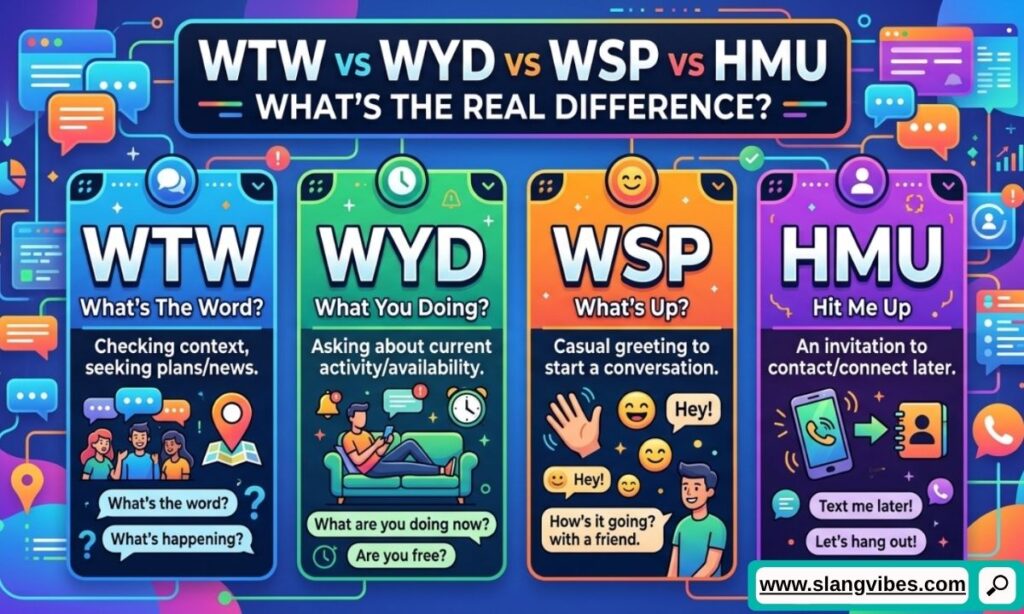
These four abbreviations get mixed up constantly, even though they carry different shades of meaning. Understanding the difference makes texting feel a lot less confusing.
| Abbreviation | What It Asks | How It Feels |
|---|---|---|
| WTW | What’s the word / what’s the plan | Open-ended, casual check-in |
| WYD | What are you doing right now | Direct, present-moment focused |
| WSP | What’s up | General greeting, low effort |
| HMU | Hit me up | Invitation to reach out or connect |
Notice that WTW text meaning tends to be broader than WYD. While WYD wants a specific answer about your current activity, WTW often leaves more room for a vague or general response. Someone could reply to “wtw” with anything from “nothing much” to “thinking about going out later,” and either answer fits naturally.
WSP, meanwhile, functions almost purely as a greeting, similar to saying hello. It rarely expects a detailed response. HMU works differently still, since it’s less of a question and more of an invitation, often used when someone wants you to reach out once you’re free or available.
So while these four terms get grouped together as generic “what’s up” slang, each one carries its own subtle expectation. Once you notice the difference, replying becomes a lot more natural, because you’ll instinctively match the tone the other person set.
How to Reply to WTW (By Situation)
Knowing the WTW meaning in text is one thing, but figuring out how to respond is where people actually get stuck. The right reply depends heavily on who’s texting you.
With a close friend, keep it light and easy:
Friend: wtw You: not much, just got home. you?
With a crush or someone on a dating app, you can add a bit more personality:
Match: wtw tonight 👀 You: thinking about it, depends who’s asking lol
In a group chat, WTW often signals someone trying to organize plans:
Group member: wtw for Friday You: down for whatever, just lmk the time
If you genuinely don’t want to talk, a short and polite reply still works:
Person: wtw You: kinda busy rn, talk later?
Notice that none of these replies require overthinking. The WTW slang meaning practically invites a relaxed response, so there’s no need to craft something elaborate. Matching the other person’s energy, whether that’s playful, neutral, or brief, keeps the exchange feeling natural rather than forced.
Texting Etiquette: When to Use (and Skip) WTW
Even casual slang has unwritten rules, and the WTW meaning in text doesn’t excuse you from them. Knowing when it fits, and when it doesn’t, saves you from awkward moments.
It’s a safe bet in these situations:
- Texting close friends or people you talk to regularly
- DMing someone on Instagram or Snapchat after a story or post
- Group chats where the tone is already relaxed
On the other hand, WTW usually feels out of place here:
- Workplace emails or professional Slack messages
- First messages to someone you’ve never spoken with before
- Formal situations like reaching out to a teacher, landlord, or older relative
Texting someone WTW out of nowhere, especially if you haven’t talked in a while, can also come across as a little blunt. In that case, adding a small bit of context softens it considerably. Instead of just “wtw,” something like “wtw, haven’t talked in forever” feels warmer and less abrupt.
Overusing it matters too. If every single text starts with WTW, conversations can start to feel repetitive or low-effort. Mixing it in occasionally, rather than leaning on it constantly, keeps your texting style feeling genuine instead of formulaic.
US vs UK Slang Use: Does WTW Mean the Same Thing?
Slang doesn’t always travel the same way across the Atlantic, so it’s worth asking whether British and American texters use WTW identically.
In the US, the WTW meaning in chat leans heavily toward “what’s the word” or “what’s the wave,” both tied to American youth slang and hip-hop influenced phrasing. It’s common across texting, Snapchat, and Instagram DMs, especially among Gen Z.
In the UK, WTW shows up less frequently, though it has gained ground through shared social media culture. British Gen Z users often favor alternatives like “wagwan” or “you good?” for similar check-ins, though WTW has crossed over thanks to TikTok and Instagram’s global reach.
Despite minor regional preferences, the core meaning stays largely the same on both sides. A UK teenager texting “wtw” to a friend means roughly the same thing as an American teenager would. Platforms like TikTok blur regional slang boundaries quickly, so a phrase popular in one country often spreads internationally within months.
Therefore, whether you’re texting from London or Los Angeles, the WTW meaning in text holds up consistently. The biggest difference isn’t meaning, it’s frequency. American texters currently use it more often, though that gap continues narrowing as global slang keeps merging across platforms.
Common Mistakes People Make With WTW

A few missteps come up again and again when people first encounter this abbreviation, so it helps to know what to avoid.
One frequent mistake is assuming WTW always means the exact same thing as WYD. While they’re related, WTW often asks a broader question about plans or general updates, whereas WYD wants to know your current activity specifically.
Another common error involves tone misreading. Because WTW is text-only, people sometimes assume it sounds rude or demanding when it’s typically just casual curiosity. Without vocal tone, a quick “wtw” can look more intense than the sender actually intended.
Using WTW in formal communication is another slip-up worth avoiding. Sending it in a work email or a message to someone significantly older can come across as unprofessional, even though it feels completely normal among friends.
Finally, some people confuse texting slang WTW with unrelated technical abbreviations that share the same three letters in fields like aviation or healthcare documentation. Outside of casual messaging, those letters can mean something entirely different, so context always matters before assuming the slang definition applies.
Avoiding these mix-ups makes the WTW meaning in text much easier to apply correctly, whether you’re replying to a friend or just trying to keep up with how younger relatives communicate.
Read New Article: WYLL Meaning in Text: What It Stands for on Snapchat & TikTok
Frequently Asked Questions
Both, actually. “What’s the word” is the more common version, while “what’s the wave” shows up more in slang-heavy or trend-driven conversations. Either way, the core question stays the same: what’s happening right now.
It depends entirely on context and emojis. A plain “wtw” between friends usually feels neutral, while “wtw 👀” or “wtw tonight?” on a dating app often carries a flirtier undertone.
Keep it simple and match the sender’s energy. Something like “not much, you?” works for most situations, while a playful reply fits better in flirtier conversations.
Not exactly. WYD asks specifically what you’re doing right now, while WTW is broader and can include plans, updates, or general check-ins.
Outside casual slang, WTW can stand for entirely different industry-specific terms depending on the field. It’s not standardized the way the texting version is, so it’s worth asking for clarification if you see it in a professional document.
Final Thoughts
The WTW meaning in text isn’t complicated once you see it in action across a few real conversations. It’s a quick, friendly way of asking what’s going on, whether that shows up in a TikTok comment, a Snapchat caption, or an Instagram DM. Tone, platform, and a stray emoji do most of the heavy lifting in shaping how it feels.

Alex Carter is a language enthusiast and internet culture expert at SlangVibes. He explains the latest slang terms and text meanings in simple, clear English so everyone stays in the loop.