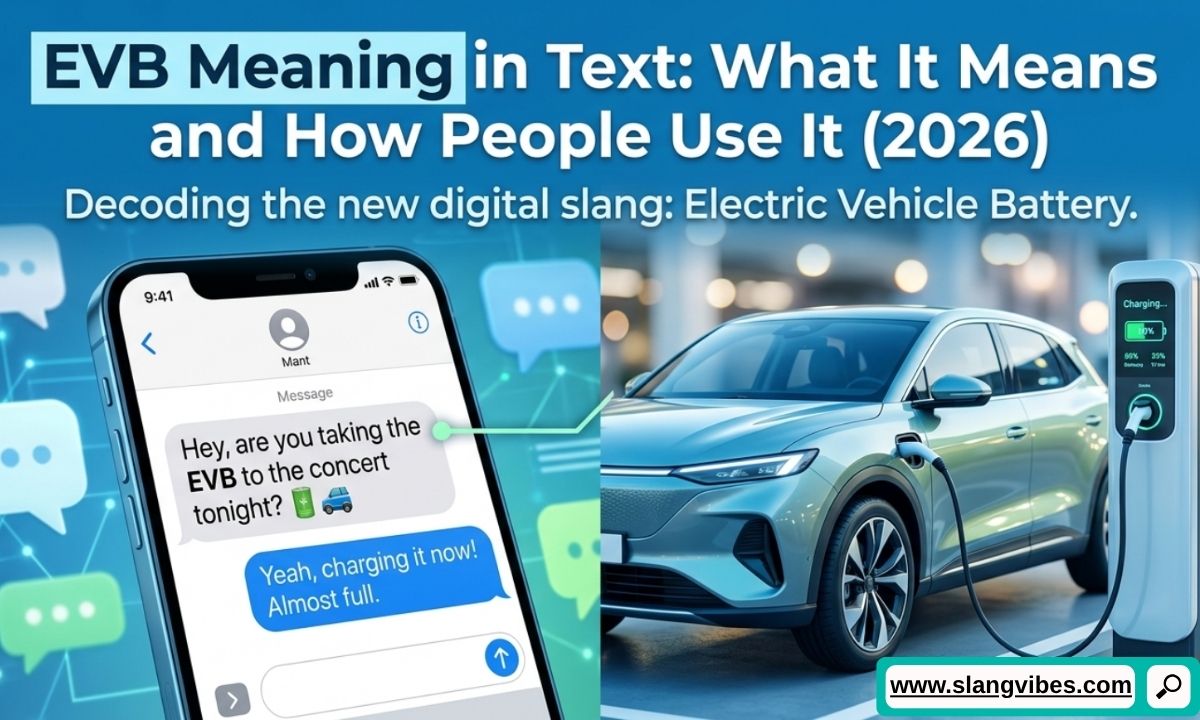
I was mid-conversation with my cousin last summer when she sent me “EVB to that rooftop bar in Brooklyn?” I stared at my phone for a solid 30 seconds. Was she upset? Was this some new reaction? I typed back “what?” like the confused millennial I am, and she laughed at me for a full minute. Turns out, EVB meaning in text is one of those things people assume everyone already knows. So if you’ve ever frozen up seeing those three letters pop up in a chat, you’re in good company. This guide covers every meaning, every context, and every way people use EVB across platforms in 2026.
What Does EVB Meaning in Text Actually Tell You?
The short answer is: it depends on the sentence around it. EVB internet slang has two main meanings that show up in everyday texting and online chats.
The most common one is “Ever Been.” People use it to ask whether you’ve experienced something, visited somewhere, or tried something before. It’s quick, casual, and fits perfectly into a fast-moving group chat. The second meaning is “Everyone’s Very Busy,” which works more as a status update or a way to explain slow replies in a group setting.
Here’s the thing: both meanings are easy to separate once you know what to look for. “Ever Been” shows up as a question. “Everyone’s Very Busy” shows up as a statement, usually explaining a vibe or a situation.
| EVB Usage | What It Signals |
|---|---|
| “EVB to Coachella?” | Asking about a past experience |
| “Sorry for the quiet, EVB rn” | Explaining collective busyness |
| “EVB skiing before?” | Casual curiosity about your life |
| “Group chat’s dead, EVB” | Noting that everyone’s occupied |
Neither meaning is rare. So when you spot EVB in messages, scan the sentence first and the meaning will land immediately.
Where Did This Three-Letter Abbreviation Come From?
Texting abbreviations didn’t appear overnight. They grew out of a deeply human need to say more with fewer keystrokes, especially back when SMS had character limits. Over time, even as those limits disappeared, the habit of shortening everything stuck around hard.
EVB slang meaning emerged naturally from group chat culture, where people ask each other about past experiences all the time. Typing “Have you ever been to…” felt clunky in a fast-moving thread. So it got chopped down to “EVB to…” and people kept rolling. The same way “LOL” stopped meaning actual laughing out loud and became a tone softener, EVB settled into casual shorthand without anyone officially deciding that.
The “Everyone’s Very Busy” usage came slightly later, mostly from workplace group chats and friend groups trying to explain radio silence without writing a whole paragraph. It serves the same purpose as “things are hectic” but in three letters.
EVB abbreviation meaning doesn’t trace back to one viral moment or one specific platform. It spread the same way most slang does: one chat at a time, one contact list at a time, until enough people recognized it that it stuck.
Read Also: MHM Mean in Text: What It Really Means in Chats and Social Media (2026)
Real Conversation Examples That Show Both Meanings
This is where EVB text meaning gets clear fast. Real examples do more than definitions ever do, so here are five actual-style conversations showing EVB in the wild.
Conversation 1 (Ever Been, travel context):
Maya: EVB to Nashville? Jordan: No but I want to go so bad Maya: We should plan a trip fr
2 (Ever Been, food context):
Chris: EVB to that Thai place on 5th? Sam: Yeah it’s insane, get the pad see ew Chris: Done, going tonight
3 (Everyone’s Very Busy, group chat):
Tyler: Why is everyone ghosting this chat lol Priya: EVB this week, work is wild Tyler: Same honestly
Conversation 4 (Ever Been, experience-based):
Lena: EVB to a silent disco? Bree: No what even is that Lena: You wear headphones and dance to music only you hear, it’s unreal
Conversation 5 (Everyone’s Very Busy, casual apology):
Group chat: Hey who’s coming Saturday? Dev: EVB rn but I’ll check my schedule
Notice how every example makes the EVB meaning in chat obvious from the words around it. You don’t need the other person to spell it out. The context carries it completely.
EVB Meaning in Text Across Social Media Platforms
EVB meaning in texting doesn’t stay locked in one-on-one messages. It moves across platforms and each one uses it a little differently.
EVB meaning on TikTok shows up mostly in comment sections. Someone posts a travel video and the comments fill up with “EVB there??” or “EVB tried this?” It’s a quick way to engage without writing a full sentence. TikTok’s fast scroll culture makes short abbreviations feel right at home.
EVB meaning on Instagram appears in DMs and caption replies. When someone posts a throwback from a trip, their friends drop “EVB??” in the comments, meaning they want to know if you’ve been there too. It also pops up in Stories replies where people respond to polls or location tags with EVB as a quick question.
EVB meaning in WhatsApp is where it shows up most frequently. Group chats move fast, and WhatsApp’s read receipts add pressure to respond quickly. EVB fits perfectly into that rhythm. Someone shares a restaurant recommendation and within seconds someone in the group types “EVB there??”
EVB meaning in messages on Snapchat follows the same casual pattern. Since Snaps disappear, people lean even harder on shorthand. EVB is a natural fit for a platform built on brevity.
The tone shifts slightly by platform, but the meaning stays consistent. EVB in online conversations always signals either a question about past experience or a collective note about being swamped.
EVB in Text: How Gen Z and Millennials Use It Differently
This is a gap the competitor article missed entirely, and it matters more than most people think.
Gen Z tends to use EVB in its question form and often layers sarcasm or humor on top of it. You’ll see “EVB rejected lmao” as a dry way to commiserate, or “EVB to a gym this year?” as a self-deprecating joke. For Gen Z, EVB communication meaning leans playful. It’s rarely a straight question without some kind of tone underneath it.
Millennials, on the other hand, use EVB more sincerely. When a millennial types “EVB to that conference in Austin?” they genuinely want to know. The “Everyone’s Very Busy” usage also skews millennial, especially in work-adjacent group chats where people feel the need to explain their silence without sounding rude.
Here’s a quick breakdown:
Read New Article: YNS Meaning in Text: What It Stands For and How People Use It
| Generation | Preferred EVB Use | Typical Tone |
|---|---|---|
| Gen Z | “Ever Been” with humor or sarcasm | Playful, dry, ironic |
| Millennials | “Ever Been” sincerely OR “Everyone’s Very Busy” | Direct, explanatory |
Neither group is wrong, of course. They’re both using EVB shorthand meaning correctly. The difference is in how much emotional weight they put behind it.
EVB Meaning in Text vs. Technical Fields: Same Letters, Different World
When you step outside casual texting, EVB acronym explained takes on completely different definitions. These meanings never appear in personal chats, so there’s no real risk of mixing them up. Still, it’s worth knowing they exist.
In electronics and engineering, EVB stands for Evaluation Board. This is a hardware platform engineers use to test circuits and components before full production. It’s a standard term in product development documentation.
In medicine, specifically cardiology, EVB refers to an Endovascular Balloon, a device used in minimally invasive vascular surgeries. If you see EVB in a medical chart or clinical paper, that’s the meaning.
In physics, EVB stands for Electron Valence Band, which describes specific energy levels of electrons within a material. This shows up in semiconductor research and materials science literature.
The key point here is simple: none of these meanings will ever appear in your group chat. If you’re texting a friend and they send “EVB?”, they’re not asking about circuit boards. Context keeps these worlds completely separate, and that’s a good thing.
How to Respond When Someone Texts You EVB (With Real Reply Examples)
The competitor article gave three vague bullet points for this section. You deserve better than that.
When someone uses EVB in the “Ever Been” sense, they want a real response. They’re either starting a conversation, making a recommendation, or bonding over shared experiences. So your reply should do one of those things too.
If you HAVE been there or done it:
Them: EVB to that new speakeasy on Clement St? You: Yes omg it’s so good, get the lavender gin thing Them: Ok I’m going this weekend
you HAVEN’T:
Them: EVB to Portugal? You: No but it’s at the top of my list, how was it? Them: Literally perfect, you have to go
now if someone uses “Everyone’s Very Busy”:
Them: EVB this week, sorry for the late reply You: No worries at all, same here honestly You: Let’s catch up when things slow down
The EVB definition in texting changes your reply strategy a little. For the question form, ask a follow-up or share your own experience. For the status form, show empathy and offer a no-pressure out. Both moves keep the conversation warm without demanding more from someone who’s already stretched thin.
When You Should NOT Use EVB in Text (Avoid These Mistakes)
Here’s a section you won’t find in most other articles on this topic.
EVB works great between friends, in group chats, and on social media. It does not work everywhere, and using it in the wrong place creates confusion fast.
Avoid EVB in:
- Work emails or Slack messages to people you don’t know well
- First-time texts to someone new (it reads as random or confusing)
- Messages to older family members who don’t follow internet slang
- Any formal or professional context where clarity matters more than speed
The “Everyone’s Very Busy” meaning creates a specific risk at work. If you send “EVB this week” to a colleague who doesn’t know the slang, they might think you made a typo, sent the wrong message, or are testing them with some internal code. It lands weird.
Common Mistake: Using EVB in a message to someone outside your usual texting circle and getting radio silence back, not because they’re ignoring you, but because they have no idea what you said.
The fix is easy. Save EVB for people you already text casually. With anyone else, type it out in full.
Read New Article: LMS Meaning in Text: What It Really Means on Snapchat, TikTok & Instagram (2026)
Frequently Asked Questions About EVB Meaning in Text
EVB meaning in text is most commonly “Ever Been,” used to ask about past experiences, or “Everyone’s Very Busy,” used to explain a collective state of busyness. Context tells you which one applies.
Both are correct EVB text meanings. “Ever Been” is more common in casual one-on-one or group chats. “Everyone’s Very Busy” tends to appear more in group settings when someone is explaining slow responses.
Yes. EVB meaning in social media spans TikTok comments, Instagram DMs, Snapchat replies, and WhatsApp groups. It’s especially common on TikTok and Instagram where short replies dominate.
No. EVB slang meaning belongs in casual conversations. In professional settings, especially with people who don’t know you well, spell out your full meaning to avoid confusion.
Similar shorthand includes HBU (How About You), WYD (What You Doing), YK (You Know), and NGL (Not Gonna Lie). All of these follow the same pattern of compressing common phrases into quick abbreviations for faster texting.

Alex Carter is a language enthusiast and internet culture expert at SlangVibes. He explains the latest slang terms and text meanings in simple, clear English so everyone stays in the loop.