My friend sent me a voice note at 11 PM on a Tuesday. She said her coworker had quit on the spot, flipped a chair, and walked out mid-meeting. I stared at my phone for a solid five seconds, then typed three letters: YNS. She knew exactly what I meant. No paragraph needed. No follow-up question. Just YNS meaning in text doing its job in the fastest way possible.
If you’ve seen those three letters pop up in your group chat or DMs and had no idea what to say back, you’re not alone. This guide breaks down everything: what it means, where it came from, how different people use it, and when you probably shouldn’t.
What Does YNS Mean in Text Messages?
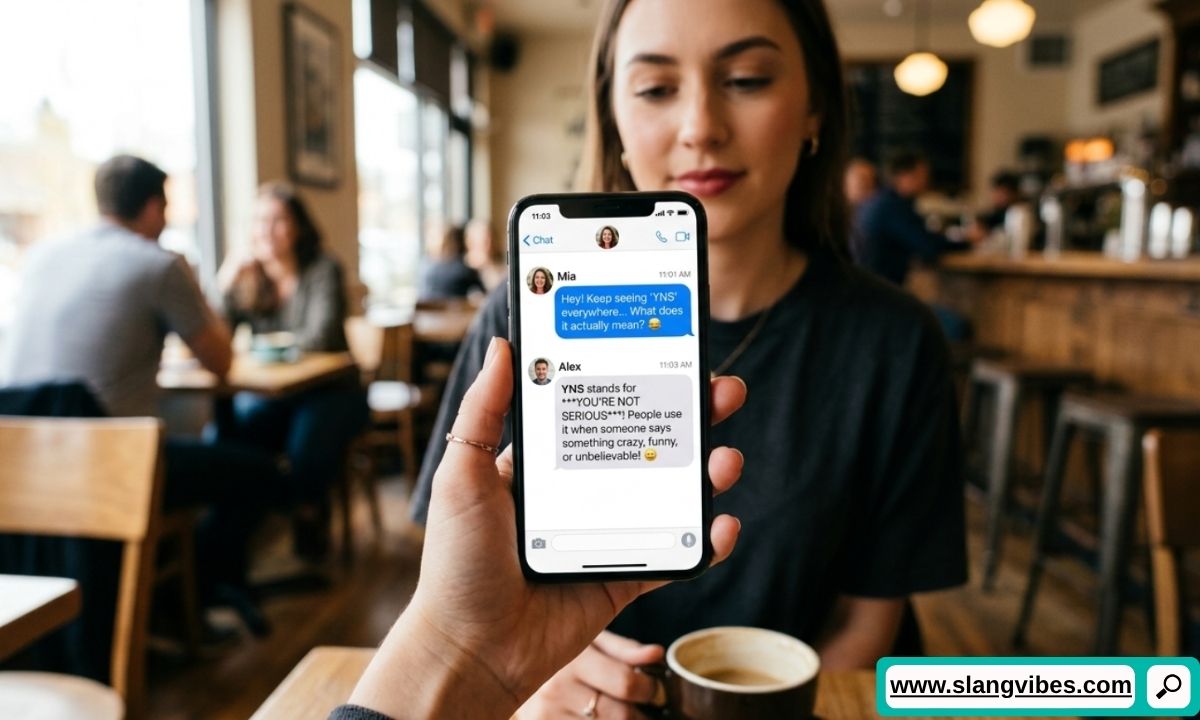
YNS meaning in text stands for “You’re Not Serious.” It’s a reaction abbreviation, the kind people reach for when something is so surprising, so outrageous, or so hard to believe that typing a full sentence feels like too much work. Three letters, one emotional beat, zero wasted space.
Quick Answer: YNS = “You’re Not Serious.” It signals disbelief, shock, or stunned amusement in response to something unexpected.
The secondary meaning worth knowing is “You Never Said.” That one shows up in arguments or dispute threads, usually when someone is pushing back on a claim. It’s far less common than the disbelief reading, but it does exist, and in the wrong context it changes the meaning of a message completely.
Here’s a simple breakdown of when each definition applies:
| Situation | YNS Meaning |
|---|---|
| Someone shares shocking or surprising news | You’re Not Serious |
| Someone disputes a claim made earlier | You Never Said |
| A wild screenshot lands in the group chat | You’re Not Serious |
| A heated argument thread online | You Never Said (occasionally) |
Context always does the sorting. The two or three messages before a YNS almost always tell you which meaning is in play.
Where Did YNS Come From? The Origin of This Slang
Reaction abbreviations have been part of internet culture since the early 2000s. OMG, WTF, SMH, each one captured a specific emotional frequency that full sentences couldn’t match for speed. YNS slotted into that same tradition, filling a gap between pure shock and mild disappointment where neither OMG nor SMH felt quite right.
The slang history of YNS follows the same pattern as most abbreviations that stuck around. It spread through Twitter, Snapchat, and WhatsApp group chats, carried by one simple rule: good slang travels fast when it maps onto a feeling everyone recognizes instantly. You don’t need to explain YNS to someone who’s never heard it. The first time you see it, you get it. That’s the mark of an abbreviation built to last.
What helped it gain ground with Gen Z specifically was timing. As texting moved faster and group chats got busier, single-word and three-letter reactions became the default language for high-energy conversations. Typing “Are you actually being serious right now?” breaks the flow of a fast thread. YNS keeps it moving without losing any of the emotional weight.
It wasn’t invented in one place or by one person. It evolved, the way all living slang does, through repetition across platforms until enough people were using it that it became its own understood shorthand.
Read Also :CMP Meaning in Text: Popular Uses Across Social Media
All the Different Meanings of YNS You Should Know
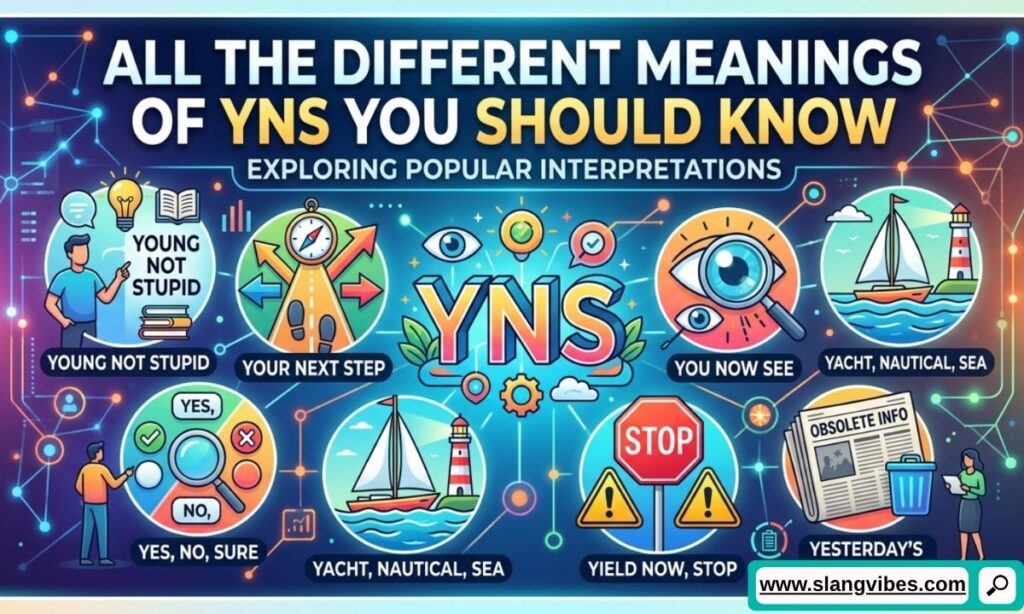
Most people encounter YNS in its “You’re Not Serious” form and stop there. Here’s the thing, there are a few other definitions floating around that show up in different spaces, and knowing them saves you from reading a message wrong.
“You’re Not Serious” is the dominant reading in everyday texting, social media, and group chats. It’s disbelief, sometimes with a hint of humor, sometimes genuinely stunned.
Example: “I got offered the job and they doubled the salary.” / “YNS right now.”
“You Never Said” surfaces in arguments and dispute threads. It’s confrontational rather than expressive, used when someone denies making a claim or contradicts their earlier position.
Example: “YNS that was part of the deal, nobody agreed to that.”
“Your Neighborhood Services” is an institutional acronym used by certain regional organizations and municipal bodies. Nothing to do with texting.
“Youth and Neighbourhood Support” appears in UK social work, charity, and education sectors. Again, no overlap with informal digital talk.
If you’re reading YNS in a casual message after someone shares wild news, none of the institutional definitions are relevant. But if it appears in a formal document or a heated online argument, the alternate interpretations are worth a second look.
How YNS Is Used in Real Text Conversations
Seeing YNS in context makes it click faster than any definition. Here are six realistic exchanges that show how people actually drop it in chat messages across different relationships and situations.
Between best friends:
Jordan: “My landlord just texted and said rent is going up $400 next month.” Priya: “YNS. That’s insane.” Jordan: “Fully serious. Looking at moving.”
In a group chat:
Alex: “Tyler showed up to the reunion with his ex’s sister.” Mia: “YNS 💀” Dev: “He did NOT”
On Twitter/X (quote tweet energy):
Original post: “I’ve decided to start charging my friends for emotional support.” Reply: “YNS right now but honestly same”
Romantic/dating app context:
Match: “I once accidentally sent my boss a meme meant for my best friend. It was about him.” You: “YNS 😭 what happened?” Match: “He never mentioned it. Still haunts me.”
The “You Never Said” version in an argument thread:
Commenter A: “You said you’d cover the deposit.” Commenter B: “YNS that was ever the agreement.”
Deadpan exhaustion version (classic Gen Z):
Sam: “Professor moved the final exam to 7 AM on a Saturday. YNS.”
That last one isn’t asking a question. It’s a statement of tired disbelief. The abbreviation does two different jobs with the same three letters.
Read Also; EMP Meaning in Text: Platform-by-Platform Guide
How Gen Z and Millennials Use YNS Differently
Both generations use YNS, but they don’t always mean exactly the same thing when they type it. The gap is subtle but it changes the tone of a conversation.
Gen Z uses YNS with tonal layers that older users sometimes miss. It can signal genuine shock, performative shock, or exhausted resignation, and the same three letters cover all three without changing. A Gen Z user who texts “YNS they cancelled the show” after a beloved series gets axed isn’t necessarily devastated. They might be genuinely upset, or they might be leaning into the drama of it for effect. Reading which one requires knowing the person.
There’s also a deadpan quality to genz culture’s version of YNS that Millennials tend to use less. Gen Z drops it at the end of a chaotic story almost like a full stop, “and then my phone died at the airport. YNS.” It lands as resigned commentary, not a question.
Millennials use it more literally. A Millennial texting YNS after hearing surprising news is typically expressing genuine, straightforward disbelief without the layers of irony or performative exhaustion. The reaction is closer to “wait, seriously?” than to anything more layered.
Platform habits differ too. TikTok comments, Snapchat streaks, and Discord servers trend younger and carry more of the Gen Z flavor. WhatsApp threads with mixed-age groups tend to see the more literal Millennial usage. Same abbreviation, different emotional register depending on who’s typing it and where.
YNS on Every Platform: What It Means Where You Find It
YNS shows up across most major platforms, but the vibe shifts depending on where you are. Here’s how it lands in different online spaces.
On Snapchat, YNS is almost always a quick, close-contact reaction. You send it to someone you know well, after they share something wild or unexpected. It’s low-effort in the best way, a signal that says “I’m here, I heard you, and I’m shook.”
On TikTok, it turns up in the comments section under plot-twist videos, dramatic life updates, or anything where the creator reveals something nobody saw coming. TikTok comments move fast, and YNS fits the format perfectly.
On Twitter/X, it carries a sharper edge. Quote-tweeting with YNS lands as pointed skepticism or amused disbelief, depending on tone. It’s the reaction that says “I see what you posted and I have thoughts.”
On Instagram DMs, it’s the close-friends thread energy. Someone shares a screenshot or a story, and YNS is the instant reaction before the voice notes start flying.
On Discord, particularly in gaming communities and small servers, it occasionally still surfaces as “You Never Said” in argument threads. Younger audiences default to the disbelief reading, but older Discord users sometimes use the dispute version.
On WhatsApp, group chat reactions are where YNS lives most naturally. Someone drops news, and three different people reply with it before anyone types a full sentence.
When You Should NOT Use YNS in Text
Knowing a slang term is one thing. Knowing when to put it down is just as important. YNS works brilliantly in the right context and lands badly in the wrong one.
Avoid it in professional settings. Texting a coworker or manager “YNS” after they share a work update reads as dismissive or mocking, even if that’s not the intent. In messaging contexts where tone already needs to stay clear, abbreviations that signal disbelief create friction.
Skip it with older family members who don’t text in slang. Sending YNS to a parent or grandparent who hasn’t seen it before is going to prompt a confused “what does that mean?” reply, which derails the conversation.
Be careful in new relationships or early-stage friendships. Someone who doesn’t know you well might read YNS as dismissive rather than engaged. The playful version of disbelief requires shared context and familiarity to land right.
Avoid it when the conversation is already emotionally charged. If someone is sharing something serious or upsetting and you reply with YNS, it reads as minimizing, even unintentionally. In sensitive digital talk, a full sentence does more work than any abbreviation.
What to Say When Someone Texts You YNS
Getting a YNS in your inbox usually means one of three things: someone is shocked by what you said, someone is playfully disbelieving it, or someone is disputing it. How you respond depends on which one it is.
If YNS reads as curious shock, they want confirmation and more detail. Keep going. “Yes, fully serious, here’s what happened next” is the natural follow-up. They’re not dismissing you. They’re telling you they’re locked in and want the rest of the story.
If it reads skeptical, stay calm. “I know it sounds unlikely but here’s exactly what happened” lands better than getting defensive about a three-letter response. Defensiveness turns a small moment into a bigger conversation than either person wanted.
If it’s the playful version between close friends, match the energy. They’re enjoying the moment. Lean into it.
Here’s the thing: YNS is almost never a conversation-ender. It’s an invitation to continue. Someone who texts it is engaged, not dismissing you.
Read Also: IFG Meaning in Text Messages and Social Media Explained
Slang Words Similar to YNS and When to Use Each One
YNS isn’t the only abbreviation living in the disbelief zone. Several similar slang terms share its emotional space but with different tones. Knowing which one to pick keeps your texting from going flat.
| Slang | What It Means | How It Feels vs YNS |
|---|---|---|
| FR? | For Real? | Softer, less shocked, more curious |
| OMG | Oh My God | Broader shock, works for good and bad news |
| SMH | Shaking My Head | More disappointed than disbelieving |
| WTF | What The F*** | More visceral and aggressive than YNS |
| Deadass? | Are you being completely serious? | Closest cousin to YNS; more NYC-coded |
| No Way | Written-out disbelief | Softer and more casual than YNS |
| NGL | Not Gonna Lie | Signals honesty before a blunt statement; not pure reaction |
| BRO | Standalone reaction | Tone-dependent; works for shock, awe, or disappointment |
The short answer is: YNS and “Deadass?” are the closest pair. Both question sincerity directly. YNS is faster and more clipped. “Deadass?” has a slightly more interrogative energy. FR sits in the same lane but lands softer. SMH belongs in a completely different emotional register.
Swapping these carelessly shifts the tone of a message more than most people realize.
Frequently Asked Questions
It means the same thing regardless of who sends it: “You’re Not Serious.” In most cases it signals surprised disbelief, but between close friends it often reads as playful mock-shock rather than genuine skepticism.
Neither, and both. Between friends reacting to good news, it reads as delighted disbelief. In an argument or after bad news, it skews more negative. The tone of the surrounding conversation determines how it lands every single time.
Both live in the disbelief space, but FR (“For Real?”) is softer and more genuinely curious. YNS carries more shock and slightly more intensity. Use FR when you want to gently confirm something. Use YNS when the news is genuinely wild.
In most everyday texting, “You’re Not Serious” is the dominant meaning. “You Never Said” shows up in specific argument or dispute contexts. The messages before it almost always make clear which one applies.
Probably not right away. YNS works best with people who already know your tone. With a new acquaintance or someone you’re just getting to know, it can come across as dismissive before the relationship has the context to soften it.
YNS is one of those abbreviations that feels obvious the second you learn it, and then you start spotting it in every group chat you’re in. Three letters, one clean emotional beat, no ambiguity when the context does its job.
Next time you see YNS in a text, you’ll know exactly what to say back.

Alex Carter is a language enthusiast and internet culture expert at SlangVibes. He explains the latest slang terms and text meanings in simple, clear English so everyone stays in the loop.