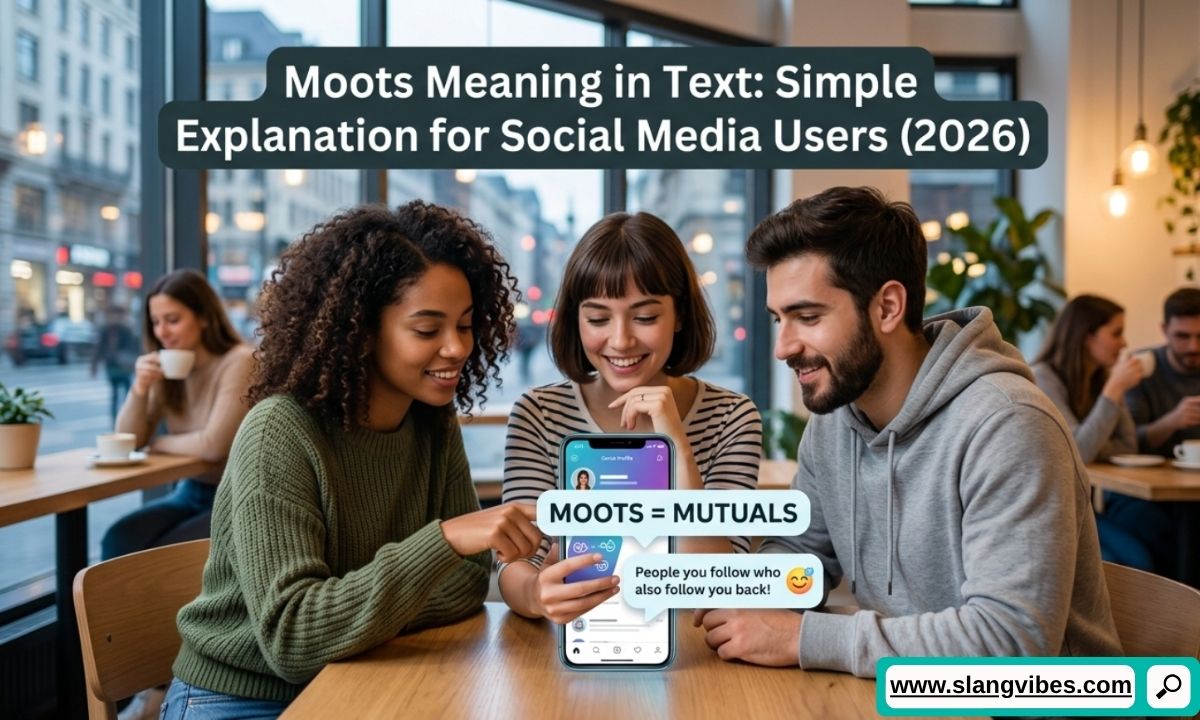
So you’re scrolling through Instagram, minding your own business, and someone drops a comment that says “ayy you’re one of my moots now fr.” You stare at your screen. You read it three times. What does that even mean? You’re not alone here. Half the internet has had this exact moment, that small panic when a word shows up that everyone else seems to understand except you. Moots meaning in text comes down to one simple idea: mutuals, the people who follow you back and you follow them too.
That’s it. That’s the whole mystery. But there’s more to unpack here, because this little word carries a lot of social weight in 2026, and knowing how to use it (or when to avoid it) can save you from an awkward reply. This guide breaks down everything you need to know, from where the term came from to how it shows up differently on TikTok versus Discord versus your group chat.
What Does “Moots” Mean in Text? (Quick Definition)
Here’s the simple answer. Moots meaning in text refers to mutuals, people you follow online who follow you back. It’s short for “mutuals,” trimmed down the way internet slang tends to do with most words these days. If you and another user both hit follow on each other, congrats, you’re moots now.
The tone here matters a lot. This isn’t a formal label like “colleague” or “acquaintance.” It’s playful, warm, and a little informal, the kind of word you’d use in a comment section, not a cover letter. People use it to acknowledge a connection without making things sound overly serious.
Think of it this way: a follower is someone watching from the sidelines. A moot is someone standing next to you in the same circle, waving back. That small difference changes the whole vibe of the interaction.
You’ll mostly see this term in casual digital spaces. Comment sections, DMs, bios, group chats. It rarely shows up in professional settings, and honestly, it would feel strange if it did. Below is a quick breakdown of how the word functions:
| Example / Context | What It Means / How It Feels |
|---|---|
| “We’re moots now!” | Mutual follow confirmed, friendly excitement |
| “Shoutout to my moots” | Public appreciation for online friends |
| “Add me, let’s be moots” | A casual invite to follow each other |
Once you get the definition down, the rest of this guide becomes a lot easier to follow.
Read Also: STG Meaning in Text: What This Popular Acronym Really Means 📱💬
Where Did “Moots” Come From? (Origin and History)
Slang doesn’t just appear out of nowhere, and “moots” has a pretty traceable path. The word “mutuals” started gaining traction on Twitter and Tumblr years ago, back when those platforms built entire micro-communities around who followed whom. People wanted a quick way to say “we follow each other,” so “mutuals” became the standard term.
From there, internet culture did what it always does: it shortened things. “Mutuals” became “moots” because typing four fewer letters matters when you’re replying to fifty comments a day. This shift mirrors how other slang terms evolved too, trimmed for speed, optimized for fast-paced typing on a phone screen.
Did You Know? The word “moot” actually existed in English long before social media, tracing back to Old English where it meant “a meeting” or “an assembly.” Legal terms like “moot court” and “moot point” come from that same root. The slang version you see today has zero connection to that history, it’s purely a coincidence that the shortened form of “mutuals” landed on the same spelling.
As Twitter’s mutuals culture spread, moots meaning in text picked up steam on Instagram and TikTok too. Each platform absorbed the term in its own way, though the core idea stayed consistent. By 2026, it’s become one of the more recognizable pieces of internet slang moots culture has produced, sitting comfortably alongside terms like “mutuals,” “fam,” and “squad.”
Understanding where a word comes from helps you use it with more confidence. Now that you know the backstory, let’s look at how it actually plays out across different apps.
Moots Meaning on Instagram, TikTok, Twitter/X, and Discord (Platform Differences)
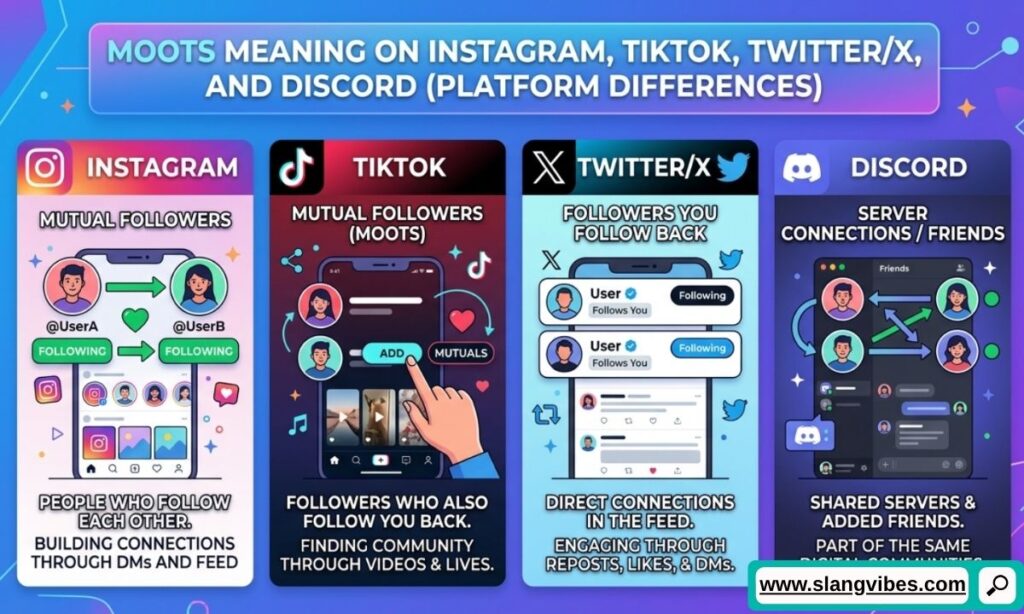
Not every platform treats this word the same way, and that’s something a lot of guides skip over. Knowing what does moots mean on TikTok versus what it means on Discord can genuinely change how you use it.
On Instagram, mutuals meaning in social media circles often shows up in bios. You’ll see phrases like “mutuals only” or “DM if we’re moots.” Instagram mutuals meaning here leans toward visibility and trust, people want to know who’s actually following back before they engage further.
TikTok flips the energy a bit. Comment sections light up with phrases like “good morning moots” or “love you moots.” It’s less about tracking follow-backs and more about community vibes, a way to greet the people who consistently show up in your comments. Moots meaning in chat on TikTok feels closer to a friendly nickname for your regulars.
Twitter/X is where this whole thing started, so naturally, it stays closest to the original definition. Mutuals meaning in Instagram borrowed heavily from Twitter’s culture, where moots meaning in text simply tracks two-way follows without much extra sentiment attached.
Discord adds its own twist. Here’s a quick comparison:
| Platform | How “Moots” Is Used |
|---|---|
| Bio tags, mutual-follow culture | |
| TikTok | Comment greetings, community warmth |
| Twitter/X | Original mutual-follow tracking |
| Discord | Server regulars you vibe with often |
So while the core definition stays steady, moots meaning WhatsApp conversations or app-specific contexts can shift the tone slightly. Context always matters.
Real Text and DM Examples of “Moots” in Use
Reading definitions only gets you so far. Seeing the word in action makes everything click faster. Here are five realistic conversation examples showing how people actually use this term.
Example 1: Instagram DM Person A: “wait are we moots? i feel like i see you everywhere lol” Person B: “yesss we are now, officially 🤝”
Example 2: TikTok comment User: “good morning to all my moots, hope today treats you well 🌞”
3: Group chat Friend 1: “can someone add my moot to this chat, he’s chill” Friend 2: “say less, sending the invite”
4: Twitter/X reply User A: “love seeing my moots pop up on my timeline” User B: “facts, this app hits different when your moots are active”
Example 5: Dating app opener Match 1: “lol we have like 5 moots in common” Match 2: “small world, guess that’s a good sign 😂”
Notice how the tone shifts slightly depending on the setting, but the underlying meaning stays consistent. Whether it’s a quick comment or a longer DM exchange, moots meaning in text always points back to that same idea of mutual connection. These examples should give you a solid feel for how natural this word sounds once you start using it yourself.
Read New Articles: What Does WSP Mean in Text? Real Meaning in Chat & Social Media
Singular vs. Plural: “Moot” vs. “Moots” (Common Grammar Mix-Up)
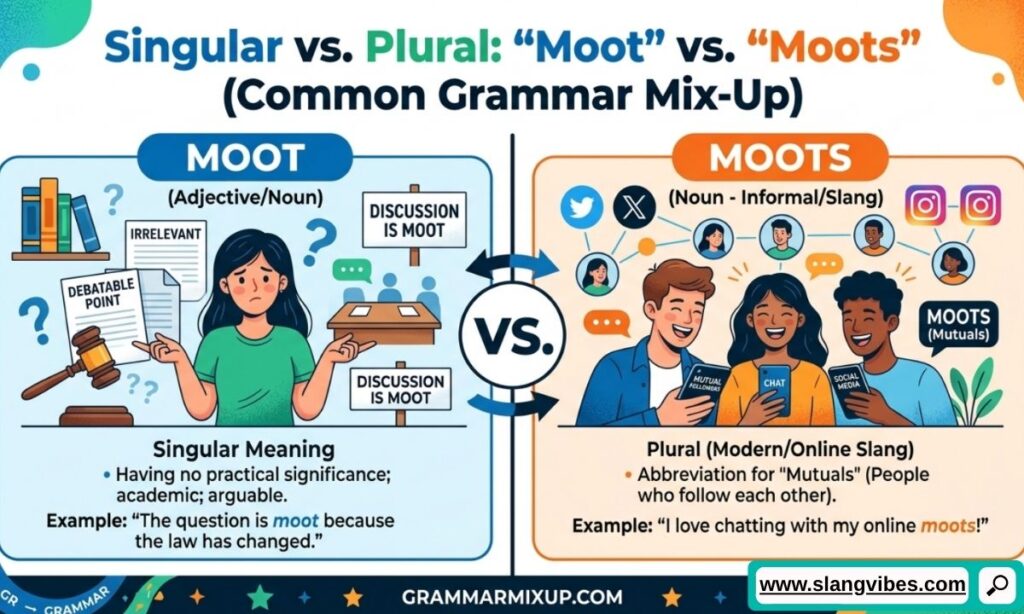
This part trips people up more often than you’d expect. Since “moot” already exists as a real English word with a totally different meaning, things can get confusing fast.
When referring to one person, you’d say “he’s my moot” or “she’s a moot of mine.” The plural form, “moots,” refers to multiple people, as in “shoutout to my moots” or “love you all, my moots.” Grammatically, it behaves like a regular noun, just add an “s” for plural.
Here’s where context becomes critical, though. The standalone word “moot” can also mean something is debatable or no longer relevant, as in “that point is moot now.” If someone texts “that’s moot,” they likely mean the legal-adjacent meaning, not the slang one. The surrounding sentence usually makes the intended meaning obvious within a second or two.
A simple way to keep both meanings straight:
| Phrase | Likely Meaning |
|---|---|
| “He’s my moot” | Mutual follower (slang) |
| “That argument is moot” | No longer relevant (traditional English) |
| “My moots showed up today” | Group of mutual followers (slang) |
Once you spot this pattern, the confusion clears up almost instantly. Most native speakers pick up on the difference through tone and sentence structure without even thinking about it.
Moots vs. Mutuals vs. Friends vs. Followers: What’s the Real Difference?
People often treat these four words as interchangeable, but they actually sit on a sliding scale of closeness. Understanding moots vs mutuals difference, along with where friends and followers fit, helps clear up a lot of confusion.
A follower is the most basic connection. They see your content, but you might not follow them back, so there’s no mutual recognition happening yet. A mutual (or moot, since they’re essentially the same thing) takes it one step further: both people follow each other, creating a two-way relationship, even if it’s a light one.
Friends go deeper than that. This usually implies some real connection beyond just following, conversations, shared history, maybe even meeting in person. Here’s a simple breakdown:
| Term | Relationship Level |
|---|---|
| Follower | One-way, no reciprocal follow |
| Moot / Mutual | Two-way follow, casual recognition |
| Friend | Deeper bond, often beyond the app |
So while moots meaning in chat often gets tossed around loosely, it technically sits in the middle of this scale. It’s warmer than a stranger but lighter than an actual friendship. That distinction matters when you’re figuring out how to address someone online, calling a random follower your “friend” might feel like a stretch, but calling them your “moot” fits just right.
When NOT to Use “Moots” (Common Mistakes and Cringe Red Flags)
Knowing when to skip this word matters just as much as knowing when to use it. A few situations call for caution.
First, professional settings are a hard no. Slang like this has no place in a work email or LinkedIn message, even if you’re trying to sound relatable. Second, avoid using it to imply romantic interest. Moots meaning in text has nothing to do with attraction, it’s strictly about mutual following, so dropping it in a flirty context can send mixed signals.
A few more situations worth flagging:
- Calling someone your “moot” before they’ve actually followed back, this can feel presumptuous
- Overusing the term in every single comment, which starts to feel forced rather than genuine
- Using it with people much older or outside typical social media slang circles, where the term might not land
- Mixing it into formal writing or customer service messages
Gen Z slang terms 2026 trends fast, and “moots” is no exception. While it’s still widely understood right now, throwing it into every sentence can come across as trying too hard. The best approach? Use it naturally, the way you’d drop any casual nickname, only when it actually fits the moment.
How to Respond When Someone Calls You Their Moot
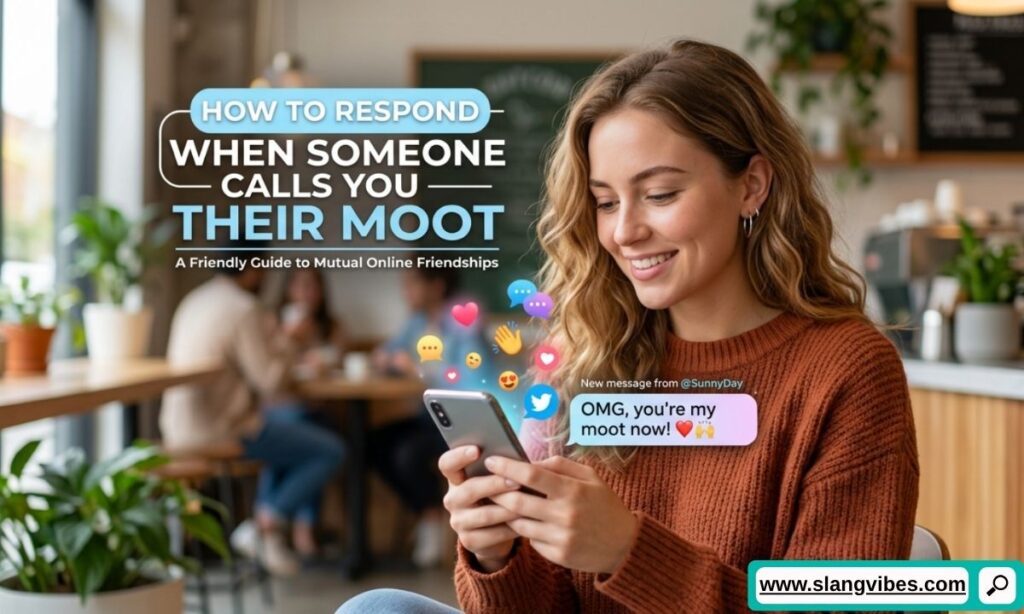
Getting tagged as someone’s moot doesn’t require an essay back. A short, warm reply usually does the job perfectly.
In the US, common replies lean casual: “appreciate you fr” or “right back at you 🤝.” UK users sometimes lean slightly different, with phrases like “cheers, mate” or “love that, moot.” Either way, matching the other person’s energy works best. If they sent a quick one-liner, a quick reply fits. If they wrote something longer and more heartfelt, it’s worth matching that warmth.
A few solid response options:
- “Yesss, glad we’re moots now!”
- “Aww thank you, you’re one of mine too”
- “Appreciate you showing up in my comments 🙏”
Whether it’s a TikTok comment or an Instagram DM, social media slang explained simply comes down to reading the room and replying with similar energy. There’s no wrong answer here, as long as the tone feels genuine rather than copy-pasted.
Read New Article: GPI Meaning in Text: Everything You Need to Know in 2026
Frequently Asked Questions
Yes, “moots” is simply a shortened version of “mutuals.” Both refer to people who follow each other back online, and the words are used interchangeably across most platforms.
Yes, the singular form is “moot.” You’d say “he’s my moot” when referring to a single mutual follower, while “moots” refers to multiple people.
Mostly, though Millennials have picked it up too, especially since many grew up alongside early mutuals culture on Twitter and Tumblr. It’s not exclusive to one age group anymore.
No, those are unrelated. “Moot point” comes from an older English legal term meaning something debatable, while the slang “moots” simply refers to mutual followers online.
Not at all. It’s strictly about mutual following and casual online connection, with no romantic implication attached, even on dating apps where the term sometimes pops up.
Final Thoughts
At its core, moots meaning in text boils down to something pretty simple: mutual respect between two people who follow each other online. It’s friendly, lightweight, and honestly kind of nice once you understand it, a small way of saying “I see you, and I’m glad we’re connected.”
Whether you’re scrolling TikTok comments, replying to an Instagram DM, or chatting in a Discord server, this term shows up everywhere now, and understanding its different shades across platforms makes you sound a lot more fluent in how online communities actually talk. Next time you see “moots” in a text, you’ll know exactly what to say back.

Alex Carter is a language enthusiast and internet culture expert at SlangVibes. He explains the latest slang terms and text meanings in simple, clear English so everyone stays in the loop.