Picture this. It’s one in the morning, and you’re staring at a screen that never brings anything good. You’ve reread the last message you sent to someone who hasn’t written back. You’ve watched the same Instagram story for the fifth time tonight. Somewhere in your group chat, a friend sums up the whole scene with two words, and everyone knows exactly what they mean.That’s <strong>down bad slang</strong> in action. It shows up in comment sections, group chats, and now, of all places, a Taylor Swift album title. This guide breaks down what it means, where it came from, and how to use it without sounding off.
What Does “Down Bad” Mean?
Quick Answer: Down bad describes someone acting desperate for a person’s attention, usually in a way that costs them a little dignity. It also has an older meaning: being in a rough spot in life, financially or emotionally.
The romantic version is the one you’ll see most today. If you’re texting someone who left you on read three days ago, you’re down bad. If you’re refreshing your crush’s story every ten minutes hoping they post something, that’s down bad too. The word carries a bit of a roast built into it. Someone using this phrase isn’t just noting that you like a person. They’re pointing out that the liking has taken over your judgment.
The older meaning still gets used, especially by people who grew up around it before the internet reshaped it. In that sense, down bad means hitting a genuinely low point: broke, stressed, or struggling with something that has nothing to do with romance. A lost job, a failed test, a losing streak at the casino. Context tells you which meaning applies. A caption under a thirst trap means one thing. A tweet about rent means another.
What ties both meanings together is a loss of composure. Down bad isn’t sadness on its own. It’s sadness (or longing) strong enough to make someone act against their own self-interest.
Read Also: Oura Meaning in Slang: Real Examples from TikTok, Snapchat & Text Messages
Where the Phrase Comes From
The roots trace back to African American Vernacular English, where “down bad” described being in a hard place: broke, struggling, or dealing with a run of bad luck. Wiktionary’s entry still lists this older, non-romantic sense as the original one.
From there, the phrase moved through several distinct stages before landing where it is today:
- Early 2010s: The phrase surfaces in rap tracks, with its meaning tied to hardship rather than romance.
- 2017: A viral tweet from rapper Kash Doll, documented on Know Your Meme, helps push the phrase toward its now-familiar “desperately into someone” meaning.
- 2019: Dreamville releases the track “Down Bad,” featuring J.I.D, Bas, J. Cole, EARTHGANG, and Young Nudy. The song itself leans on the older meaning, describing a climb out of hardship. The release still gives the phrase a huge boost in visibility.
- 2020 to 2021: TikTok and Twitter run with the romantic meaning, turning it into a go-to caption for callouts, roasts, and self-deprecating posts.
- 2024: Taylor Swift titles a song “Down Bad” on The Tortured Poets Department, introducing the phrase to an audience far outside hip-hop and TikTok culture.
That’s a lot of ground for one phrase to cover in roughly a decade, and it explains why people disagree about what it “really” means. Depending on who’s talking, both answers are correct.
Read More: SH Meaning in Text: Uses, Examples & Social Media Guide (2026)
Down Bad in Pop Culture: Taylor Swift, TV, and the Dictionary
Swift’s “Down Bad” leans into the emotional side of the phrase rather than anything explicit. The song deals with the disorientation of falling hard for someone and feeling foolish about it afterward, which lines up neatly with how the term gets used in everyday conversation: less about lust, more about losing your composure over a person.
Merriam-Webster now carries an entry for the phrase, defining it as being in a bad state or condition, with a note on the romantic-desperation sense. The dictionary’s own usage examples pull from mainstream press, including a Time piece describing a House of Dragon character, a Vulture review, and a New Yorker essay. That’s a strong sign the word has moved well past internet-only slang and into everyday published English.
Not everyone agrees on where the line sits, though. Palmer Ward, who ran the account @downbadpatrol, spent time documenting examples of the romantic version online and has pushed back on the idea that the phrase is inherently negative or creepy. His take treats it as closer to a shared, slightly embarrassing human experience than an insult.
Editor’s note: the split between the two meanings is genuinely fun to watch play out. Older speakers and people tied to the phrase’s hip-hop roots still use down bad for hardship, in line with the original sense, while most of Gen Z online reaches for it only in a romantic context. Both uses are correct at this point, and mixing them up is half the joke.
Read New Article: DRS Meaning in Chat: What It Really Means in Text, Snapchat & Social Media (2026)
How to Use “Down Bad” in a Sentence
Down bad works as an adjective phrase, sitting after a form of “to be.”
- “I’m down bad” (standalone confession)
- “He’s down bad for her” (attached to a specific person, using “for”)
- “She’s been down bad since the breakup” (attached to a situation, using “since”)
- “That’s down bad” (reacting to someone else’s behavior)
People stretch the phrase for extra emphasis by swapping “bad” for a stronger word: down horrendous, down atrocious, down abominable. These aren’t standard dictionary terms, but they show up constantly in captions and comment sections when “down bad” doesn’t feel dramatic enough for the moment.
One common mix-up: using down bad to describe someone who’s simply single, without any specific desperate behavior attached. The phrase needs an action or a pattern behind it, like repeated texting, stalking a profile, or an obvious change in behavior around a crush. Being single isn’t down bad on its own. Acting on loneliness in an embarrassing way is.
Down Bad on TikTok, Twitter/X, and Instagram
The tone shifts a bit depending on where you see it.
| Platform | Common Use | Typical Tone |
|---|---|---|
| TikTok | Comments calling out desperate behavior in a video | Mocking, but usually playful |
| Twitter/X | Self-deprecating posts about your own bad decisions | Humorous, bonding over shared misery |
| Comments under thirst traps or obvious crush posts | Sarcastic |
On TikTok, it’s mostly a comment-section reaction, dropped under videos where someone’s clearly caught in a moment of romantic desperation. On Twitter/X, people tend to use it about themselves first, turning an embarrassing 2 a.m. text into a joke instead of a confession. Instagram lands somewhere in between, often paired with a laughing emoji rather than a full sentence.
Read Here: What Does Meta Mean in Slang? A Real-Life Guide to How People Use It Today (2026)
What Down Bad Looks Like in Real Life
Here’s how the phrase plays out across a few different scenarios.
Group chat, after someone admits to liking an old photo:
Priya: guys I accidentally liked his photo from 2021 and unliked it 0.3 seconds later but the notification probably already sent Dana: oh you’re SO down bad Priya: I know. I know.
A sibling conversation about a crush:
Mateo: why do you keep asking if she texted back Leo: she hasn’t Mateo: bro you’re down bad, put the phone away
A non-romantic use, in a chat about money:
Jordan: rent’s due Friday and I have $40 to my name Alex: down bad down bad Jordan: don’t remind me
These examples cover the three most common lanes: the self-deprecating group chat post, the friend-to-friend roast, and the older, non-romantic “rough patch” meaning still hanging around in casual use.
Down Bad vs Simp vs Thirsty vs Whipped
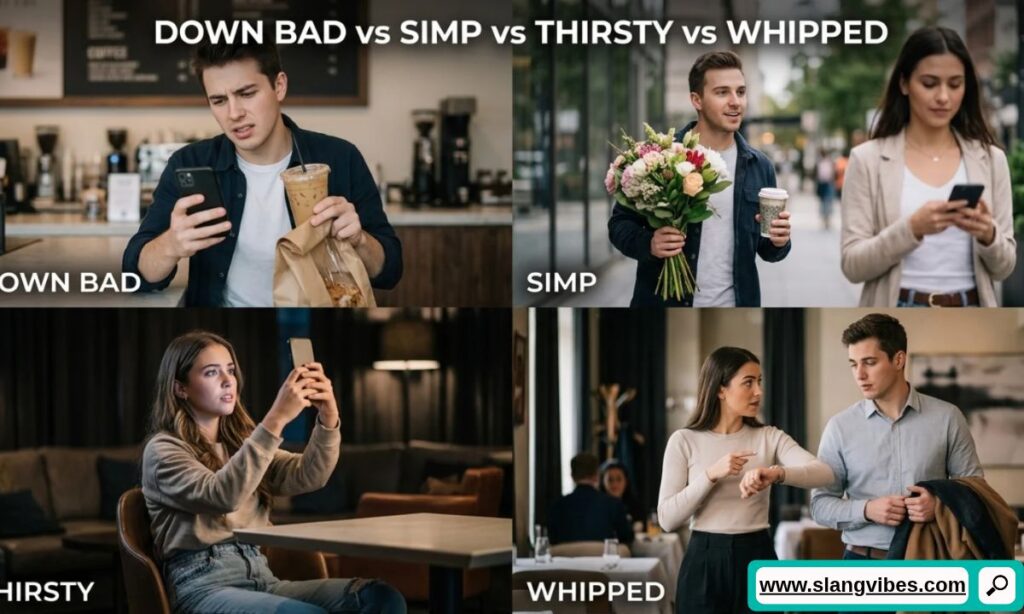
These four terms overlap, but they’re not identical.
| Term | What it describes | Focus |
|---|---|---|
| Down bad | A desperate emotional or romantic state | Feeling |
| Simp | Doing too much for someone who doesn’t reciprocate | Behavior |
| Thirsty | Craving attention, often sexual | Desire |
| Whipped | Letting a partner control your decisions | Control in a relationship |
A simp is often down bad, but down bad doesn’t require simping. You could be down bad quietly, with nobody around to witness the extra effort. Simp specifically points at visible, over-the-top actions: buying gifts too early, dropping everything for a text back. Thirsty leans more toward wanting attention in general, romantic or otherwise, without the embarrassment angle baked in. Whipped is about an existing relationship, not a one-sided crush.
Read More Articles: Aura Slang Meaning: What It Means on TikTok & Social Media
When Not to Use “Down Bad”
This one’s built for casual settings among people who already know internet slang. A few places it doesn’t belong:
- Job interviews or workplace conversations
- Conversations with someone going through an actual loss or grief
- Formal writing, like a cover letter or a school assignment
- Talking with someone who’s dealing with real, ongoing mental health struggles
The phrase works because it’s exaggerated and a little silly. Aimed at someone in genuine emotional pain, it stops being funny and starts sounding dismissive. Save it for lighthearted moments: a crush, a bad text decision, a friend’s obvious infatuation.
How to Respond When Someone Calls You Down Bad
You’ve got options beyond just taking the hit.
Own it: “Yeah, and? No shame in my game.” Deflect: “I’m not down bad, I’m just thorough.” Flip it back: “Says the person who screenshots their crush’s stories.”
Most of the time, the label isn’t meant as a real attack. Playing along tends to land better than getting defensive about it.
FAQ
Is “down bad” an insult?
Not usually. Among friends, it’s a light roast rather than a genuine put-down. It only reads as an insult when a stranger uses it to mock feelings someone hasn’t shared willingly.
What’s the difference between down bad and simp?
Down bad describes a feeling or state. Simp describes specific actions, like overspending or over-texting someone who isn’t reciprocating. Overlap is common, but the words aren’t interchangeable.
Where did “down bad” actually come from?
It started in African American Vernacular English, originally describing financial or personal hardship. Internet culture reshaped it into a term for romantic desperation between roughly 2017 and 2021.
Is “down bad” okay to use around kids?
The phrase itself has no profanity attached to it. It does carry a romantic, sometimes sexual undertone depending on context, so it’s worth reading the room before using it around younger kids.
Does “down bad ” mean something different for a guy versus a girl?
No. The meaning stays the same regardless of who’s using it or who it’s aimed at. Any difference comes down to the specific behavior being described, not gender.
Conclusion
Down bad has covered a lot of distance for a two-word phrase, moving from a term about financial hardship to a Taylor Swift album title and a Merriam-Webster entry. The core idea hasn’t changed much though: it’s about losing your composure over someone or something, and being self-aware enough to laugh about it. Use it with friends who already know the phrase, skip it in serious moments, and you’ll land it right every time.

Alex Carter is a language enthusiast and internet culture expert at SlangVibes. He explains the latest slang terms and text meanings in simple, clear English so everyone stays in the loop.