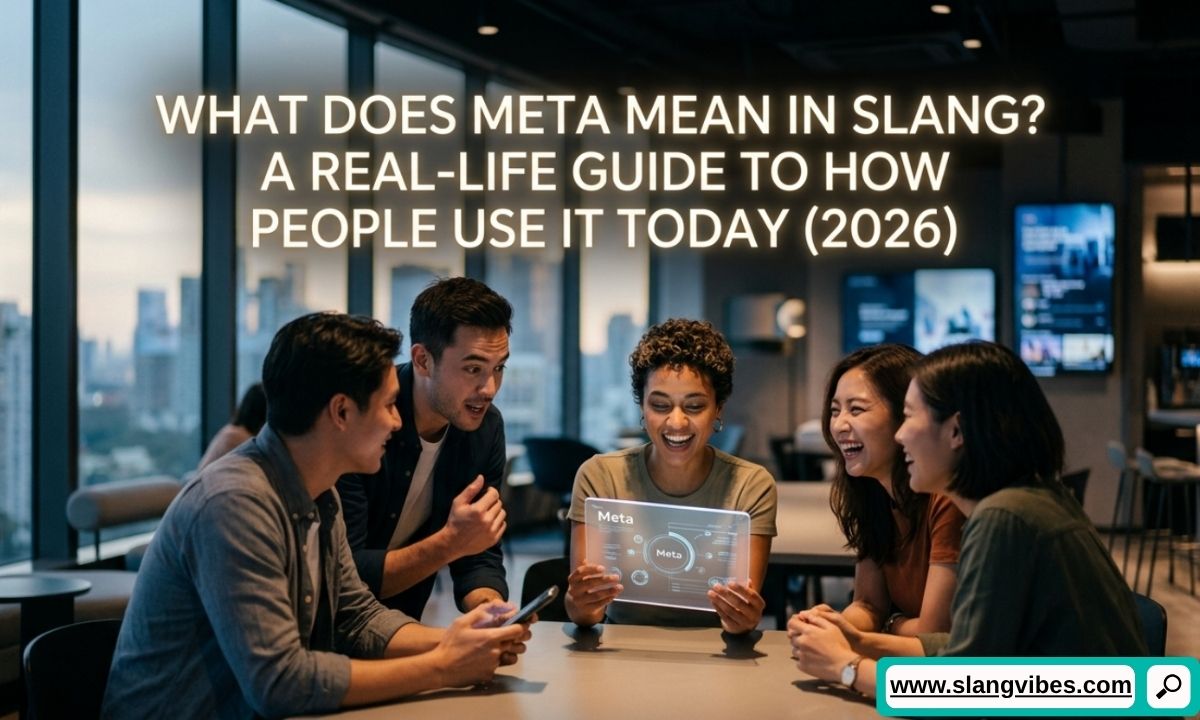
Picture this: you’re scrolling through a group chat. Someone drops “lol this is so meta” after sending a screenshot of the conversation you’re already in. You pause. Everyone else moves on like nothing happened. So you sit there, phone in hand. You’re wondering what does meta mean in slang and why it made three people laugh at once. This word shows up everywhere now. You’ll spot it in gaming lobbies, TikTok captions, and work Slack channels. It carries more than one meaning, and mixing them up leads to confusing moments. This guide breaks down every version of meta you’ll run into. You’ll learn where it started and how to use it without sounding off.
What Does Meta Mean in Slang? The Quick Answer
So what does meta mean in slang, boiled down to plain English? It describes something self-aware or self-referential. A joke pointing out it’s a joke is meta. A video mocking trends while riding the same trend is meta too.
The word splits into two everyday lanes. One lane covers content, humor, and internet culture: memes about memes, jokes commenting on themselves. The other lane lives inside gaming, where meta means the strongest strategy players lean on right now.
Both lanes share one thread: awareness. Meta signals someone stepping back and noticing the bigger picture, whether it’s a joke format or a winning build in a video game.
Quick examples show this best:
- “Explaining the joke inside the joke is so meta.”
- “Screenshotting your own tweet to post it again? Meta.”
- “Everyone’s running the same build now, it’s the meta.”
You don’t need a college degree to get these examples. The word works because it points at something obvious once you see it: content aware of its own existence, or a strategy everyone already knows works.
No single dictionary line covers every use case, either. Meaning shifts depending on who’s talking, where the conversation happens, and what the person means to highlight. A teenager texting a friend and a streamer breaking down a patch note both reach for the same word, yet they’re pointing at different things entirely.
Read Also: iMsg Meaning in Text: The Viral Chat Term Explained with Real Examples (2026)
Where the Word “Meta” Comes From
Meta didn’t start online. Its roots go back to Ancient Greek, where the word meant “beyond” or “after.”
Philosophers used it first. Aristotle’s work on ideas beyond physics earned the label “metaphysics,” meaning beyond physics. Writers borrowed the same trick later, calling a story about storytelling “metafiction.”
For decades, meta stayed inside classrooms and books. Regular conversations rarely touched it.
Early internet forums changed this path. Programmers and gamers picked up the prefix to describe systems commenting on themselves: a “meta discussion” about how a forum worked, rather than what people posted on it.
Gaming communities pushed the word further. Strategy guides started referencing the “metagame,” the layer of knowledge sitting above individual matches, covering which characters or tactics dominate a season.
By the 2010s, meme culture grabbed the word and ran with it. Jokes about jokes, memes about memes, and self-aware captions turned meta into everyday internet vocabulary. Around the same stretch, online gaming communities built around titles with shifting character rosters leaned on the word heavily, turning “the meta” into standard vocabulary on forums and in patch-note breakdowns long before TikTok existed.
Today, the word carries both histories at once. Academic roots. Internet slang. Somehow, the two coexist without much friction.
The Two Real Meanings of Meta in Slang
Getting a straight answer for what does meta mean in slang gets tricky because two different worlds use the same word. Knowing which one applies changes everything about how you read a sentence.
Self-Aware Meta: Content Aware of Itself
This version shows up most across social media, group chats, and memes. Something counts as self-aware meta when it points at its own existence instead of pretending to stand alone.
A TikTok video mocking trend formats, filmed using the exact trend it mocks, fits perfectly. A meme explaining why memes stop being funny once explained also fits, ironically.
Friends do this constantly without naming it. Someone points out a repeated joke pattern mid-conversation, and the conversation turns meta on the spot.
Content creators lean on this heavily too. Videos titled “why I keep making videos about making videos” pull viewers into a loop, and audiences generally love it. The format rewards viewers who catch the layered joke.
Self-aware meta thrives on timing. Say it too early, and nobody gets the reference yet. Say it after everyone already noticed, and it lands perfectly.
Here’s a simple test: if removing the self-reference leaves the joke completely flat, the humor depended on being meta in the first place.
Read More: Sigma Meaning Slang: Complete Guide to the Viral Internet Term (2026)
Gaming Meta: Most Effective Tactic Available
Gaming flips the definition slightly. Here, meta stands for Most Effective Tactic Available, often shortened to the acronym itself.
Players use “the meta” as a noun. It refers to whichever characters, weapons, or strategies dominate a game at a given moment. Patches shift it. Community testing shifts it. A single tournament run reshapes it overnight.
“What’s the meta right now” is a real question people ask before ranked matches. Ignoring the answer puts a player at a disadvantage against opponents who studied it.
This meaning carries a sharper edge sometimes. Calling someone a “meta slave” isn’t a compliment. It suggests a player only copies whatever build wins, without creativity or personal style. Competitors save the term for players leaning entirely on dominant strategies instead of experimenting.
“Off-meta” describes the opposite: a pick or build working outside the dominant strategy, riskier but occasionally more rewarding.
This meaning didn’t start as internet slang. Esports commentary and strategy forums built it first, and general internet culture borrowed the vocabulary later.
Did You Know? The backronym “Most Effective Tactic Available” gets debated among linguists. Some trace gaming meta straight back to the Greek root instead, describing strategy existing “beyond” or “above” individual matches. Either origin story works, and both show up in gaming communities today.
Is Slang Meta the Same as the Company Meta?
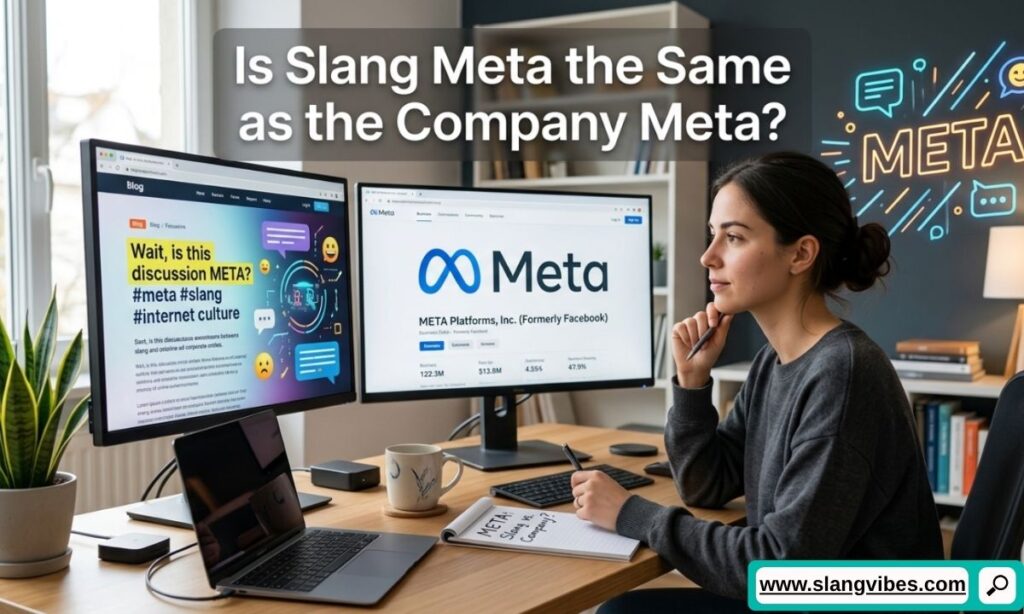
Short answer: no, though the overlap causes real confusion.
Meta Platforms is the company behind Facebook, Instagram, and WhatsApp. Mark Zuckerberg renamed the parent company in 2021, borrowing the word to signal a shift toward virtual and augmented reality.
Slang meta existed long before the rebrand. Gamers and internet communities used the word for years before any company adopted it as a name.
Context usually makes the difference obvious. A sentence about privacy policy, stock prices, or VR headsets points toward the company. A sentence about jokes, strategies, or self-aware content points toward the slang.
Search engines sometimes blur this line. Typing “meta meaning” pulls up company news alongside slang definitions, which explains part of the confusion people run into online.
One simple rule helps: swap in “the company” and see if the sentence still works. If it does, the sentence means Meta Platforms. If swapping in “self-aware” or “the strategy” fits better, the sentence means the slang version.
The word “metaverse” adds another layer to the confusion. It borrows the same Greek root, describing a space existing beyond or alongside the physical world. This concept doesn’t connect to slang meta directly, though the shared root explains why the words keep showing up near each other in search results and headlines.
Read New Articles: Loved an Image Meaning Explained: Text, iPhone & Social Media (2026)
What Meta Looks Like in Real Texts and Conversations
Seeing what does meta mean in slang play out in a live conversation looks different from reading a dictionary entry. Tone, timing, and platform all shape how it lands.
Group chats often use it playfully, especially when someone catches a pattern mid-joke.
Jordan: why did you screenshot your own message and repost it Sam: because reposting a repost is peak meta Jordan: I hate how much sense this makes Sam: exactly, this is the joke
Gaming lobbies use meta differently, closer to strategy talk than humor.
Alex: why’s everyone running the same three characters Riley: it’s the current meta, patch notes buffed them last week Alex: feels boring honestly Riley: boring wins matches though
Notice how the first exchange treats meta as a punchline, while the second treats it as practical information. Both usages sit under the same word, and reading the surrounding context tells you which lane applies.
Text threads also show a shorthand version: people drop “so meta” alone, without explaining further, trusting the other person already gets it. This shorthand works best among friends or communities sharing the same references. Strangers online sometimes miss it completely, which occasionally sparks a “wait what do you mean” reply mid-conversation.
How to Use Meta Slang the Right Way (and When to Skip It)

On TikTok, Instagram, and Group Chats
Social platforms reward meta content when it feels natural rather than forced.
TikTok captions using the word tend to work best paired with content genuinely referencing itself, not slapped onto random posts for extra engagement. Instagram comments use it similarly, usually pointing out an ironic pattern inside the post itself.
Group chats give the widest freedom. Friends already share context, so a single word carries weight without extra explanation needed.
Comment sections sometimes turn meta on their own, with users pointing out patterns in earlier comments. Riding this energy works well. Jumping in cold usually falls flat.
One small caution: overusing the word drains its meaning fast. Calling every slightly ironic post meta turns the word into filler rather than a genuine observation. Save it for moments where the self-reference genuinely stands out.
Read Also: OF Page Meaning Explained: What It Really Means in 2026
In Gaming Chat, Dating Apps, and at Work
Gaming chat treats meta as functional vocabulary, not humor. Asking “what’s meta right now” before a match reads as completely normal, even in serious competitive settings.
Dating apps see occasional meta usage too, usually self-deprecating. A bio joking about writing a bio about hating bios counts as classic meta humor, and it tends to land well when kept short.
Work settings need more care. Creative teams, marketing groups, and social media managers use meta comfortably, often discussing content strategy in meta terms. Formal meetings, client calls, and hierarchical environments call for caution instead.
A safe workplace example: “This feedback loop conversation is getting a little meta.” A risky example: dropping “no cap this is so meta” during a budget review, which likely confuses more people than it amuses.
The general rule holds across every setting: match the room’s energy. Casual spaces welcome playful meta usage. Formal spaces need it stripped down or skipped entirely.
Meta vs Similar Slang: What’s the Real Difference
Meta shares territory with a handful of other words, though each one works differently once you look closely.
The meta slang meaning centers on awareness, specifically a thing pointing at itself. Ironic humor, by contrast, plays with expectation rather than self-reference. Satirical content criticizes something through exaggeration, which meta doesn’t require. Self-aware content overlaps closely with meta but leans more toward acknowledging flaws than commenting on format.
Here’s a side-by-side breakdown:
| Term | Meaning | Vibe |
|---|---|---|
| Meta | Self-referential, points at itself | Clever, layered |
| Ironic | Opposite of what’s expected | Dry, unexpected |
| Satirical | Uses humor to criticize | Pointed, sharp |
| Self-aware | Knows its own flaws | Honest, sometimes cringe |
| Cheugy | Outdated trend, tries too hard | Dismissive, dated |
| Deadpan | Delivered without emotion | Flat, understated |
The clearest way to tell meta apart from the rest: ask whether the joke or comment references its own existence. If yes, it’s meta. If the humor comes from timing, exaggeration, or delivery, another word usually fits better.
“Cringe” gets tossed into this mix often too, though it measures something different. Cringe describes secondhand embarrassment, with no requirement for self-reference at all. A person acts cringe without ever pointing at themselves, and this separates the word cleanly from meta.
Read Here: Stud Meaning in Slang: What It Really Means in 2026 (With Examples)
Common Mistakes and How Meta Shifts by Generation
Where People Get Meta Wrong
Most confusion around what does meta mean in slang comes from mixing the two meanings up. The self-aware version and the gaming version work differently, and swapping them mid-conversation creates awkward moments.
The biggest mix-up: assuming meta automatically means “better” or “smart.” It doesn’t. Meta describes awareness, not quality. A genuinely bad joke pointing out its own badness still counts as meta.
Another common slip: forcing the word onto content missing any self-reference. Calling an outfit “meta” without explaining what it references confuses listeners rather than impressing them. The word needs something to point back at.
Overuse causes damage too. Sprinkling meta onto every slightly clever post empties the word of meaning fast. Save it for moments where the self-awareness genuinely drives the joke or observation.
Gaming contexts bring their own trap: assuming “the meta” stays fixed. Patches, balance changes, and community testing shift it constantly. What counted as meta last season occasionally becomes a weak pick this season. Confusing meta with the company name causes mix-ups too, especially in search results and casual conversation online.
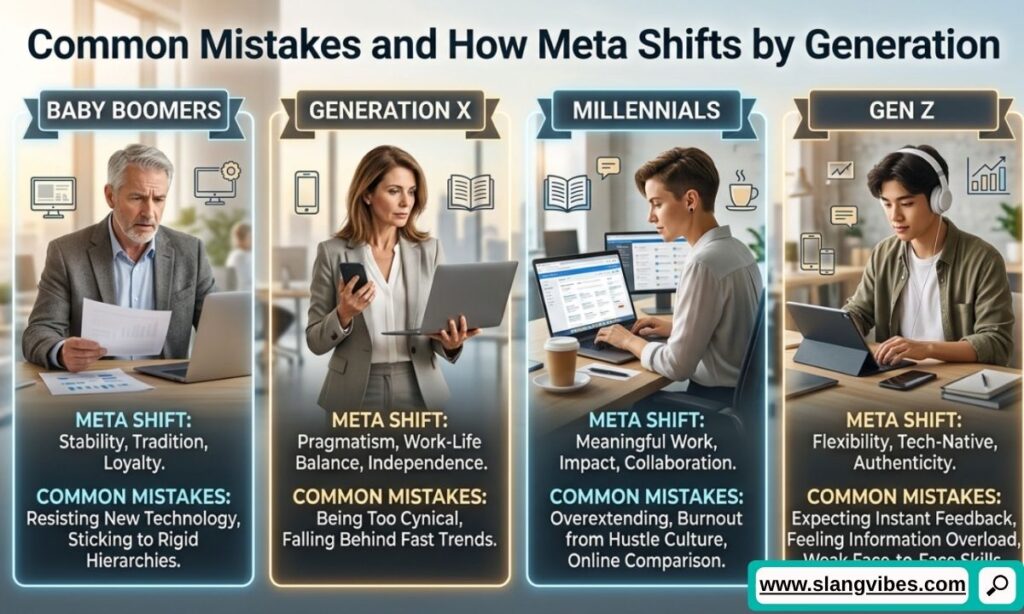
Gen Z vs Millennial Usage
Gen Z leans on meta constantly, often stacking it with other internet vocabulary like “no cap,” “core,” or “rizz.” The word feels second nature inside this age group, showing up in captions without a second thought.
Millennials use meta too, though usually with more explanation attached. This generation grew up watching the word move from gaming forums into mainstream culture, so context gets spelled out more often.
A workplace text shows the generational gap clearly:
Priya: this project retro about our retro process is getting meta Devon: lol true, on brand for this team
Dating app messages show a lighter version:
Casey: my bio about hating bios is peak meta energy Morgan: say less, matched for the memes alone
US and UK usage stays fairly close overall, with both regions pulling from the same online spaces. Gaming communities worldwide share meta as common vocabulary, regardless of location, since strategy discussions cross borders easily inside shared servers and forums.
FAQs About Meta in Slang
What Does Meta Mean in Slang?
In slang, meta describes something self-aware or self-referential, like a joke pointing out it’s a joke. In gaming, the same word refers to the strongest strategy players use right now.
What Does META Stand For in Gaming?
Many gamers use it as shorthand for Most Effective Tactic Available, describing whichever build or strategy dominates a game at the moment. Some trace the term back to the Greek root instead.
Is Calling Something Meta an Insult?
Not usually. The word stays mostly neutral or playful. One exception: calling a player a “meta slave” carries a mildly critical edge, suggesting they only copy winning strategies without adding creativity.
Is Meta Slang Related to the Company Meta?
No, though the names overlap. Meta Platforms is Mark Zuckerberg’s company behind Facebook and Instagram. Slang meta existed for years before the company adopted the name.
How Do You Use Meta in a Sentence?
Drop it whenever something points back at itself: “This ad making fun of ads is so meta,” or “Everyone’s using the same weapon, it’s the meta right now.”
Conclusion
Meta carries more weight than a single definition allows. Online, it points toward jokes and content aware of their own existence. In gaming, it points toward whichever strategy currently dominates. Both meanings share the same root idea: stepping back and noticing the bigger pattern.
Now you know what does meta mean in slang the next time it lands in a group chat or gaming lobby. Context tells you which version applies almost instantly once you know what to listen for.
The word keeps shifting too. New platforms bring new self-aware jokes. New patches bring new dominant strategies. Meta will likely keep evolving alongside whatever internet culture and gaming communities build next.
Before dropping the word around new people or in a new group chat, take a beat and read the room. Gaming friends expect the strategy meaning. Meme-loving friends expect the self-aware version. Getting the lane right makes the word land every time.

Alex Carter is a language enthusiast and internet culture expert at SlangVibes. He explains the latest slang terms and text meanings in simple, clear English so everyone stays in the loop.