Picture this: you’re scrolling TikTok at midnight, and a caption stops you cold. “+2000 aura” sits under a clip of someone catching a football behind their back without looking. There’s no context and no explanation. Only a word and a number you’ve seen a hundred times, yet you’ve never looked it up. So the aura slang meaning confused you the same way it confuses much of the internet right now. But here’s the good part: it isn’t as mysterious as it sounds. This word went from a spiritual buzzword to a full-blown scoring system for confidence, charisma, and cringe. Below is exactly what it means, where it came from, and how to use it the right way.
What Is the Aura Slang Meaning, Exactly?
The aura slang meaning comes down to one idea: presence. So when someone says a person “has aura,” they mean this person gives off a strong, magnetic energy without trying. It isn’t about looks alone. Instead, it’s about how someone carries themselves, how they speak, and how they make a room feel.
So what does aura mean in slang, in practice? Think of it as a mix of vibe, confidence, and charisma rolled into one word. A calm walk into a room reads as aura. A perfectly timed one-liner reads as aura too. Then even silence, held the right way, reads as aura.
The aura definition slang crowd uses today shares little with the strict dictionary meaning of an invisible field around a body. Instead, Gen Z borrowed the word and gave it a social spin. Rather than describing a literal energy field, people use it to rate personality, style, and social presence.
Here’s a simple way to picture it. Aura energy meaning, in this context, blends your body language, facial expressions, fashion choices, and attitude into one moment. Nail all four, and people say you have aura. Miss the mark, though, and people joke your aura took a hit.
The word works as a noun and, informally, almost like a currency. People talk about having aura, losing aura, and even farming aura, which we’ll cover shortly. Meaning of aura in slang keeps shifting with every viral trend. Still, the core stays the same: energy people notice without you saying a word.
Read Also: HBU Meaning in Text: What It Really Means on Social Media
Where Does the Aura Slang Meaning Come From?
The word aura has old roots. It comes from a Greek word meaning breeze or air. Doctors still use it in medicine, describing warning signs some people feel before a seizure or migraine. Long before TikTok, spiritual and New Age communities used aura to describe an energy field surrounding a person’s body.
Slang usage split away from this spiritual meaning around the early 2020s. From there, sports commentary and highlight clips got much of the credit. Fans used aura to describe athletes moving with unshakable confidence, the kind of presence turning ordinary plays into highlight reels.
The real explosion came in summer 2024. Aura moved from sports talk into a full internet trend on TikTok, tied to a specific format. So people started quantifying how much aura someone gained or lost in a given social scenario. A smooth recovery from a stumble might earn thousands of points. Meanwhile, an awkward moment in public might cost the same amount.
Did You Know: Merriam-Webster added a slang definition for aura, describing it as stylishness paired with confident, suave excellence. So this shows how far the word has traveled from its spiritual and medical roots.
Today, the aura meaning TikTok users apply has almost nothing to do with energy fields or migraines. Instead, it’s about reputation, coolness, and the story a single clip tells about someone’s character in three seconds or less.
Aura Points: The Aura Meaning slang Behind the Numbers
If you only remember one thing from this guide, remember aura points. So this is the mechanic turning aura from a compliment into a game.
Here’s how it works. First, someone posts a clip of a social moment, smooth or messy. Then a caption assigns a point value, like “+5,000 aura” or “-2,000 aura.” The bigger and more unexpected the moment, the higher the number climbs.
Positive aura points show up for things like landing a trick shot without looking. They also show up when someone stays calm during an embarrassing moment. Pulling off a bold outfit with total confidence counts too. On the other hand, negative aura points show up for tripping in public, getting caught staring, or trying too hard to look cool and missing badly.
This has no rulebook behind it. Instead, the numbers are invented on the spot, and this is the joke. Overall, bigger numbers mean bigger reactions from viewers, not a real score anyone tracks.
Here’s a text exchange showing how the phrase moves from TikTok into everyday conversation:
Maya: did you see the video of the guy catching his phone mid-fall without looking Jordan: yeah wild aura ngl Maya: like +8000 aura easy Jordan: he didn’t even flinch lol
Aura points work as shorthand for a shared reaction. You don’t need a scoreboard. Instead, you need a moment everyone agrees deserves a number attached to it.
Read More: MHM Mean in Text: What It Really Means in Chats and Social Media (2026)
What Is Aura Farming?
Aura farming is the next term you’ll run into, and it works differently than aura itself. While aura describes a natural quality, aura farming describes effort. Specifically, it’s when someone acts a certain way on purpose, hoping to rack up aura points, usually in an exaggerated or funny way.
Picture a guy walking into a party in slow motion with sunglasses on at night, clearly performing for the camera. Viewers recognize the bit immediately and call it out as aura farming. So the humor comes from the gap between trying so hard and pretending not to try at all.
Still, aura farming isn’t always a joke. Some creators genuinely lean into confident, stylized movement to build a brand around presence. For instance, basketball players strutting after a big shot, or a musician walking off stage without acknowledging the crowd, both get tagged with the phrase.
The line between real aura and aura farming comes down to intent. Real aura reads as effortless. Aura farming, however, reads as a performance of effortlessness, and audiences usually spot the difference within seconds.
Meaning of aura in slang widens a bit here, since aura farming works almost like a subgenre. In other words, it takes the core idea, presence people notice, and turns it into a bit playing out on purpose. Both terms get thrown around together constantly, so knowing the difference helps you use each one correctly in a comment section or a group chat.
Strong Aura, Dark Aura, and Elite Aura: What Each Type Means
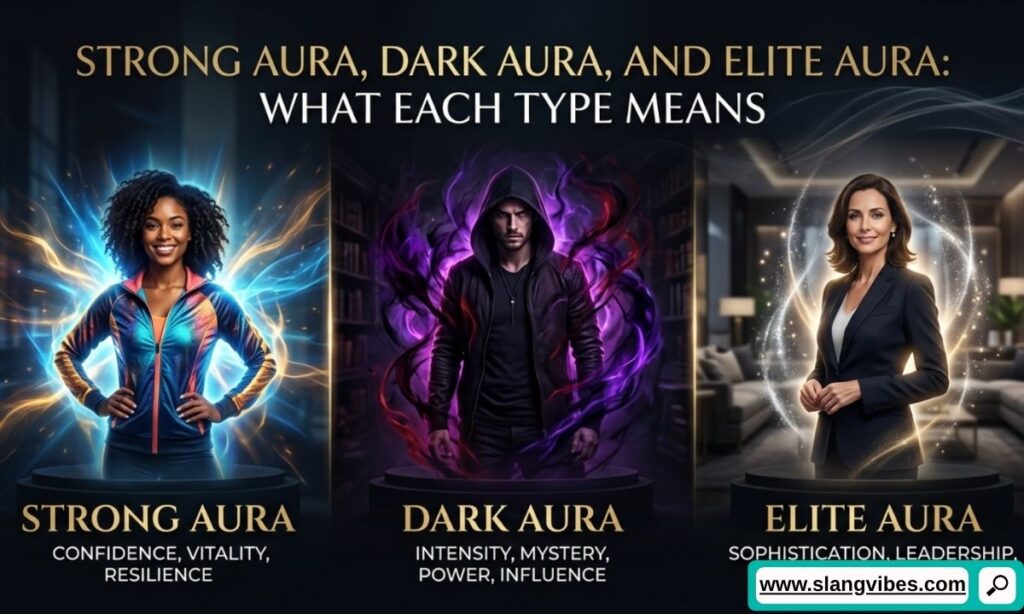
Aura splits into types once people start describing exactly what kind of energy someone gives off. Each version carries its own tone and its own set of situations where it fits best.
Positive and Warm Aura Types
Strong aura meaning points to someone bold, confident, and hard to rattle. Meanwhile, calm aura meaning goes the opposite direction, describing someone grounded and soothing to be around. Cute aura meaning, on the other hand, covers a softer, gentler charm, a kind making people smile without trying. And elite aura meaning gets used for anyone who looks expensive, put-together, or effortlessly impressive, even in something simple like a plain outfit worn well.
Darker or More Intense Aura Types
Dark aura meaning shows up when someone reads as mysterious, intense, or a little intimidating, even if they’re friendly once you get to know them. It isn’t always negative, though. In fact, plenty of people wear a dark aura as a compliment, especially in fashion and gaming spaces, where mystery reads as style.
Here’s a quick breakdown of how each type sounds in real use:
| Aura Type | What It Signals | Example Use |
|---|---|---|
| Strong Aura | Bold, unshakable confidence | “He walked in like he owned the place, strong aura.” |
| Calm Aura | Peaceful, grounded presence | “She kept everyone relaxed, such a calm aura.” |
| Elite Aura | Polished, expensive, effortless | “This fit is elite aura, no notes.” |
| Dark Aura | Mysterious, intense, guarded | “Doesn’t talk much, but dark aura for sure.” |
| Cute Aura | Soft, warm, approachable | “Puppy energy, total cute aura.” |
Priya: ok but why does the new intern have such elite aura already Sam: the blazer is doing a lot of work ngl Priya: no, it’s more than the blazer, it’s how she walks in Sam: fair, dark horse elite aura fr
Read Here: WYLL Meaning in Text: What It Stands for on Snapchat & TikTok
Aura Meaning on Social Media: TikTok vs Instagram vs X
The aura meaning on social media shifts slightly depending on where you see it. Overall, the core idea stays the same, but the delivery changes by platform.
On TikTok and Instagram
TikTok is where aura points live. Point-scoring captions, aura edits set to music, and slow-motion clips of someone looking effortlessly cool all trace back to this platform. In contrast, Instagram leans more visual. There, aura often gets tied to aesthetic, a curated photo dump, a certain color palette, or an outfit photographing well against a specific backdrop.
On X and in Texts
X uses aura a bit differently. Instead of a single clip, aura on X often builds from someone’s whole online presence, their replies, their tone, and how they carry themselves across many posts over time. So someone builds a reputation for aura on X without ever posting a video, purely through how they write.
In texts and group chats, meanwhile, aura meaning in text usually shows up as shorthand praise or gentle teasing. A friend might text “the aura on you today” after you show up looking sharp, or “zero aura” after a public stumble. It travels fast because it’s short, visual in the reader’s head, and easy to type one-handed.
Across every platform, though, the pattern holds. Aura describes an impression, not a fact. Ultimately, it lives in how something looks and feels to the people watching, whether the setting is a For You page, a feed, or a phone screen at 1am.
Read More: WB Meaning in Text: What It Really Means on Social Media (2026)
Aura vs Vibe, Rizz, and Sigma: What’s the Difference?
Aura shares space with a handful of other slang terms, and people mix them up constantly. Knowing the difference, however, helps you pick the right word for the moment.
Aura vibe meaning gets confused most often. A vibe is temporary, tied to a mood or a moment. Aura, on the other hand, runs deeper and feels more like a lasting trait. So someone’s vibe might be off today, while their aura stays intact.
Rizz, meanwhile, focuses specifically on charm used to attract someone romantically. Aura is broader and applies in any social setting, not only dating. Sigma, similarly, describes a personality type, someone independent and unbothered by social approval. Aura describes an impression rather than a personality category, so the two terms answer different questions entirely.
| Term | What It Means |
|---|---|
| Aura | Overall presence, energy, or charisma someone gives off |
| Vibe | The mood or atmosphere of a moment |
| Rizz | Charm specifically used in flirting or dating |
| Sigma | A personality type built around independence |
| Main Character Energy | Acting like the center of your own story |
Devon: bro said one sentence and the whole room went quiet Priya: this isn’t rizz, this is aura Devon: how are they different Priya: rizz is for flirting, aura is presence, he wasn’t even trying to charm anyone
Millennials vs Gen Z: Why the Aura Meaning in Text Confuses Parents
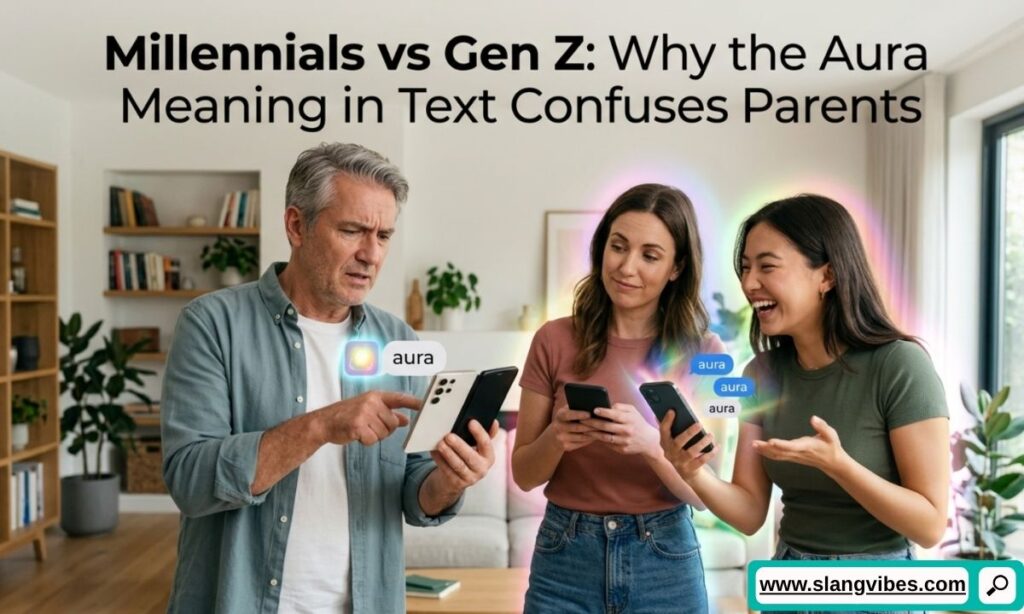
Ask a Millennial what aura means, and many will describe something spiritual, an energy field, sometimes tied to colors or chakras. Ask a Gen Z or Gen Alpha kid the same question, though, and you’ll get a completely different answer involving points, farming, and viral clips.
Still, this gap causes real confusion at home. A parent compliments their kid’s “positive aura,” meaning it warmly and spiritually, only to get a confused look back. So the kid hears it as a slang compliment about their social presence, not their spiritual energy, and the conversation stalls out right there.
Online, this mix-up became its own bit. Videos of parents guessing what “zero aura” or “aura points” mean rack up views because the misunderstanding feels relatable to millions of families. Similarly, teachers report the same pattern in classrooms, where students throw the word around constantly, and adults nod along without full understanding.
The generational split makes sense once you trace the word’s path. Older generations picked up aura from spirituality and wellness culture. Meanwhile, younger generations picked it up from sports clips and TikTok trends. Even so, both groups are technically right about their own version. They’re each drawing from a different chapter of the same word’s history, decades apart.
If you’re a parent or an older sibling trying to keep up, the fastest fix is simple. First, drop the spiritual definition when your kid uses the word casually. Nine times out of ten, they’re talking about vibes and confidence, not chakras or energy fields.
Read New Articles: RLS Meaning in Text: What It Really Means on Social Media (2026)
When (and When Not) to Use Aura in Conversation
Aura works best in casual settings: group chats, comment sections, captions, and conversations with friends. There, it fits naturally into a compliment, a joke, or a reaction to something impressive someone pulled off.
It fits less naturally, however, in formal writing, professional emails, or conversations with someone unfamiliar with internet slang. Using it there risks landing flat or sounding forced, especially if the tone doesn’t match the setting around it.
One common mistake is overusing the word until it loses meaning. Calling everything “aura,” from a sandwich to a parking spot, waters down the term fast. Instead, save it for moments genuinely standing out, and it keeps its punch.
Another common mistake involves tone. Aura reads as a compliment in most contexts, but pairing it with the wrong emoji or delivery flips the meaning into sarcasm. Skull emojis and heavy irony, in this case, usually signal the speaker means the opposite of what they’re saying out loud.
Here’s how it plays out in a group chat setting:
Ravi: did you see coach calling a timeout with zero seconds left lol Ben: brutal, negative aura for the whole team Ravi: coach personally lost 10000 aura points right there Ben: down bad fr
Used with the right timing, aura adds personality to a message without much extra effort. Used carelessly, though, it reads as forced or dated fast, especially among people already tired of hearing it everywhere online.
Frequently Asked Questions
What does aura meaning in slang?
In slang, aura describes the vibe, energy, or presence someone gives off. Specifically, it covers confidence, charisma, and overall social impression rather than one specific trait.
What is aura farming?
Aura farming means acting a certain way on purpose to gain aura points, usually in an exaggerated or ironic way, often for laughs on camera.
What does zero aura or negative aura mean?
Zero aura and negative aura describe an awkward, cringe, or embarrassing moment. In other words, they’re the opposite of a smooth, confident impression.
Is aura a compliment or an insult?
Aura is a compliment by default. However, adding words like “dark,” “zero,” or “negative” shifts it toward a joke or a lighthearted insult.
Is aura the same as vibe?
No. A vibe is temporary and tied to a single moment. Aura, on the other hand, feels more lasting, describing someone’s overall presence over time.
Conclusion
Aura slang meaning boils down to presence: the energy, confidence, and charisma someone gives off without saying a word. What started as a spiritual term turned into a full internet economy of points, farming, and viral clips, all built around the same core idea. In short, people notice something about you before you open your mouth, and slang finally gave this feeling a name everyone recognizes.
Whether you hear it about an athlete’s highlight reel, a friend’s outfit, or a stranger’s confident walk across a room, the word points to the same thing. Someone left an impression, and the internet found a way to measure it out loud.
The trend will likely fade or shift eventually, the way most slang does. For now, though, aura remains one of the clearest ways Gen Z and Millennials both describe the impression a person leaves behind. Next time someone tells you your aura is unmatched, you’ll know exactly what they mean, and possibly how many points you earned along the way.

Alex Carter is a language enthusiast and internet culture expert at SlangVibes. He explains the latest slang terms and text meanings in simple, clear English so everyone stays in the loop.