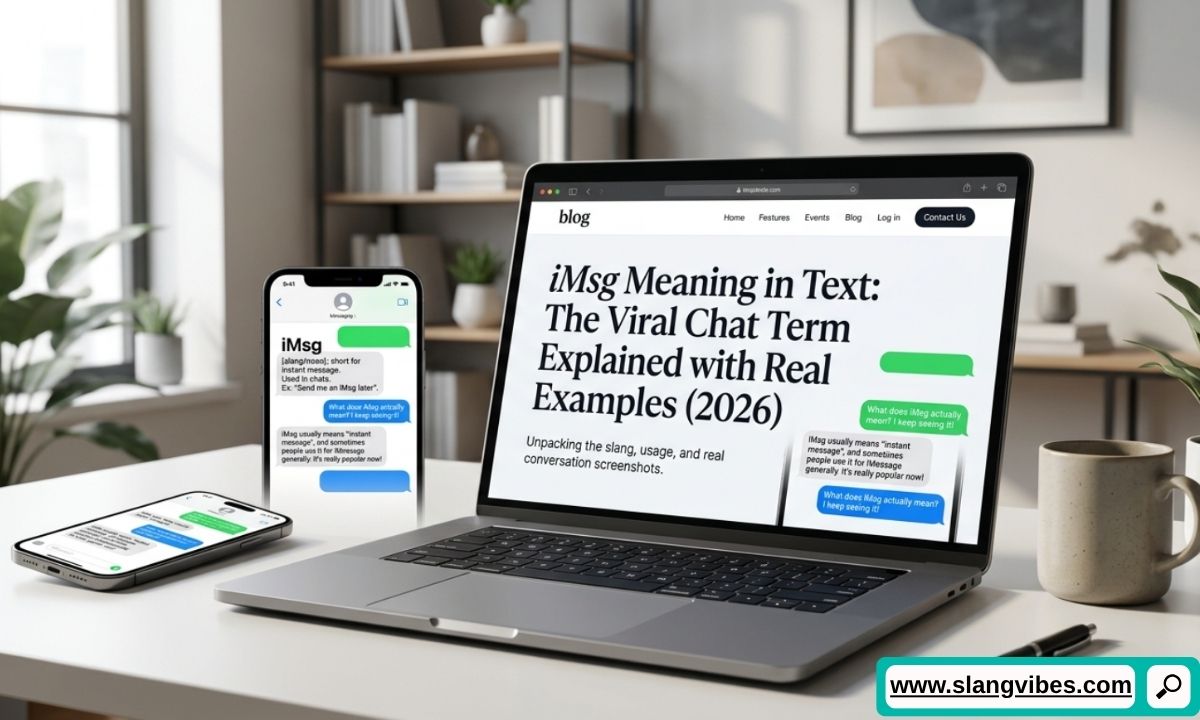
My roommate handed me her phone last month and said, “text him back, use iMsg.” I stared at the screen for three seconds straight. iMsg? Was it a typo? A new app? Turns out I’d been using the term daily without seeing it spelled out anywhere. iMsg meaning in text comes up more than you’d expect, especially once you start noticing your own group chats. It’s short for iMessage, Apple’s built-in messaging service, but the story behind it goes way past a simple abbreviation. Stick around, and you’ll get the real definition, the culture behind it, and how to use it yourself.
iMsg Meaning in Text: The Quick Answer
Here’s the short version. iMsg stands for iMessage, the messaging app built into every iPhone, iPad, and Mac. Apple’s Messages app uses it to send texts over Wi-Fi or mobile data instead of a regular cell signal. People shortened “iMessage” to “iMsg” the same way they shorten everything else in a chat: to type faster.
You’ll see it used as a noun and a verb. Someone might say “check your iMsg” (noun) or “I’ll iMsg you tonight” (verb). Both mean the exact same thing: a message sent through Apple’s system.
Did You Know: iMessage only works between Apple devices. If either person uses an Android phone, the message switches to regular SMS or MMS automatically, and the bubble color changes too.
The term shows up everywhere once you start looking for it. Group chats, Instagram comments, TikTok captions, even casual work chats between coworkers who both own iPhones. It’s become shorthand for a specific kind of messaging experience: fast, private, and loaded with extra features regular texting doesn’t have.
People searching for iMsg meaning often expect a complicated answer. The truth is simpler. It’s an abbreviation for an app most of us already use every day, dressed up in casual internet shorthand. Once you know the definition, spotting it in the wild gets easy.
Read Also: Sigma Meaning Slang: Complete Guide to the Viral Internet Term (2026)
Where the iMsg Meaning in Text Comes From
The iMsg meaning in text traces back to 2011, when Apple launched iMessage with iOS 5. Before iMessage, every text on an iPhone went out as a plain SMS, the same limited format flip phones used for years. Apple wanted something faster, richer, and free to use over the internet.
The name iMessage fit Apple’s naming pattern perfectly, following iPhone, iPod, and iPad. Users picked up on the pattern too, and shortened it the way people shorten most tech names in casual writing. Message became msg long before iMessage existed, so the jump to iMsg felt natural.
Texting culture rewards speed. Typing five extra letters slows down a fast conversation, so abbreviations spread wherever people chat quickly: group texts, comment sections, DMs. iMsg followed the same pattern as other shortened tech terms like insta for Instagram or fb for Facebook.
Apple never officially shortened the name. iMsg grew entirely from user habit, not marketing.
By the mid-2010s, the abbreviation had spread past Apple’s own community. People without iPhones started recognizing the term too, mostly through friends who owned one. Fifteen years after launch, iMessage still updates constantly, adding new features almost every year. The core idea behind the shorthand hasn’t changed, though: a quick way to refer to a messaging app everybody already knows.
The iMsg Meaning in Text vs SMS: Blue Bubbles vs Green Bubbles
Understanding the iMsg meaning in text gets a lot clearer once you notice bubble color. The bubble color you see in Messages tells you exactly which system sent it. Blue bubbles mean iMessage. Green bubbles mean regular SMS or MMS.
Here’s what’s happening behind the scenes. iMessage sends texts over the internet, using Wi-Fi or mobile data, straight between two Apple devices. SMS uses your carrier’s cellular network instead, the same system phones have used since text messaging began. When you text another iPhone user, Messages checks whether the other device supports iMessage. If it does, the bubble turns blue automatically. If the person uses an Android phone, or their iPhone loses connection, the message falls back to SMS, and the bubble turns green.
What Happens in Group Chats
Group chats show this problem clearly. Add one Android user to a group of iPhone owners, and the whole thread drops to SMS. Read receipts disappear. Typing indicators stop working. Reactions turn into ugly text notifications instead of smooth animations. Everyone in the group notices immediately, and someone usually complains about it.
People often blame the green bubble on a bad phone or weak signal. Most of the time, it simply means the other person isn’t using an iPhone.
SMS and iMessage aren’t interchangeable for another reason too: iMessage uses end-to-end encryption. SMS doesn’t offer the same protection, which matters more to some people than others. Photo and video quality take a hit as well. iMessage sends full-resolution files over the internet. MMS compresses everything to fit cellular limits, so photos sent to a green bubble often look blurry next to the same shot sent over iMessage. Either way, the color difference isn’t cosmetic. It signals which network carried your message, and it shapes what features you get to use once it arrives.
Read More: OF Page Meaning Explained: What It Really Means in 2026
iMsg in Text Messages: Real Conversation Examples
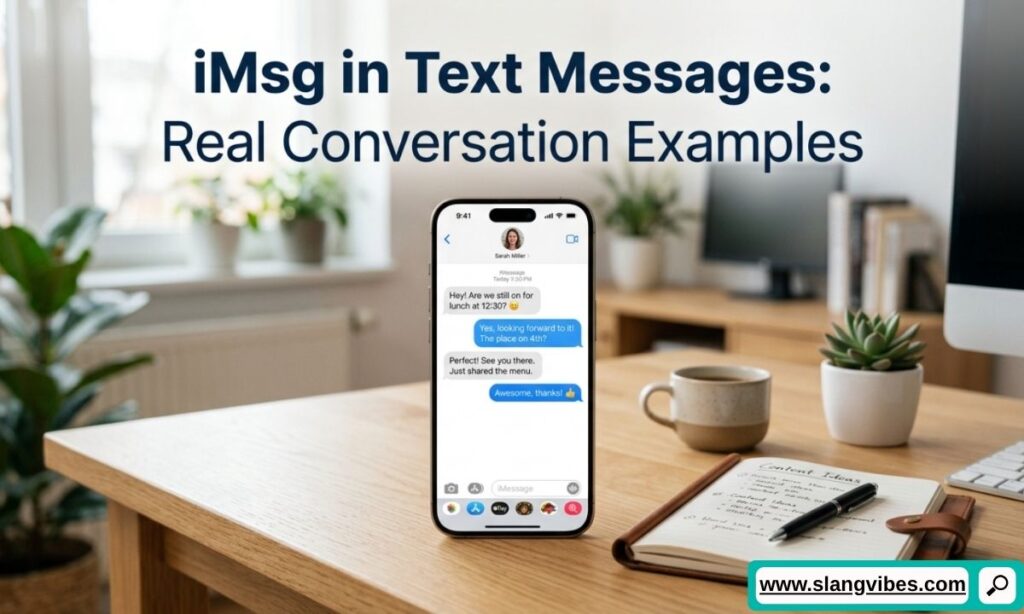
Real examples make the term easier to picture. Here’s how iMsg shows up in everyday chats.
Maya: Photos won’t load on WhatsApp Jordan: Weird, I’ll iMsg them to you instead Maya: Perfect, thanks
Group chats show the term differently, usually connected to the bubble color issue:
Priya: Why did everyone go green? Sam: Devon’s on Android, group dropped to SMS Priya: No more reactions then, ugh
The term shows up in flirtier contexts too, especially when someone wants to move a conversation off a public platform:
Alex: Instagram DMs keep glitching for me Riley: Same, iMsg me instead Alex: Sending my number now, check iMsg in a sec
Notice how the term stays consistent across every scenario. It’s never emotional or complicated. It’s a plain reference to a messaging app, dropped into casual sentences the same way people say “text me” or “call me”. The verb form (“I’ll iMsg you”) and noun form (“check your iMsg”) both work fine. Native speakers switch between them without thinking twice.
One more pattern worth noticing: iMsg rarely shows up in long sentences. Most examples online sit under ten words. Short, direct, functional. This fits the whole point of texting slang: saying more with fewer letters.
Why iMsg Turned Into a Viral Social Media Trend
The iMsg meaning in text stopped being purely technical somewhere around the early 2020s. Bubble color turned into a symbol.
On dating apps, plenty of users started joking about “no green bubbles” as a dealbreaker. TikTok videos joke about texting an Android user, showing screenshots of choppy group chats and low-quality photos. Some of it’s playful. Some of it points to something less fair: judging someone’s phone as a stand-in for judging them personally.
The joke spread because the technical differences are real. Blue bubble chats load photos faster, support read receipts, and keep group chats smooth. Green bubble chats compress images, drop some features, and sometimes feel clunky by comparison. People noticed the gap, and social media turned noticing into content.
Gen Z gets blamed for starting the trend, though plenty of millennials pile on too. Either way, iMsg stopped being a plain abbreviation once it got tied to phone brand status. Saying “iMsg me” now carries a small unspoken message: I use an iPhone, and I expect you to keep up.
Apple’s own marketing leaned into the divide at points, highlighting features exclusive to iMessage. Critics argue this locks users into buying iPhones only to avoid the green bubble stigma. Whatever the reason, the trend shows no sign of fading soon. iMsg carries cultural weight now, not only technical meaning.
iMessage Features Fueling the Culture
Bubble color isn’t the only reason iMessage feels different. A handful of built-in features keep people loyal to it.
Tapbacks let you react to a message with a heart, thumbs up, laugh, or exclamation mark, all without typing a reply. Send someone a photo, and they might tap back with a heart instead of typing “cute!”
Jamie: Look at my dog in this sweater Priya: Obsessed [taps a heart reaction on the photo]
Message effects add animation to a text: confetti for celebrations, balloons for birthdays, even a laser show for big announcements. Read receipts show when someone opened your message, and typing indicators show three bouncing dots while they type a reply. Standard SMS doesn’t include any of this.
iMessage also supports full-quality photo and video sharing, group chat naming, location sharing, and GamePigeon-style mini games playable straight inside a thread. Two friends manage a game of chess or 8-ball without leaving the conversation. Memoji stickers and SharePlay, which lets two people watch or listen to something together inside the same thread, round out the list.
These extras explain why so many people resist switching away from iMessage. Losing them feels like a downgrade, not a lateral move. When a chat drops to SMS, all of it disappears at once: no more tapbacks, no more effects, no more games. This single moment, watching a thread lose its features, explains a big part of why bubble color matters so much to begin with.
Read New Article: Stud Meaning in Slang: What It Really Means in 2026 (With Examples)
Other iMsg Meanings You Might See
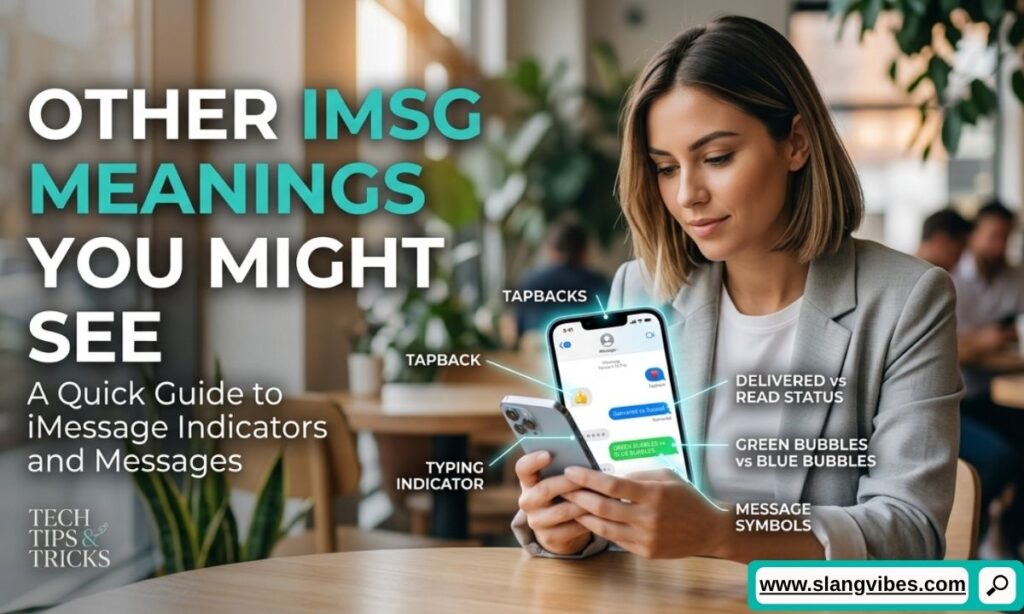
iMessage is the dominant meaning, though not the only one floating around online. A few other definitions pop up depending on where you see the term.
Some people use IMSG to mean “instant message” in a general sense, unrelated to Apple specifically. This usage shows up more in older forums and some IT documentation, where “instant messaging” covers any real-time chat platform, not one particular app.
A smaller group uses it as shorthand for “I’m messaging,” a quick way of saying a reply is coming. This version reads more like a placeholder than a real definition, and it’s far less common than the Apple-specific meaning.
In technical or corporate settings, IMSG occasionally stands for something unrelated entirely, like an instant messaging service gateway, a piece of infrastructure connecting different chat systems. Regular texters almost never run into this meaning.
One more variation shows up mostly on TikTok and gaming-focused threads: some people use IMSG as shorthand for “instant message games,” a nod to the mini games playable inside iMessage itself. It’s a niche use, and most readers online still default to the Apple messaging meaning first.
Context settles the confusion fast. A message about iPhones, group chats, or bubble colors points straight to iMessage. A message from an IT department or a networking manual points somewhere else entirely. For anyone reading this because a friend texted “iMsg me,” the Apple meaning is nearly always the right one.
Common Mistakes People Make With the iMsg Meaning in Text
Even with a clear iMsg meaning in text, a few mix-ups come up again and again.
Assuming it works everywhere. iMessage only connects Apple devices. Sending “I’ll iMsg you” to someone with an Android phone sets up confusion, since the message lands as a normal SMS with none of the extra features attached.
Using it in professional settings. Coworkers who both own iPhones sometimes slip into “iMsg you the file,” but it reads casually in an email thread or a work Slack channel. Sticking with “I’ll message you” or “I’ll send it over” keeps things sounding appropriate for work.
Confusing it with general instant messaging. iMsg refers to Apple’s specific app, not instant messaging as a broad category. WhatsApp and Messenger are instant messaging apps too, but nobody calls those iMsg.
Treating the term as universal slang. Plenty of people, especially outside heavy iPhone markets, have never heard the abbreviation. Dropping it into a conversation without context risks confusing anyone unfamiliar with Apple’s ecosystem.
Ignoring the tone shift. “iMsg me” sounds casual and quick. Typing out the full phrase, “message me on iMessage,” sounds a little more deliberate and formal. Picking the right version for the moment avoids sounding either too stiff or too breezy.
Read Also: Diddy Meaning Explained: How People Use It in Modern English
How to Reply When Someone Says “iMsg Me”
Replies change depending on tone and relationship. A few natural options fit different situations.
Casual and friendly:
- Got it, sending now
- Sure thing, check your messages soon
- On it
Playful or joking:
- Ooh, fancy, moving up to iMsg
- VIP messaging only, got it
- Only if you promise not to leave me on read
Low-key flirty:
Casey: Instagram’s glitching, iMsg me instead? Drew: Already found your number, expect a text soon Casey: Looking forward to it
Professional pivot, useful when a coworker or client says it and formality matters more:
- I’ll follow up by email instead, easier to track
- Happy to message you through Teams or Slack
- I’ll send the file over shortly
No iPhone on your end? A short, honest reply avoids confusion:
- I’m not on iMessage, but text or WhatsApp works
- Android here, send it through Messenger instead
Matching tone matters more than picking the perfect words. A funny reply lands better with close friends. A straightforward reply works better with someone newer or a work contact. Either way, replying with a plain “okay” or “got it” always works as a safe default, no matter who sent the message.
Turning iMessage On, Off, or Fixing It When It Breaks
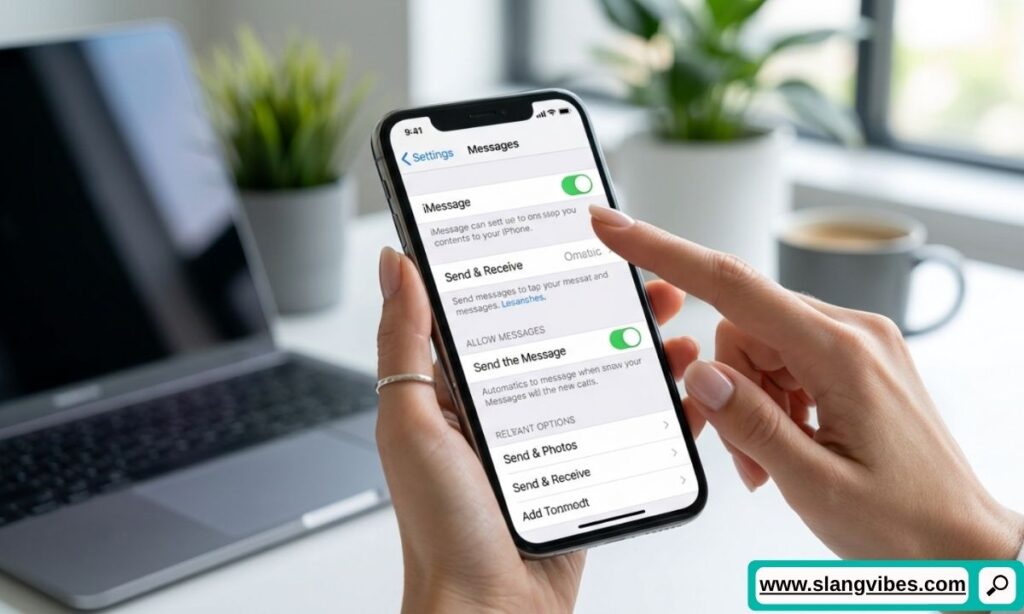
iMessage occasionally causes headaches, especially for anyone switching from iPhone to Android or troubleshooting a stuck message. Here’s how to handle the most common situations.
Turning iMessage off, usually done before switching to a new phone: open Settings, tap Messages, then switch the iMessage toggle off. Doing this before switching phones prevents future texts from getting stuck in Apple’s system instead of reaching an Android device.
Fixing messages stuck on green when they should be blue: check whether the other person’s iMessage is active. Confirm both devices have a working internet connection. Try toggling iMessage off and back on in Settings. A quick restart of the phone solves this more often than people expect.
Deregistering a number after switching to Android: Apple provides a deregistration tool online for anyone who already sold or gave away an iPhone. Skipping this step often means texts from iPhone users disappear into iMessage instead of reaching the new Android phone.
Fixing iMessage when it won’t activate on a new iPhone: this usually comes down to a weak signal or an incorrect date and time setting. A temporary outage on Apple’s end causes it sometimes too. Waiting a few minutes and restarting the device solves it most of the time.
Most of these fixes take a few taps and don’t need advanced tech skills. The rest usually clears up within minutes.
Read More Articles: Huzz Meaning in Slang (2026): What It Really Means on TikTok, Snapchat & Gen Z Culture
Frequently Asked Questions
What does iMsg meaning in a text message?
The iMsg meaning in text comes down to one thing: iMessage, Apple’s built-in messaging app for iPhone, iPad, and Mac.
Why do some texts show up green instead of blue?
Green means the message went out as regular SMS, usually because the other device isn’t running iMessage.
Do Android users get iMsg or iMessage?
No. iMessage stays exclusive to Apple devices, so Android phones always fall back to standard SMS or MMS.
Is it rude to say “iMsg me”?
Not usually. It reads as casual and quick, fitting best with friends, family, or close coworkers rather than formal settings.
How do I turn iMessage off on my iPhone?
Open Settings, tap Messages, then switch the iMessage toggle off before switching to a different phone.
Conclusion
So next time a group chat lights up with “iMsg me” or a friend jokes about green bubbles, the whole conversation makes sense. The iMsg meaning in text boils down to one idea: Apple’s messaging app, built for speed, privacy, and a handful of features regular texting skips entirely.
The term carries more weight than a plain abbreviation these days. Bubble color turned into a social signal, tied up in dating trends, group chat drama, and a fair share of online jokes. The core definition stays the same, even with all the extra meaning attached. It’s still a fast way to refer to a messaging app millions of people use every day.
My roommate’s phone moment makes a lot more sense looking back. She wasn’t asking me to learn a secret code. She was using shorthand every iPhone owner picks up eventually, the same way anyone learns local slang after spending enough time somewhere new. Next time iMsg shows up in a chat, replying with confidence should come naturally.

Alex Carter is a language enthusiast and internet culture expert at SlangVibes. He explains the latest slang terms and text meanings in simple, clear English so everyone stays in the loop.