Sigma meaning slang is one of those phrases people search the moment a friend drops it mid-conversation. It leaves them wondering if it’s a compliment or a dig. The word shows up in TikTok captions, Instagram bios, and group chats every day. The meaning shifts depending on who types it. Some people use it to describe a quiet, independent personality. Others toss it around as a punchline aimed straight at someone taking themselves too seriously. Here’s the thing, both uses are correct at once. Knowing which one you’re dealing with changes how you should respond.
Sigma Meaning Slang: What It Means
Did You Know: Merriam-Webster added an official slang entry for sigma. It describes a man whose confident, self-assured individualism reads as a mark of status and appeal among his peers.
In plain terms, sigma describes someone independent, self-reliant, and detached from typical social hierarchies. In slang use it points to a person, often male but not always, who succeeds without chasing attention or approval. Know Your Meme documents this same idea. It frames sigma as a label for men who reach success without following the usual social ladder.
Among younger users, the word carries a second layer. Gen Alpha and younger Gen Z creators often say “sigma” with a smirk. They’re poking fun at anyone acting distant or broody in an obvious way. The sigma meaning slang carries today depends heavily on tone and context, not the word alone.
Think of it this way: call a stoic movie character sigma, and the label lands as earnest praise. Call a coworker sigma for staying silent during an awkward meeting, and it’s the joke version. Both readings trace back to the same root idea, a person standing outside the usual social hierarchy. They land in different places depending on delivery and who’s speaking.
Read Also: MHM Mean in Text: What It Really Means in Chats and Social Media (2026)
Where the Sigma Male Idea Started
Most explainers skip straight from “Greek letter” to “internet meme.” The real story runs through a decade of online writing most readers never see.
The Manosphere Connection
Blogger Theodore Beale writes under the name Vox Day. He first laid out a hierarchy of male social types on his blog around 2010. He described sigma men as socially successful yet operating outside the alpha and beta ranking system entirely. Beale describes himself as a Christian nationalist. His broader writing sits inside what’s commonly called the manosphere. This is a loose network of blogs and forums built around male self-improvement and social ranking theories.
For years the idea stayed niche, discussed mostly on forums built around dating advice and self-improvement. A small subreddit, r/SigmaMales, launched in 2014. It picked up a modest following over the next several years. Subscriber numbers stayed well under 500 for most of its early life. Writers on sites like Hack Spirit and Medium picked up the framework through the mid-2010s. They pitched sigma men as a quieter alternative to the loud, attention-seeking alpha archetype. These same blogs had already spent years promoting the alpha image itself. The concept stayed inside these small communities for years. A specific moment in 2021 pushed it into mainstream internet culture, covered next.
Knowing this origin matters. It explains why some critics push back on sigma culture, a point worth returning to later in this guide.
How Sigma Went From a Niche Subreddit to a Viral Twitter Moment

Sigma sat quietly online for roughly a decade before it exploded into mainstream slang. The shift traces to a single moment.
On January 25, 2021, Twitter user @LilySimpson1312 posted a set of infographics. The caption asked a mocking question about what was going on with men online. The post ridiculed the entire alpha-beta-sigma hierarchy concept, and it spread fast. Know Your Meme picked up the trend soon after. The site cataloged the format alongside spinoffs like the Sigma Stare and the Sigma Male Grindset.
By June 2021, another viral post reworked the concept into what’s now called the Sigma Grindset format. It paired motivational captions with stock footage of stoic men. From there, TikTok and YouTube creators ran with it. They paired clips of confident fictional characters with sigma captions and moody music.
The irony here is hard to miss. A concept meant to describe men who ignore social hierarchies became one of the internet’s most widely mocked social hierarchies. What started as earnest self-improvement content turned into a meme format used mostly for jokes. This dual identity, half sincere and half satire, still defines how people use the word today.
Read More: HBU Meaning in Text: What It Really Means on Social Media
Sigma vs Alpha vs Beta: The Real Differences
The alpha-beta-sigma framework confuses people because all three types sound like they describe confidence. The sigma meaning slang carries shifts a little once alpha and beta enter the comparison. The differences come down to where each type gets its sense of validation.
| Type | Motivation | Social Style | Power Source |
|---|---|---|---|
| Alpha | Leads the group, enjoys attention | Outgoing, competitive | External, built on dominance |
| Beta | Follows leaders, seeks approval | Cooperative, agreeable | External, built on acceptance |
| Sigma | Focuses inward, values freedom | Quiet, self-directed | Internal, built on self-control |
| Omega | Withdraws from social systems entirely | Isolated, detached | Neither internal nor external |
An alpha wants the room’s attention. A beta wants the room’s approval. A sigma doesn’t think about the room at all, at least according to the framework’s own logic. Omega sits below beta in the original hierarchy. This label describes men who disengage from social competition entirely, rather than opting out on their own terms.
This chart explains the personality type on paper. Real usage rarely stays this tidy though. Most people who call themselves or a friend “sigma” haven’t read the underlying framework. They’re borrowing a vibe from memes, not applying a formal classification system.
Patrick Bateman, Sigma Face, and the Icons Behind the Term
Ask ten people for a sigma male example and most will name a fictional character before describing a real trait. Patrick Bateman from American toxic sits at the center of this. Merriam-Webster’s own slang entry names him directly. It ties the character’s cold, image-obsessed confidence to what became known as the sigma grindset.
Picture opening TikTok and seeing a slowed-down clip of Bateman’s blank stare set to orchestral music, captioned “sigma.” This single image spawned an entire meme format called Sigma Face in 2022, built around expressionless close-ups of stoic characters.
Other recurring reference points include Han Solo, Neo from The Matrix, and John Wick. These characters operate alone, follow their own code, and rarely explain themselves to anyone. None of these characters were written with “sigma” in mind. Fans layered the label onto them after the fact. They picked out matching traits: minimal dialogue, total self-control, an aura of danger kept below the surface.
These icons show exactly what the sigma meaning slang carries look like in pop culture. The pattern across every example stays consistent. Sigma icons rarely raise their voice. They rarely explain their choices, and rarely need anyone’s approval to feel secure in a decision.
Read Here: Ditto Meaning in Text Explained for Social Media Users
Sigma Grindset and Other Slang Terms You’ll See Alongside It
Sigma rarely shows up alone. A handful of companion phrases travel with it across captions, bios, and group chats.
- Sigma grindset: hustling quietly and consistently without announcing it. “He’s on the sigma grindset, all goals, zero noise.”
- Sigma energy: calm confidence, often used as a compliment for staying composed under pressure.
- Sigma rule: a personal life motto framed around independence, often delivered as a joke. “Sigma rule number one, never explain yourself.”
- Sigma stare: the blank, unreadable expression tied to the Bateman-inspired meme format.
Here’s how this plays out in an actual group chat:
Devon: yo why didn’t u say anything when Priya roasted the pitch Marcus: sigma grindset, I let the work speak Devon: bro admit u had nothing to say Marcus: 💀 fine yeah I froze
Notice how the joke works. Marcus first frames his silence as intentional sigma behavior. Devon calls out the bluff right after. The humor lands because everyone recognizes the gap between the aspirational label and what happened. This back-and-forth captures how the phrase functions day to day, more punchline than personality description.
How the Sigma Meaning Slang Keeps Shifting in 2026
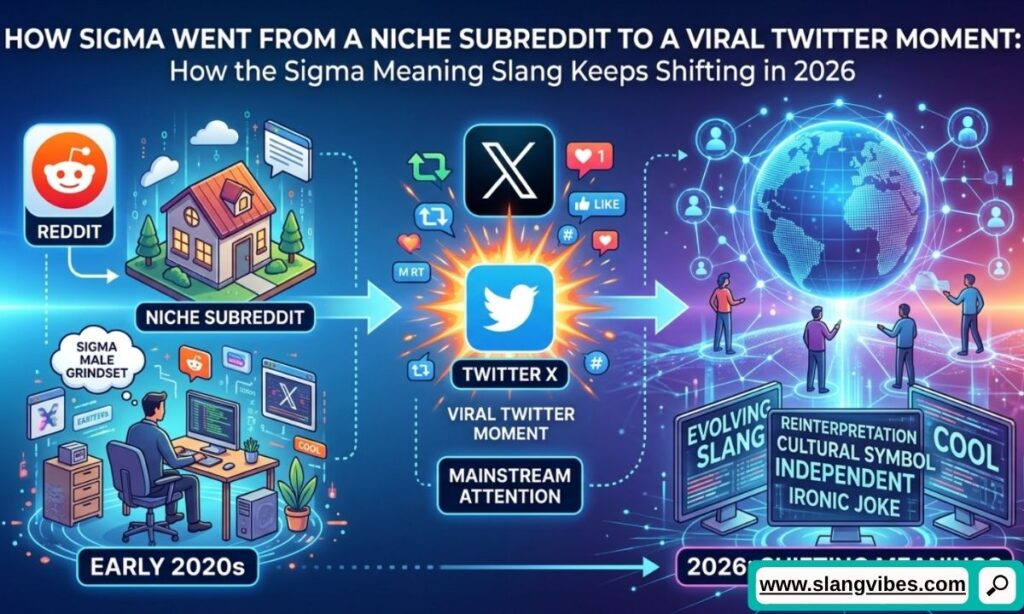
The word hasn’t stood still since 2021. What began as an earnest, if odd, self-improvement label has drifted toward irony among younger users.
Gen Alpha creators now lump sigma in with brainrot slang terms like rizz, gyat, and skibidi. These words work more for comedic rhythm than literal description. A ten-year-old calling a classmate “sigma” rarely means the same thing an adult self-improvement account means by it. The former reads closer to a punchline. The latter leans earnest, even aspirational.
Millennials and older Gen Z tend to fall somewhere in between. Many use it with a wink. They stay aware of the meme’s mocking history while still finding something relatable in staying independent and unbothered.
The sigma meaning slang keeps shifting because the word never settled into one register. It started serious, then became a punchline. Now it lives in both spaces, depending entirely on who’s typing it and what platform they’re on. Reading tone before reading the word matters more than ever here. A caption under a workout video reads earnest. The same word dropped into a group chat roast reads as a joke.
Read Also: SPWM Meaning in Text: What It Really Means on Social Media (2026)
Sigma Slang Meaning: US vs UK Differences
Usage shifts a little depending on where you’re texting from, though the difference sits more in tone than in meaning.
American slang leans into the earnest, self-improvement side more openly. Gym accounts, hustle-culture creators, and workout captions on US-based TikTok often use sigma without much irony. They treat it as a genuine descriptor for discipline and quiet ambition. Search interest for terms like “sigma grindset” and “sigma mindset” skews heavily toward fitness content. Much of it comes from American productivity creators.
British usage tilts harder toward mockery. UK creators and commenters frequently deploy sigma with a heavier dose of self-aware sarcasm. They treat the entire alpha-beta-sigma framework as inherently ridiculous rather than aspirational. A British group chat calling someone “peak sigma” for staying quiet at a party usually carries more eye-roll than praise. It reads closer to teasing than flattery.
Neither reading is wrong. The word itself travels the same across both countries. The tone attached to it shifts with regional meme culture. It also depends on how comfortable a given online community feels mocking self-improvement content outright.
How to Respond When Someone Calls You Sigma
Context decides everything before you type a reply. A caption on a motivational post calls for one tone, a group chat jab calls for another.
Say a friend calls you sigma as a genuine compliment, perhaps on a video of you handling pressure well. A simple acknowledgment lands fine. If it shows up mid-roast, playing along usually reads better than getting defensive.
Here’s an example from a sibling group chat:
Priya: bro went sigma mode and left the party without saying bye Amir: didn’t wanna make it a whole thing Priya: 😭 THATS SO SIGMA OF YOU Amir: I’ll take it
Amir doesn’t push back or over-explain. He leans into the label, which keeps the exchange light. Getting defensive or over-explaining tends to undercut the joke. It reads as the opposite of the calm, unbothered energy the word describes in the first place.
One more thing worth knowing: overcorrecting reads worse than ignoring the comment entirely. Launching into a serious explanation of why you left early, or insisting you’re not trying to seem mysterious, tends to make a joke land harder rather than defusing it. A short reply, an emoji, or simply moving on usually works better than a paragraph of justification. Save the earnest response for moments when the compliment is clearly sincere, like a friend praising how you handled a stressful situation without losing your cool.
Why Some People Push Back on Sigma Culture
Not everyone finds the sigma trend harmless fun. Coverage from outlets like British GQ has traced the term’s roots back to manosphere writing. It notes ties to a framework built by a self-described Christian nationalist blogger.
Critics argue the broader alpha-beta-sigma hierarchy reduces men to a ranking system built around dominance and social status. This echoes older, more explicitly misogynistic ideas about masculinity, dressed up in meme-friendly language. Philip Lindsay, a special education math teacher in Arizona, broke down the hierarchy for his students on TikTok. He walked through how the framework sorts boys into rigid categories. Many of these boys haven’t had much chance yet to figure out who they are on their own terms.
Supporters of the term generally argue most people using it today have zero awareness of, or interest in, its origin. For the average teenager, captioning a selfie “sigma” signals confidence, nothing more. It has nothing to do with hierarchy theory. The meme’s ideological roots and its everyday casual use sit far apart. This gap is part of why the debate keeps resurfacing every time the term trends again.
This controversy matters for anyone trying to understand the sigma meaning slang carries beyond its surface use. Both things sit true at once. The term’s roots trace to a specific, ideologically loaded corner of the internet. Most casual use today carries none of this baggage consciously. Worth knowing the history, even if you never bring it up mid-meme.
Read New Article: What Does HMJ Mean in Text? What It Really Means on Social Media (2026)
Sigma Female: Does the Slang Apply to Women Too?
The sigma label expanded past its original male-only framing fairly quickly. “Sigma female” now describes women with the same traits, independence, quiet confidence, and low interest in outside validation.
Common traits attached to the sigma female label include strong personal boundaries, quiet ambition, and emotional steadiness under pressure. The framing shows up often in dating and relationship content. It usually praises a woman for not chasing attention or approval from a partner.
Here’s how it plays out in a dating-app conversation:
Maya: he said I give off sigma female energy lol Blake: wait is this a compliment Maya: apparently means independent and hard to read Blake: sounds like a compliment wrapped in a TikTok trend
The exchange captures the confusion well. Sigma female carries a positive spin in most contexts. Like the male version though, tone and platform shape how earnestly it lands. A dating bio using it reads aspirational. A sarcastic comment under a viral video reads as a gentle jab.
The term also sidesteps some of the criticism aimed at its male counterpart. Since it never carried the same manosphere baggage, sigma female tends to read as straightforward praise more often than the male version does. Wellness and self-improvement creators have leaned into it as a way to describe emotional independence without framing it around rejecting men or competing with other women, unlike some older, more combative slang about female confidence.
Frequently Asked Questions
What does sigma mean in slang?
Sigma describes a person, independent and self-assured, who operates outside typical social hierarchies. This is the sigma meaning slang carries in its simplest form. Context still decides whether it reads as a compliment or a joke.
Is calling someone sigma an insult or a compliment?
It depends entirely on tone and platform. A caption on a confidence-themed post reads as praise. The same word dropped mid-roast in a group chat usually lands as a joke.
What’s the difference between alpha, beta, and sigma?
Alpha describes someone who leads and enjoys attention. Beta describes someone who follows and seeks approval. Sigma describes someone who ignores the hierarchy entirely, drawing confidence from within rather than from social standing.
Where did the sigma male concept come from?
Blogger Theodore Beale, known online as Vox Day, first described the sigma hierarchy around 2010. The idea stayed niche for roughly a decade before a viral 2021 Twitter thread pushed it into mainstream slang.
Is sigma still relevant slang in 2026?
Yes, though its use has shifted. Younger users often treat it as ironic brainrot slang, alongside terms like rizz and gyat. Older users tend to use it with a mix of sincerity and self-awareness.
Conclusion
Sigma started as a decade-old blog theory about male social hierarchy. It sat quietly online for years. Then a single viral tweet in 2021 turned it into one of the internet’s most recognizable personality labels. Today, the sigma meaning slang carries lives a double life. Some people use it earnestly to describe quiet confidence and independence. Others use it purely as a punchline aimed at anyone acting a little too broody in public. Neither use is wrong. The gap between them explains most of the confusion people run into when the word shows up in a text or caption. Before reacting to being called sigma, read the room first. A workout caption and a group chat roast call for completely different responses. Once you spot which version you’re dealing with, the word stops being confusing. It becomes one more piece of internet shorthand you know how to read.

Alex Carter is a language enthusiast and internet culture expert at SlangVibes. He explains the latest slang terms and text meanings in simple, clear English so everyone stays in the loop.