My phone buzzed last week with a text from my roommate: “kms, I locked myself out again.” My stomach dropped for a second before I remembered what those three letters usually mean online. If you have hit the same moment of confusion, you are not alone. The KMS meaning trips up a lot of people the first time they see it, especially outside texting circles where it started. Here is the short version: it stands for “kill myself,” but almost nobody typing it means it in a literal sense. Understanding the KMS meaning comes down to reading tone, not only the letters on the screen.
KMS Meaning in Messages: The Quick Definition
Quick Answer: KMS stands for “kill myself.” Online, it almost always works as an exaggerated reaction to something stressful, awkward, or annoying, not a literal statement.
The KMS meaning shows up most in texting, group chats, and social media comments. People type it the way they might say “ugh” or “I can’t even,” except with more shock value built in. A friend forgets their homework and types “kms.” Someone trips in the hallway and posts “kms 😭” under a video. The words are heavy, but the tone is usually light.
This is why the KMS meaning confuses so many people the first time they see it. Read on its own, “kill myself” sounds alarming. Read in context, next to a laughing emoji or a story about spilled coffee, it reads as dark humor instead. The gap between the literal words and the intended tone is the reason this term needs a real guide instead of a one-line slang definition.
The abbreviation sits in a strange spot compared to other texting shorthand. LOL and BRB do not carry weight outside of chat. KMS does, since the full phrase points to something serious in real life. This mix of heavy subject matter and everyday casual use is what makes the KMS text meaning worth breaking down properly. Skimming past it in a slang list does not do it justice.
This is not unique to English, either. Plenty of languages have their own dramatic shorthand for stress or embarrassment. English texting culture happens to lean on a phrase this heavy. This heaviness is part of why it draws so much attention the first time someone reads it cold.
Read Also: Zesty Meaning in Slang: Real Definition, Examples & Social Media Uses (2026–2027)
Where the KMS Meaning Comes From
Texting shorthand has been around since phones had actual number pads and every letter cost a button press. Early abbreviations like LOL, BRB, and TTYL grew out of a need for speed. KMS followed a similar path, only its wording started out sounding a lot more serious.
In the early days of texting and instant messaging, “kill myself” got typed out in full sometimes as a dramatic complaint. People said it the same way someone might vent out loud after a rough day. Over time, as texting sped up and shorthand took over, the full phrase shrank down to three letters.
Meme culture on Twitter, Reddit, and later TikTok pushed the shift even further. Once a phrase gets used enough as a joke, the joke becomes the default reading. This is largely what happened here. This term most people recognize today grew out of thousands of small, casual, non-literal uses stacked on top of each other. Over time, the dramatic-but-not-serious version became the norm. Nobody sat down and decided this shift on purpose. It built up slowly, one relatable text at a time, until the joke version outnumbered the sincere one by a wide margin.
This history matters for one reason: it explains why the term still sits in a gray area. The joke version and the original, literal phrase never fully separated from each other. Both meanings still exist side by side, and only context tells you which one you are looking at in any given message.
KMS vs KYS: What Each One Means
People often lump KMS in with KYS, but the two are not the same, and mixing them up matters.
KMS is self-directed. Someone types it about their own bad day, their own mistake, their own embarrassment. It works as a form of self-deprecating humor, aimed inward.
KYS stands for “kill yourself,” and it points outward, at someone else. This single shift changes everything. Where KMS usually reads as a joke about your own rough moment, KYS reads as an attack. It shows up in arguments, insults, and harassment far more often than it shows up as a joke between friends.
| Term | Directed At | Common Tone |
|---|---|---|
| KMS | Yourself | Self-deprecating, hyperbolic |
| KYS | Someone else | Hostile, an insult or a threat |
Platforms treat the two differently for good reason. KYS sent to another person often counts as harassment or targeted bullying under platform rules, and it carries real consequences at school or online. KMS, sent about your own day, usually does not trigger the same response. Repeated or serious-sounding use of either term is still worth paying attention to.
Knowing this difference helps you read a message correctly the first time, instead of assuming every three-letter “kill” abbreviation means the same thing. It also helps explain why one version gets treated as harmless slang while the other gets flagged by moderators almost everywhere.
This distinction shows up outside of texting too. Group chat arguments, comment sections, and gaming lobbies all draw a hard line here too. Venting about your own day reads nothing like directing the same phrase at another player or user. One reads as a bad mood. The other reads as an attack, and platforms increasingly respond accordingly.
Read More: IDM Meaning Decoded: What It Truly Stands For Online (2026)
How People Use KMS in Texting and Chat Today
With Friends
Among friends, the KMS meaning almost always points to exaggeration.
Maya: I called my teacher “mom” in front of the whole class Jordan: NO Maya: kms, I am never going back Jordan: everyone forgets it by tomorrow, promise
Nobody here reads this as an actual crisis. It is closer to shorthand for “I want to disappear from embarrassment,” a feeling most people know well. The dramatic phrasing does the emotional work a plainer sentence would not.
In Group Chats
Group chats push the term into a more performative space, since more people are watching.
Sam: guys I tripped on the escalator in front of my crush Priya: kms Deja: kms fr Sam: kms times three at this point
Here, KMS spreads as a shared reaction rather than a personal statement. Everyone piling on with the same word turns it into group commiseration instead of one person’s private feeling. This pattern shows up constantly in casual online conversations, especially among Gen Z texting culture. Reacting in unison is half the fun of a group chat in the first place. It also spreads the embarrassment around, so no single person carries the whole moment alone.
Dating conversations tend to sit somewhere between the two. Early on, the term rarely shows up at all, since it reads as a bit too intense for a new connection. Once two people know each other’s humor, it shows up the same way it would with any close friend.
How KMS Shows Up on Snapchat, TikTok, and Discord
On TikTok and Snapchat
On TikTok, KMS shows up constantly in comment sections under embarrassing or relatable clips. It usually sits next to a skull emoji or a crying-laughing face, working as instant social proof a moment is cringe-worthy. Snapchat use looks similar, often attached to a caption about a bad day or an awkward snap streak moment. The KMS meaning on TikTok and on Snapchat both lean toward the same lighthearted, performative use, closer to a caption than a confession.
Instagram comments follow a similar pattern, though a bit more restrained. WhatsApp chats between close friends read closer to the private, one-on-one version, since there is no audience beyond the people already in the conversation.
Read Here: Gooner Slang Meaning: Viral Definition, Memes & Modern Usage (2026–2027)
In Discord and Gaming Chat
Gaming spaces use KMS differently. After a rage-inducing loss or a bad play, someone might type it into a voice chat log or a server channel as a stand-in for frustration. It works as the digital version of slamming a controller down. It spreads fast in these spaces since gaming culture already leans on dramatic, over-the-top reactions to losses. A missed shot, a lost ranked match, or a teammate’s mistake often gets the same three letters, more habit than genuine despair.
Across all of these platforms, the underlying idea stays fairly consistent: exaggerated frustration or embarrassment, not a literal statement. What changes is the audience. A joke landing fine in a private Discord server with close friends reads completely differently in public. A TikTok comment seen by strangers unfamiliar with someone’s humor lands in a different way entirely.
When KMS Might Not Be a Joke
Most of the time, KMS is noise, not a warning sign. Still, context changes the read.
Pay attention if the word shows up alongside signs of real distress instead of a single embarrassing moment. Someone repeating it often, or pairing it with talk about feeling hopeless, alone, or not wanting to be around anymore, sends a different signal. This deserves a different response than someone joking about a bad haircut.
Picture a friend who normally jokes around suddenly sending several messages in a row about feeling like a burden. Then “kms” shows up, with no lighthearted follow-up and no emoji. This pattern reads differently than a single “kms lol” after tripping in the hallway. Frequency, tone, and what surrounds the word all matter more than the word by itself.
Time of day and timing often say a lot too. A “kms” sent at noon after a bad grade reads differently than the same word sent alone, late at night. Context earlier in the conversation changes everything. Neither one guarantees anything on its own, but together with other signals, timing helps fill out the picture.
There is no perfect rule separating joke from genuine distress every single time. The safest approach treats a serious-sounding pattern as worth a real check-in, even if it turns out to be nothing. Asking never makes a situation worse, and staying quiet out of awkwardness helps nobody.
How to Respond When Someone Sends You KMS
In Casual and Dating Contexts
When the tone is clearly joking, matching the energy usually works fine.
Alex: I said “you too” when the waiter told me to enjoy my meal, kms Riley: honestly so real, I have done this exact thing Alex: I wanted to sink into the floor
A light, relatable reply like Riley’s keeps the exchange casual without ignoring what was said. It signals the joke landed without turning the moment into a bigger deal than it needs to be.
With Siblings and Family
Family texts often carry more weight, since siblings tend to know each other’s real stress levels.
Noah: failed the chem test again, kms Liv: okay but for real, are you doing okay this week, not only about the test Noah: yeah tired, ignore me lol Liv: I am here either way
Liv’s reply checks in without making a big scene out of it, which keeps the door open if Noah wants to say more later. A response like this shows how a sibling’s history with someone changes what a reasonable reply looks like.
In any context, a short, direct question like “hey, are you okay?” works better than ignoring the word completely or laughing it off automatically. It costs nothing to ask, and it tells the other person someone is paying attention.
Is It Okay to Use KMS at Work or School?
Short answer: avoid it in both settings.
At work, KMS reads as unprofessional at best. Picture typing “ugh, kms” into a work Slack channel out of habit after a rough meeting. A coworker unfamiliar with your texting style might not read it as a joke. HR might not either, given the literal phrase behind the letters. Even a joking use sometimes triggers a wellness check, a manager conversation, or a formal note in some workplaces. Companies increasingly treat any mention of self-harm language as something worth flagging rather than ignoring.
School carries similar risk. Teachers, counselors, and administrators train to take self-harm language seriously, even in an abbreviation. A student typing KMS in a school chat, an assignment comment, or a private message someone reports might end up in a meeting with a counselor. What started as a throwaway joke turns into a serious conversation fast.
This does not mean the term stays banned everywhere. Casual texting with friends who know your sense of humor sits in a different category than a formal or supervised setting. The general rule is simple: the more public, professional, or unfamiliar the audience, the less room there is for a phrase spelling out self-harm. This holds true no matter how jokingly it gets used.
The safest habit is treating KMS the way you would treat any workplace or classroom language. It stays fine among people who share your context, and it turns risky the moment strangers or supervisors enter the picture.
Read Also: SH Meaning in Text: Uses, Examples & Social Media Guide (2026)
Real Support If You Are Worried About Someone
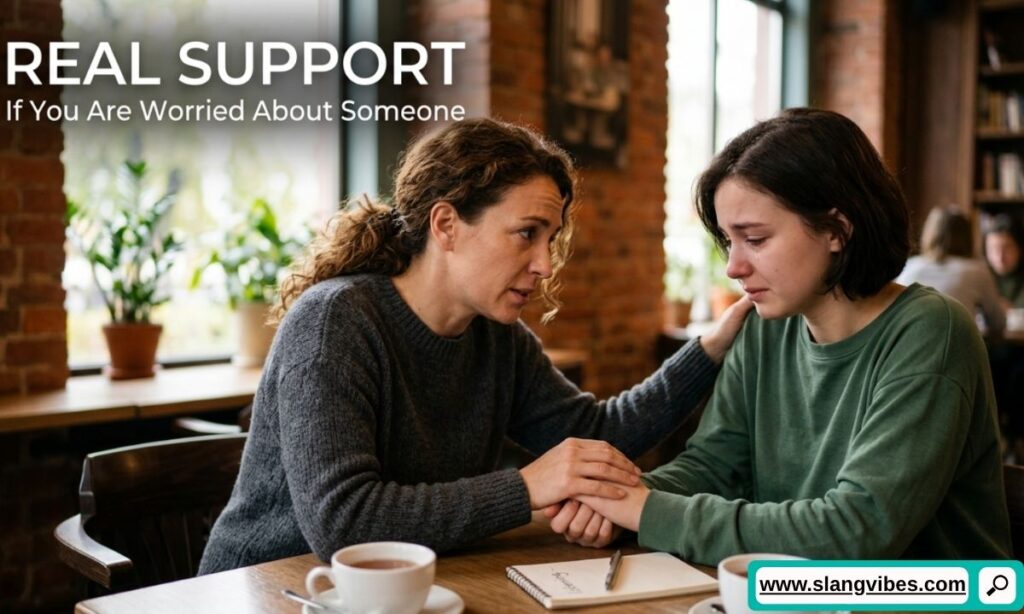
If a message ever feels like more than a joke, treat it as one deserving attention. Trust the instinct instead of second-guessing it.
Start with a direct, caring question. “Hey, this sounded heavier than usual, are you okay?” opens the door without accusing anyone of anything. Listen to the answer without rushing to fix it or brush it off.
If someone shares real thoughts of self-harm or suicide, resources exist beyond a friend’s text back.
In the US, the 988 Suicide and Crisis Lifeline is available by call or text, any hour, free of charge. Crisis Text Line offers support by texting HOME to 741741. In the UK, Samaritans is reachable at 116 123, also free and available around the clock.
These resources exist for exactly this kind of moment: uncertain, worried, unsure whether something is serious. Reaching out on someone’s behalf, or helping them reach out themselves, is never an overreaction, and it never requires having the perfect words ready first.
Platforms have started building in extra safeguards too. Instagram now blocks searches tied to suicide and self-harm and routes people toward support resources instead. Parent alert features started rolling out in 2026 for repeated searches on teen accounts. This shift reflects how seriously platforms now treat this kind of language. Even casual corners of the internet, where most of it started as a joke, are getting watched more closely now.
Read New Articles: Oura Meaning in Slang: Real Examples from TikTok, Snapchat & Text Messages
Frequently Asked Questions About KMS Meaning in Messages
What Is the KMS Meaning in Messages
KMS stands for “kill myself.” In texts, it almost always works as exaggerated slang for stress, embarrassment, or frustration rather than a literal statement. It reads similar to saying “I want to disappear” out loud.
Is KMS Always a Joke?
Most of the time, yes. Context matters though. Repeated use alongside real signs of distress, like talk of hopelessness or isolation, deserves a closer look. A direct check-in works better than an automatic laugh.
What Is the Difference Between KMS and KYS?
KMS is self-directed and usually hyperbolic, aimed at your own bad day. KYS is aimed at someone else and reads as hostile or threatening far more often, which is why platforms treat the two so differently.
Is It Fine to Use KMS With Friends?
In casual chats with people who know your humor, it is common and generally low-risk. Avoid it in professional, school, or unfamiliar settings where the joke will not land the way it does at home.
What Should I Do if Someone’s KMS Text Seems Serious?
Ask directly if they are okay, without judgment. If the answer suggests real distress, point them toward resources like the 988 Suicide and Crisis Lifeline in the US or Samaritans in the UK. Offer to help them reach out directly.
Conclusion
The KMS meaning comes down to three letters carrying two entirely different weights, depending on who is typing them and why. Most of the time, it is dark humor about a bad day, nothing more. Every so often, it is something worth a second look, and telling the difference matters more than memorizing a definition ever will.
Reading a text like this well means looking past the letters themselves. Tone, history with the person, and what surrounds the message all tell you more than the abbreviation alone ever could. A joking “kms” after tripping in the hallway does not carry the same weight as a quiet, repeated “kms” after a rough week. They look identical on a screen, but the weight behind them is not.
Platforms, schools, and workplaces are paying closer attention to this kind of language than they used to, and this shift is not a bad thing. It means fewer people slip through the cracks when a joke stops being one.

Alex Carter is a language enthusiast and internet culture expert at SlangVibes. He explains the latest slang terms and text meanings in simple, clear English so everyone stays in the loop.