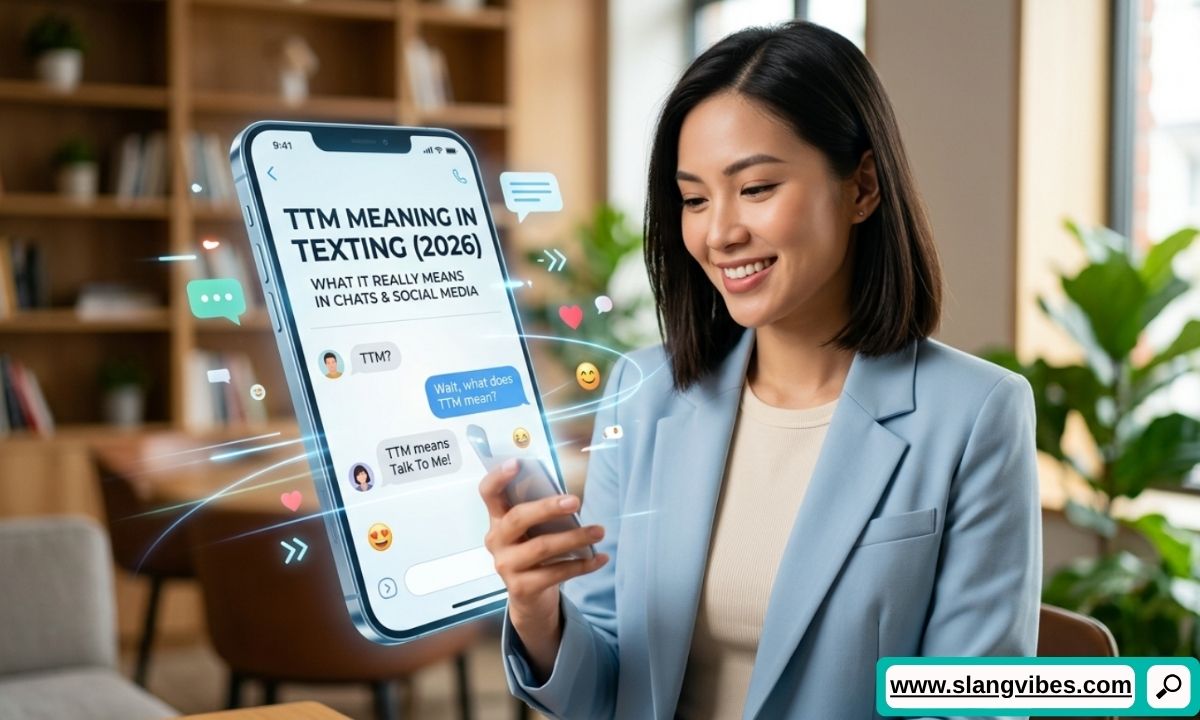
Picture this: your phone buzzes at midnight and the message reads TTM, nothing else. No punctuation. No context. You stare at the screen for a second, then text a friend to ask what it means. This confusion is common, and it’s why so many people search for the TTM meaning every week. The abbreviation shows up in DMs, group chats, and comment sections across every major app. It still catches people off guard the first time they see it. This guide breaks down what TTM stands for, where it came from, and how to reply without sounding lost.
TTM Meaning: The Quick Answer
TTM stands for “Talk To Me.” People send it as a short invitation to start a conversation or keep one going. You’ll spot it in texts, Snapchat stories, Instagram comments, and group chats. It’s most common among Gen Z and Millennial texters who grew up shortening everything to save time and thumb effort.
Quick Answer
- TTM = Talk To Me
- Tone: casual, friendly, sometimes flirty
- Common use: opening a conversation, checking in, or nudging someone to reply
A few examples of how it shows up in real messages:
- “Hey, TTM. I’m bored tonight.”
- “TTM whenever you’re free.”
- “You’ve been quiet lately. TTM.”
The letters stay the same everywhere, but the feeling behind them shifts depending on who sent it and why. A sibling sending TTM during a slow afternoon reads differently than a crush sending it late at night. Context does most of the work here, not the abbreviation itself.
Most people run into TTM for the first time in a DM or a comment reply, without any warning about what it means. It rarely comes with an explanation attached, so the confusion at first glance makes sense. Keep this in mind while reading the rest of this guide. Tone and platform change the message more than the definition ever does.
Read Also: JSP Meaning in Texting and Social Media (2026)
Where TTM Comes From: A Short History
TTM grew out of the same texting culture behind LOL, BRB, and HMU. Back when phones charged by the character or limited texts to 160 characters, shortening phrases wasn’t optional. It was practical. Typing “talk to me” took nine characters plus two spaces. Typing “TTM” took three.
As SMS gave way to smartphone messaging apps, these old habits stuck around. People kept the shorthand even after character limits stopped mattering, mostly because it felt fast and familiar. Abbreviations like TTM moved from flip-phone texts to iMessage, then into comment sections on Instagram and Snapchat captions.
By the time TikTok slang started spreading through captions and duets, TTM had settled into its current role. It became a low-effort way to open a conversation or show someone you’re around and paying attention, It didn’t need a viral moment or a specific creator to spread it, It spread the way most texting slang does, through repetition between friends who picked it up from each other.
Today the abbreviation feels less like a shortcut and more like its own small piece of digital language. Younger texters use it without thinking twice about what the letters originally stood for. Knowing the TTM meaning behind it, though, still helps when the context around a message isn’t obvious.
TTM Meaning on Snapchat, Instagram, TikTok, and Dating Apps
On Snapchat, Instagram, and TikTok
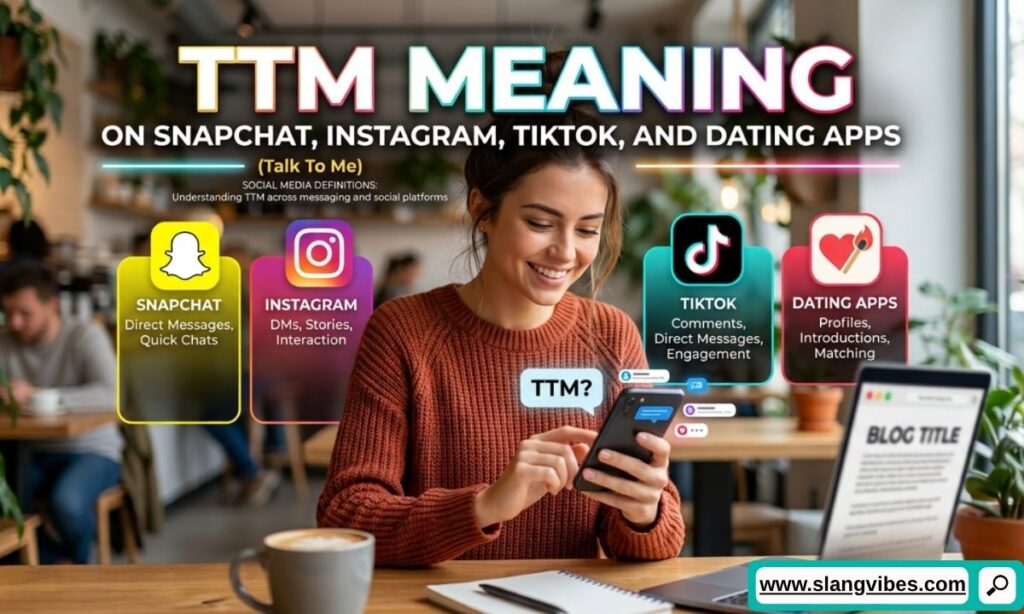
Snapchat’s fast, disappearing format makes short slang like TTM a natural fit. Someone might send it after a story to signal they want a reply. Others drop it in a Snap caption when they’re bored. On Instagram, TTM tends to show up in DMs and comment replies. It often follows a story hinting at drama, travel, or a big change. On TikTok, it mostly appears in comment sections under emotional or personal videos, where viewers use it to offer support or curiosity.
In DMs and Dating Apps
Dating apps add a different layer. On Tinder, Bumble, or Hinge, TTM often works as a soft opener or a follow-up after a stalled conversation. Here’s an example of how it looks in practice:
Riley: Hey, saw we matched on hiking trails 🏔️ Avery: Yes! Been wanting to try Eagle Peak Riley: TTM about it, I’ve done this trail twice Avery: Okay, tell me everything
“TTM if you’re around” reads as low-pressure interest. It’s less direct than asking someone out, but it still signals someone wants to keep talking.
In Discord and Gaming Chats
Gaming chats move fast, and TTM fits right into the rhythm. Players drop it between rounds, in Discord voice-chat text channels, or after a match wraps up. It usually means someone wants to debrief, plan the next game, or keep the conversation going while everyone’s still online. The tone here leans friendly and low-stakes. It’s closer to how friends use it than how it plays out on dating apps.
The platform shapes the tone more than most people realize. The same three letters feel playful on TikTok. They land differently on a dating app, depending on where and when they show up.
Read More: Mean Mean in Text: What It Really Means in Messages (2026)
The Real Meaning Behind TTM’s Tone: Friendly or Flirty?
Here’s the thing about TTM: the letters never change, but the feeling behind them does. Punctuation, timing, and emoji all shape how the message lands.
A plain “TTM” sent in the afternoon usually reads as casual, almost like checking in on a friend. Add an emoji, like a wink or a heart, and the tone shifts toward flirty. Send it late at night with no other context. It often carries a different weight, hinting at loneliness, interest, or both.
Who sends it matters as much as when. From a close friend, TTM usually means what it says on the surface: they want to talk, From someone you text on and off, especially after a quiet stretch, TTM often signals an opening for something more, From a near-stranger, it might come across as forward, since there’s no shared history to soften it.
Gender doesn’t decide tone on its own, but patterns show up anyway. TTM from a guy after a long silence often gets read as flirty by default, fair or not. TTM from a girl checking on a friend who seems upset usually reads as supportive. Neither reading is guaranteed. The full conversation, not the abbreviation, tells you the real intent behind it.
Other Meanings of TTM Outside of Texting
Texting isn’t the only place TTM shows up. The same three letters carry different meanings once you leave chat apps and DMs behind.
| Field | TTM Meaning | Where You’ll See It |
|---|---|---|
| Finance | Trailing Twelve Months | Earnings reports, stock analysis |
| Medicine | Targeted Temperature Management | Hospital charts, post-cardiac-arrest care |
| Mental health | Trichotillomania | Clinical discussions, support forums |
| Collecting | Through The Mail | Autograph collector communities |
| Texting | Talk To Me | Texts, DMs, social media |
In finance, TTM refers to a company’s performance over the past twelve months rather than a fixed calendar year. Analysts use TTM revenue or TTM earnings to get a current read on a business between official reports.
In medicine, TTM stands for Targeted Temperature Management, a treatment used to control body temperature after cardiac arrest and protect brain function. This version rarely appears outside clinical settings.
Trichotillomania, often shortened to TTM in mental health spaces, describes a condition. Someone with it feels an urge to pull out their own hair. It’s classified as a body-focused repetitive behavior linked to stress or anxiety.
Autograph collectors use TTM to mean “Through The Mail,” describing requests sent by post to public figures for signed items. These definitions don’t overlap with texting slang. The surrounding context usually tells you which one applies within a sentence or two.
Read Here: TT Meaning in Text Messages and Social Media (2026)
TTM vs Similar Texting Slang (TMM, HMU, DM)
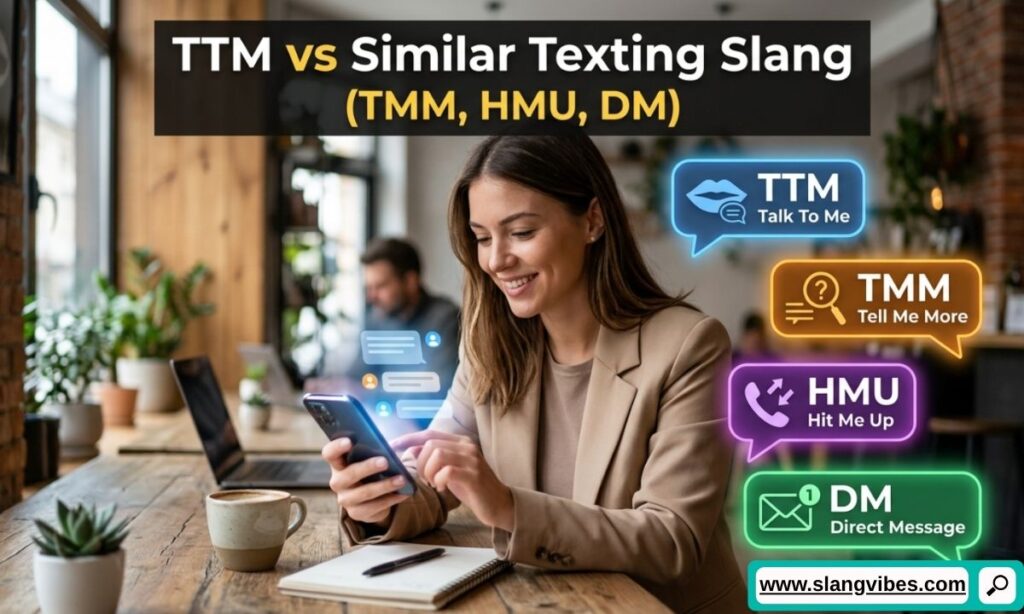
TTM often gets confused with a nearly identical abbreviation: TMM. The two look alike but mean different things entirely.
Mia: Wanna talk about the trip TTM? Leo: Wait, do you mean today or tomorrow? Mia: Sorry, autocorrect. I meant TMM, tomorrow Leo: Got it, tomorrow works
TMM stands for “Tomorrow,” used in messages like “Let’s talk TMM” or “TMM works better for me.” TTM, on the other hand, means “Talk To Me” and works as an invitation, not a time reference.
| Term | Meaning | Tone | Best Use |
|---|---|---|---|
| TTM | Talk To Me | Friendly, sometimes flirty | Starting or restarting a conversation |
| TMM | Tomorrow | Neutral | Setting a time to talk |
| HMU | Hit Me Up | Casual | Asking someone to reach out later |
| DM | Direct Message | Neutral | Referring to a private message on a platform |
| WYD | What You Doing | Casual | Checking someone’s plans |
TTM stands apart from these because it directly asks for conversation rather than describing a time, action, or platform. HMU carries a similar invitation but leans slightly more casual and often implies plans, like hanging out later. DM refers to the message format itself, not an invitation. Knowing the correct TTM meaning next to a lookalike term keeps your texts clear. TTM and TMM get mixed up more often than most people expect.
How to Reply to a TTM Text
Replying to TTM doesn’t have to feel complicated. The right response depends on your relationship with the sender and the tone they used. A quick scan of the conversation before it, if there is one, usually points you toward the right kind of reply.
1.For a casual reply, keep it short and open:
- “Hey, what’s up?”
- “I’m here, what’s on your mind?”
2.For a flirty reply, match their energy without overthinking it:
- “Only if you start 😉”
- “Depends what you want to talk about.”
3.For a funny reply, lighten the moment:
- “I charge by the minute.”
- “Only if snacks are involved.”
4.For a mature or confident reply, keep it direct and warm:
- “Sure, I’m free now. What’s going on?”
- “Let’s talk, I’ve got time.”
For a polite decline, stay kind but clear:
- “Kind of swamped right now, talk soon?”
- “No time to chat right now, I’ll reach out later.”
If you’re unsure how to read the tone, mirror the sender’s energy. A short, warm reply almost always works, and it leaves room for the conversation to grow from there. There’s no rule saying you have to reply right away, either. A TTM text usually holds up fine for an hour or two, so a delayed reply rarely comes across as rude.
Read Also: HG Mean in Text: What It Really Means in Messages (2026)
When TTM Feels Off: Context, Formal Settings, and Red Flags
TTM works fine in casual spaces, but it doesn’t belong everywhere. Sending it in a work email or a formal message reads as unprofessional, even when unprofessional isn’t the intent.
Priya: Hey, TTM about the deck when you get a sec Noah: Would you send a quick summary instead? Easier to reference later Priya: Good call, I’ll type it up
Swapping TTM for a direct request, like “Let’s discuss this when you’re free,” lands better in professional settings. It also tends to get a faster response.
Context matters outside of work, too. A single TTM from a close friend rarely raises concern. The same message from someone you don’t know well is worth a second look. Watch for pressure to reply fast or share personal details alongside it. This applies to teens and adults alike. Strangers sometimes use casual-sounding openers like TTM to start conversations heading somewhere uncomfortable.
A common mistake is treating every TTM as an urgent request. Most of the time, it’s a low-pressure nudge, not a demand for an immediate reply. A few situations worth pausing over before replying:
- The sender is someone you’ve never met in person
- The message comes with pressure to share personal information
- The conversation moves quickly toward something uncomfortable
This doesn’t mean TTM is unsafe on its own. It’s one of the most common, harmless abbreviations in texting. The context around it, not the abbreviation itself, tells you whether something feels right.
Common Mistakes People Make With TTM Meaning

Even simple slang gets misread sometimes. A few patterns show up again and again once you start paying attention to how people misuse TTM.
The biggest one is confusing it with TMM, covered above. The second most common mistake is sending TTM repeatedly without a response. It often comes across as pushy rather than inviting.
Zoe: bored, TTM 💀 Zoe: helloooo Zoe: TTM pls 😭
This kind of repeat messaging often backfires, even when the intent is playful. A single TTM, followed by patience, tends to land better than three in a row.
Another mistake is assuming TTM always signals flirting. Plenty of texters use it as a plain, platonic check-in. Reading too much into it sometimes creates awkwardness which wasn’t there to begin with. On the flip side, some people miss genuinely flirty TTM texts because they assume the term is always casual.
Using TTM in professional or academic writing is another slip worth avoiding entirely. It might feel natural in the moment. It still reads as out of place in an email, a school assignment, or a formal message to someone you don’t know well. Sticking to full sentences in those settings keeps the tone appropriate.
Read New Article: NM Mean in Text: What It Really Stands For (2026)
How TTM’s Meaning Shifts by Generation and Region
Gen Z vs Millennials
Gen Z texters tend to pair TTM with emojis, GIFs, or voice notes, treating it as one piece of a larger, more visual conversation.
Zoe: bored, TTM 💀 Max: say less, what’s up
Millennials lean toward using it as a standalone message, closer to how “call me” worked in earlier texting habits.
Dana: Hey, TTM when you get a chance. Chris: Sure, calling you in ten.
Neither generation invented TTM, but each uses it slightly differently based on how they grew up communicating.
US vs UK Usage
In the US, TTM shows up constantly across texts, Snapchat, and Instagram, especially among teens and young adults. In the UK, the same abbreviation gets used. British texters sometimes favor “text me” or “hit me up” in similar situations, giving TTM a slightly more American flavor. It’s still understood widely across UK social media, especially among younger users active on TikTok and Instagram. Slang spreads across borders quickly through shared trends and sounds.
These differences aren’t dramatic. Texting slang travels fast between countries now, since platforms spread trends without regard for borders. Still, noticing these small shifts explains a lot. A term often feels more familiar to a teenager in Los Angeles than to an older relative in Manchester. The same gap shows up between Gen Z and an established Millennial in the same US city.
FAQ About TTM meaning
What does TTM meaning in a text message?
TTM stands for “Talk To Me.” People use it to invite someone into a conversation or check in after a quiet stretch.
Is TTM always flirty?
No. Tone depends on context, timing, and who sent it. Between friends, it usually reads as casual and supportive rather than flirty.
What does TTM meaning besides “Talk To Me”?
Outside texting, TTM refers to Trailing Twelve Months in finance, Targeted Temperature Management in medicine, Trichotillomania in mental health, and Through The Mail among autograph collectors.
Is it okay to send TTM to someone I don’t know well?
It’s generally harmless, but pace matters. If the other person seems hesitant or slow to respond, give them space instead of pushing for a reply.
What’s the difference between TTM and TMM?
TTM means “Talk To Me,” while TMM means “Tomorrow.” They look alike but serve entirely different purposes inside a message.
Conclusion
TTM looks small on a screen, but it carries a clear, simple message: someone wants to talk. Whether it shows up in a group chat, a Snapchat reply, or a dating app opener, the meaning stays consistent. The tone shifts around it instead. Pay attention to who sent it, when, and how, and the rest usually falls into place on its own.
Outside of texting, remember the same three letters mean something completely different in a hospital chart or a stock report. Context always comes first when the setting changes. Once you’ve seen TTM a few times in real conversations, reading it gets easy fast.
Understanding the TTM meaning behind a single text takes only a moment once you know what to look for. The next time it lands in your messages, you’ll know exactly what to say back. You won’t need to text a friend to figure it out, and you might even use it yourself the next time you want someone to talk.

Alex Carter is a language enthusiast and internet culture expert at SlangVibes. He explains the latest slang terms and text meanings in simple, clear English so everyone stays in the loop.