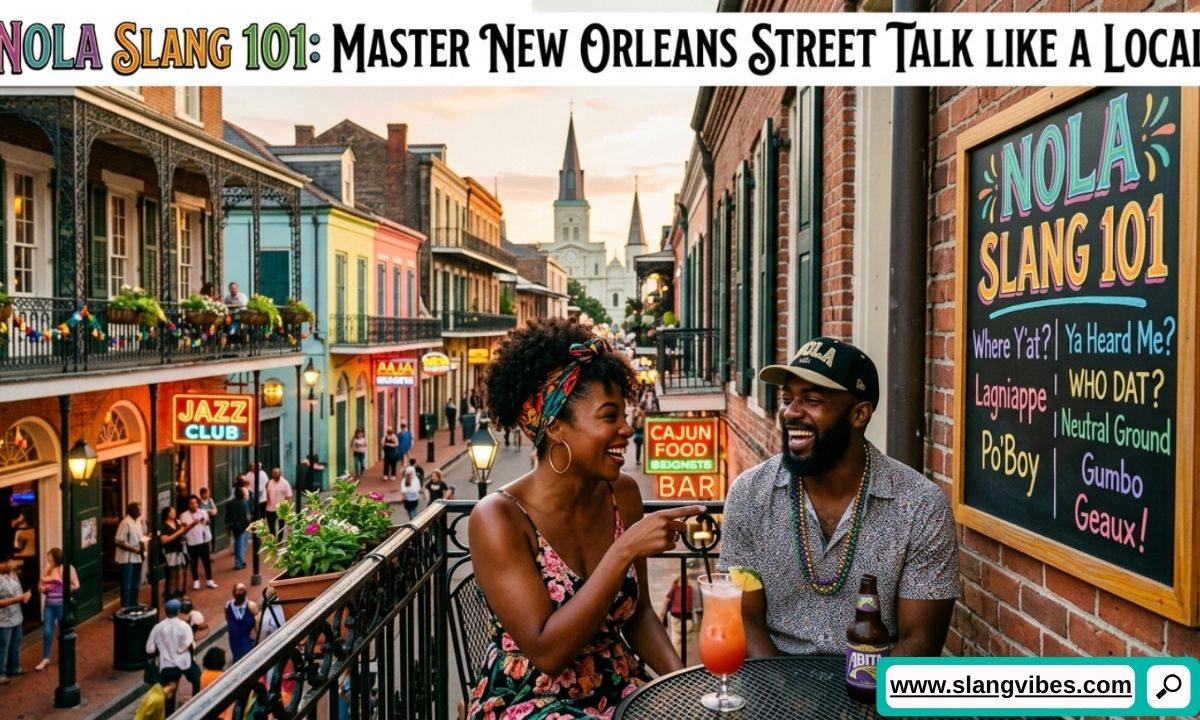
Picture this: you land in New Orleans and grab a cab from the airport. The driver glances back and asks, “Where y’at?” You freeze up. Is it a question? A greeting? Some kind of test? Ten minutes later, someone behind the coffee counter calls you “baby.” You’re still catching your breath from the first one. NOLA Slang 101 exists for exactly this moment.
This guide breaks down the words locals use every day. It covers greetings you’ll hear on every block and Mardi Gras words locals only bring out once Carnival season hits. Some of these words trace back to French settlers. Others come from Creole kitchens, Cajun bayous, and the hip-hop pouring out of car speakers on Claiborne Avenue. By the end, you’ll know what people mean, not only what they say.
NOLA Slang 101: Where This Language Comes From
New Orleans sits at a crossroads most American cities never had. French settlers arrived first. Spanish rule followed. Waves of Haitian and Caribbean immigrants brought their own Creole language and traditions. Enslaved Africans and their descendants shaped the city’s rhythm, food, and speech patterns in ways still heard today. Add in Cajun communities from the surrounding bayous. The result is a dialect unlike anywhere else in the Southern United States.
Jazz culture grew out of this same mix. It was born in dance halls and street parades around the French Quarter in the early twentieth century. This musical tradition shaped the rhythm of everyday speech, long before hip-hop culture added its own layer decades later. Walk through the French Quarter today. You’ll hear brass bands, second line rhythms, and casual conversation blending into one soundscape.
This mix is why NOLA slang sounds French in one sentence and pure African American Vernacular English in the next. Words like “lagniappe” come straight from French and Spanish trade language. Phrases built on rhythm and repetition echo AAVE and jazz culture, both born in this city. Cajun expressions drift in too, carried by families who move to New Orleans for work or school.
This mix formed over centuries, not by chance. Locals take pride in the way they talk because of it. Every phrase carries a small piece of New Orleans culture, not only a definition.
NOLA Slang 101: Classic Greetings You’ll Hear Everywhere
Three phrases follow you around New Orleans more than any others. They are Where Y’at, Who Dat, and How’s Your Mama ‘n Dem.
Where Y’at works as a full greeting on its own. It means something close to “how are you” or “what’s going on,” and it doesn’t need a real answer. Most people respond with “all good” and keep walking.
Who Dat carries more weight than a simple greeting. It started as a Saints football chant: “Who Dat say dey gonna beat dem Saints.” Over time, it grew into a citywide identity marker. Locals say it during game season and outside of it, as a way to show love for the city.
How’s Your Mama ‘n Dem asks about someone’s whole family in one breath, not only the person you’re talking to. It signals warmth and shows you see someone as part of a household, not a stranger.
Here’s how a real exchange might sound between two neighbors on a porch:
Renee: Where y’at, girl? Tasha: All good, got off work not long ago. How’s your mama ‘n dem? Renee: They good, thank you for asking. Who Dat this weekend, right? Tasha: Who Dat!
These three phrases show up in texts, in person, and on game days alike. Learn them first, and the rest of NOLA slang starts to make more sense.
Terms of Endearment and Everyday NOLA Sayings
Terms of Endearment
New Orleans runs on affectionate nicknames, and three stand out most: Sha, Dawlin, and Cmere.
Sha comes from the French word “cher,” meaning dear. Locals use it for friends, children, or anyone they feel warm toward, regardless of age or gender. Dawlin works the same way. It’s a Southern-style stretch of “darling.” It fits into nearly any friendly exchange, from a cashier to a grandmother.
Cmere means “come here,” but it carries more meaning than the words alone suggest. Someone saying “cmere, sha” wants closeness, not distance. It shows up when someone wants to share news, offer comfort, or pull you into a conversation.
All three phrases sound warm, even between strangers. A server calling you “dawlin” while taking your order counts as normal here, not flirtation.
Everyday Phrases and Small Talk
Beyond nicknames, a handful of phrases carry NOLA culture into daily conversation. Three worth knowing: Mais, Pass a Good Time, and Ya Heard Me.
Mais comes from French, meaning “but” or “well.” Locals drop it into sentences as filler with attitude, similar to how someone elsewhere might open with “well.” “Mais, I wasn’t expecting it” sounds completely natural coming from a local.
Pass a Good Time means to enjoy yourself, especially at a party, festival, or family gathering. It shows up constantly around Mardi Gras and any weekend with live music on the schedule.
Ya Heard Me works as a verbal check-in, confirming someone understood a point. It often lands at the end of a sentence for emphasis, not as a real question. A father telling his son to be home by curfew might close with “ya heard me.” No reply is expected beyond a nod.
Read Also: Snowball Kiss Meaning: The Truth You Didn’t Expect 😳
How to Sound Like a Local: Cracking the Yat Accent
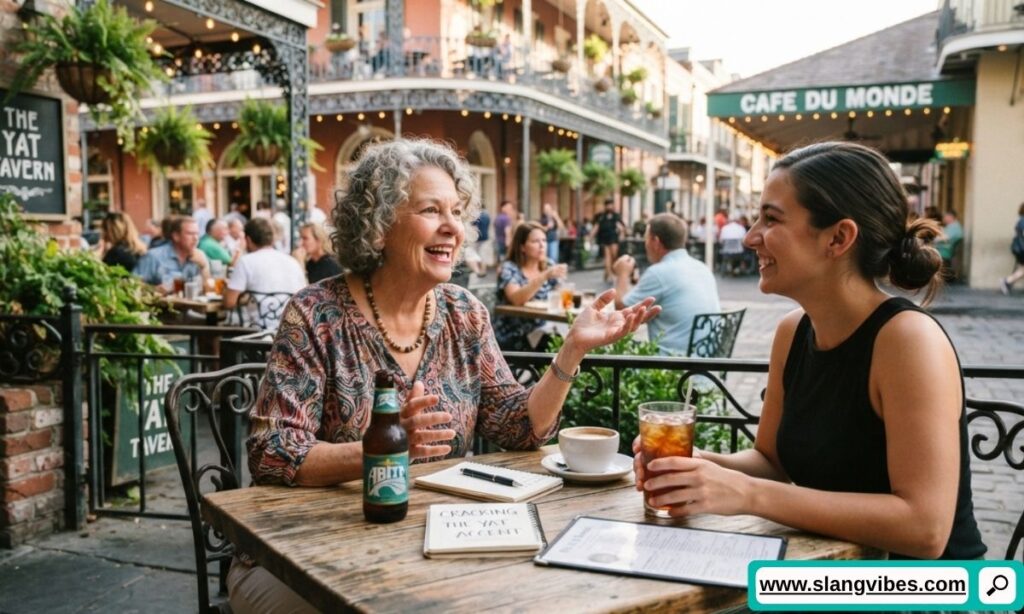
NOLA slang isn’t only about vocabulary. Pronunciation changes everything, and the Yat accent has its own rules. This kind of pronunciation shift sits at the center of NOLA Slang 101.
Locals say “ax” instead of “ask,” a pattern with roots stretching back centuries in English itself, not a recent shortcut. Soda becomes “cocola,” no matter the actual brand poured into the cup. Consonant sounds shift too: th-words often turn into d-words, so this becomes dis, and those becomes dose.
Family terms get compressed as well. “Mother and them” turns into “mudda n dem,” used to ask about someone’s whole household at once. Streets and sidewalks carry their own pronunciation quirks, with “banquette” (sidewalk) sounding closer to “BANK-et” than the French original.
Here’s a quick check-in between coworkers grabbing lunch:
Jordan: You want anything from the corner store? Priya: Grab me a cocola if they got one. Jordan: Bet, I’m walking down the banquette now.
This doesn’t sound put-on to a New Orleans local. It’s simply how the city talks, shaped by generations of working-class neighborhoods where these sounds stuck.
NOLA Food Slang Every Visitor Should Know
Food slang matters as much as any greeting in New Orleans. Get these words wrong, and a server will know you’re new in town.
Make Groceries means to buy groceries, translated loosely from French “faire son marché.” Locals still use it today: “I gotta make groceries before the game.”
Dressed describes how a po-boy comes topped, with lettuce, tomato, pickles, and mayonnaise. Order a po-boy “dressed” and the sandwich arrives fully loaded. Skip the word, and you might end up with plain bread and meat.
Lagniappe means a little something extra, thrown in for free. A baker slipping an additional beignet into your bag counts as lagniappe. The word traces back to Spanish and French trade language. Locals still use it today for any small bonus in daily life.
Roux talk shows up around gumbo season. It refers to the flour-and-fat base starting almost every Creole dish. Locals debate roux color the way other cities argue about barbecue sauce, and getting it “dark enough” carries real pride.
A short exchange at a po-boy counter might sound like this:
Cashier: Shrimp po-boy, dressed? Customer: Yes, and throw in some lagniappe if you got extra.
Getting Around Like a Local: NOLA Geography Slang
Forget north, south, east, and west. New Orleans runs on its own directions, and outsiders get lost fast without knowing them.
Uptown and Downtown split the city along the Mississippi River’s curve, not a straight compass line. Riverside and Lakeside replace east and west, pointing toward the river or Lake Pontchartrain instead. Locals give directions this way without a second thought: “It’s three blocks lakeside of Canal Street.”
Neutral Ground refers to the median strip running down the middle of many streets. It includes the famous stretch along Canal Street. The name dates back to when this median separated the French and Creole part of town from the American sector, a literal neutral zone between two communities.
Banquette means sidewalk, a French holdover locals still use in daily conversation. Backatown describes neighborhoods set back from the river, away from the natural levees where the city first grew. Parish replaces county across all of Louisiana. The system comes from French and Spanish Catholic rule rather than the standard American structure.
Ask someone for directions here. You’ll likely hear something like: “Go up two blocks, cross the neutral ground, and it’s riverside on your left.”
Read More: MyB Meaning in Text: How People Use It on WhatsApp, TikTok & Snapchat
Mardi Gras and Carnival Season Vocabulary
Carnival season brings its own vocabulary, and skipping this section means missing half of what locals talk about every spring. Mardi Gras vocabulary makes up one of the richest parts of NOLA Slang 101.
Krewe refers to the private clubs and organizations putting on Mardi Gras parades and balls. Each krewe builds its own floats, picks its own theme, and throws its own set of items to the crowd. Throws covers everything tossed from floats, beads, cups, toys, and the prized hand-painted coconuts from the Krewe of Zulu.
Second Line describes a specific style of parade, built around a brass band and a dancing crowd. Handkerchiefs wave behind the main group the whole route. It grew out of jazz funeral traditions. Now it shows up at weddings, birthdays, and Sunday afternoon parties across the city.
King Cake Baby refers to the small plastic figure hidden inside a king cake during Carnival season. Whoever finds the baby in their slice owes the group the next king cake, a tradition tied closely to celebration and community identity.
Fais Do-Do means a Cajun dance party, often with live zydeco or accordion music. Geaux is a playful spelling of “go.” It shows up on shirts and signs across the city, especially tied to the Saints and local pride.
These words don’t disappear after Mardi Gras ends. Locals use several of them year-round, especially krewe, second line, and geaux.
New Orleans Slang 101 for Gen Z and Millennials
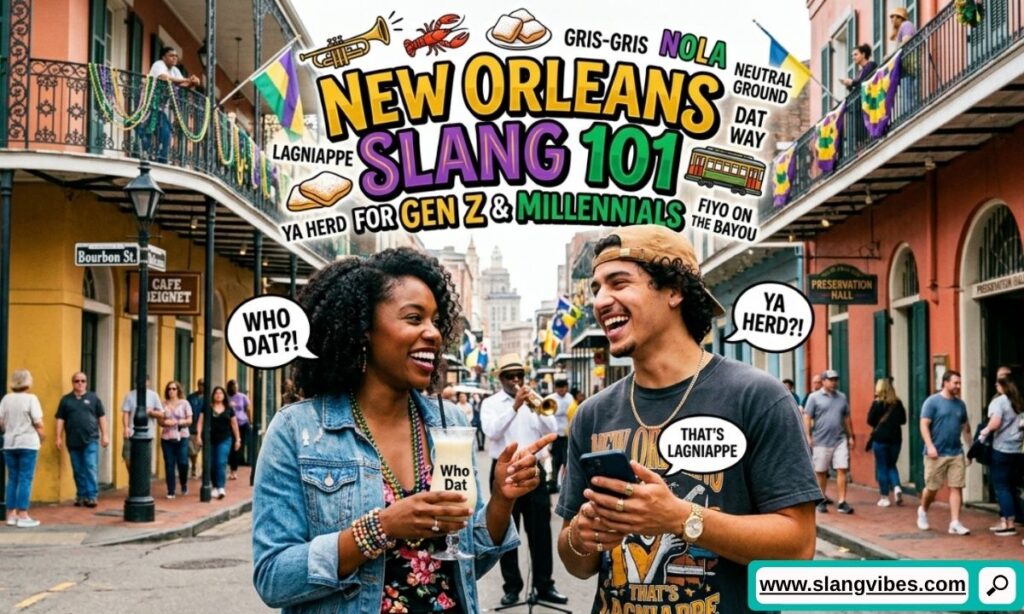
Words for Friends, Flexing, and Vibes
Modern NOLA slang blends local roots with national internet and hip-hop culture, especially among younger speakers.
Woadie means a close friend, someone from your inner circle. Chop It Up means to talk casually, catch up, or hang out in conversation. Flexin describes showing off, whether it’s new sneakers, a car, or a recent win.
Trill combines “true” and “real,” describing someone genuine and trustworthy. Buggin means acting irrational, dramatic, or strange, usually said with a hint of teasing rather than real frustration.
A group chat between friends planning a Friday night might look like this:
Kayla: You still coming through or naw? Jerome: Yeah, gonna pull up with my woadie. Kayla: Bet, we finna chop it up all night.
These words move first through bounce music and local radio before spreading online today. Someone calling a friend their woadie signals real closeness, not a casual acquaintance from school or work. Flexin describes subtle things too, like a slow drive through the neighborhood in a freshly washed car. It doesn’t only mean big purchases. Chop It Up sometimes replaces an entire plan for the evening. Catching up with someone counts as the whole point of hanging out.
Words for Feelings, Agreement, and Reactions
A second cluster of modern slang covers emotional reactions and quick agreement.
No Cap means someone is being honest, with zero exaggeration. Bet confirms agreement or approval, often replacing “okay” or “sounds good” entirely. Boo’d Up describes being happily in a relationship, often used to tease a friend about a new partner.
Down Bad describes struggling emotionally, financially, or romantically, usually said with humor rather than real concern. Throwed means acting wild, chaotic, or overly excited, often describing a party or event getting out of hand.
No Cap sometimes gets a physical gesture too, a hand crossed over the heart to back up the words. Boo’d Up shows up heavily around Valentine’s Day and homecoming season, tied to relationship milestones people want to announce. Down Bad works for small setbacks and bigger ones alike, from losing a phone charger to a rough breakup. The phrase stays flexible in daily conversation this way.
These words move fast through social media slang and TikTok before landing in everyday conversation. A term trending online this month might sound outdated by next year. This part of NOLA Slang 101 keeps shifting.
Old-School vs. New-School: How the Slang Has Shifted
Every generation in New Orleans speaks a slightly different version of the same city.
Older speakers lean on classic regional expressions. Lagniappe, Make Groceries, and Dawlin show up more with grandparents than with teenagers. These words carry deep roots in Creole and Cajun tradition, passed down through families rather than picked up online.
Millennials grew up blending hip-hop influenced slang with local phrases. They mix Trill and Flexin with Where Y’at and Who Dat. This generation bridges older Louisiana dialect with the wider Southern slang heard across the country.
Gen Z leans hardest into social media slang. No Cap, Bet, and Down Bad show up constantly in texts and group chats. Local terms still appear too, layered on top of national internet trends rather than replacing them entirely.
This doesn’t mean older slang is disappearing. Grandparents still say “sha” and “dawlin” daily. Younger locals pick up these words simply by growing up around them.
Radio hosts and local musicians often bridge the gap between generations. They mix older Louisiana dialect with current social media slang in the same breath. A single family gathering might feature a grandmother saying “lagniappe” and a grandchild responding with “no cap,” both speaking authentic New Orleans culture in their own way.
Common Mistakes Outsiders Make With Local Sayings
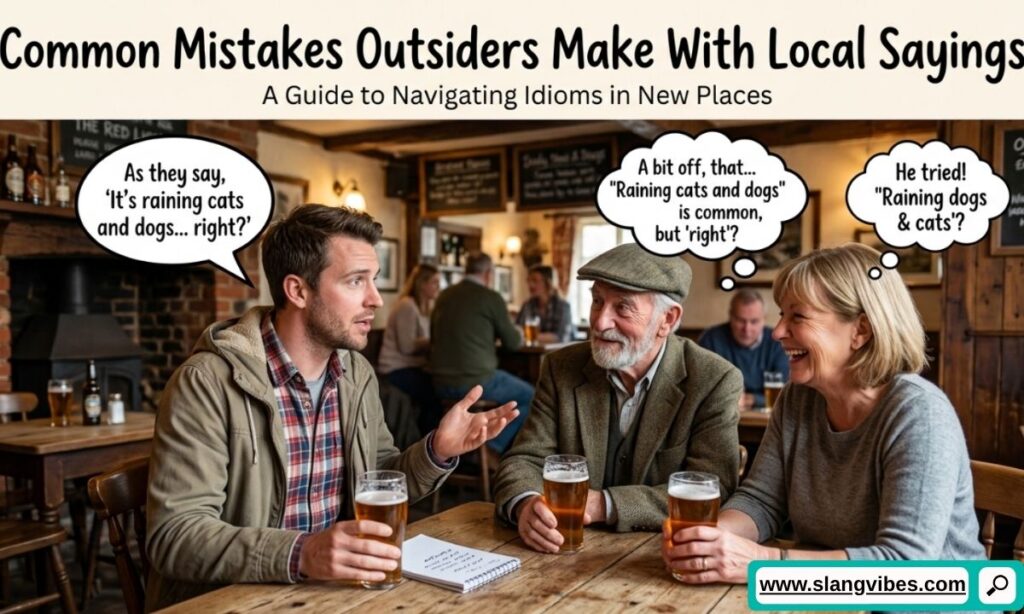
Visitors often mean well but slip up in a few predictable ways.
Using outdated slang tops the list. Terms like “trill” feel dated to some younger locals now, even though older millennials still use them regularly. Dropping local words into formal writing or a job interview also lands wrong. Most NOLA slang belongs strictly to casual settings.
Overusing slang creates a different problem. Stringing five local phrases into one sentence sounds forced, not authentic. Locals weave slang naturally into conversation, not as a performance for visitors.
Mixing up Cajun and Creole terms trips up plenty of visitors too. The two cultures share geography but carry distinct histories, foods, and vocabulary. Treating them as interchangeable comes across as a shortcut rather than genuine interest. A little research beforehand goes a long way toward sounding informed instead of scripted.
Common Mistake: Treating “where y’at” as a real question needing a detailed answer. It works as a greeting, not a real check-in on someone’s day. A simple “all good” or a wave back covers it.
Respect matters too. Words tied to African American Vernacular English and Creole language carry cultural weight beyond simple vocabulary. Using them thoughtfully, rather than as a costume, keeps the exchange genuine.
Quick Reference: The NOLA Slang Glossary
Keep this NOLA Slang 101 cheat sheet nearby for a fast refresher before your next trip or conversation.
| Term | Meaning | Category |
|---|---|---|
| Where Y’at | Greeting, “how are you” | Greeting |
| Who Dat | Saints chant, city pride | Greeting |
| Sha | Affectionate nickname | Endearment |
| Dawlin | Darling, warm address | Endearment |
| Make Groceries | To buy groceries | Food |
| Lagniappe | A little extra, free bonus | Food |
| Neutral Ground | Median strip in the road | Geography |
| Banquette | Sidewalk | Geography |
| Krewe | Mardi Gras parade organization | Mardi Gras |
| King Cake Baby | Figurine hidden in king cake | Mardi Gras |
| No Cap | Being honest, no exaggeration | Modern |
| Bet | Agreement or confirmation | Modern |
| Boo’d Up | In a happy relationship | Modern |
| Down Bad | Emotionally struggling | Modern |
| Woadie | Close friend | Modern |
| Throwed | Acting wild or chaotic | Modern |
| Trill | Genuine, authentic | Modern |
| Buggin | Acting strange or dramatic | Modern |
| Chop It Up | To talk casually | Modern |
| Pass a Good Time | To enjoy yourself | Everyday |
| Ya Heard Me | Confirming understanding | Everyday |
| Mais | French-rooted “but” or “well” | Everyday |
This table covers only part of the full list of local expressions. New words enter regular use every year, especially through social media slang and Gen Z slang.
Read New Article: GTFO Meaning in Chat: Snapchat, TikTok, Instagram & WhatsApp
Frequently Asked Questions About New Orleans Street Talk
These five questions cover the parts of NOLA Slang 101 people ask about most.
What does NOLA mean in slang?
NOLA stands for New Orleans, Louisiana. Locals use it as a shorthand nickname for the city itself. It appears constantly across social media slang, merchandise, and everyday conversation.
Is Who Dat only about football?
No. Who Dat started as a Saints chant, but it grew into a broader symbol of city pride. Locals say it during football season and outside of it, especially around Mardi Gras and other citywide celebrations.
Do locals still say Make Groceries?
Yes, though it shows up more with older generations. Younger locals understand the phrase and use it occasionally. It leans toward classic Louisiana dialect rather than everyday Gen Z slang.
What’s the difference between Cajun and Creole slang?
Cajun expressions trace back to Acadian settlers from Canada, centered around rural parishes and bayou communities. Creole language reflects a mix of French, Spanish, African, and Caribbean influences, centered more around the city itself.
Is it okay for visitors to use NOLA slang?
Yes, as long as it’s used naturally and with respect for where the words come from. Overusing slang or using it as a performance tends to feel forced rather than genuine.
The Bottom Line on NOLA Slang 101
New Orleans speaks in layers. French roots sit next to Creole rhythm, Cajun expressions, and the newest wave of social media slang. All of it stacks into one dialect found nowhere else in the country.
Learning a handful of terms won’t turn a visitor into a local overnight, and this is okay. Start with the basics: Where Y’at, Who Dat, and a little lagniappe wherever you find it. Add local geography terms so directions make sense. Pick up a few Mardi Gras words before Carnival season rolls around.
This wraps up NOLA Slang 101. Use these words with genuine curiosity, not as a performance, and conversations with locals will feel warmer almost right away.

Alex Carter is a language enthusiast and internet culture expert at SlangVibes. He explains the latest slang terms and text meanings in simple, clear English so everyone stays in the loop.