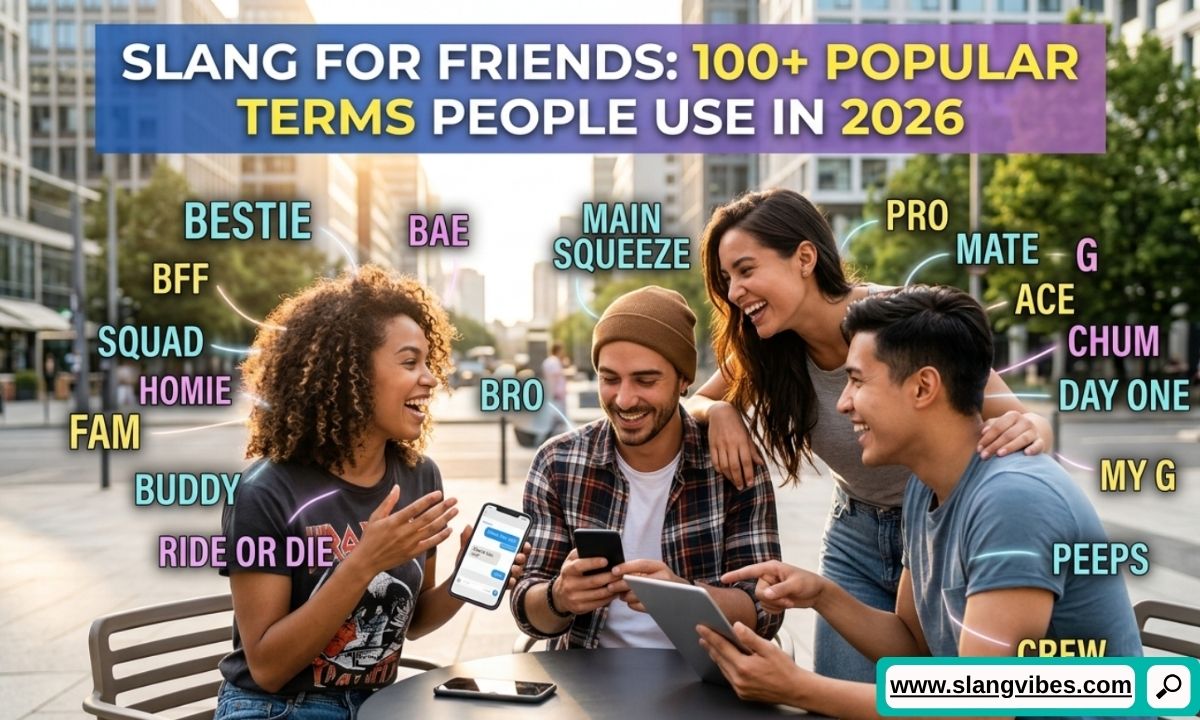
Somebody in my friend group sent “you’re my ride or die” last week, then added “no cap, such a bestie” right after. I sat there trying to figure out if this counted as one compliment or two. This is the reality of slang for friends right now. New words show up every few months, old ones quietly fade out, and keeping up feels like a full-time job. This guide breaks down every popular term below, from classic words your parents used to phrases your group chat invented last month. You’ll get meanings, real examples, and tips on when each word fits.
What Is Slang for Friends, and Why Does It Change So Fast?
Slang for friends covers any informal word people use instead of the plain word “friend.” Think bro, bestie, homie, or squad. Each word carries more than a dictionary definition. It signals closeness, humor, and belonging in a single syllable.
Where does this language come from? Mostly from three places: music, gaming communities, and social media. A rapper drops a new phrase in a song. A streamer repeats it during a match. A meme turns a random phrase into an inside joke overnight. Within weeks, versions of it show up across millions of comments. Texting speeds this process up even further. Group chats invent private jokes, and those jokes spread far past the original group.
Generations play a role too. Gen Z leans toward playful, internet-born terms shaped by youth culture, like twin or bestie. Millennials grew up saying squad and homie during the early social media years. Older speakers still reach for buddy, pal, and mate, words with decades of casual use behind them.
This vocabulary never settles down for long, since language evolution moves alongside culture rather than behind it. A term fresh in 2022 might feel dated by 2026, while an unfamiliar word from last year might show up in every caption today. This kind of language works partly as social identity, showing which group, generation, or platform someone belongs to. Tracking these words means following a moving target rather than memorizing one fixed list.
Did You Know? “Homie” traces back to hip hop culture and West Coast slang from the 1990s, long before it became a universal term for a close friend online.
Classic Slang for Friends That Never Really Left
Long before hashtags existed, people already had plenty of casual words for friend. Buddy, pal, and mate topped that list, and they still work today.
Buddy sounds warm and easygoing. Parents use it with their kids, coworkers use it with each other, and old friends use it without a hint of irony. Pal carries a similar tone, though it leans slightly more old-fashioned, the kind of word a grandfather might use with genuine warmth.
Mate belongs mostly to British and Australian English, though American speakers borrow it often enough that it feels familiar everywhere. Chum and compadre round out this group. Chum sounds almost vintage now, more likely to show up in an old movie than a group chat, while compadre carries a Spanish-language warmth that fits well among close friends regardless of background. Amigo works similarly, used casually across Spanish-speaking communities and picked up widely in American English too, especially in warmer, joking contexts.
Best bud and old pal both describe long-term friendships built on history rather than trend. These classic nicknames for friends rarely fade, since they describe a relationship rather than a moment. Nobody outgrows the need for a word describing a friend who has stuck around for years.
What sets these terms apart from newer slang is longevity. Nobody needs internet culture to understand buddy or pal. Grandparents and teenagers both know exactly what these words mean, giving them a flexibility trendier terms rarely have. When in doubt about which word fits a situation, these classic options rarely go wrong.
Read Here: Jody Military Slang Meaning (2K26 Guide): Origin, History & Real-Life Military Use
Modern Friend Slang Gen Z and Millennials Actually Use
Some of these terms function as cool names for friends whenever a caption needs personality, while others work purely as funny names for friends between people who already share the joke.
Slang for Friends Who Show Loyalty
Some modern terms exist purely to show how far a friendship goes.
Ride or die describes someone who stays loyal no matter what happens. Day one refers to a friend present from the very beginning of a chapter in your life, whether it started in middle school or during a first job. Bestie began as a cute nickname for a best friend, then grew into something used constantly, sometimes sincerely and sometimes as a joke between people who barely know each other.
OG stands for “original,” used to respect a friend who was around before anyone else. My people describes a trusted circle rather than one individual. Fam works the same way, treating close friends as chosen family rather than acquaintances.
This whole group works well as loyal friend slang, ideal for heartfelt captions and sincere messages rather than jokes.
Slang for Friends With a Playful Vibe
Other terms lean toward humor rather than deep loyalty.
Twin describes a friend who thinks and acts so similarly to you it feels uncanny. Bruh works as a reaction, a greeting, or a mild complaint, depending entirely on tone. G, dawg, and homie all describe a trusted friend with a slightly tougher, cooler edge.
Here’s a quick breakdown of how these terms compare:
| Term | Meaning | Tone |
|---|---|---|
| Bestie | Close, trusted friend | Warm, playful |
| Twin | Friend who feels identical to you | Playful |
| Ride or die | Friend who stays loyal always | Sincere |
| Day one | Friend from the very start | Respectful |
| OG | Long-time respected friend | Admiring |
| Bruh | Casual reaction or greeting | Humorous |
| Dawg | Trusted, cool friend | Relaxed |
Group chats mix these words constantly, often within the same conversation. A late-night gaming session shows how naturally they blend together.
Marcus: bro where were you, we needed you last round Priya: he was afk again lol Marcus: nah dawg I was eating Priya: bestie, eat on your own time next round Marcus: my bad, love you guys fr
British Slang Words for Mates and Besties

American slang for friends gets most of the attention online, but British English brings its own rich set of words.
Mate tops the list, used constantly across the UK, Australia, and New Zealand for any close or casual friend. Bruv, short for brother, carries a similar warmth, especially in London slang. Blud, popular among younger British speakers, works almost identically to homie in American English, describing someone deeply trusted.
Bezzie, short for “best friend,” functions as the British answer to bestie, often shortened further to bez in texting. Chief and boss both show up as friendly, respectful ways to address someone, more common among older Millennials and Gen X speakers in the UK.
A few terms carry extra cultural weight. Blud and certain uses of bruv come from Black British communities and grime music culture, similar to how homie and fam trace back to African American Vernacular English in the US. Using these words with respect means understanding where they came from, beyond borrowing the sound.
Hearing “he’s my blud” or “she’s my bezzie” for the first time often confuses American ears, though the meaning lines up closely with bestie or homie. Slang for friends looks different depending on which side of the Atlantic someone grew up on, even when the underlying feeling stays the same.
Slang for Your Friend Group and Squad
Some terms apply to a whole group rather than one person.
Squad became one of the most recognizable examples, especially once “squad goals” spread across social media. Crew works almost interchangeably, often describing people who share a specific activity, like a gym crew or a study crew. Gang carries a similar meaning in casual use, though context matters since the word carries heavier associations depending on setting.
Framily, a blend of “friends” and “family,” describes a group so close it functions like actual family. My people and the crew both express the same sentiment with slightly different tones, my people feeling warmer and more personal, the team sounding a bit more dramatic or aspirational.
The girls and the boys work as simple, gender-specific ways to refer to a friend group, common in texting and captions alike. The crew doubles as a catch-all term flexible enough for almost any group setting, whether it’s a study group, a travel group, or a group of coworkers.
Here’s how this plays out among coworkers who became genuine friends outside work:
Dana: the crew doing lunch again tomorrow? Malik: obviously, same spot? Dana: same spot, tell the squad Malik: already on it, framily never misses
Read New Article: Slang for Mustache (2K26 Guide): 25 Funny, Cool & Popular Nicknames
Friend Slang for Every Type of Relationship
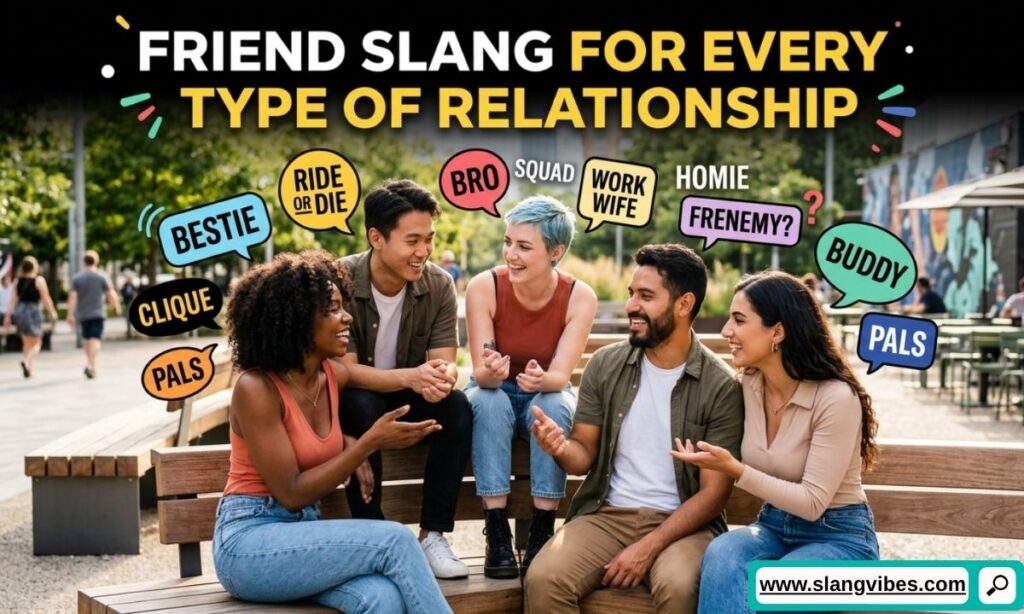
Guy Friends and Girl Friends
Slang for friends often shifts slightly depending on who you’re talking about.
Bro, homie, dawg, and G typically describe guy friends, carrying a slightly tougher or more casual tone. These words show up constantly in gaming chats, sports conversations, and group texts among men. Partner in crime describes a friend who joins every scheme or spontaneous plan, and this one works across genders without much fuss.
Sis, bestie, and twin usually describe close girl friends, though none of these words are strictly limited by gender anymore. Plenty of guy friends call each other bestie without a second thought, and plenty of women use bro casually too. Language around friendship keeps loosening these old boundaries every year.
Work Friends and Childhood Friends
Work friendships get their own vocabular, Work wife and work husband describe a close, platonic office friendship, someone you vent to and grab coffee with daily. These terms stay firmly platonic despite the domestic-sounding names.
Childhood friends earn their own respect, usually through terms like day one or OG. These words point to history rather than a specific personality trait, honoring someone who watched a friendship grow over years rather than months.
Picking the right slang for friends often comes down to context. A term perfect for a college roommate might feel wrong for a coworker, and a phrase suited to your childhood best friend might feel forced when applied to someone met last month.
Texting and DM Slang Between Friends
Texting changed friendship vocabulary more than almost anything else. Group chats move fast, and abbreviations save time when everyone already knows the reference. Most of this counts as online friend slang more than spoken language, built for captions and comment sections rather than face-to-face conversation.
FRFR, short for “for real, for real,” adds emphasis to something already said. IYKYK signals an inside joke shared only within a close circle, a way of acknowledging closeness without spelling out the joke itself. Framily and bestie both show up constantly as text openers, often replacing someone’s actual name entirely. This overlaps heavily with broader social media slang trends too.
Emojis pair naturally with these words. A skull emoji often follows something funny a friend said. Two dancing figures usually accompany squad or the girls. A pinky promise emoji shows up around ride or die or bestie, reinforcing loyalty visually instead of only through words.
Here’s how this looks in a dating context, where a partner asks about a close friend:
Jordan: who’s the bestie you keep mentioning Casey: oh, Priya, my day one since freshman year Jordan: the ride or die energy makes sense now Casey: exactly, IYKYK with those two
Texting slang for friends moves faster than any other category here, since new abbreviations spread within days rather than months.
Slang Terms to Use With Care (Origins and Respect)
Several popular terms in this space carry real cultural history worth acknowledging.
Homie, fam, and dawg trace back largely to African American Vernacular English and hip hop culture before spreading into mainstream use. Words like blud and dawg started as street slang for friends within specific communities before spreading everywhere, including certain London slang carrying similar roots within Black British communities. These words became widely adopted because they sound warm, cool, and expressive, not because their origins disappeared.
Using slang with real cultural roots respectfully means recognizing where a word comes from rather than treating it as ownerless internet culture. This doesn’t mean avoiding these words entirely. It means using them the way they were intended: to express genuine closeness rather than performing a borrowed identity or mocking an accent.
A useful gut check before using slang from outside your own background: would you say this word the same way in front of the people who created it? If the answer feels uncomfortable, the discomfort is worth listening to. This kind of awareness doesn’t require overthinking every text, only a bit of respect toward where the words began.
US vs UK: A Quick Friend Slang Comparison
Comparing regions side by side makes the differences easy to spot.
| US Term | Closest UK Equivalent |
|---|---|
| Bro | Mate |
| Homie | Blud |
| Squad | The lads / the girls |
| Bestie | Bezzie |
| Buddy | Chum |
| Dawg | Bruv |
| Ride or die | Ride or die (used both places) |
| Fam | Fam (shared across both) |
Some terms cross the Atlantic without changing at all. Fam and ride or die show up in both American and British conversations almost identically, largely thanks to social media flattening regional lines. Australian English adds its own flavor on top of this, leaning on mate just as heavily as the UK, with legend and champ often thrown in as friendly, joking substitutes.
Here’s how a mismatch might play out between an American student and a British friend abroad:
Emily: you’re my bestie now, no cap Oliver: aw, you’re my bezzie too then Emily: wait, what’s a bezzie Oliver: same thing as bestie, only British
Small mismatches like this happen constantly, and most people figure out the meaning from context within seconds.
How to Use Friend Slang Naturally

Knowing fifty words for friend means nothing if none of them fit the moment.
Start with tone. Warm, sincere words like ride or die or day one suit heartfelt moments, the kind of message sent after a hard week. Playful words like bruh or twin suit lighter, funnier exchanges, the type shared over a group chat joke.
Context carries equal weight. Slang for friends belongs in texts, captions, and casual conversation. It rarely belongs in professional emails, job interviews, or conversations with someone significantly older who might not recognize the term.
Overuse dulls even the best slang. Calling every acquaintance bestie eventually strips the word of meaning, the same way calling every meal “amazing” eventually says nothing at all. Save the strongest words for the friendships built to deserve them.
Watching how people around you talk offers the best guide. Notice which words show up in your specific circle, then use those instead of forcing a trending term nobody in your group actually says. The right words work best when they sound like you, not like a list copied from an article.
Read Also: Hood Slang Meaning (2K26 Guide): Popular Street Terms & Their Real Meanings
FAQs About Friend Slang
Bestie remains the most common choice across texting and social media in 2026, though ride or die and day one are close behind for deeper, more sentimental friendships.
No. Millennials use it constantly too, and the word has spread widely enough that older generations recognize it even if they don’t say it themselves.
Mate is the most common British equivalent, alongside bruv and blud depending on region and age group.
Use the words the way they’re meant, to express real closeness, and stay aware of where terms like homie, fam, or blud originated rather than treating them as trend-only vocabulary.
BFF and dawg both feel like they’re fading, replaced largely by bestie and ride or die among younger speakers, though plenty of people still use them without issue.
Final Thoughts on Friend Slang
Slang for friends will keep shifting long after this list goes stale. New words will show up through TikTok sounds, group chat jokes, or a song nobody expects to blow up, and some of today’s terms will fade the same way BFF and dawg already have for plenty of speakers.
What stays constant is the reason these words exist at all. Bro, bestie, homie, fam, ride or die, and dozens of others exist because plain old “friend” sometimes doesn’t carry enough weight. Friendship vocabulary keeps expanding every year, and this expansion says a lot about how much people value the friends they have.
Pick the terms fitting your own circle rather than chasing every trending phrase. A word feels right when it matches how your friendships genuinely sound, not whatever shows up on a trending page.
The next time a friend calls you their day one or their bestie, you’ll know exactly what they mean, and you might have a better word ready to send back. Keep an ear out for whatever comes next, since the group chat has never once stopped inventing new ones.

Alex Carter is a language enthusiast and internet culture expert at SlangVibes. He explains the latest slang terms and text meanings in simple, clear English so everyone stays in the loop.