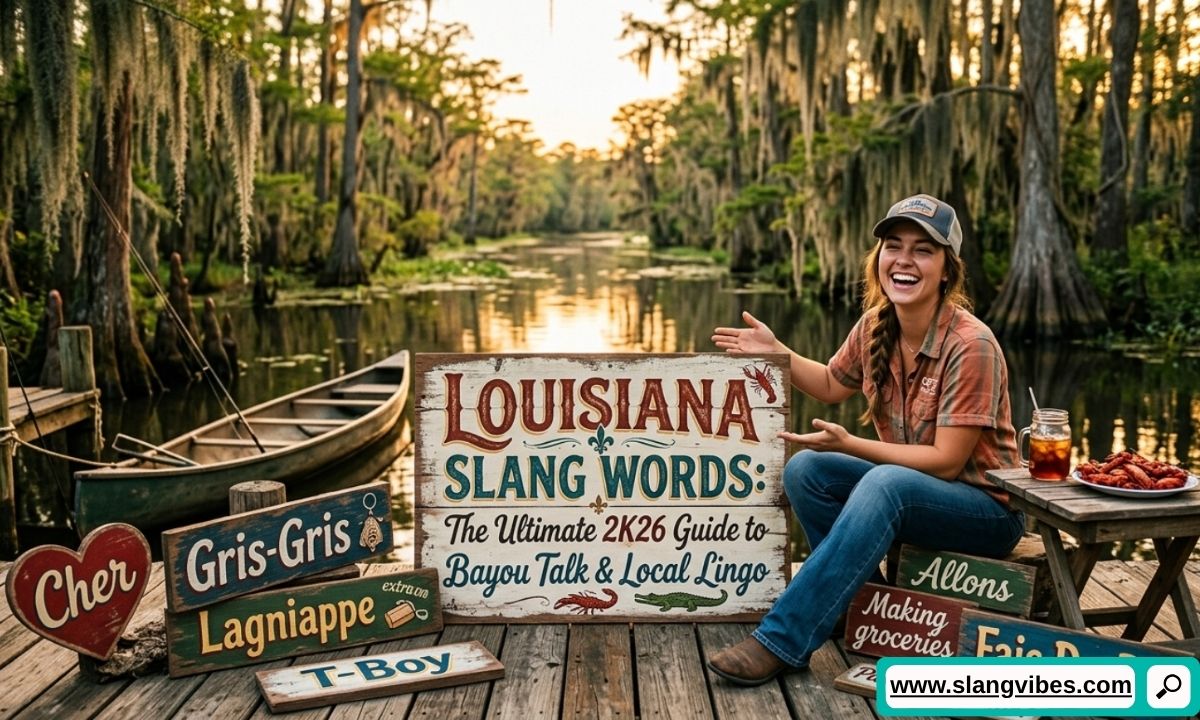
My cousin from Ohio visited New Orleans last summer and texted me in a panic. Someone at the po-boy counter asked if she wanted it dressed, and she thought they were talking about her outfit. She had no idea people were asking about lettuce and tomato. This was the moment she learned Louisiana Slang Words don’t work like slang anywhere else in the country. Down here, words carry French roots, Creole rhythm, and a whole lot of history packed into a handful of letters. This guide breaks down where the words came from and what they mean today. It also covers how locals from New Orleans to the bayou parishes still use them in 2K26. Grab your coffee and get ready for a real New Orleans and Cajun crash course.
Louisiana Slang Words Cheat Sheet: A Quick Reference Table
Before diving into the stories behind each word, here’s a fast Louisiana Slang Words cheat sheet worth bookmarking for later.
| Term | Meaning | Pronunciation | Region | Still Used Today |
|---|---|---|---|---|
| Cher / Sha | Dear, sweetie | shair | Statewide | Yes |
| Where y’at | Greeting, “how are you” | wear-YAT | New Orleans | Yes |
| Making groceries | Grocery shopping | Statewide | Yes | |
| Lagniappe | A little something extra | LAN-yap | Statewide | Yes |
| Neutral ground | Grassy median strip | New Orleans | Yes | |
| Dressed | Sandwich with all the toppings | Statewide | Yes | |
| Fais do-do | Cajun dance party | fay-doh-doh | Cajun country | Somewhat |
| Couyon | Playful term for a fool | koo-YAWN | Cajun country | Yes |
| Envie | A craving | ahn-VEE | Cajun country | Yes |
| Gris-gris | A charm or luck | GREE-gree | New Orleans / Creole | Yes |
| Who dat | Saints fan chant | Statewide | Yes | |
| Geaux | “Go,” LSU spelling | go | Statewide | Yes |
| Wodie | Close friend | WOH-dee | New Orleans / Gen Z | Yes |
| Throwed | Wild in a fun way | Statewide / Gen Z | Yes | |
| 225 | Baton Rouge shorthand | Baton Rouge | Yes |
Each term gets a full explanation below, including where it comes from and how it sounds in real conversation.
Where Louisiana Slang Words Come From
Louisiana Slang Words carry fingerprints from five different cultures. Few American states share this mix.
French settlers arrived first and left words like lagniappe and cher behind. Acadian refugees came next, pushed out of Canada in the 1700s, and became the Cajun people we know today. Their French dialect shaped hundreds of local terms.
Creole culture added its own layer, blending French, Spanish, African, and Caribbean roots into a language all its own. New Orleans grew up under both French and Spanish rule, so Spanish words slipped into everyday speech too.
Enslaved Africans and free people of color brought rhythm and phrasing into the mix. Their influence shaped everything from food terms to music slang. Native American place names still mark the map, from Atchafalaya to Natchitoches.
Put it all together and you get a dialect found nowhere else in the Southern United States.
Did You Know? The word Cajun comes from Acadian, the name for French settlers exiled from Nova Scotia by the British in 1755. Many resettled in Louisiana and became the Cajun communities still thriving today.
Read Also: 12 Meaning in Slang: What the Viral Number Really Means in 2026
New Orleans Slang and the Yat Accent
New Orleans has its own accent long before it has its own slang. Locals call it the Yat accent, named after the greeting “where y’at,” which means simply “how are you.” It sounds closer to a Brooklyn or Jersey accent than a Southern drawl, especially in neighborhoods like the 9th Ward.
Here’s how the greeting plays out between friends.
Marcus: Where y’at, man? Devin: Doing alright, fresh back from making groceries. Marcus: You going to the parade later? Devin: Wouldn’t miss it, baby.
Notice how “baby” shows up as a friendly address, not a romantic one. Locals use it for friends, coworkers, and strangers alike. “Making groceries” means grocery shopping, borrowed straight from the French phrase faire son marché. “Neutral ground” refers to the grassy median between streets, a term found almost nowhere else in the country. Tourists usually stumble on this one first, since New Orleans directions rely on it constantly.
Locals also drop “who dat” into casual talk, not only during football season. The phrase works as a greeting, a cheer, or a way to hype someone up before anything happens.
Cajun Country and Acadiana Slang
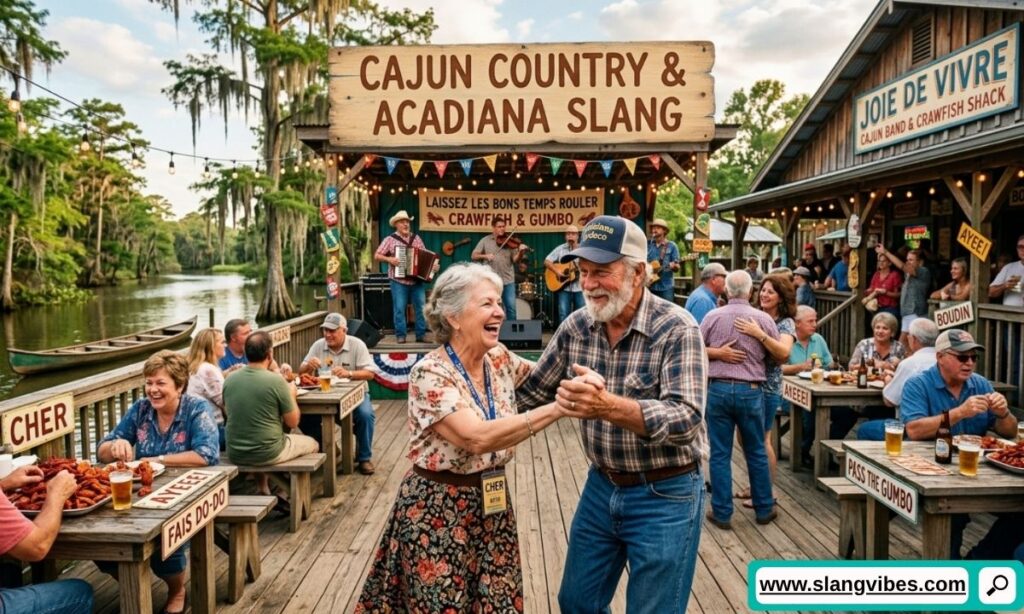
Head west into Acadiana and the vocabulary shifts again. This region holds the deepest Cajun French influence in the state, and the slang reflects centuries of French Louisiana history.
Cher, pronounced shair, works as a term of endearment for nearly anyone close to you. Sha carries the same warmth, often used with kids or a partner. Couyon describes someone acting silly or foolish, usually said with a laugh rather than an insult. Envie describes a craving, most often for food, and Cajun cooks use it constantly during boiling season.
Down the bayou refers to the rural communities south of the main highways. These are places built around fishing, trapping, and family land passed down for generations. A fais do-do is a Cajun dance party. It traditionally happened after children fell asleep, since the phrase translates loosely to “go to sleep.”
Picture a porch conversation on a Saturday afternoon. Someone mentions they have an envie for boudin. A neighbor invites the whole family to a fais do-do the same night. Somebody’s teenage cousin gets called a couyon for forgetting the cooler. This counts as a normal exchange in Cajun country, no translation needed for locals.
Food, Crawfish, and Kitchen Slang
Food runs through Louisiana Slang Words more than any other category. Locals build entire conversations around what’s cooking and how to eat it right.
Dressed means a sandwich topped with lettuce, tomato, pickles, and mayo, most often heard when ordering a po-boy. The holy trinity refers to onions, bell peppers, and celery, the base of nearly every gumbo, jambalaya, and étouffée. Making a roux means slowly browning flour and fat together, a skill locals take seriously enough to argue about online.
A boudin run means driving from gas station to gas station tasting different versions of the Cajun sausage. It often turns into a full afternoon trip. Cold drink simply means soda, a phrase confusing visitors expecting an actual temperature description.
Eating crawfish comes with its own instructions. Locals say pinch the tail and suck the head. This means separating the tail meat and pulling the seasoned juice from the head before eating. First timers usually get corrected within their first boil, and nobody minds the teaching moment.
Picture a backyard crawfish boil in May. Someone hands a newcomer their first crawfish and walks them through pinching the tail. The whole table watches to see if they suck the head too. Food slang like this sticks because it comes from doing, not reading.
Mardi Gras and Festival Season Slang
Mardi Gras season brings out a slang vocabulary all its own. It’s built around parades, costumes, and crowds packed along the route.
Throw me something is the classic shout aimed at float riders, asking for beads, cups, or doubloons. Krewe refers to the parading organization behind each float, and locals talk about their krewe with serious pride. King cake baby refers to the tiny plastic figure hidden inside a king cake. Whoever finds the slice hosts the next party or buys the next cake.
Laissez les bons temps rouler is French for “let the good times roll.” It shows up on t-shirts, banners, and porch conversations all season long. Second line describes the parade forming behind a brass band. Anyone nearby is welcome to join in and dance along.
Here’s how a group chat sounds the week before Fat Tuesday.
Priya: Y’all catching the parade Saturday? Marcus: For sure, meeting on the neutral ground around 5. Priya: Bringing my king cake, somebody find the baby last time? Devin: Nah, still in the box, laissez les bons temps rouler though.
Even people outside a krewe pick up this vocabulary fast during parade season. The words show up on radio, local news, and every group chat in the city.
Read More: Type Meaning in Slang: What It Really Means in Text (2026)
Who Dat Nation: Sports Slang in Louisiana
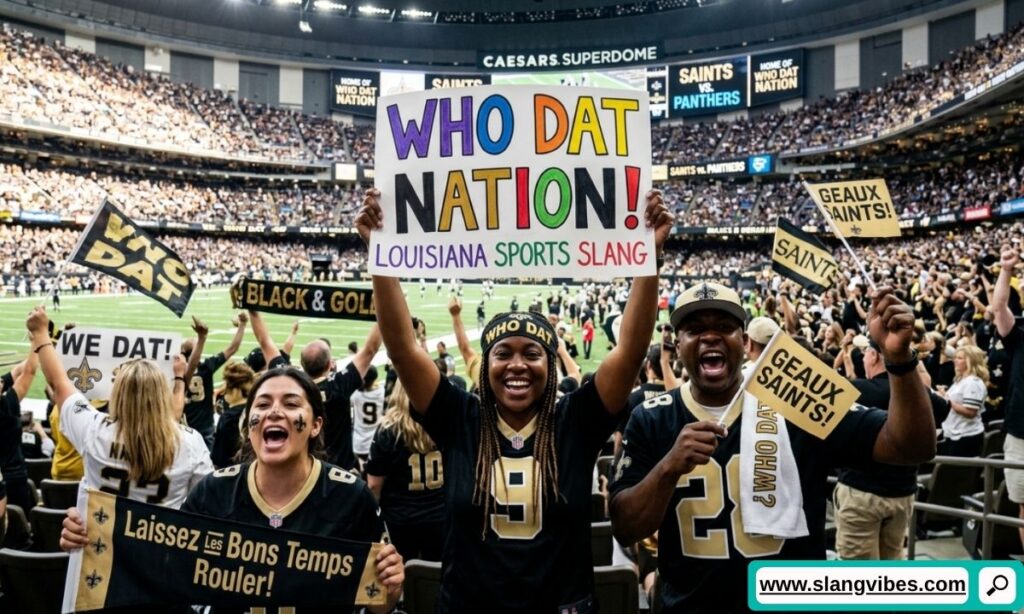
Football and sports culture shape a huge share of everyday Louisiana slang, especially around Saints season and LSU football.
Who dat started as a Saints fan chant and grew into a full identity. Fans call themselves Who Dat Nation. The phrase shows up on flags, license plates, and text threads year round, win or lose. Geaux replaces the standard spelling of “go” across LSU branding. It shows up in Geaux Tigers and dozens of local business names statewide.
Saints fans greet each other with who dat instead of hello during football season. The response almost always matches the question. LSU fans do the same with geaux tigers, treating it as both a cheer and a greeting rolled into one.
Picture a coworker walking into the break room on a Monday after a Saints win. They might get a full round of who dat before anyone says good morning. Sports slang like this crosses every other category on this list, showing up in Cajun country, New Orleans, and Baton Rouge alike.
Geaux shows up well beyond football too. Local shops use it in business names, and road signs get repainted with it during rivalry week. Text threads lean on it as shorthand for encouragement in general, not only sports. A friend heading into a big work presentation might get a quick “geaux get ’em” text instead of plain old good luck. This crossover is part of why Louisiana sports slang feels less like a hobby vocabulary. It reads more like a second layer of everyday language across the whole state.
Gen Z and TikTok Louisiana Slang
Younger speakers keep Louisiana slang alive online, blending old regional words with new internet language every year.
Wodie means close friend, popular in New Orleans hip hop and spreading fast through TikTok and Instagram captions. Throwed describes something wild in a fun way, said with pride rather than criticism. Gumbo vibes describes a mixed, chaotic, high energy group or setting, borrowing the food metaphor for a diverse crowd. Boogie means stylish or lively, often aimed at someone dressed sharp for a night out. Clownin means joking around or acting silly, sometimes playful and sometimes a light dig at a friend.
225 refers to the Baton Rouge area code, used as shorthand for the whole city and its culture online.
Here’s a texting exchange between two people setting up a first date.
Jayla: You still tryna link this weekend? Chris: Yeah for sure, wodie put me on to this new spot downtown. Jayla: Say less, sounds boogie already lol Chris: It’s giving gumbo vibes fr, mixed crowd every night
Millennials in Louisiana grew up on an earlier wave of hip hop slang like trill and flexin. Gen Z leans into a mix of local terms and broader internet slang. The two generations still understand each other fine, since half the newer words borrow straight from Louisiana food culture anyway.
Cajun French Sayings and Playful Louisiana Expressions
Cajun French left behind more than single words. Full sayings still show up in daily conversation, especially among older generations and close families.
Couyon, already mentioned above, doubles as a playful insult during these exchanges too. It’s usually aimed at a family member who did something silly. Pauvre bête translates to “poor thing” or “poor beast.” It’s said with genuine sympathy rather than an insult, often directed at someone having a rough day. Boo-dree describes something messy, wild, or out of control, heard less often now but still recognized by most locals over thirty.
Cajun humor leans on gentle teasing more than harsh insults. Calling someone a couyon at a family dinner draws laughs, not offense, since everyone knows the tone behind it. The same word said with a different face might mean something sharper. Context and tone carry as much weight as the word itself.
Families pass these sayings down the same way they pass down recipes. The words travel through repetition at the table, not a book or a class. A grandmother teasing a grandkid for forgetting to season the gumbo captures this perfectly. The words carry warmth even when the meaning sounds harsh on paper.
Younger family members often learn these sayings passively, picking them up at holidays and boils long before anyone explains the French roots behind them. A teenager might say couyon without knowing it comes from French at all. This gap between hearing a word constantly and knowing its origin is common in Cajun households, and it rarely bothers anyone. Locals treat the sayings as part of daily rhythm first, and history lesson second, if ever.
North vs South Louisiana: Regional Slang Differences
Louisiana slang shifts noticeably depending on which part of the state you’re standing in.
New Orleans leans into the Yat accent and French and Spanish influenced vocabulary. Food centered phrases tie into po-boys and gumbo too. Cajun country covers Acadiana and the parishes west of Baton Rouge. It keeps the deepest Cajun French influence, with words like cher, envie, and fais do-do showing up daily. Baton Rouge blends both worlds, adding its own 225 identity along with LSU sports slang. North Louisiana, including Shreveport, sounds closer to a traditional Southern drawl, with fewer French loanwords and less Creole influence overall.
| Region | Sounds Like | Signature Words |
|---|---|---|
| New Orleans | Brooklyn meets the South | Where y’at, neutral ground, baby |
| Cajun Country | French rooted Southern drawl | Cher, envie, fais do-do |
| Baton Rouge | Mixed regional accent | 225, geaux tigers, who dat |
| North Louisiana | Classic Southern drawl | Fixing to, y’all, mama and them |
A visitor driving from New Orleans to Shreveport in one day passes through four distinct dialects. They never even cross a single state line. This range explains why Louisiana slang resists a single, tidy definition. The state holds several overlapping cultures instead of one.
Radio and local news play a bigger role in this spread than people expect. A New Orleans DJ dropping “who dat” gets picked up statewide during football season, while Cajun radio stations in Lafayette keep French phrases in regular rotation. Shreveport stations sound noticeably different, leaning into country music culture and a slower, more traditional Southern cadence. Anyone scanning radio stations while driving across the state hears these regional shifts happen in real time, almost like flipping through separate dialects on the dial.
Read New Article: WTV Meaning in Text: What It Really Means on Snapchat, TikTok, Instagram & WhatsApp (2026)
How to Sound Like a Local, Not a Tourist
Picking up a few phrases feels natural after reading this far. Timing and tone matter more than memorizing a list.
Match the setting first. Slang fits a crawfish boil or a group chat, not a job interview or a business email. Listen before jumping in, since locals notice when a phrase gets forced into a conversation where it doesn’t belong. Cajun and Creole aren’t interchangeable, even though outsiders mix them up constantly, so learning the difference earns real respect fast. Coonass gets used by some Cajuns to describe themselves, but the term carries a rough history. Outsiders using it usually land badly, so it’s worth skipping entirely.
Pronunciation trips people up too. New Orleans gets said “n’AW-lins” by locals, never the syllable by syllable version outsiders often default to.
Here’s a short exchange showing this play out between a visitor and a local.
Sam: Is it pronounced New Or-LEENS? Riley: Nah, it’s n’AW-lins around here. Sam: Got it, thanks for the heads up. Riley: No worries, everybody learns eventually.
Small corrections like this happen constantly and rarely feel harsh. Locals generally appreciate someone trying, mispronunciations and all, as long as the effort feels genuine rather than performative. Picking up two or three phrases and using them naturally beats memorizing the whole list. Forcing every phrase into a single conversation backfires fast.
FAQs About Louisiana Slang
What’s the difference between Cajun and Creole slang?
Cajun slang comes from Acadian French settlers and stays strongest in Acadiana. Creole slang blends French, Spanish, African, and Caribbean influence, and stays strongest around New Orleans.
Is “where y’at” still used in New Orleans today?
Yes, locals still use it daily as a casual greeting, especially among people who grew up in the city.
What does “making groceries” mean?
It means going grocery shopping, borrowed from the French phrase for the same activity, and it’s still common across generations.
Is it okay to say “coonass”?
Some Cajuns use the term for themselves, but it carries a difficult history. Outsiders should avoid saying it out of respect.
Do locals use Louisiana Slang Words online?
Yes, plenty of these phrases show up daily on TikTok, Instagram, and group chats, especially among younger Louisiana residents keeping the culture alive online.
Final Thoughts on Bayou Talk
Louisiana Slang Words carry centuries of French, Creole, Spanish, and African influence packed into everyday conversation. Think of a po-boy dressed with everything, or a Saints fan yelling who dat on Monday morning. Both tell you exactly where you’re standing in the state.
New Orleans brings the Yat accent and neutral ground directions. Cajun country brings cher, envie, and fais do-do. Baton Rouge brings 225 pride, and North Louisiana keeps a more traditional Southern drawl. Gen Z keeps the whole list evolving with wodie, throwed, and gumbo vibes showing up in captions every week.
Learning a few of these phrases won’t turn anyone into a local overnight, and nobody expects it to. Using them with the right tone, in the right setting, shows genuine interest in the culture behind the words. Next time someone asks where y’at, a simple “doing alright” works fine, no textbook required.

Alex Carter is a language enthusiast and internet culture expert at SlangVibes. He explains the latest slang terms and text meanings in simple, clear English so everyone stays in the loop.