My friend Priya texted me three paragraphs about a fight with her roommate last week. I typed back my best advice and felt pretty proud of it. Her reply came back seconds later: “K.” One letter. No emoji, no punctuation, nothing else. I sat there for ten minutes rebuilding our entire friendship in my head. She’d lost signal on the subway right after sending it. If you’ve had a moment like this, you already know the feeling. K meaning in text is one of the most searched texting questions online. This guide breaks down where it comes from. You’ll see what it means on every app you use, and how to read it without the spiral.
What Is the K Meaning in Text? (Quick Answer)
Quick Answer: In texting, “K” is shorthand for “okay.” It’s an acknowledgment, not a full sentence. The word itself is neutral. The tone people read into it depends on timing, punctuation, and the relationship between the two people texting.
At the most basic level, the k meaning in text works like this. Someone sends information, and “K” confirms it landed. “I’ll be there at 7.” “K.” Message received, plan confirmed, done.
The confusion starts because texting strips out tone of voice and facial expression. When a friend says “okay” out loud, warmth or annoyance comes through instantly. On a screen, one letter has to carry all of it alone. People fill in the blank with whatever mood fits the conversation.
This is where k text meaning gets interesting. The same letter shifts meaning across threads. It reads as “got it, no problem” in one and “I’m annoyed and done talking” in another. Nothing about the word changes. The context around it changes, and this is exactly why this small reply generates so much conversation online. People search phrases like what does K mean in text and K meaning in messages for this reason. The letter looks harmless on the surface. In practice, it rarely feels so simple.
Related searches tell the same story. K meaning from a girl, K meaning from a guy, and K reply meaning all point back to one question: is this person fine, or upset? Nine times out of ten, the honest answer sits closer to fine than upset.
Where the K Text Meaning Came From: A Short History
Long before smartphones existed, phone plans charged people by the character or capped messages at 160 characters total. Every letter cost something, so texters shortened words on instinct. “Okay” became “OK,” and eventually “OK” became “K.”
The word “okay” has its own strange backstory. Language historians trace this back to an 1800s newspaper trend of joke misspellings. Writers spelled “all correct” as “oll korrect” and abbreviated it to “OK.” This version stuck around for two centuries, long before digital texting shaved it down even further.
Early instant messengers like AIM and MSN Messenger picked up the habit in the late 1990s and early 2000s. Typing fast mattered more than typing fully. “K” became standard shorthand in chatrooms, forums, and flip-phone texts, long before it ever showed up in a TikTok comment section.
What shifted over time is not the abbreviation itself. It’s the emotional read attached to it. Early texters used “K” the same way people used “OK” out loud: plain, practical, forgettable. Gen Z and younger millennials grew up watching internet culture change, too. Short replies turned into a whole genre of memes about cold or annoyed texting. This is the real reason a single letter now feels loaded in a way it never did back in 2003.
K vs kk Meaning: Why Punctuation Changes Everything
Not all “K”s look the same. Readers pick up on the difference instantly, even without being able to explain why.
| Version | Typical Read |
|---|---|
| k | Casual, low effort, no strong feeling attached |
| K | Slightly more deliberate, sometimes read as flat or serious |
| K. | Final, cold, often read as annoyed |
| kk | Warm, friendly, closer to “got it!” |
A trailing period changes texting tone the same way it does in full sentences. “Sure.” reads more serious than “sure,” and “K.” follows the same pattern. Doubling the letter to “kk” softens it back down. This is why kk usually reads as the friendliest version of the bunch. Adding an emoji softens it further still, so “K 😊” and a plain “K” almost never land the same way.
The Autocorrect Factor Nobody Mentions
Here’s something worth knowing before you read too much into a capital letter. Most phones auto-capitalize the first letter of a new message by default. Someone typing a quick “k” on an iPhone often gets “K” without touching the shift key at all. The capital letter people treat as a mood signal is frequently a keyboard default, not a decision.
Group chats show how much punctuation shifts the vibe:
Maya: dinner’s at 8, table’s booked Jordan: k Sam: kk see you there! Maya: K.
Jordan’s lowercase “k” reads as neutral. Sam’s “kk” reads warm. Maya’s capital “K” with a period comes right after a question. It reads like she’s annoyed the plan moved again, even though nobody mentioned being upset.
Read Also: Trade Gay Slang Meaning: What “Trade” Really Means in LGBTQ+ Culture
K Meaning on TikTok, Snapchat, Instagram & iMessage
The k meaning in texting shifts slightly by app. Each platform carries its own texting norms.
TikTok
On TikTok, “K” shows up in comment sections nearly as often as in DMs. A lone “K” under a controversial video usually works as sarcasm. It’s a way of saying “sure, whatever you say” without writing out a whole argument. K meaning on TikTok leans dry and a little dismissive, more so than in a private chat with a friend.
Snapchat
K meaning on Snapchat gets tangled up with streak culture. Snaps move fast. A bare “K” reply often means nothing beyond “seen it, moving on.” Snapchat conversations tend to feel personal, though. A flat “K” after something emotional lands harder than it would in a group chat.
Instagram DMs favor speed over depth. K meaning on Instagram usually stays neutral: a quick nod before someone gets back to scrolling. Story replies with only “K” tend to signal mild interest rather than real engagement.
WhatsApp and iMessage
On WhatsApp, read receipts and “last seen” timestamps add pressure other apps don’t have. A “K” sent right after someone reads a long message feels colder than one sent after a delay. The delay at least suggests they thought about a reply. iMessage’s typing bubble works the same way. Watching three dots appear and disappear changes things. A plain “K” after the buildup stings more than it would on its own.
Across every platform, the k meaning in text stays close to the same idea. What changes is the speed of the app and the amount of pressure the speed creates around a reply.
The K Meaning in Text Decision Framework: How to Tell If Someone’s Mad
Instead of guessing, run any confusing “K” through these five checks before assuming the worst.
- Relationship type. A close friend’s “K” carries less weight than a partner’s. Close friends usually text in shorthand by habit anyway.
- Response speed. An instant “K” often means someone is mid-task. A “K” arriving twenty minutes late, after they were clearly online, tends to mean more.
- Punctuation. Compare “k,” “K,” and “K.” side by side in the same thread. The version matters more than people expect.
- Emoji or lack of one. “K 😊” and a bare “K” send two different messages, even with identical wording.
- Conversation history. One flat reply out of a normal chat pattern rarely means anything. A pattern of short, cold replies across several messages is the real signal.
Here’s how this plays out in practice:
Alex: hey, got a minute to talk tonight? Riley: K Alex: everything okay? Riley: yeah, tired, ttyl
Riley’s first “K” looks concerning on its own. Checked against the follow-up, it turns into a normal case of low energy, not conflict. This is the whole point of running through the checklist instead of reacting to one message in isolation.
K Meaning From a Girl, a Guy, a Friend, or a Boss
Context shifts the k meaning from a girl, a guy, or anyone else more than gender itself does. Relationship type and setting matter far more than who’s on the other end.
Dating and Crushes
Early in dating, a bare “K” often reads as disinterest, fair or not. New relationships run on effort signals. If someone usually sends longer, warmer texts and suddenly drops to one-letter replies, this shift is worth noticing. One short reply after a long day tells you nothing on its own. Watch the pattern instead of the single message.
Partners and Arguments
Between established partners, “K” during a disagreement usually means the conversation is far from over. It works as a placeholder. It says “I heard you, and I’m not ready to keep going” more than it says genuine agreement.
Friend Groups
Among close friends, K meaning in chat stays mostly harmless. Group chats run on speed. Everyone in the thread already knows each other’s texting habits well enough not to overanalyze a single letter.
Workplace and Professional Settings
At work, a lone “K” in reply to a manager or client tends to read as underprepared or dismissive. No rudeness has to be intended for it to land this way. Professional settings reward a slightly longer reply. Text message etiquette at work leans more formal than in a friend group chat.
Read More: STSU Meaning in Text: What It Really Means on Facebook, TikTok & Instagram (2026)
K Abbreviation Meaning Combos: kk, k thanks, kbye, k lol
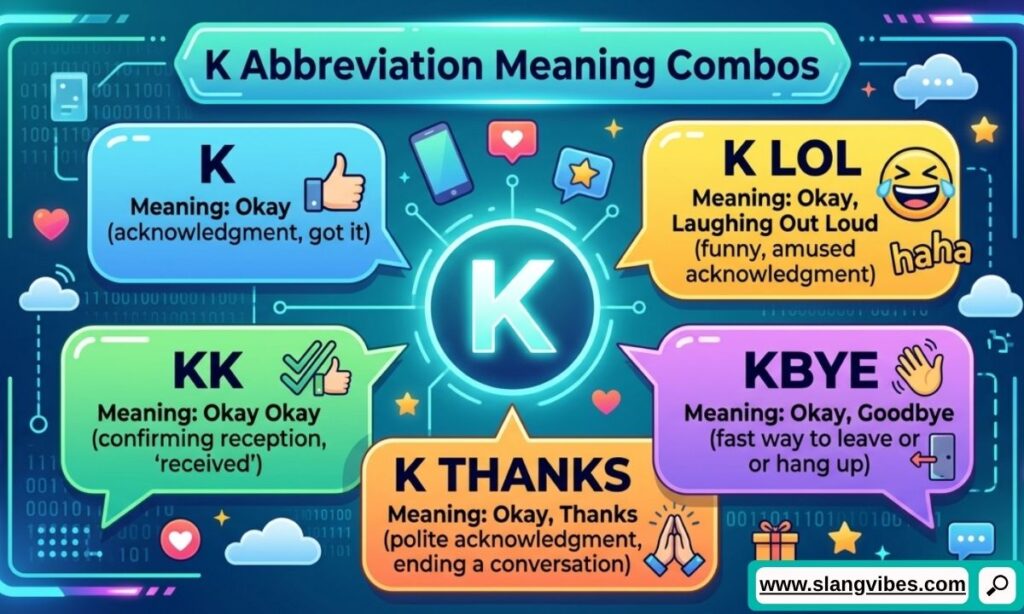
“K” rarely shows up completely alone anymore. A handful of combos carry their own distinct tone, and each one changes the whole feel of a reply.
| Combo | What It Signals |
|---|---|
| kk | Friendly, close to “got it!” |
| k thanks / kthanks | Polite on the surface, sometimes sarcastic underneath |
| kbye / k bye | Wrapping up fast, sometimes abrupt, sometimes efficient |
| k lol | Lighter tone, often used to defuse an awkward exchange |
| kden | Relaxed agreement, common in casual group chats |
Real conversations show the difference clearly:
Priya: would you feed my cat tomorrow? Sam: kk got you covered Priya: ur a lifesaver Sam: k lol don’t mention it
Notice how “kk” opens the exchange warmly, and “k lol” closes it out with the same lightness. Swap either one for a flat “K” and the whole thread reads differently, even though the actual plan never changes.
When K Isn’t About Texting: Kelvin, Thousands, Strikeouts & Discord
Outside chat apps, “K” carries a handful of completely separate meanings worth knowing. Context determines which one applies.
- Science and measurement: K stands for Kelvin, the temperature scale used in physics and chemistry.
- Numbers and money: K represents “thousand,” so a job listing at “60K” means sixty thousand dollars a year.
- Medical shorthand: K sometimes refers to potassium on lab results and medication charts.
- Baseball: A “K” marks a strikeout on a scoreboard, with a backward K noting a called third strike.
- Computing and video: KB stands for kilobyte, and 4K refers to a high-resolution video format, both unrelated to texting entirely.
- Gaming and Discord: Inside Discord servers and Twitch chat, a stream of “K”s spammed during a broadcast often works as a reaction, similar to spamming “L.” It reacts to something awkward or predictable rather than answering a question at all.
These uses have no connection to the texting version at all. A coworker asking about your “K” on a spreadsheet almost always means the number, not an acknowledgment.
Sending K Yourself: When It’s Fine and When to Type More
Most guides only cover what “K” means when you receive it. Sending it comes with its own set of judgment calls.
A bare “K” works fine in low-stakes situations. Confirming logistics, replying in a fast group chat, or answering a teammate mid-game are good examples. Speed matters more than warmth in each one. Nobody reads emotional weight into a “K” confirming what time practice starts.
It works less well in emotional conversations. This includes moments after someone shares something vulnerable, or any message where the other person is watching for reassurance. Typing two or three more words costs almost nothing and avoids a whole spiral on the other end. This matters even more in one-on-one chats where read receipts are visible. The other person sees the message got opened well before a reply shows up.
If you’ve already sent a flat “K” and sense it landed badly, a quick follow-up fixes it fast:
Casey: I’m nervous about tomorrow Dana: K Dana: sorry, meant to say I’ve got you, you’re going to be fine
This second message does more work than a paragraph of explanation would. It shows the first reply wasn’t dismissal, only a rushed thumb.
A few natural swaps work well when “K” feels too flat. Try “got it,” “sounds good,” or “on it.” Even “okay!” helps, since the exclamation point does the emotional lifting a bare letter never does.
A coworker asking for a quick update deserves the same small upgrade. “K” technically answers the question. “Got it, sending it over by 3” answers it and reassures the person waiting. The extra four words cost seconds and prevent a follow-up message asking if everything is on track.
Common K Slang Meaning Myths, Busted
A few ideas about the k slang meaning get repeated so often they start to feel true, even when they’re not.
Myth one: “K” always means anger. Most of the time, it means someone is busy, multitasking, or simply confirming a plan without ceremony.
Myth two: capital “K” is always cold. Phones auto-capitalize the first letter of a message constantly. The capital version frequently carries zero intentional meaning at all.
Myth three: an emoji always fixes a short reply. “K 😊” softens the tone, sure, but pattern matters more than any single message. A string of flat replies followed by one smiley doesn’t erase the pattern building underneath it.
Myth four: “kk” and “K” mean the same thing. They read differently to most people, with “kk” landing warmer nearly every time.
Fun fact worth remembering here: the internet’s obsession with dissecting a single letter says a lot. It reveals how anxious digital communication makes people feel, more than it reveals anything about the letter itself. Full sentences used to carry all the tone a conversation needed. Texting removed most of it, so readers started hunting for meaning in whatever letters were left.
Does K Mean the Same Everywhere? Regional and Generational Differences
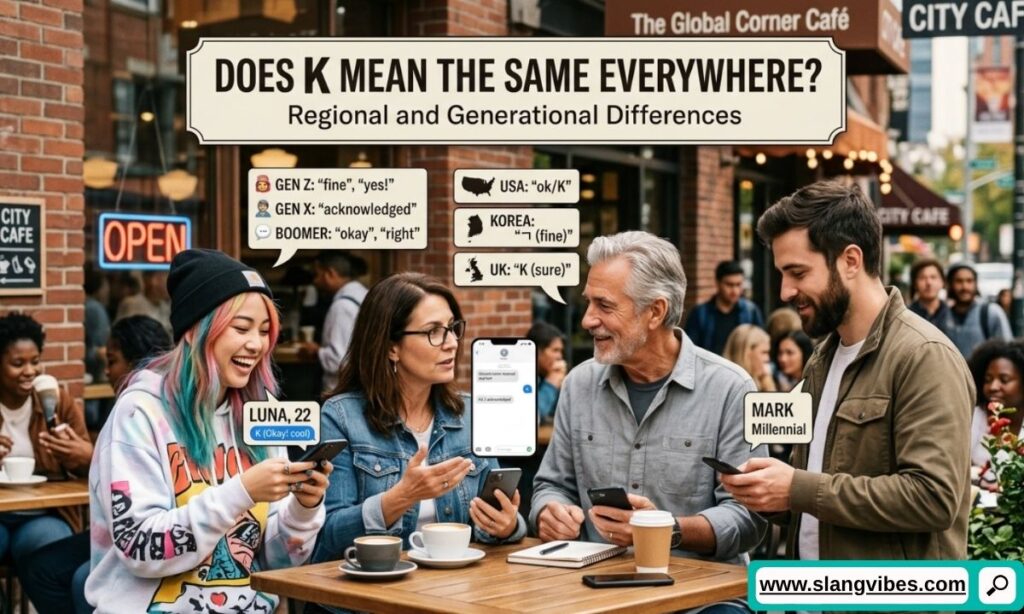
Geography and generation both shape how “K” gets read, sometimes more than the message itself does.
In parts of South Asia, including Pakistan and India, “K” gets used constantly in everyday texting. No negative charge comes attached to it. It works as pure shorthand, the same way someone might nod along in conversation. None of the cold-shoulder reputation from Western texting circles applies here.
In the UK, “K” mixes into casual texting alongside “ta” and “cheers.” It tends to read as slightly less alarming there than in parts of the US. Entire online think pieces in the US circle back to dry texting again and again.
French text-speak takes this even further in a completely different direction. Rather than standing in for “okay,” the letter “k” often replaces the “qu” sound in casual spelling. “Quoi” turns into “koi,” and “qu’est-ce que tu fais” turns into “kestufai.” It’s a phonetic shortcut, unrelated to the English “okay” meaning entirely. English-language guides rarely mention it.
Generational gaps matter too. Older texters grew up shortening words to save characters on flip phones. They tend to see “K” as harmless, exactly what it was designed to be. Younger texters grew up inside meme culture instead. Short replies turned into running jokes about dry texting, so they read far more emotional weight into the same letter. Neither generation is wrong. They’re reacting to two different eras of texting culture layered on top of the same abbreviation.
Read New Article: Ion Meaning in Chat: Snapchat, TikTok, Instagram & WhatsApp
Frequently Asked Questions
No. Most of the time, the k meaning in text is simply a fast way to confirm a message. This goes double between people who text each other often.
“Kk” reads warmer and more engaged. A single “K” reads flatter and more neutral, sometimes cold depending on context.
Periods add finality to short texts, the same way they do in full sentences. This is why “K.” often reads as annoyed or done with the topic.
It’s risky. Professional messages usually read better with a slightly longer reply, like “got it” or “sounds good.” A bare “K” often comes across as dismissive to a manager or client.
A simple check-in works best. Try “everything okay?” or “did I say something wrong?” This opens the door without putting words in their mouth.
Conclusion
The k meaning in text looks simple on the surface. It’s a fast stand-in for “okay.” The emotional weight people load onto it comes from everything surrounding the word, not the word itself. Punctuation, timing, platform, and the relationship between two texters all shape how a single letter lands.
Next time a bare “K” shows up in your messages, run it through the pattern instead of the panic. Check the punctuation, check the timing, check whether it matches how the person usually texts. Most of the time, it means exactly what it always meant: message received, nothing more dramatic.
And if you’re the one sending it, a couple of extra words costs almost nothing. One short line keeps a quick reply on good terms, instead of turning into a whole conversation about what you meant by it.

Alex Carter is a language enthusiast and internet culture expert at SlangVibes. He explains the latest slang terms and text meanings in simple, clear English so everyone stays in the loop.