You’re scrolling TikTok Live at midnight and land on a girl repeating “ice cream so good” every time someone sends her a gift, moving her head the exact same way every single time. Your first thought is probably “what is happening right now.” Your second thought, once someone in the comments explains it, is NPC. That single acronym is doing a lot of work online right now, and it doesn’t always mean what you’d guess from the name. Here’s what NPC actually means, where it came from, and how people are using it in 2026.
What Does NPC Mean in Slang? (Quick Answer)
NPC stands for “non-player character.” In gaming, that’s just a background character the computer controls instead of a real person. In slang, calling someone an NPC means they’re acting robotic, predictable, or like they’re running on a script instead of thinking for themselves.
It’s less about intelligence and more about behavior. Someone gets labeled an NPC when they seem to repeat whatever’s trending, react the exact same way every time, or blend into the background instead of standing out. Think of the coworker who says the identical joke every single morning, or the friend who agrees with literally everything the group says. That’s NPC energy.
The tone can shift depending on who’s saying it. Among friends, it’s usually a light jab, closer to teasing than insult. In a heated argument or aimed at a stranger, it lands harder and can feel genuinely dismissive. A few quick examples show the range:
- “You just repeated what the last three people said, total NPC move.”
- “My dog does the same three things every day, he’s basically an NPC at this point.”
- “She’s not an NPC, she just has a chill routine and sticks to it.”
That last one shows the word doesn’t always stick as a real accusation. Sometimes it’s just a joke that fades the second the conversation moves on.
Where NPC Comes From (Gaming Roots)
Before it was an insult, NPC was just a normal gaming term with zero attitude attached. It started in tabletop role-playing games like Dungeons and Dragons, where the game master controls every character who isn’t a player. Those characters, the shopkeeper, the guard, the random villager, exist to move the story along, not to make their own choices.
Video games picked up the term and ran with it. Open-world games like Skyrim, Grand Theft Auto, and Fortnite are packed with NPCs. They walk set paths, say the same lines when you talk to them, and repeat the identical animation loop whether it’s your first playthrough or your fiftieth. Talk to a Skyrim guard once and you’ve basically heard everything he’ll ever say to you.
That’s the core trait that carried over into slang: repetition without variation. An NPC in a game can’t improvise. It follows code, not instinct. So when someone calls a real person an NPC, they’re drawing a direct line to that same lack of spontaneity, the sense that this person is following a script rather than actually thinking through their next move.
For years, this stayed inside gaming conversations. Gamers used it to describe background characters, sometimes to describe a teammate playing so passively they might as well be computer-controlled. It hadn’t leaked into everyday language yet. That jump happened somewhere else entirely, and it’s a big part of why the word carries the weight it does today.
Read Also: What Does SB Mean in Text? Definition, Slang, Usage & Examples (2026)
NPC Meaning on Urban Dictionary
If you go looking for NPC meaning on Urban Dictionary, expect a blunter version than what you’d find in a TikTok caption. Since anyone can submit a definition there, the entries range from straightforward gaming explanations to full-on insults, describing someone with no real opinions, no independent thoughts, just following whatever’s popular that week.
A handful of the top entries lean into the 2018 political meme angle, using NPC to mock people for repeating mainstream talking points instead of thinking for themselves. That context matters if you’re searching the term there, since the highest-voted definition on any given day tends to skew harsher and more pointed than how people actually use the word out loud.
The core idea still lines up with everywhere else online: predictable, scripted, lacking a mind of their own. Urban Dictionary just tends to deliver that idea with a lot less patience and a lot more bite.
How NPC Became an Insult
Around 2018, the word broke out of gaming forums and into mainstream internet arguments, and it happened through a meme. A blank, expressionless face known as the “Wojak” meme got labeled “NPC” and started circulating as a way to mock people accused of repeating popular opinions without forming their own. The image had no distinct features on purpose, the point was that this person had no inner life of their own, just borrowed talking points.
The meme spread fast on Twitter and got wrapped up in online political fights, with people on different sides accusing each other of being “NPCs” who just parrot whatever their side says. Twitter eventually cracked down on some accounts using the meme, citing rules against dehumanizing content, which only made the term more talked about.
What matters for slang purposes isn’t the politics attached to it. It’s that this moment is what pushed NPC out of gaming vocabulary and into general internet slang. After 2018, you didn’t need to touch a controller to know what someone meant by calling you an NPC. It became shorthand for “you’re not really thinking, you’re just repeating.”
By the time TikTok and Gen Z picked it up a few years later, the political edge had mostly worn off. What stuck was the core idea: predictable, scripted, lacking originality. That’s the version most people encounter today, and it’s a lot less loaded than where the word actually started.
What Does NPC Mean on TikTok?
TikTok is where most people run into this word for the first time, and it actually shows up there in two distinct ways. The first is the classic insult use: someone comments “NPC” under a video of a person copying a trend, wearing the same fit as everyone else, or repeating a caption that’s already gone stale. The second is the streaming trend, where creators intentionally act like NPCs on purpose, for money.
Scroll the hashtag and you’ll see both mixed together, memes mocking predictable behavior sitting right next to clips of streamers embracing the label. Captions like “certified NPC behavior” or “the ultimate NPC” show up under everything from gym content to relationship drama, not just gaming videos.
Want the full story on how the streaming side of this took off? Keep reading, the next section breaks down exactly how it started.
Meet Pinkydoll: Where NPC Streaming Started
If you’ve heard NPC recently, there’s a good chance it came from TikTok Live and not a video game at all. In January 2023, a streamer going by Pinkydoll started reacting to viewer gifts with repetitive phrases and jerky, robotic movements, basically performing as a human NPC on command. Someone in her comments compared her to a video game character, and she leaned into it hard.
The format is simple. Viewers send virtual gifts, each gift triggers a specific scripted reaction, a phrase, a head tilt, a repeated sound. Send the same gift twice and you get the identical response both times, just like triggering the same dialogue from a game character. Pinkydoll built her persona partly around characters from Grand Theft Auto after watching others play it, and the bit clearly landed. Other creators copied the format within weeks.
This trend flipped the word on its head a little. NPC went from being an insult you’d never want aimed at you to a paid performance style. Streamers reportedly earned serious money from these sessions, with some accounts putting Pinkydoll’s daily earnings in the thousands of dollars. Suddenly “acting like an NPC” wasn’t something to be embarrassed about, it was a business model.
That’s worth knowing because it explains why younger audiences sometimes use NPC in a genuinely playful, almost affectionate way now. Calling yourself an NPC, or asking a friend to “do NPC mode,” has become its own inside joke completely separate from the insult version.
Read Also: JOI Meaning in Slang: The Complete Guide to Its Real Meaning
What Does “NPC Girl” Mean?
“NPC girl” is basically shorthand for the wave of mostly female creators who built content around the streaming trend Pinkydoll kicked off. It’s not really about gender in a technical sense, it’s just that the earliest and most viral examples of NPC streaming happened to be young women reacting to gifts with exaggerated, doll-like expressions and repeated catchphrases.
Search the term and you’ll find creators competing for titles like “queen of NPC,” plus a wave of parody content, friends and partners play-acting as an “NPC girlfriend” for laughs. Outside the streaming world, “NPC girl” sometimes gets used as a softer, less harsh version of the general insult, describing someone who seems a bit checked out or on autopilot rather than genuinely unoriginal.
Either way, the phrase traces back to the same source as the rest of this trend: a joke about acting like a background character that turned into an actual online persona.
NPC vs. “Main Character Energy”
If you spend any time on TikTok, you’ve probably run into “main character energy” too, and the two terms are basically opposites. Main character energy means owning your story, standing out, making bold choices like the lead in a movie. NPC energy is the background extra who never gets a close-up and just follows the crowd.
People use this contrast constantly. Someone posts a confident outfit or a spontaneous decision and captions it “main character energy.” Someone else does the exact same thing everyone else is doing that week and gets teased with “NPC behavior” instead. Neither term is really about your actual personality, they’re about how a specific moment reads to other people.
Understanding this pairing helps explain why NPC stings a little more than a random insult. It’s not just “you’re boring,” it’s “you’re not even the star of your own life right now.” That’s a sharper comparison than it sounds on the surface, even when it’s said as a joke between friends.
NPC Meaning by Platform
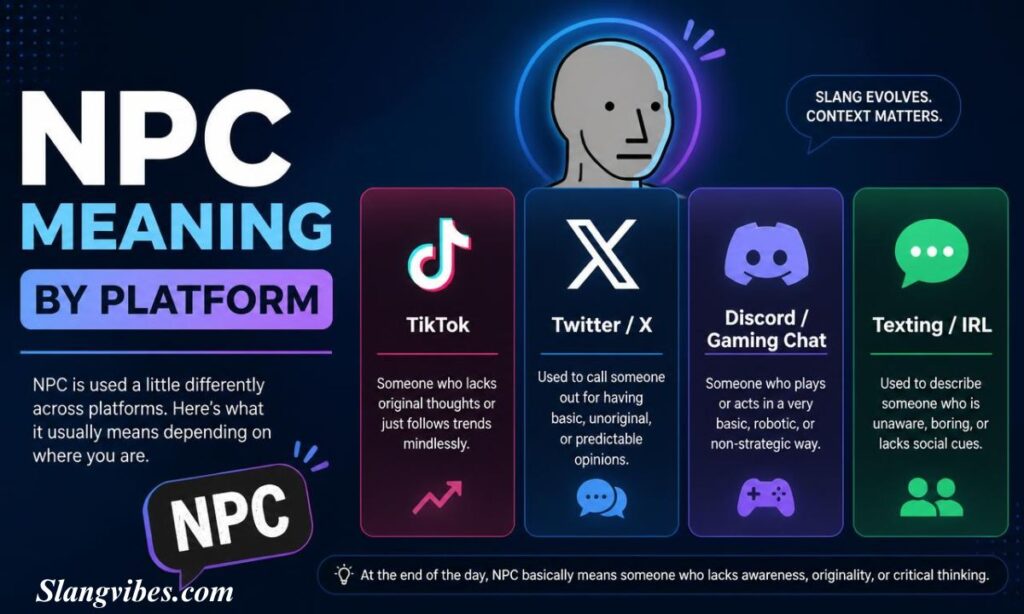
The word shows up a little differently depending on where you see it, even though the core meaning stays the same. Here’s a quick breakdown of how tone and usage shift across the places you’ll actually run into it.
| Platform | Common Usage | Example |
|---|---|---|
| TikTok | Refers to NPC streaming trend or calling out repetitive behavior in comments | “Bro really said the same caption again, NPC vibes” |
| Twitter/X | Often used as a sharper insult, sometimes tied to arguments or debates | “Everyone quoting the same headline like an NPC” |
| Discord/gaming chat | Used to describe a teammate playing passively or predictably | “Stop standing there, you’re playing like an NPC” |
| Texting/IRL | Casual jab between friends about routine or predictable habits | “You get the same coffee order every single day, NPC” |
Notice the pattern: gaming spaces keep it closer to the literal meaning, while social platforms stretch it into general commentary on personality and behavior. Neither use is more “correct,” they’re just different corners of the same word.
Read More: Down Bad Slang: Meaning, Origin, Examples & Modern Usage
NPC in a Sentence (Real Examples)
Seeing the word in actual conversation makes it click faster than any definition. These cover a mix of tones, from playful to genuinely annoyed, so you get a feel for how flexible the word really is.
Casual, between friends: Person A: “Are you seriously wearing the same hoodie again” Person B: “It’s my hoodie era, don’t be an NPC about it”
Sarcastic: “Wow, another ‘rise and grind’ post from you. Real original. Very NPC of you.”
Sincere frustration: “I asked him three different questions and got the same answer every time. Talking to him feels like talking to an NPC.”
Gaming context: “Why is our support just standing in one spot the whole match, total NPC play.”
Self-deprecating: “I’ve eaten the same lunch four days in a row, I might actually be an NPC at this point.”
These examples share one thing in common: none of them are about intelligence. Every single one is pointing at repetition, predictability, or a lack of spontaneity. That’s the throughline no matter how harsh or gentle the delivery gets.
Is Calling Someone an NPC Rude?
It depends almost entirely on context, tone, and who’s saying it. Among close friends, calling someone an NPC usually functions like any other lighthearted roast, closer to “you’re being basic” than a real insult. It’s said, laughed at, and forgotten within the same conversation.
The tone changes fast in a couple of situations. Aimed at a stranger, especially in an argument or comment section, it reads as genuinely dismissive, like you’re saying the other person doesn’t have real thoughts of their own. That’s a much bigger accusation than “you’re predictable,” and it can come across as dehumanizing given the word’s meme history.
It also lands differently depending on delivery. Texted with a laughing emoji after your friend orders the same drink for the tenth time, it’s harmless. Typed in all caps during a heated debate, it’s a way of shutting someone down instead of actually engaging with what they said. Same word, very different weight.
NPC vs. Similar Slang (Bot, Basic, Sheep)
NPC isn’t the only word for “you’re not being original,” and it helps to know how it differs from its closest relatives. “Bot” usually implies someone is spamming the same message. Or acting like an actual automated account, more about repetitive posting than personality. “Basic” is broader and softer, pointing at mainstream taste rather than a total lack of independent thought. “Sheep” is the closest older cousin, an insult that predates the internet and means someone blindly follows the crowd without questioning anything.
NPC sits somewhere between all three but leans harder into the “scripted, robotic” angle than any of them. Calling someone a sheep suggests they’re choosing to follow. Calling someone an NPC suggests they’re not even choosing, they’re just running on autopilot. That small difference is why NPC feels sharper to a lot of people, even when it’s meant as a joke.
Common Mistakes People Make With NPC
A few missteps show up constantly with this word, and they’re worth knowing before you use it yourself.
Common Mistake: Calling a total stranger an NPC to their face or in their comments, assuming it’ll read as a harmless joke. Without existing rapport, it usually just comes across as rude, since the person has no context for your tone and the word’s history leans dehumanizing.
Beyond that, people also mix NPC up with words it doesn’t actually match. It’s not the same as “extra,” which describes over-the-top behavior, the opposite direction entirely. It’s also not interchangeable with “cringe,” which is about secondhand embarrassment rather than predictability. Using NPC as a catch-all insult for anything mildly annoying dilutes the word and confuses people who know its actual meaning.
One more slip: assuming the term is always negative. Given the streaming trend, plenty of creators now use “NPC mode” as a badge, not an insult. Reading every use of the word as an attack misses how much the meaning has softened for younger audiences.
Is NPC Safe for Kids and School Use?
Generally, yes. The word itself isn’t explicit or inappropriate, and most of its current usage is playful rather than genuinely hurtful. It shows up constantly in school hallways and group chats without anyone raising an eyebrow.
Parents and teachers should just know the context: it can be used to tease someone about being boring or predictable, which stings a bit more than a random nickname. Like most slang insults, it’s fine in a joking exchange between friends and less fine when it’s used repeatedly to single someone out.
FAQ
What does NPC mean in a text message?
It means the person you’re describing is acting predictable, repetitive, or robotic, similar to a background character in a video game. It’s usually a lighthearted jab rather than a serious accusation.
Is NPC a compliment or an insult?
It started as an insult and mostly still is, though the NPC streaming trend has made it a playful, even self-applied label for some creators. Context and tone decide which way it lands.
Where did NPC streaming start?
It started in January 2023 when TikTok creator Pinkydoll began reacting to viewer gifts with scripted phrases and robotic movements after a commenter compared her to a video game character. Other streamers copied the format soon after.
Is calling someone NPC bullying?
It can be, depending on how often it’s used and who it’s aimed at. A one-off joke between friends is different from repeatedly calling out the same person in front of others, which can feel like targeted teasing.
What’s the opposite of NPC in slang?
“Main character energy” is the closest opposite, describing someone who stands out and owns their choices instead of blending into the background.
Does NPC mean the same thing in gaming and on social media?
Not exactly. In gaming, it’s a neutral technical term for any computer-controlled character. On social media, it’s slang for predictable or robotic human behavior, borrowed from that gaming concept but carrying more attitude.
Can NPC be used as a compliment now?
Sometimes, especially around the streaming trend, where creators embrace “NPC mode” as part of their brand. Outside of that context, it’s still mostly used as a light critique.
Final Words
Next time someone in your group chat gets called an NPC, you’ll know exactly what’s going on, and whether it’s actually an insult or just another inside joke.

Alex Carter is a language enthusiast and internet culture expert at SlangVibes. He explains the latest slang terms and text meanings in simple, clear English so everyone stays in the loop.