You’re scrolling TikTok at 1am and every third video starts the same way: “POV: you’re the only one who remembers the group project.” No context. No explanation. Just POV, then a scenario that somehow makes total sense the second you read it. The POV meaning behind that caption isn’t as obvious as it looks, and if you’ve ever paused mid-scroll wondering why everyone’s using it like a template, you’re not alone. Here’s the breakdown, from the literal definition to the trend that turned three letters into an entire content format.
What Does POV Mean in Slang?
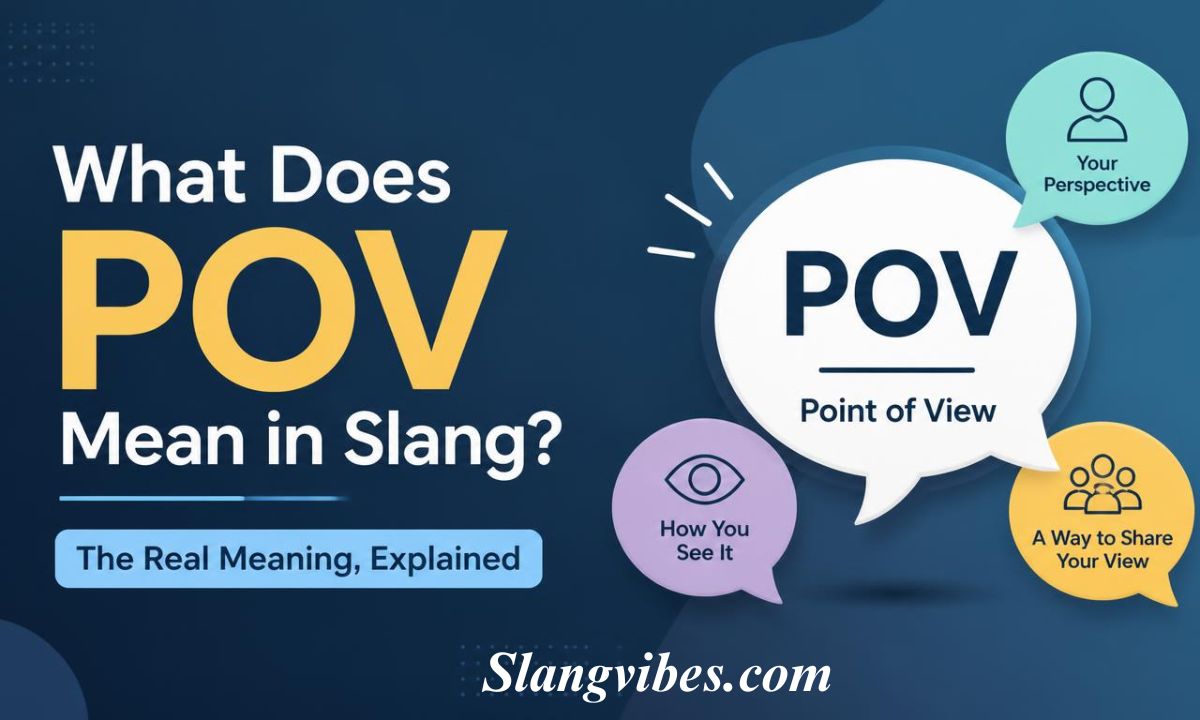
POV stands for point of view. That’s the literal, dictionary-level answer, and it’s been used that way for decades in photography, film, and video games to describe a shot taken from a character’s or camera’s perspective.
The slang version of the POV meaning is a little different. Online, POV isn’t just describing whose eyes you’re seeing through. It’s a caption format that puts the reader directly into a scenario. When someone writes “POV: it’s Sunday night and you haven’t started the assignment,” they’re not narrating a video, they’re inviting you to imagine yourself living that exact moment.
Here’s the thing that trips people up. In its original use, POV described camera angle. In its slang use, POV describes a feeling, dropped into a single line of text or a video caption. The scenario after the colon does all the work. No extra explanation needed, because the whole point is that the reader fills in the rest.
This shift matters because it changes how the term behaves grammatically too. You’re not writing “in POV” or “from a POV.” You’re writing “POV:” followed by a relatable situation, almost always in second person. That small structural difference is what separates the modern POV meaning from the technical film term it grew out of.
Read Also: What Does NPC Mean in Slang? The Real Meaning Behind It
The Origin Behind the POV Meaning We Use Today
POV as an abbreviation for “point of view” has existed in film and photography terminology since at least the mid-20th century, used to describe shots framed from a character’s literal eyeline. Gaming picked it up too, especially first-person shooters where “POV” described the on-screen perspective.
The slang caption format is much newer. It gained real traction on TikTok starting around 2020, when short-form video creators started using “POV:” as a hook to pull viewers into a scenario within the first second of a clip. Instead of explaining a video’s premise in a title or voiceover, creators just typed “POV: you’re texting your ex back after two years” over the footage and let the acting or scenario speak for itself.
Turns out, that format was perfectly built for a platform where attention spans are short and scrolling is instant. A POV caption tells you exactly what headspace to be in before the video even starts. Twitter and Instagram picked up the same structure shortly after, applying it to text-only posts and memes instead of just video.
The short answer is that the modern POV meaning didn’t replace the literal one, it grew out of it. Film and gaming still use POV to mean literal camera perspective. Social media just stretched that idea into a storytelling shortcut, and that shortcut is what most people under 30 mean now when they type the word.
How to Use “POV” in a Sentence or Caption
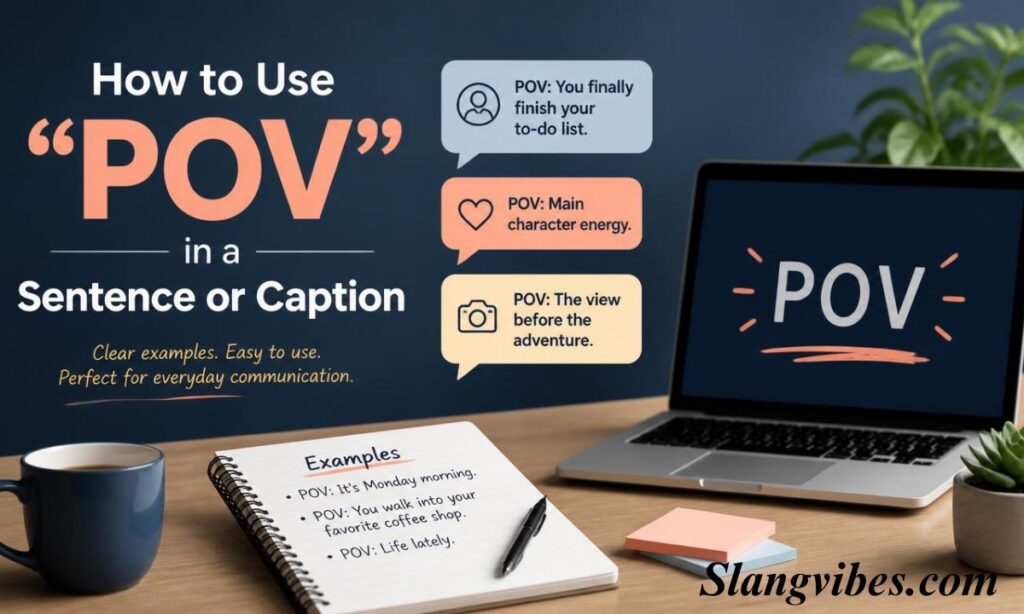
This is the part most explainers skip, and it’s usually what people are actually trying to figure out when they search the term. Using POV correctly comes down to a simple structure: POV, a colon, then a scenario written in second person.
A few rules make the format work:
- Start with “POV:” followed directly by the situation, no extra setup needed
- Write the scenario in second person (“you’re,” “your,” “you”) since the whole point is putting the reader inside the moment
- Keep tense consistent, usually present tense, since it reads like something happening right now
- Skip the explanation after the scenario. Part of the format’s appeal is that it doesn’t over-explain itself
So “POV: you just remembered you have a dentist appointment in ten minutes” works because it’s specific, present tense, and drops you straight into the panic. Something like “POV: I went to the dentist yesterday” doesn’t land the same way, because it’s past tense and first person, which breaks the whole “imagine this is happening to you” effect the format relies on.
Think of it this way: POV captions work like a movie’s opening shot. You don’t need a paragraph of backstory, you just need one line that puts the audience exactly where they need to be.
Also Read: What Does SB Mean in Text? Definition, Slang, Usage & Examples (2026)
POV in Texts, Captions, and Comments
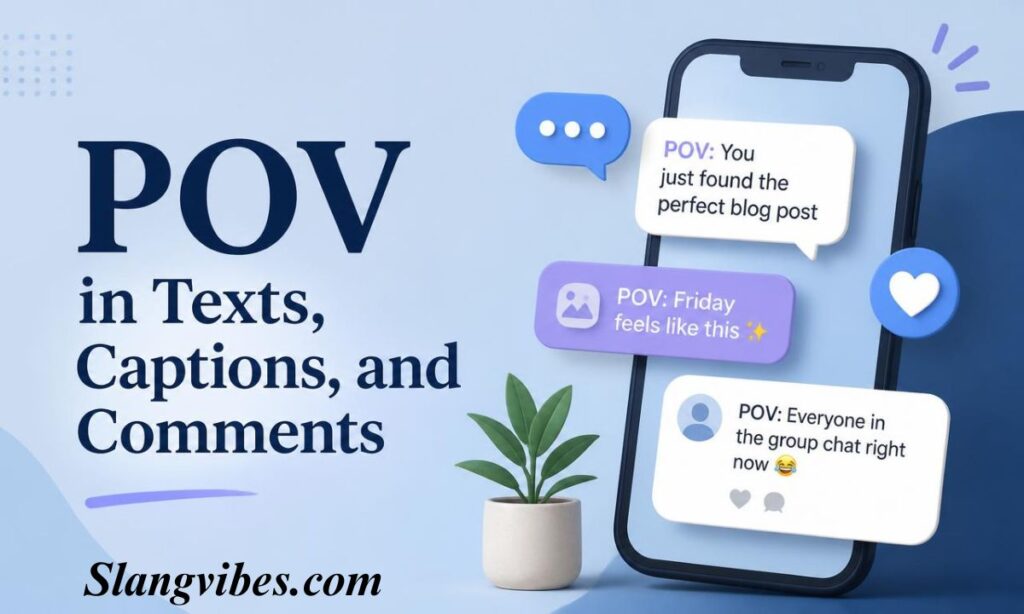
POV shows up differently depending on where you see it, and knowing the platform helps you read the tone correctly. On TikTok, it’s almost always paired with video, acting as the hook. On Twitter/X and Instagram captions, it’s often standalone text, doing the same job without footage. In group chats and comments, it tends to get more sarcastic or exaggerated, since there’s no video to sell the scenario, just the joke itself.
Here’s what that looks like in real conversations:
Text 1 (Casual)
Friend: POV: we said we’d leave the party at 10 and it’s midnight
You: lol accurate, five more minutes
Text 2 (Sarcastic)
Friend: POV: you told your mom you’d clean your room “later”
You: it’s been three weeks
Text 3 (Sincere)
Friend: POV: your best friend shows up when you didn’t even ask
You: this made me tear up ngl
Comment on a video
User: POV: you’re watching this instead of doing your homework
Reply: literally me right now
Group chat
Sam: POV: we’re all pretending we’re not stressed about finals
Jordan: don’t call me out like this
Across all of these, the format stays the same even though the tone shifts. That consistency is part of why POV became such a durable trend instead of a one-platform fad. It’s flexible enough to carry humor, sarcasm, or genuine emotion without changing its basic structure.
POV Meaning vs. Literal Point of View
Since POV carries both a technical meaning and a slang one, it helps to see them side by side, along with a couple of related caption-style terms people often mix it up with.
| Term | What It Means | Example |
|---|---|---|
| POV (literal) | Camera or narrative perspective in film, photography, or games | “The scene was shot in POV to make it feel first-person.” |
| POV (slang) | A caption format that drops the reader into a relatable scenario | “POV: you’re the last one to find out the plans changed.” |
| IYKYK | “If you know, you know,” used for inside jokes without explaining them | “That party was wild, IYKYK.” |
| No cap | Means “no lie” or “I’m serious,” used to confirm something is true | “This is the best coffee in town, no cap.” |
The overlap between POV and terms like IYKYK is that both rely on the reader filling in context the caption doesn’t spell out. The difference is that POV actively builds a scenario for you to imagine, while IYKYK just signals that a joke or reference exists without explaining it at all.
Common Mistakes People Make With the POV Meaning
A few mix-ups come up often enough to be worth flagging. The most common one is treating “POV” as if it stands for something like “point of value” or misreading it as a random acronym rather than “point of view.” It’s always the latter, whether used literally or as slang.
Another frequent mistake is writing a POV caption in first person or past tense, which weakens the effect the format is built on. “POV: I forgot my umbrella and got soaked” reads like a diary entry instead of an invitation to imagine the moment. Swapping it to “POV: you forgot your umbrella and got soaked” puts the reader back in the scene, which is the entire point of the format.
People also sometimes use POV outside of a scenario-style caption, tacking it onto a sentence where it doesn’t add anything. “POV, I like pizza” isn’t really using the format correctly, since there’s no scenario for the reader to step into. The slang works best when it frames a specific, relatable moment rather than a flat statement.
Read Also: JOI Meaning in Slang: The Complete Guide to Its Real Meaning
Other Ways People Twist the POV Meaning
Once the core format caught on, people started bending it for extra effect. One common twist is the ironic or self-aware version, where the “scenario” is something obviously exaggerated or absurd, used purely for comedic timing rather than relatability. “POV: you’re a raccoon who just found an unlocked trash can” is a good example. Nobody’s meant to actually relate to it, it’s just funny because of the format’s seriousness being applied to something ridiculous.
There’s also the “POV: you’re me” trend, where creators frame a video as if the viewer has become them specifically, often used for niche jokes, fandom content, or personality-based humor. It’s a small variation on the standard format but shifts the “you” from a general audience stand-in to a specific, sometimes exaggerated version of the creator.
Bottom line, these twists don’t change the core POV meaning, they just show how flexible the format turned out to be once it left its film and gaming roots behind.
FAQ
What does POV mean in a text message?
In texts, POV usually introduces a relatable or exaggerated scenario, written as if the reader is living it in real time, rather than referring to literal camera perspective.
Is POV always used sarcastically?
No. POV can be sincere, sarcastic, or purely comedic depending on context. The format itself is neutral, the tone comes from the scenario written after it.
What’s the difference between POV and IYKYK?
POV builds a specific scenario for the reader to imagine, while IYKYK signals an inside joke or reference without explaining what it is at all.
Do you need a video to use POV correctly?
No. While POV started as a video caption hook on TikTok, it works just as well as standalone text in tweets, captions, or chats.
Why do people write “POV:” instead of just describing the scene normally?
The colon format is a shortcut that immediately signals “imagine you’re in this moment,” which is faster and more engaging than a full explanatory sentence.
Is POV slang appropriate to use in professional or formal writing?
Not really. The slang meaning of POV is casual by nature and fits social captions, texts, or informal writing, not formal or professional contexts.
Getting Comfortable With the POV Meaning
You’ve got it down now: point of view at its root, a scenario-building caption in practice, and a structure flexible enough to carry sarcasm, sincerity, or pure comedy depending on how it’s used.
The next time POV pops up in your feed, a caption, or a group chat, you’ll know exactly what’s happening and how to reply without missing a beat.

Alex Carter is a language enthusiast and internet culture expert at SlangVibes. He explains the latest slang terms and text meanings in simple, clear English so everyone stays in the loop.