Picture this: you’re standing at airport arrivals, watching the doors slide open again and again, waiting for someone you haven’t hugged in two years. When they finally walk through, your feet won’t move. Your brain sort of freezes. You text your best friend right there in the terminal: “I don’t know how to explain this feeling.” She texts back one word: “surreal. “This single word carries more weight than three sentences would. If you’ve had a moment like this and reached for the word without knowing where it comes from, or whether you’re using it right, this guide breaks down surreal meaning in slang terms: the surreal definition, where it comes from, and how people use it in everyday conversation and on social media today.
Read Also: What Does POV Mean in Slang? The Real Meaning, Explained
What Does Surreal Mean?
Quick Answer: Surreal describes a moment feeling strange or dreamlike, difficult to believe, and a little removed from normal life. It covers good news, bad news, and everything in between.
In plain English, the meaning of surreal comes down to this: a moment feels like a dream instead of ordinary life. Something so strange it borders on unbelievable happens, and your mind hasn’t caught up yet.
The surreal meaning in slang leans into a wide emotional range. A concert feels surreal when the crowd, the lights, and the sound blend into something bigger than a normal night out, a bizarre experience in the best way. A car accident feels surreal too, for the opposite reason: the shock makes everything slow down and gives you an unreal feeling, like watching your own life from outside it.
Neither use is wrong. Surreal isn’t tied to one emotion. It’s tied to the gap between what you expected and what you’re living through right now, between reality and imagination.
Where Surreal Meaning Comes From
Surreal traces back to Surrealism, an art and literary movement shaped in Paris during the 1920s. The poet Guillaume Apollinaire used the term “surrealism” around 1917, and writer André Breton built it into a full movement a few years later. Breton and other Surrealists wanted art to pull from dreams, the unconscious mind, and imagery breaking from normal logic.
Painters like Salvador Dalí became the public face of the movement. His melting clocks in “The Persistence of Memory” are still the image most people picture when they hear the word surreal, even if they’ve never read a word about the art movement itself. This painting is a good shorthand for surreal imagery in general: familiar objects, twisted into something dreamlike.
The adjective surreal entered everyday English by the mid-1930s, according to Dictionary.com’s etymology notes. Over the following decades, people stopped reserving the word for paintings and essays and started using it for ordinary life. A wedding, a job loss, a strange coincidence: any of these earn the label once they stop feeling like normal reality.
Read More: What Does NPC Mean in Slang? The Real Meaning Behind It
Surreal Meaning: Pronunciation and Grammar Basics
Surreal is said “suh-REEL,” with the stress on the second syllable. It rhymes with “reveal” and “conceal.”
It’s an adjective, so it describes a noun or follows a linking verb: “The view felt surreal” or “It was a surreal week.” People sometimes stretch the surreal word meaning into a comparative form, “more surreal” or “the most surreal thing I’ve seen,” but there’s no such word as “surrealer.” Keep the comparison as two separate words.
Two related words trip people up:
Surrealism is the noun for the art movement itself. Surrealist describes an artist working in the Surrealist style, or gets used as an adjective for their work.
So a painting is surrealist, a movement is Surrealism, and a moment in your own life is surreal.
Surreal Meaning vs Unreal, Dreamlike, and Uncanny
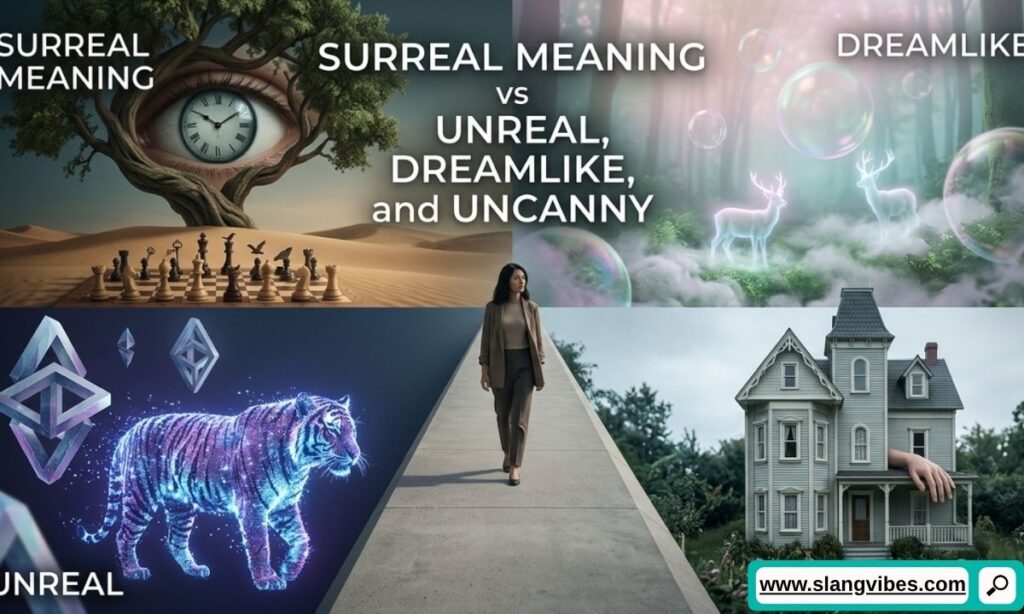
These four words overlap, but they don’t mean the same thing. Swapping one for another changes the tone of what you’re saying.
| Word | What it means | Best used for |
|---|---|---|
| Surreal | Dreamlike, hard to process, reality-bending | Big moments, both good and bad |
| Unreal | Amazing, unbelievable, over the top | Casual hype, often about skill or luck |
| Dreamlike | Soft, floaty, slow-motion feeling | Beautiful or peaceful scenes |
| Uncanny | Familiar but subtly wrong, unsettling | Creepy coincidences or eerie resemblance |
Unreal leans casual and upbeat, the kind of word you’d reach for to praise a great play: “This dunk was unreal.” Surreal carries more emotional weight and works for shocking or painful moments too, not only exciting ones. And surreal isn’t quite the same as weird, either: weird points at something odd or off, while surreal points at something so far outside normal experience it barely registers as real.
The antonyms of surreal are easy to overlook, since most guides skip them. If surreal means a moment breaks from ordinary reality, the surreal synonyms working in the opposite direction are the words for ordinary reality itself: mundane, routine, ordinary, run-of-the-mill, ho-hum. “Another mundane Monday at the office” sits at the exact opposite end of the scale from “a surreal Monday I’ll never forget.”
Read New Article: What Does SB Mean in Text? Definition, Slang, Usage & Examples (2026)
How Gen Z and Millennials Use Surreal Slang Online

Surreal meaning on social media shifts depending on who’s typing and where.
On TikTok and Instagram, surreal tends to show up in captions for milestones: graduations, travel photos, reunions. The tone leans reflective, almost like narrating your own life back to yourself, capturing a surreal atmosphere in a single word.
On Twitter/X, surreal reacts to surreal events and breaking news in real time. A shocking headline drops, and the word floods replies within minutes. It works as shorthand for collective disbelief, a fast way to say “this doesn’t feel real yet.”
This is how Gen Z uses surreal a lot of the time, paired with other reaction slang to soften or intensify it: “ngl this is surreal,” “no cap this feels surreal,” or on its own, “surreal fr.” Millennials tend to use the word by itself, in longer captions, closer to how it reads in a diary entry than a reaction post. Surreal meaning in text tends to run shorter and punchier than surreal meaning in a caption or comment thread.
Here’s how it looks in a group chat after a concert:
Maya: okay I’m still not over last night Priya: SAME I keep replaying it Maya: standing so close to the stage felt surreal ngl Priya: fr I don’t think it’s hit me yet
And here’s a shorter exchange between siblings after unexpected family news:
Ben: did mom tell you the house sold already Alex: yeah found out this morning Alex: feels surreal tbh, we grew up there.
Read More: JOI Meaning in Slang: The Complete Guide to Its Real Meaning
Surreal Examples in Everyday Sentences
A surreal experience at school: “Walking into my old elementary school as an adult felt surreal. Everything looked smaller than I remembered.”
A surreal moment with a big milestone: “Signing the lease on our first apartment felt surreal. We’d talked about it for two years.”
A surreal situation played for laughs: “Paying twelve dollars for a small popcorn at the movies is a surreal experience at this point.”
A surreal reaction to pop culture: “Watching a show you grew up with get rebooted twenty years later hits different. It’s surreal, and hard to explain to anyone younger than you.”
A dating text exchange shows a softer, more personal surreal feeling meaning:
Jordan: I keep thinking about our first date Sam: same, still feels surreal we met through an app Jordan: right?? the odds are wild
What Does It Mean When Something Feels Surreal?
There’s a real explanation behind this floaty, disconnected feeling, and it isn’t only a figure of speech.
Psychologists use the term derealization for the sense your surroundings don’t feel fully real, even though you know they are. Big, sudden, or emotionally intense moments sometimes trigger a mild, temporary version of this sense of unreality. Your senses take in the scene, but the emotional part of your brain hasn’t finished processing it, so everything feels a step removed from normal life, reality feeling distorted for a while.
This is common and, on its own, nothing to worry about. Most people notice it during weddings, funerals, graduations, accidents, or any unexpected moment where reality suddenly outpaces expectation. The feeling usually fades within minutes, hours, or a day or two, once the brain catches up to what happened.
Calling a moment “surreal” is one of the more accurate things people say online, even when they don’t realize it. The word is doing real psychological work, not only adding drama, describing a genuine emotional reaction rather than exaggerating one.
Common Mistakes People Make With Surreal
Overusing it drains the word of meaning. If every slightly nice thing happening gets called surreal, the word stops signaling anything special. Save it for moments genuinely knocking you off balance.
Confusing it with unreal is another common slip. “The goal felt surreal” sounds a little off to careful readers. “The goal was unreal” fits the excited, casual tone better. Surreal works best for moments with emotional weight behind them, not quick bursts of excitement over a sports play or a lucky win.
There’s a newer, half-joking use worth mentioning here too. Some captions apply surreal to obviously ordinary things, like a plate of instant ramen labeled “this meal was surreal,” purely for comic effect. It’s a small, ironic twist on the word, the same kind of stretch other intensifiers go through once they get used for comic effect instead of their original definition. Readers who know the original meaning get the joke. Readers who don’t might walk away confused about what the word means.
When to Use Surreal (and When to Skip It)

Use it when a moment feels dreamlike, disorienting, or bigger than ordinary life, whether the feeling is good, bad, or mixed. It fits milestones, sudden news, and moments where words like “weird” or “amazing” undersell what happened.
Skip it for mild surprise. A slightly better-than-expected coffee order doesn’t need this word. Save it for the moments stopping you in your tracks.
Surreal is fine for kids, too. Teachers use it, it shows up in school reading lists, and it carries no hidden or inappropriate meaning. A kid describing a dream or a strange movie scene as surreal is using the word correctly.
It also holds up in formal writing. The word started in art criticism, so journalists, teachers, and professionals use it without raising eyebrows. The rule applying everywhere, casual or formal, is precision: use surreal when the moment earns it, and reach for a plainer word when it doesn’t.
Read Also: Down Bad Slang: Meaning, Origin, Examples & Modern Usage
FAQ
What does surreal meaning in simple words?
It means something feels strange or dreamlike, difficult to believe, in a way not matching ordinary reality. People use it for moments so unusual or extraordinary the mind hasn’t fully caught up yet.
Is surreal a positive or negative word?
Neither, by itself. The word is neutral. “The sunset was surreal” reads as a compliment, while “the diagnosis felt surreal” reads as something painful. Context carries the emotional weight, not the word itself.
What is the difference between surreal and unreal?
Unreal leans casual and usually praises something impressive, like a great play in a game. Surreal carries more emotional depth and covers both wonderful and difficult moments, not only exciting ones.
Is surreal okay for a formal essay or a work email?
Yes. It originated in art and literary criticism, so it reads as legitimate in academic or professional writing. Use it when the moment genuinely warrants strong language, not as a filler word.
Why do people say something is surreal?
Social media gives people a platform to narrate big moments publicly, so the word shows up constantly in captions and reactions. It’s a fast, relatable way to say “I don’t know how to process this yet” without writing three paragraphs.
Conclusion of surreal meaning
Surreal fills a gap other words don’t quite reach. It names the exact moment when reality and expectation stop lining up, whether you’re standing in an airport, reading unexpected news, or watching a childhood memory play out in front of you again.

Alex Carter is a language enthusiast and internet culture expert at SlangVibes. He explains the latest slang terms and text meanings in simple, clear English so everyone stays in the loop.