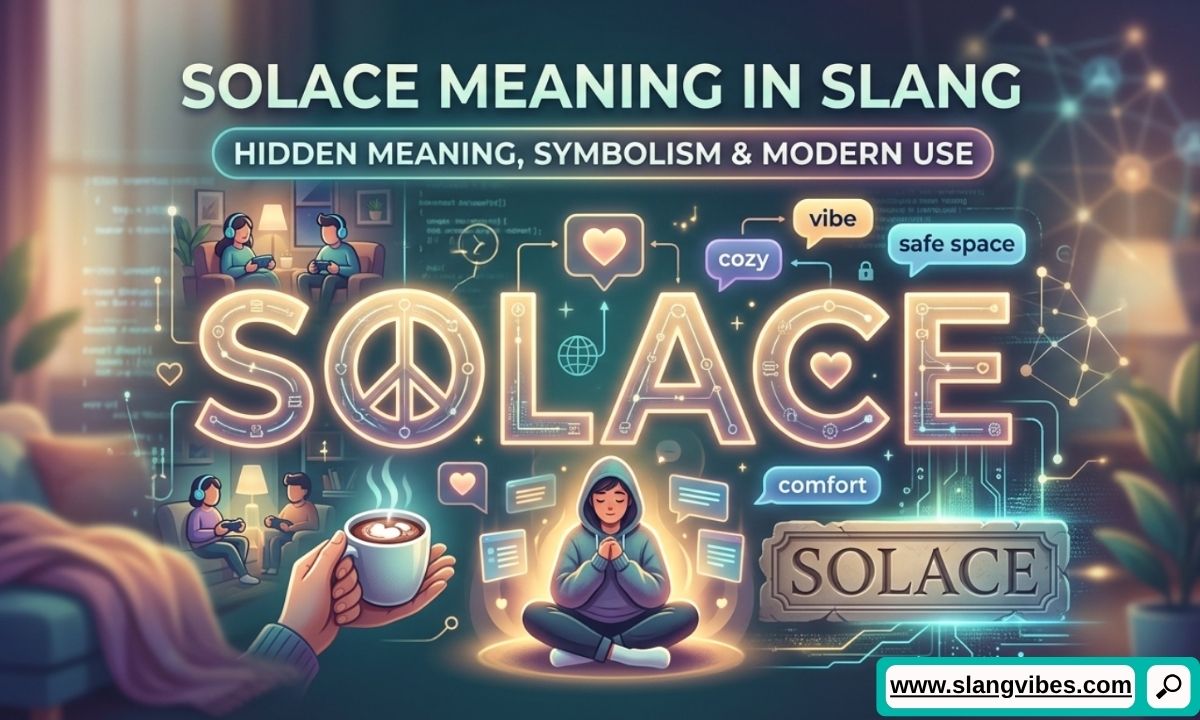
Scroll through enough captions and comment sections and the same word keeps popping up: solace. It shows up under sunset photos, breakup posts, and song lyrics screenshotted onto a black background. Nobody explains what it means. Everyone writes it like you already know.Here’s the thing: most people who use it online understand it, even if they wouldn’t spell out a definition on the spot. The solace meaning comes down to comfort found during a hard stretch of life, not happiness exactly, more like relief. It’s the word for what a song does after a bad week, or what a friend’s voice does during a rough call.
This guide covers where the word came from, what it signals when someone uses it, and how to use it yourself without sounding like you lifted it from a Pinterest quote board.
What Does “Solace” Actually Mean?
Quick Answer: Solace means comfort or relief someone feels during sadness, grief, or a hard period. It doesn’t mean happiness. It means the easing of pain.
Solace describes a specific kind of comfort. It shows up when something, or someone, eases pain instead of erasing it.
Say a person writes “this playlist is my solace.” They don’t mean the songs make them happy. They mean the songs help them get through something difficult.
The word works across categories: people, places, routines, memories, even silence. A grandmother’s kitchen might be someone’s solace. A morning run might be another person’s. The thread stays the same across every case: relief during distress, not a replacement for whatever caused the distress.
Read Also: Tweaker Meaning in Slang: Definition, Usage, and Spiritual Meaning
Where the Word Comes From
Solace has roots in Latin. <cite index=”2-1″>Merriam-Webster traces it back to a 14th-century borrowing from Latin by way of Anglo-French</cite>, so the word has sat inside English for close to 700 years.
For most of its history, solace lived in religious writing, poetry, and formal speech. Funeral services and hymns leaned on it heavily. Sermons used it to describe the ease faith brings during grief.
The meaning hasn’t shifted much across the centuries. What changed is where the word lives now. Instead of staying inside prayer books and eulogies, it moved into captions, texts, and lyrics.
Read Also: OF Page Meaning Explained: What It Really Means in 2026
The Hidden Meaning and Symbolism Behind Solace
Solace carries more weight than a plain comfort word. It symbolizes shelter, not celebration. When someone reaches for solace instead of “comfort” or “peace,” they’re pointing at something specific: relief sitting next to sadness, not instead of it.
This is part of why the word fits grief and healing content so well. Solace doesn’t promise the hard part is over. It only promises a moment of rest inside it. A person can find solace in a memory of someone they lost while still deep in grieving that person. Both feelings exist together, side by side.
It’s worth saying plainly: the word has started drifting toward aesthetic performance in some corners of Instagram and TikTok, dropped under any moody photo whether real emotion sits behind it or not. This doesn’t cancel out the genuine uses. It just means the word carries less weight in certain feeds than it used to, the same way heavily overused words lose their punch. Context still separates a sincere use from a decorative one.
Read New Article: Pookie Meaning in Slang: The Cute Word Everyone Is Using in 2026
Solace as a Verb, and How to Actually Say It
Most people know solace only as a noun (“my solace”), but it also works as a verb. <cite index=”2-1″>Merriam-Webster’s entry shows the verb used for counselors comforting grieving children, and for someone easing their own wait with a book.</cite> “To solace someone” means to comfort them directly, an older but still valid way to say console.
On pronunciation: say it “SAH-liss,” rhyming with “chalice,” stress on the first syllable. People often say “SO-lace,” rhyming with “lace,” which is a common mix-up. Don’t worry if you’ve done this yourself.
Read Also: Stud Meaning in Slang: What It Really Means in 2026 (With Examples)
How Solace Shows Up in Texts and on Social Media

Online, the word tends to shift tone depending on where it lands. Captions on Instagram and TikTok often lean poetic and moody, paired with quiet visuals: a rainy window, an empty room, a candid shot nobody posed for. Texting strips that away and gets more direct, usually naming exactly what or who helped.
Support-focused spaces, like grief or mental health threads on Reddit, use it in a quieter, more sincere register, closer to how it reads in a journal than how it reads in a caption.
A group chat exchange might look like this:
Priya: I finally deleted his number
Priya: felt like ripping off a band-aid
Sam: proud of you, honestly
Sam: what’s been helping this week?
Priya: running every morning, my solace lately
Read Also: WFH Meaning: What It Stands for in Texts, Chats, and at Work (2026 Guide)
Solace vs. Comfort vs. Peace vs. Consolation
These words overlap, but each carries a different weight and use case.
| Word | What It Means | How It Differs From Solace |
|---|---|---|
| Solace | Relief during grief or distress | The baseline word this guide covers |
| Comfort | General ease, physical or emotional | Broader, works for small problems too, not only grief |
| Peace | A calm state of mind | Not tied specifically to easing pain, works even without a hard event behind it |
| Consolation | Relief after a loss or disappointment | Close cousin, sounds slightly more formal, shows up in phrases like “consolation prize” |
Solace in Pop Culture: Quantum of Solace, Will Solace, and Baby Names
The word shows up past captions, too. “Quantum of Solace,” the 2008 James Bond film, pulled its title from an Ian Fleming short story of the same name. Read plainly, a quantum of solace means the smallest measurable trace of comfort one person still owes another, small enough to notice its absence.
In fiction aimed at younger readers, Will Solace, a character from Rick Riordan’s Percy Jackson books, carries the word as a surname, fitting a character written as a healer who cares for others.
Some parents pick Solace as a first name for exactly this meaning, choosing warmth over a more common option. This reads more as a personal choice tied to the word’s meaning than a documented naming trend.
Read Also: IYKYK Slang Meaning: The Internet Phrase You Need to Know
How to Respond When Someone Calls You Their Solace

This moment carries weight. A joke or a shrug tends to land wrong here.
With a friend, something honest works best: “I’m glad I get to be that for you” or “that means more than you know.” With a partner, it’s worth matching the sincerity rather than deflecting with humor. With family, a simple acknowledgment usually lands fine.
A dating-context example:
Alex: not gonna lie, you’re my solace on the bad days
Riley: this means a lot to hear
Riley: I’ve got you, always
When to Use It (and When to Skip It)
Use it when:
- You’re naming something that genuinely eased a hard time
- You’re writing a heartfelt caption or message
- You want to thank someone sincerely, not casually
Skip it when:
- You’re joking around or being sarcastic
- You’re firing off a quick text with no emotional weight behind it
- You’re unsure the other person knows the word
On the safety side, solace carries no inappropriate meaning. It shows up in classroom vocabulary lists and assigned reading, and works fine across any age group, including kids and teens.
Read More Articles: BBG Meaning: Slang Definition, Text Uses & Examples (2026)
FAQ
What does solace meaning in simple words?
Comfort or relief felt during a hard time. It eases pain rather than replacing it.
Is solace slang, or an actual dictionary word?
It’s a real, centuries-old English word. Social media revived its use rather than inventing it.
Is solace ever used as a verb?
Yes. “To solace someone” means to comfort them directly, a usage confirmed in standard dictionaries.
What does “quantum of solace” mean?
It refers to the smallest trace of comfort one person owes another, a phrase popularized by the Ian Fleming story and the 2008 Bond film sharing its title.
Is it strange to call someone your solace over text?
Not strange, though it reads as sincere and a bit poetic rather than casual. Save it for moments where you mean it.
Final Thoughts
Solace never needed social media to mean something. Long before captions and comment threads, it sat inside prayer books, poems, and quiet conversations about grief. What changed is visibility, not meaning.
Next time it shows up under a caption, or fits a message you’re writing, trust it. The word carries real weight, so save it for moments that match: genuine comfort, genuine relief, a hard stretch named out loud.
Skip it for jokes or throwaway texts. Save it for the friend who shows up, the song stuck on repeat during a rough week, the person who feels like solid ground. Used with intention, this word still does what it did seven hundred years ago: name the exact feeling of finding relief inside pain.

Alex Carter is a language enthusiast and internet culture expert at SlangVibes. He explains the latest slang terms and text meanings in simple, clear English so everyone stays in the loop.