You open TikTok, scroll through a comment section, and hit a wall. Someone calls a video “mid.” Someone else says it’s “giving delulu energy.” Then a third comment reads “the rizz is unmatched.” It doesn’t read like the English you learned in school. Still, everyone else seems fluent. This confusion is exactly why this guide exists. TikTok slang moves fast, and new words show up faster than most people manage to track them. So this guide breaks down over 150 terms you’ll run into on the app, grouped by category, explained in plain language, and updated for how people use them right now. No guesswork required.
Read More: Ghetto Slang Meaning (2K26 Guide): 30 Popular Terms, Origins & Real Usage
What Is TikTok Slang, and Why Does It Move So Fast?
TikTok slang is the shorthand vocabulary that spreads through short-form video, comments, and captions. Some of it started on the app. However, a lot of it arrived from gaming chats, streamer culture, ballroom scenes, and Black American communities, then TikTok picked it up and pushed it everywhere at once.
The speed comes down to the app’s structure. First, the For You Page shows content to people who don’t follow the creator, so a single clip has a shot at reaching millions overnight. On top of that, sounds, duets, and stitches carry a phrase from one video into thousands of others within days.
Compare that to how slang spread twenty years ago. Back then, a word needed months, sometimes years, to travel from one region to another. Now a fifteen-second clip does the job by dinnertime.
Here’s a quick example of how fast it moves in real conversation.
Maya: did you see the new dance trend Jordan: no what’s it called Maya: it’s giving “corporate but make it feral” Jordan: I have no idea what that means but I need to see it
That’s the pace this guide tries to keep up with. So every term below reflects how people currently use it, not how it looked when it first appeared.
Read Also: BBL Slang Meaning (2K26 Guide): What BBL Really Means in Text, TikTok & Social Media
The Full TikTok Slang Glossary: 150+ Terms at a Glance
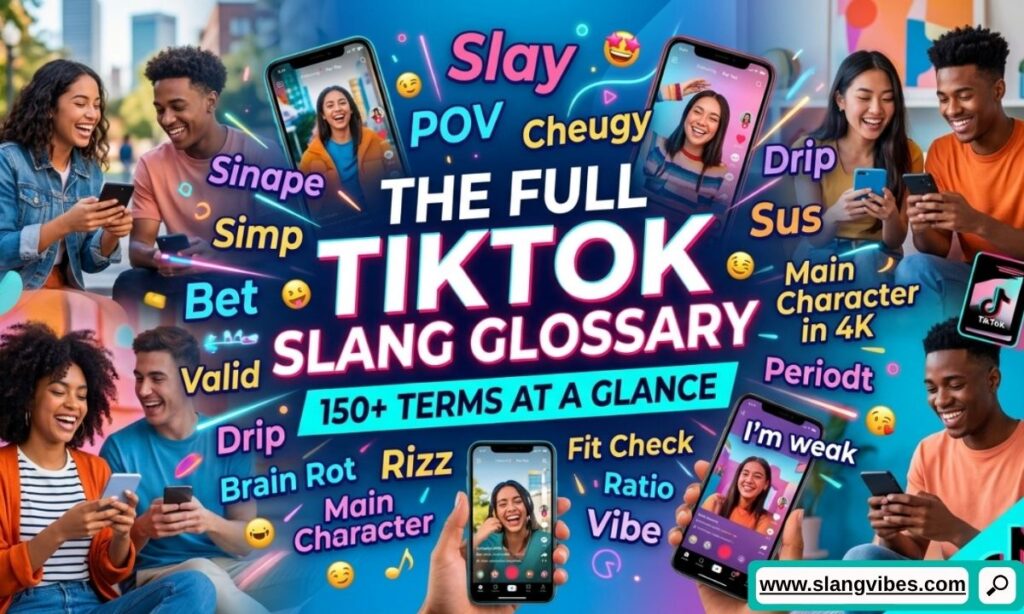
Below sits a scannable reference for the terms you’ll hit most often. Overall, each row keeps the meaning short so you can skim it fast and come back later when you forget one. Here’s the first batch to start with.
Quick Reference: Reactions and Everyday Terms
| Term | Meaning | Example |
|---|---|---|
| Rizz | Natural charm, especially in flirting | “He’s got rizz.” |
| Delulu | Playfully unrealistic or in denial | “That’s delulu.” |
| Ate | Did something flawlessly | “She ate that look.” |
| NPC | Acting robotic or repetitive | “He’s being an NPC.” |
| Mid | Average, unimpressive | “The show was mid.” |
| Slay | Performed impressively | “You slayed that.” |
| Cap | A lie or exaggeration | “That’s cap.” |
| No Cap | No lie, seriously | “No cap, best tacos ever.” |
| Main Character Energy | Confident, center-of-attention vibe | “She’s giving main character.” |
| Bet | Agreed, deal | “Meet at six? Bet.” |
| Side Eye | A suspicious glance or reaction | “Side eye at that excuse.” |
| It’s Giving | Describes a vibe | “It’s giving vintage.” |
| Touch Grass | Go outside, log off | “Bro needs to touch grass.” |
| Understood the Assignment | Nailed exactly what was expected | “She understood the assignment.” |
| Sus | Suspicious | “That’s sus.” |
| Bussin | Really good, usually food | “This ramen is bussin.” |
| Drip | A sharp outfit or look | “That fit is drip.” |
| Snatched | Looking flawless | “Her makeup is snatched.” |
Quick Reference: Relationship and Culture Terms
Next up is the batch that covers dating, internet culture, and a few Gen Alpha additions.
| Term | Meaning | Example |
|---|---|---|
| Baddie | Confident, styled aesthetic | “She’s a baddie.” |
| Ick | A sudden loss of attraction | “He gave me the ick.” |
| Situationship | An undefined romantic connection | “We’re in a situationship.” |
| Skibidi | A nonsense meme filler word | “That’s so skibidi.” |
| Fanum Tax | Taking a share of someone’s food or win | “Pay the fanum tax.” |
| Sigma | An independent, unbothered persona | “Sigma mindset.” |
| Girl Dinner | A random small snack meal | “Cheese and crackers, girl dinner.” |
| Brainrot | Content so absurd it fries your focus | “This whole feed is brainrot.” |
| Glow Up | A noticeable positive change | “She had a glow up.” |
| Yeet | To throw something, or a shout of excitement | “Yeet it in the trash.” |
| Bop | A catchy song | “This track is a bop.” |
| Tea | Gossip | “Spill the tea.” |
| Periodt | Marks a statement as final | “We’re not doing that. Periodt.” |
| Stan | A devoted fan | “I stan her.” |
| Simp | Overly devoted to someone romantically | “He’s simping hard.” |
| Ghosted | Suddenly cut off contact | “She got ghosted.” |
| Lowkey | Secretly, quietly | “Lowkey obsessed with this.” |
| Highkey | Openly, obviously | “Highkey the best show this year.” |
Quick Reference: Wins, Warnings, and Vibes
The last batch rounds out the terms tied to wins, losses, and reading a situation.
| Term | Meaning | Example |
|---|---|---|
| Flex | To show off | “New sneakers, had to flex.” |
| W | A win | “Big W today.” |
| L | A loss | “That’s an L.” |
| Vibe Check | Reading the mood or fit of a moment | “Vibe check failed.” |
| Ratio | A reply outperforming the original post | “That got ratioed.” |
| Based | Confidently authentic, unbothered by others’ opinions | “That take is based.” |
| Cheugy | Outdated, trying too hard | “Those jeans are cheugy.” |
| Canon Event | A defining, shaping life moment | “That breakup was my canon event.” |
| Caught in 4K | Caught with clear proof | “Caught in 4K lying.” |
| Pressed | Overly upset about something small | “Why are you so pressed?” |
| Menty B | A minor mental breakdown | “Having a menty b today.” |
| Hits Different | Feels unusually powerful | “This song hits different.” |
| Rent Free | Something you can’t stop thinking about | “Living rent free in my head.” |
| Chronically Online | Too immersed in internet culture | “You sound chronically online.” |
| Red Flag | A warning sign in someone’s behavior | “Ignoring texts for days, red flag.” |
| Green Flag | A good sign in someone’s behavior | “Remembers small details, green flag.” |
| Down Bad | Desperate over a crush | “He’s down bad for her.” |
TikTok Slang by Category
Overall, sorting terms by category makes them easier to remember. It also shows “…how much of TikTok slang clusters around…” a handful of themes: praise, insults, dating, food, and internet culture in general.
Compliments and Praise
Slay, ate, understood the assignment, snatched, and based all do roughly the same job. In short, they tell someone they nailed it. Still, the tone shifts from term to term. Slay leans playful, while understood the assignment feels more formal, almost like a grade. Based, on the other hand, applies to opinions and takes rather than looks or performances. So save it for when someone says something you agree with.
Insults and Callouts
Mid, cap, sus, NPC, cheugy, and pressed cover the critical end of the spectrum. For example, mid is blunt but not cruel, closer to “meh” than an actual insult. Cap, meanwhile, calls out a lie. Sus flags something suspicious without fully accusing anyone, while NPC teases someone for acting on autopilot. Even so, these words work best among friends who already read each other’s tone correctly.
Dating and Relationship Slang
Situationship, ick, rizz, down bad, and red flag or green flag dominate TikTok’s dating content. Specifically, a situationship sits in the gray area between friendship and a relationship. An ick, on the other hand, is the moment attraction disappears over something small, like a strange laugh or a bad text habit.
Riley: he texted “hey stranger” after three weeks of nothing Priya: massive ick Riley: I know, deleting the thread Priya: as you should
Food Slang
Bussin and girl dinner cover most of TikTok’s food vocabulary. Bussin means something tastes excellent, usually said with real enthusiasm in a review-style video. Girl dinner, meanwhile, describes a meal made of small, mismatched snacks instead of an actual cooked dish. It started as a joke and turned into a full trend.
Fashion and Beauty Slang
Drip, baddie, and glow up show up constantly in outfit and transformation videos. Drip refers to a standout look, usually streetwear or a fit someone put real thought into. Baddie, meanwhile, describes a confident, polished aesthetic. Glow up, on the other hand, covers any visible improvement, whether it’s a haircut, a fitness change, or a full style overhaul over months.
You’ll also see “fit check” as a caption, which signals the video is about to show off an outfit before a night out or a big event. Similarly, snatched crosses over here too, usually describing sharp makeup or a fitted silhouette rather than an entire look.
Gaming-Origin Slang
Sus, W, L, and GG all started in gaming spaces before TikTok adopted them. Sus, for instance, came from the game Among Us, where players call out suspicious behavior. W and L, meanwhile, stand for win and loss and now apply to anything, not just games. GG, short for good game, sometimes shows up as a sarcastic way to end an argument or a bad day.
Clutch is another gaming carryover worth knowing. It describes pulling off a win at the last possible second, and TikTok stretched that meaning to cover any tight, last-minute save, like finishing a project right before a deadline. You’ll also see “no shot” doing double duty here, meaning either “that’s impossible” or “I don’t believe you,” depending on the tone of the video.
Brainrot and Gen Alpha Terms
Skibidi, fanum tax, sigma, and brainrot itself belong to a newer wave driven largely by Gen Alpha. In fact, these terms often don’t have a literal meaning at all. Skibidi, for example, works as filler, similar to how “like” gets used in casual speech. Fanum tax, meanwhile, came from streamer culture, where a creator named Fanum became known for grabbing food off other people’s plates on stream.
Read New Article: DMV Slang Meaning (2K26 Guide): 24 Popular Words & Phrases You Need to Know
Where TikTok Slang Actually Comes From
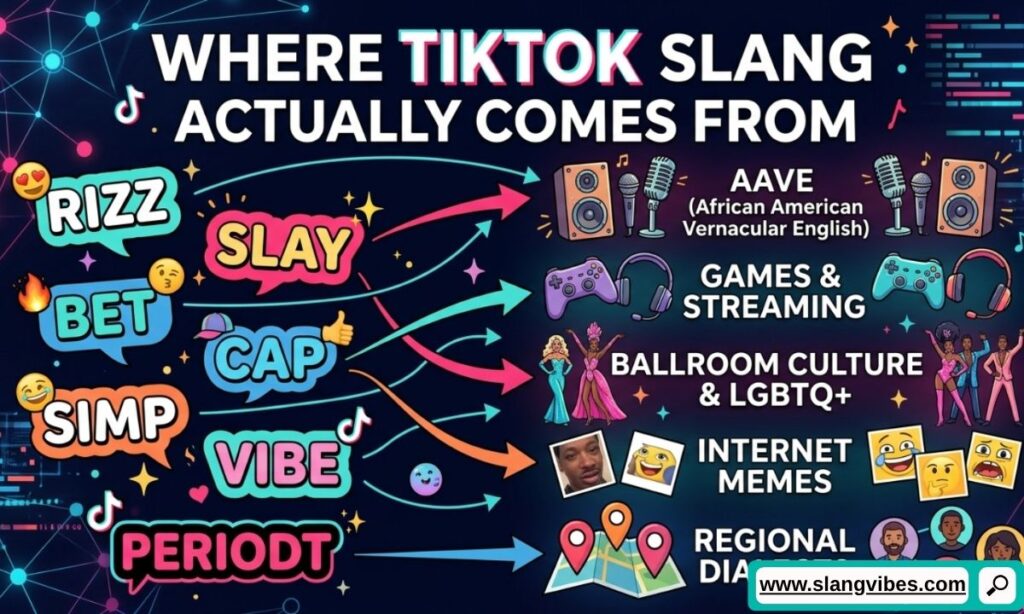
“A large share of TikTok slang didn’t start on the app itself.”. Instead, they started in Black American communities and spread through AAVE, African American Vernacular English, long before the app existed. Slay, tea, no cap, and finna, for example, all trace back to this origin, carried into wider use through music, comedy, and social media.
Ballroom and drag culture contributed another chunk. Periodt, shade, reading someone, and yas queen all come from ballroom scenes that date back decades, long before any of this went viral on a phone screen.
Gaming and streamer culture added the rest. Sus, for instance, came from Among Us. Fanum tax came from a specific streamer’s on-camera habit, while clutch and GG both migrated from competitive gaming chat rooms into everyday texting.
Knowing where a term comes from matters. Overall, using slang without any awareness of its roots can come off as careless, especially with words tied to communities that built entire styles of speech that mainstream culture later borrowed.
Gen Z vs. Gen Alpha vs. Millennial TikTok Slang
Each generation online built its own slang layer, and the gaps between them show up fast in a family group chat.
Millennials, for example, carried early internet terms like YOLO, epic fail, on fleek, and extra. Gen Z, meanwhile, built a TikTok-native vocabulary around rizz, delulu, mid, and NPC. Gen Alpha, the generation that grew up with TikTok already established, leans into more abstract terms like skibidi, sigma, and brainrot, many of which barely translate to older users.
| Generation | Sample Terms | Vibe |
|---|---|---|
| Millennial | YOLO, epic fail, on fleek | Nostalgic, direct |
| Gen Z | Rizz, delulu, mid, NPC | Sharp, reaction-based |
| Gen Alpha | Skibidi, sigma, brainrot | Abstract, filler-heavy |
Here’s what that gap looks like in real life.
Dana: my little brother just called me sigma for making dinner Casey: what does that even mean Dana: I asked and he just said “you know” and walked off Casey: gen alpha is a different language at this point.
Read Also: White Heart Emoji Meaning: Love, Friendship & Hidden Symbolism
US vs. UK: How These Terms Change Across the Pond
Most TikTok slang travels internationally without much change, but a handful of terms shift meaning or blend with local British slang once they cross the Atlantic.
British teens, for instance, often stack American TikTok terms on top of UK slang, producing lines like “that’s bare slay, innit.” Bare, in this case, functions as an intensifier similar to “very.” Mid caught on in the UK almost as fast as it did in the US, while a term like peak carries an extra meaning in British slang, describing something unfortunate or annoying, on top of its American use for “the best version of something.”
| US Term | UK Twist |
|---|---|
| Very | Bare |
| Mid | Mid (used the same way) |
| Peak (the best) | Peak (also means “bad luck”) |
| Attractive | Peng |
How Long Does TikTok Slang Actually Last?
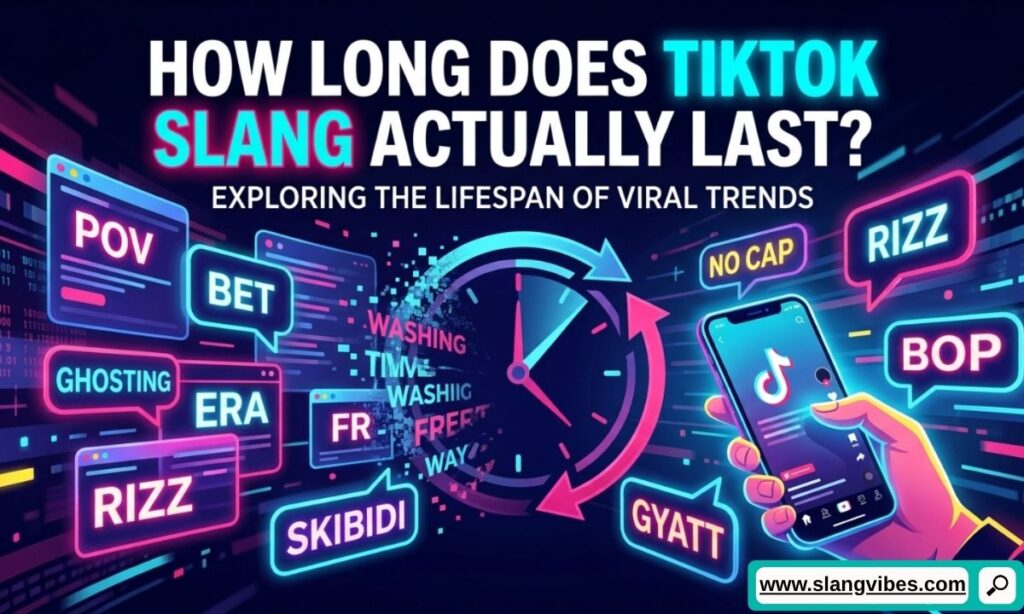
Most TikTok slang has a short shelf life. Trend watchers who track this space, for example, often describe a rough four-to-six-week cycle before a word starts to feel dated among the people who used it first. As a result, a phrase can peak, saturate every comment section, and then flip into a punchline within a single month.
Did You Know: Some slang skips the fade-out entirely and gets absorbed into everyday English. Words like “selfie” and “on fleek” started as fringe internet slang before dictionaries added them.
Right now, a few terms show signs of fading. Understood the assignment, for instance, feels slightly dated to heavy TikTok users, even though people outside the app still use it. Sus, meanwhile, has stuck around for years, but it’s lost some of its original bite. Rizz, delulu, mid, ick, and situationship, on the other hand, still show strong daily use across comment sections and captions as of this guide’s update.
A term’s staying power usually comes down to how flexible it is. Words tied to one specific joke or sound clip, for example, tend to fade the fastest, since the reference stops making sense once the original video stops circulating. Words that describe a general feeling, like mid or ick, on the other hand, tend to stick around longer because they apply to almost any situation.
Read Also: Ice Slang Meaning: What “Ice” Really Means in Text, Rap & Street Culture (2026)
How to Use TikTok Slang Without Sounding Forced
“TikTok slang lands best when it matches the room.”. For instance, dropping “no cap” into a group chat with close friends reads completely differently than dropping it into a client email.
A flat sentence like “That was good” turns into “No cap, that was bussin” among friends who already talk that way. The same swap in a work message, however, would land badly. So match your vocabulary to your audience first, then let the slang follow.
Here’s a coworker exchange that shows the line between casual and overdone.
Sam: the new intern’s presentation was honestly kind of a slay Nina: right, she understood the assignment Sam: didn’t expect that from someone on their first week Nina: definitely a green flag hire
Avoid stacking three or four slang terms into one sentence. Otherwise, it reads as trying too hard, which is close to the exact energy that “cheugy” mocks. Instead, keep it to one or two terms per sentence to sound natural.
Terms to Avoid at Work, School, or in Formal Writing
Slang carries a casual tone that doesn’t belong in a job interview, an academic paper, or a formal email. For instance, calling a coworker’s idea “mid” in a meeting reads as dismissive rather than honest feedback, even if that’s not the intent behind it.
A safer approach: save slang for texts, DMs, and comment sections, and switch to plain, direct language anywhere your words get evaluated professionally or academically. Terms rooted in specific communities, like periodt or slay, are also worth using with some awareness of where they came from, rather than tossing them around as generic filler.
Frequently Asked Questions
What does it mean when something is “giving” a certain vibe?
In short, “it’s giving” describes the overall mood or aesthetic something reminds you of. Saying a room “is giving cozy cabin” means the space feels like a cozy cabin without spelling out every detail.
Is TikTok slang only used by teenagers?
No. Still, teens drive most new terms, but plenty of millennials and even older users pick up popular words like bet, no cap, and rizz once they cross into mainstream conversation.
Why do some TikTok slang words disappear so fast?
The same algorithm that spreads a word overnight also burns it out fast. As a result, once a phrase saturates every comment section, early adopters move on and treat it as dated.
Does TikTok slang eventually become normal English?
Some of it does. For example, words like selfie and on fleek started as internet slang before dictionaries and everyday speech absorbed them permanently.
What’s the difference between Gen Z slang and Gen Alpha slang?
Gen Z slang, like rizz and mid, tends to describe a specific reaction or judgment. Gen Alpha slang, on the other hand, like skibidi and sigma, leans more abstract and often works as filler rather than a term with one fixed meaning.
Bottom Line
TikTok slang changes constantly. It’s a moving target shaped by gaming chats, ballroom culture, AAVE, streamer habits, and whatever clip happens to blow up this week. Knowing terms like rizz, delulu, mid, and situationship, for example, gets you through most comment sections today. Understanding where the language comes from, meanwhile, helps you use it with real context instead of repeating sounds without knowing why.
Trends here move in weeks, not years. So treat this guide as a living reference rather than a finished list. Still, check back when a new term shows up in your comments and you can’t figure out what it means. Chances are, it’ll be added here before too long.

Alex Carter is a language enthusiast and internet culture expert at SlangVibes. He explains the latest slang terms and text meanings in simple, clear English so everyone stays in the loop.