Ever scroll through a comment section and hit a word you don’t recognize, then feel weirdly out of the loop? Someone in your group chat calls their new sneakers “drip,” or a coworker says something is “bussin,” and you nod along without a clue what’s happening. Ghetto slang meaning trips up more people than you’d expect, since this label covers dozens of words with different histories, moods, and rules for when to use them. This guide breaks down where these words started, what they mean today, and how to use them without sounding forced. Whether you’re catching up on TikTok trends or decoding a text from a friend, you’re in the right spot.
Ghetto Slang Meaning: What It Means Today
The word “ghetto” started far from any American neighborhood. It first described a segregated Jewish quarter in 16th century Venice, and over the 20th century it shifted to describe under-resourced, often majority-Black urban neighborhoods in US cities. Online, the phrase “ghetto slang” turned into a catch-all search term for informal language tied to these communities, hip-hop culture, and city life in general.
People searching for this phrase usually want the same thing: a plain answer without judgment. Most of the words under this label come from African American Vernacular English (AAVE), a fully formed dialect with its own grammar and history, not a random pile of “made-up” words. Terms move from block parties and barbershops into rap lyrics, then into group chats and comment sections within weeks. A word means one thing on Tuesday and picks up a slightly different shade of meaning by the following month.
Here’s how it plays out in a normal group chat:
Group Chat Jordan: “Bro you seeing this fit at the mall rn” Priya: “No cap, this fit’s clean” Jordan: “Bet, I’m pulling up”
In three lines, two terms show up without either person stopping to explain them. “No cap” signals honesty, and “bet” signals agreement. The words carry enough shared context on their own to move the conversation forward, which is the whole point of slang: speed and personality over formal grammar.
Where Ghetto Slang Comes From: History and Real Origins
From the Great Migration to Hip-Hop
Most words under this label trace back to Black American communities, starting with the Great Migration of the early-to-mid 1900s, when millions of Black families moved from the rural South into cities like Chicago, Detroit, and New York. Neighborhoods, church culture, and jazz clubs shaped the language forming in those spaces. Jazz slang of the 1930s and 40s gave way to bebop-era expressions in the 1950s, then to funk and soul vocabulary in the 70s, each wave layering onto the last before hip-hop absorbed and amplified all of it starting in the late 1970s in the Bronx.
Hip-hop turned local, neighborhood-specific expressions into a national vocabulary starting in the 1970s and 1980s. Artists rapped in the language they grew up speaking, and radio, then MTV, then the internet carried it everywhere. By the 2000s and 2010s, terms like “fresh,” “fire,” and “squad” had crossed so far into mainstream English, and plenty of people using them had no idea where the words came from.
How Individual Words Evolved Over Time
A few individual word histories show this pattern clearly. “Cap,” meaning a lie, grew out of older phrases like “capping” and “talking a lot of cap,” in circulation for decades before social media picked it up. “OG” started inside 1970s and 80s gang culture as shorthand for “original gangster,” then loosened into a general term of respect for anyone experienced or trusted, from a grandmother to a favorite teacher. Watching a single word travel from a narrow, specific meaning into something broader and gentler is common across this entire vocabulary.
Did You Know? Linguists describe AAVE as a dialect with consistent grammar rules of its own, not a “broken” version of standard English. Patterns like dropping the verb “to be” in phrases such as “she tired” follow the same structured rules as any other dialect.
Social media sped this process up even further. A phrase heard in a song on Monday shows up in TikTok captions by Wednesday and in a middle schooler’s group chat by Friday. This speed explains why definitions shift so quickly here, since the words rarely sit still long enough to settle into a dictionary before the next wave arrives.
Read More: 369 Meaning Slang: What It Really Means in Text, TikTok & Social Media (2026 Guide)
30 Ghetto Slang Terms and Their Real Meaning
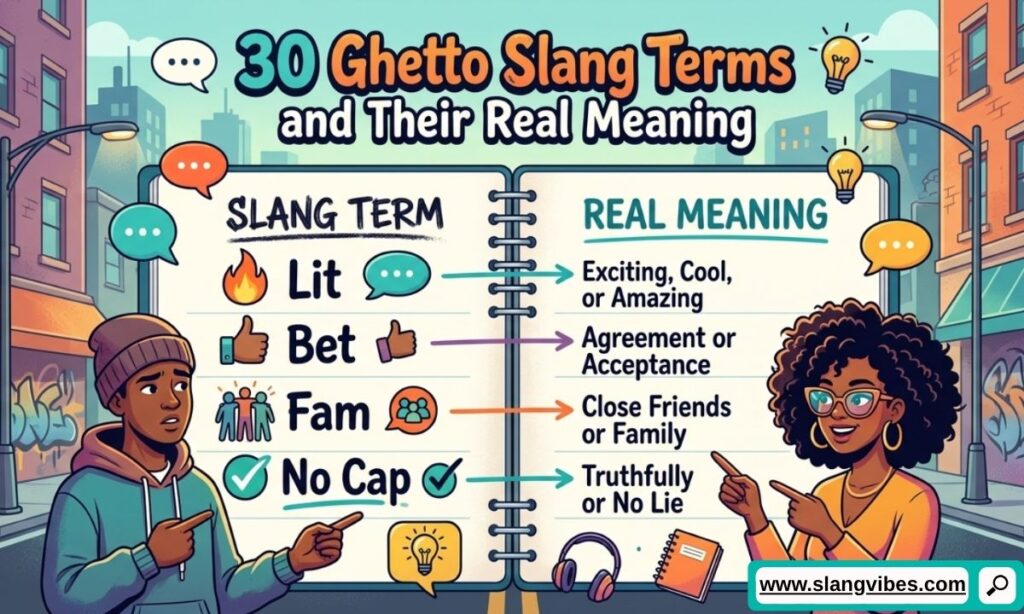
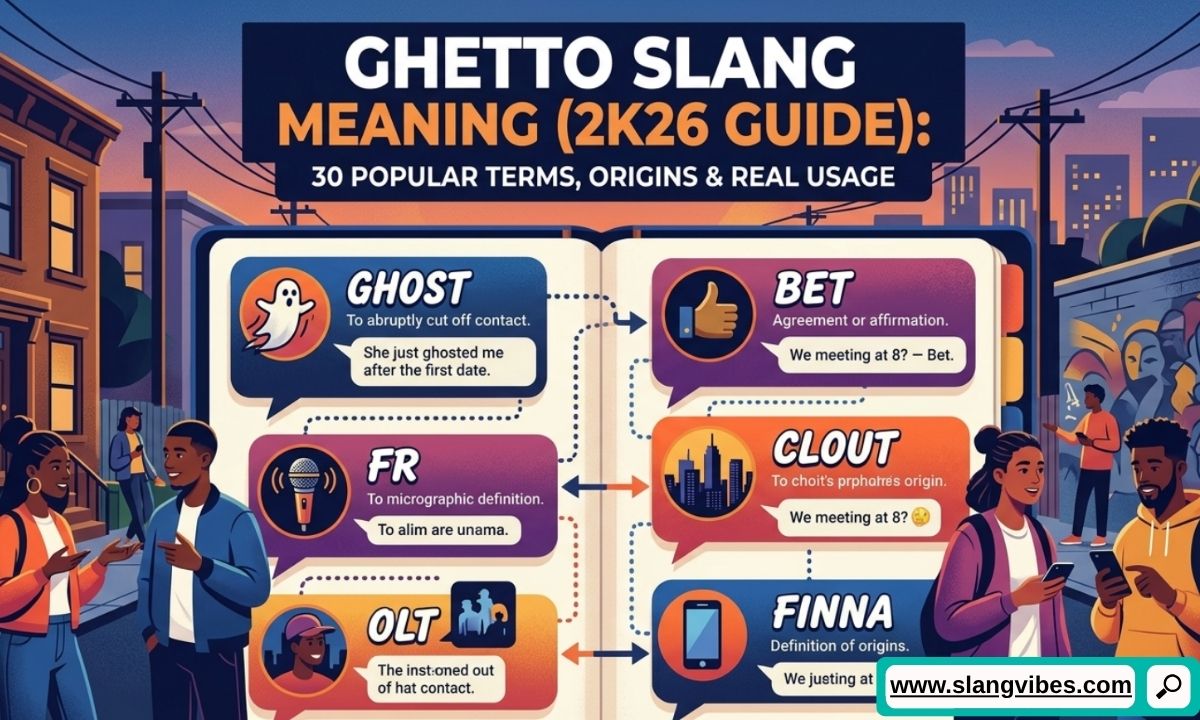
Here’s the ghetto slang meaning breakdown for 30 terms you’re likely to run into online and in person, sorted into five groups so you’re not scrolling through one long list.
Money and Status
These cover cash, reputation, and bragging rights.
| Term | Meaning | Example |
|---|---|---|
| Bands | Large amounts of cash, often rubber-banded stacks | “He walked in with bands on him.” |
| Stacks | A big sum of money, usually thought of in thousands | “Saved up two stacks this month.” |
| Bread | Money in general | “Gotta get some bread before Friday.” |
| Clout | Influence, reach, or online popularity | “This post got her serious clout.” |
| OG | “Original,” someone respected for experience | “He’s the OG of this whole scene.” |
| Goated | The greatest at something, from “GOAT” | “Everyone says she’s goated at chess.” |
Style and Compliments
These describe looking good or sounding impressive.
| Term | Meaning | Example |
|---|---|---|
| Drip | A stylish, put-together outfit | “New shoes got real drip.” |
| Fire | Excellent or impressive | “This playlist is fire.” |
| Fresh | Clean, new, sharp-looking | “He came through looking fresh.” |
| Snatched | Perfectly styled or put together | “Her makeup is snatched today.” |
| Fly | Cool, attractive, stylish | “This jacket is fly.” |
| Bussin | Extremely good, usually about food | “This burger is bussin.” |
Warnings and Conflict
These flag tension, irritation, or an actual dispute.
| Term | Meaning | Example |
|---|---|---|
| Beef | An ongoing conflict between people | “They’ve had beef since freshman year.” |
| Opp | Short for “opposition,” an enemy or rival | “He’s not friendly, he’s an opp.” |
| Shook | Startled, nervous, or caught off guard | “This jump scare had me shook.” |
| Salty | Bitter or annoyed, often after losing | “Don’t get salty over one game.” |
| Big mad | Extremely angry | “She’s big mad about the schedule change.” |
| Petty | Acting small or spiteful over something minor | “Blocking him over a text is petty.” |
Reactions and Emotions
These capture quick, in-the-moment feelings.
| Term | Meaning | Example |
|---|---|---|
| Cap / No cap | A lie / the truth, no lying | “Stop capping, you weren’t there.” |
| Bet | Agreement, “okay” or “deal” | “See you at seven? Bet.” |
| Dead | Laughing hard | “I’m dead, this video killed me.” |
| Mood | A relatable feeling shared with others | “Rainy Monday energy, big mood.” |
| Lowkey | Somewhat, quietly, without making it obvious | “Lowkey excited for this weekend.” |
| Highkey | Openly, obviously, without hiding it | “Highkey need coffee right now.” |
People and Relationships
These describe who’s in someone’s inner circle.
| Term | Meaning | Example |
|---|---|---|
| Fam | A close friend treated like family | “What’s good, fam?” |
| Squad | A tight friend group | “Squad’s meeting up Saturday.” |
| Bae | A romantic partner, “before anyone else” | “Getting dinner with my bae tonight.” |
| Homie | A close, trusted friend | “He’s my homie from way back.” |
| Ride or die | Someone loyal no matter the situation | “She’s my ride or die, always.” |
| Real one | A genuine, trustworthy person | “He’s a real one, no games.” |
Ghetto Slang Meaning vs. Hood Slang vs. Street Slang: What’s the Difference?
Knowing where a word falls only helps if you also understand which bucket it belongs to, since these three labels overlap without being identical.
“Hood slang” usually points to vocabulary specific to one neighborhood or city, the kind of word your friend from Atlanta uses without your friend from Chicago recognizing it. “Street slang” leans wider and often carries an edge of danger or illegality, covering coded language around crime, gangs, or hustling most outsiders aren’t meant to fully decode. “Ghetto slang” sits somewhere in between as a loose, informal search label people type into Google, overlapping heavily with everyday AAVE terms with nothing to do with crime at all, words like “fam,” “bet,” and “no cap.” The lines blur constantly online, since one listicle’s “hood slang” is another site’s “ghetto slang” with barely any difference in the actual entries.
Here’s a friend group texting about weekend plans, where the difference shows up naturally:
Friend Group Chat Marcus: “Y’all tryna pull up to the cookout Saturday” Devon: “Bet, I’m bringing my whole squad” Marcus: “Say less, it’s gonna be fire”
Nothing in this exchange touches street or crime-related slang. It’s everyday, casual, AAVE-rooted language, which is closer to what most people mean when they type “ghetto slang” into a search bar looking for a plain definition instead of a coded warning system.
Read Also: Type Meaning in Slang: What It Really Means in Text (2026)
US Ghetto Slang vs. UK Roadman Slang: Regional Differences
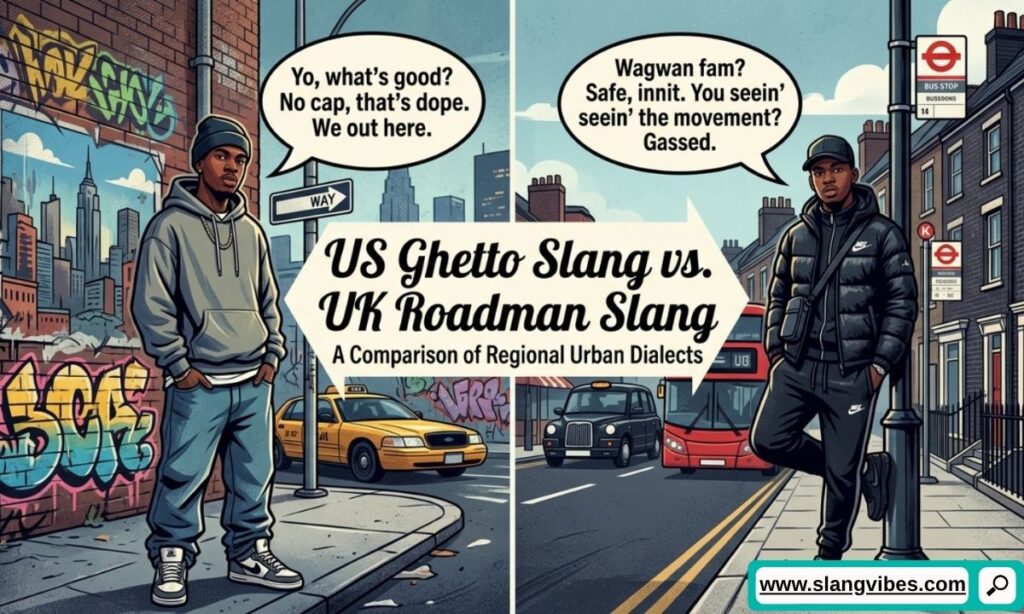
A term’s meaning in the US doesn’t always line up with its closest UK equivalent, since British street slang, often called “roadman slang,” grew out of a different mix of communities: Caribbean patois from the Windrush generation, West African languages, South Asian influence, and working-class British English blended together in cities like London.
| Concept | US Term | UK Term | Meaning |
|---|---|---|---|
| Respected person | OG | G | Someone trusted or experienced |
| Close friends | Fam / Homie | Blud / Mandem | A tight circle of friends |
| Impressive style | Drip / Fire | Peng | Looks great, attractive |
| Agreement | Bet | Safe | Okay, understood, cool |
| Honesty | No cap | On God | I’m not lying |
| Conflict | Beef | Beef | An ongoing dispute (shared term) |
A handful of words, like “beef” and “fam,” cross over cleanly between the two. Others sound completely different despite meaning close to the same thing, which is why a US Gen Z reader and a UK Gen Z reader, watching the same video, each pick up on different parts of the slang.
How Ghetto Slang Meaning Took Over Pop Culture
Pop culture turned this vocabulary into common knowledge for people who never grew up around the communities these words came from. Music did most of the heavy lifting first. Hip-hop and R&B artists rapped and sang in their own everyday language, and every platinum record carried it to new listeners.
TikTok changed the timeline dramatically. Where a slang term used to take months or years to spread through radio and television, a single viral clip puts a word in front of millions of viewers overnight. Sounds, captions, and comment sections repeat a phrase so often it stops sounding new within days. Dictionaries have started tracking the shift too. Merriam-Webster has added several of these words in recent years, including “OG,” a small but telling sign of how far the vocabulary has traveled beyond its original neighborhoods.
A sibling text exchange shows how casually this crosses into daily life now:
Sibling Text Thread Aaliyah: “mom said dinner’s at 6, don’t be late again” Kevin: “bet, no cap I forgot last time lol” Aaliyah: “highkey annoyed but ok, see you then”
Neither sibling is trying to sound trendy on purpose. The words are simply part of how they talk. Brands, celebrities, and streaming shows picked up on this shift and started using the same vocabulary in captions and dialogue, which pushed these terms even further past their original communities and into mainstream, everyday conversation.
Using Ghetto Slang Meaning Respectfully (Without Sounding Fake)
Know Where the Words Come From
Respecting these words starts with knowing where they come from. Most of this vocabulary carries real cultural weight, tied to Black American communities and, increasingly, Caribbean and African diaspora communities in the UK. Using a word without acknowledging this history, or leaning on it as a costume for laughs, lands in a completely different place than picking it up naturally through friends, music, or online culture.
There’s a real double standard worth naming here too. Speakers who grew up using this dialect often face judgment or professional consequences for the exact grammar patterns and words other people pick up and get praised for using once they go viral. Keeping this gap in view is part of using the language with genuine awareness, rather than treating it purely as a trend to borrow from.
A simple gauge helps here: if you picked up a phrase because you enjoy the music, shows, or friends connected to it, you’re likely using it the way most casual speakers do. If you’re using it to perform toughness or exaggerate someone else’s culture for a laugh, this crosses into territory worth reconsidering.
When and Where to Use It
Context matters too. Slang belongs in group chats, captions, and casual conversation, not in a work email or a formal presentation. A coworker text is a solid example of where it doesn’t fit:
Work Slack Message Sam: “Would you send over the Q3 numbers? This deck is fire btw” Manager: “Sure, I’ll grab them. Let’s keep the report itself pretty formal though”
Sam’s compliment lands fine in a casual Slack thread between coworkers, but the same word choice in a client-facing report would feel out of place. The safest approach is code switching, the same skill most bilingual and multi-dialect speakers already use every day: match your language to the room you’re in, and don’t force slang into a setting where it clashes.
Read New Article: White Heart Emoji Meaning: Love, Friendship & Hidden Symbolism
Common Mistakes People Make With Ghetto Slang Meaning
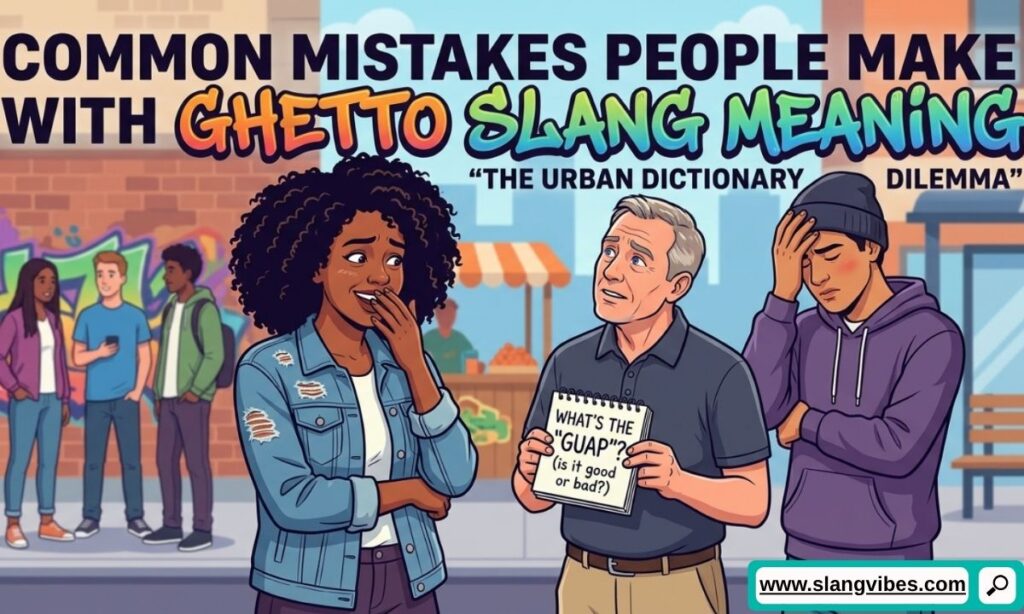
Even people who use this vocabulary often trip over a few recurring mistakes.
Mixing up a term’s tone is the most common one. “Shook” describes surprise or nervousness, not anger, and swapping it in for “mad” confuses the whole sentence. Overusing slang in one message is another mistake. Stacking five terms into a single sentence reads as forced rather than natural, the same way a foreign-language learner sounds stiff when cramming vocabulary into every line.
Timing trips people up too. Slang expires fast, and terms feeling fresh two years ago, like “on fleek,” now sound dated rather than cool. Treating one city’s slang as universal causes mix-ups as well. A word common in Atlanta or Houston might land as unfamiliar in Chicago or New York, and the same goes for UK cities outside London. Checking a term’s regional reach before dropping it into conversation with someone from a different city saves an awkward blank stare.
A dating app message shows how a small misstep changes the whole vibe:
Dating App Chat Alex: “ur pic is fire, u seem highkey cool” Riley: “lol thanks! you’re pretty fly yourself” Alex: “bet, we should link up this weekend”
This exchange lands naturally because both people use the vocabulary lightly and correctly. Swap in outdated terms, or pile on too many at once, and the same message starts to feel try-hard instead of charming.
FAQ: Common Questions About This Slang
It covers informal words and phrases tied to Black American communities and hip-hop culture, most of them rooted in AAVE, along with related street and neighborhood terms.
Not exactly. AAVE is a full linguistic dialect with its own grammar rules, while “ghetto slang” is a looser, informal search label people use for everyday AAVE-rooted vocabulary and related street terms.
Most of these words move freely through music and social media, and plenty of people use them casually without issue. The safest approach is picking terms up naturally through genuine exposure, giving credit to where the language comes from, and steering clear of mocking accents or treating the dialect as a joke.
“No cap,” “bet,” and “drip” show up constantly across TikTok, group chats, and everyday conversation among Gen Z and younger Millennials.
UK roadman slang leans on Caribbean patois, West African languages, and Multicultural London English, while US ghetto slang leans more directly on AAVE and hip-hop culture. A few words, like “beef,” cross over between both.
Conclusion
Ghetto slang meaning comes down to context, tone, and respect for where the words started. These 30 terms move through group chats, song lyrics, and comment sections fast, shifting shade depending on who’s using them and where. Knowing the history behind a word, like AAVE’s role in shaping “fire,” “fam,” and “no cap,” makes the difference between using slang naturally and using it awkwardly.
Slang keeps moving regardless of who’s tracking it. New terms replace old ones within a year or two, and today’s overused word becomes tomorrow’s outdated one. The best approach isn’t memorizing every entry on this list. It’s paying attention to how people around you talk day to day, then matching their energy instead of forcing a word already past its moment.

Alex Carter is a language enthusiast and internet culture expert at SlangVibes. He explains the latest slang terms and text meanings in simple, clear English so everyone stays in the loop.