Picture this: someone is mid-conversation with a friend, the replies are quick and fun, and then, out of nowhere, the chat ends with a single line: “ttyl.” No explanation. No emoji. Three letters, then silence. Is the person busy? Bored? Annoyed? For anyone who has stared at this message wondering what it means, here’s the short answer: TTYL mean in text situations is simple, uncomplicated, and worth a full explanation. It stands for “talk to you later,” and it’s one of the most common sign-offs in digital conversation. This guide breaks down where the term came from, how it shows up across different apps, why it still matters in 2026, and what to say back when someone drops it into a chat.
What Does TTYL Mean in Text?
TTYL stands for “talk to you later.” People use it to close a conversation without sounding cold or final. Unlike a plain “bye,” it signals the chat is pausing, not ending for good.
The tone behind TTYL mean in text conversations is almost always friendly. Someone sends it when they need to step away, whether school is starting, a meeting is calling, or they simply have somewhere else to be. It works as a soft exit, one keeping the door open for round two.
Here’s a quick example:
“Gotta go, dinner’s ready. TTYL!”
This single line does three things at once: it explains the pause, keeps things warm, and sets up the next chat without needing a whole paragraph.
Did You Know? TTYL made it into the Oxford English Dictionary in 2016, alongside other digital-era terms like SMH and TBH, a sign of how deeply texting slang has shaped everyday English.
Where TTYL Mean in Text Actually Came From
Understanding TTYL mean in text history helps explain why the abbreviation still feels natural today, decades after it first appeared. TTYL isn’t new. It traces back to the early internet chatroom era, on platforms like IRC, then picked up steam through instant messaging services such as AIM, MSN Messenger, and Yahoo Messenger in the late 1990s and early 2000s. Typing full sentences on a dial-up connection took time, and phone lines were often tied up by the same connection, so shorthand like TTYL, BRB, and LOL spread fast among people trying to squeeze in a quick chat before logging off for the night.
Before mobile phones put messaging in everyone’s pocket, signing off from a chatroom carried real weight. Shutting down a home computer meant the conversation was truly over for the day, so a phrase like TTYL worked as a small promise: the chat would pick back up eventually, though not right away.
One popular theory ties the phrase to a British expression from the 1980s, “ta-ta, you all,” used as a casual goodbye. Whether or not this theory holds the full truth, the timing lines up with when the abbreviation started appearing in early online communities, and the two phrases share more than a passing resemblance.
The term also picked up a bit of pop culture weight. In 2004, author Lauren Myracle released a young adult novel titled “ttyl,” written entirely as text and instant-message conversations between teenage friends. It landed on the New York Times bestseller list and helped cement the abbreviation in mainstream language, well beyond chatrooms.
Read Also: X Meaning in Text: What It Really Means and How People Use It (2026)
Platform-Specific Usage: TTYL Across Social Media
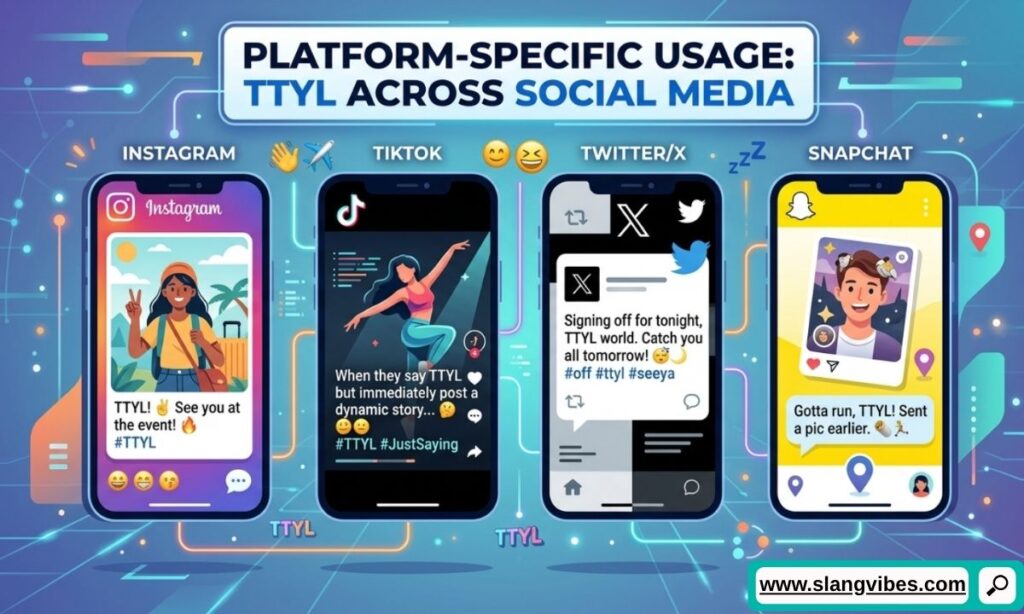
TTYL meaning in chat has stayed fairly consistent, but how it shows up shifts slightly depending on where it’s typed.
- WhatsApp: TTYL meaning on WhatsApp usually shows up at the tail end of a personal or family chat, often paired with a heart or wave emoji.
- Instagram DMs: TTYL meaning on Instagram tends to appear when someone is jumping to another app or heading offline mid-scroll.
- TikTok: TTYL meaning on TikTok pops up in comment sections and duets, often used more for humor than for a real goodbye.
- Snapchat: Common when someone is closing a Snap chat streak conversation but wants the streak (and the friendship) to continue.
- Facebook Messenger and SMS: The most traditional use case, closing out a standard text thread.
The core meaning barely changes across apps. What shifts is the tone, since a TikTok comment reads more casual and joke-driven than a private WhatsApp message to a parent.
TTYL Mean in Text 2026: Is It Still Used?
Some assume texting abbreviations like TTYL faded out once emojis and voice notes took over. This isn’t the full picture. Based on how the term shows up online today, TTYL still holds a steady place in everyday texting, particularly among people closing casual conversations quickly.
Gen Z tends to use it with a wink, sometimes ironically, sometimes layered with emojis to soften or add flavor to the tone. Millennials often use it closer to its original, straightforward sense: a polite, no-frills way to pause a chat. Either way, TTYL hasn’t disappeared. It sits alongside newer slang instead of being replaced by it.
TTYL vs Similar Texting Abbreviations
Comparing TTYL mean in text usage against its close cousins makes the differences easier to spot. TTYL belongs to a small family of sign-off acronyms, and mixing them up is easy to do. Each one signals a slightly different amount of time away.
| Abbreviation | Full Meaning | Typical Time Away |
|---|---|---|
| TTYL | Talk To You Later | Hours to a day or more |
| BRB | Be Right Back | A few minutes |
| GTG | Got To Go | Leaving now, no set return |
| TTYS | Talk To You Soon | Shorter gap than TTYL |
| TTFN | Ta-Ta For Now | Casual, similar to TTYL |
| AFK | Away From Keyboard | Short break, often gaming-related |
If someone is stepping away for a moment during a call or game, BRB fits better. If the conversation is properly wrapping up for the day, TTYL is the natural choice.
Read More: FYE Meaning in Text: What It Really Means in Messages (2026)
Is TTYL Rude? What TTYL Meaning in Text Implies
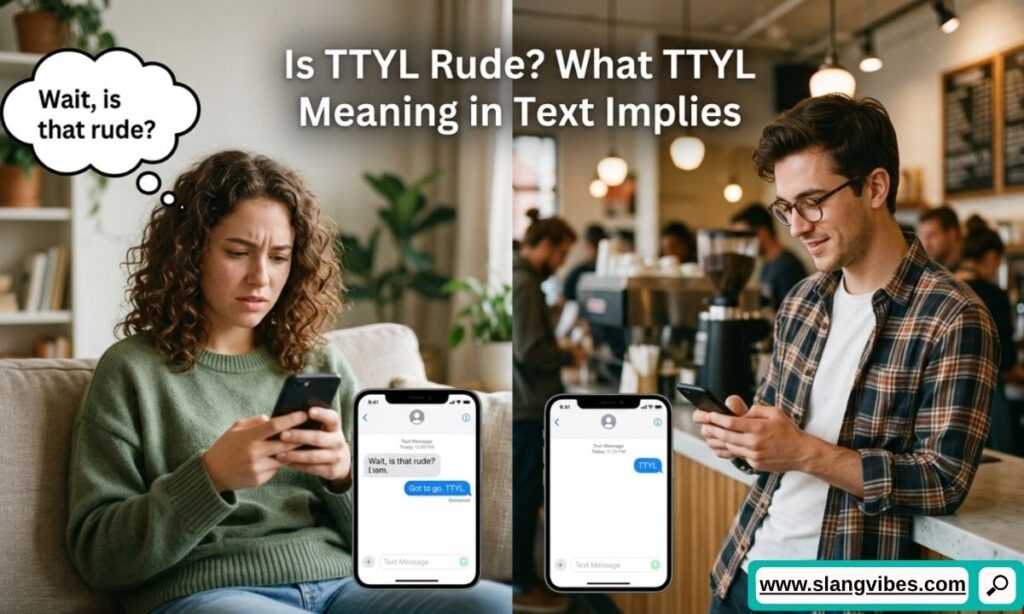
Understanding what TTYL mean in text situations feels like on the receiving end matters as much as knowing the definition. One of the biggest misreadings of texting slang happens right here. A dry “ttyl” with zero punctuation tends to feel abrupt, especially to someone unfamiliar with how casual digital shorthand reads on screen. The letters alone don’t carry warmth, so the words around them, or the emoji attached, end up doing the heavy lifting.
Timing plays a role too. A “ttyl” sent right after a heartfelt message, with no reaction to what was said, tends to sting more than one sent at the natural end of a conversation. The abbreviation itself hasn’t changed, but the moment it lands in shapes how it gets read.
Common Mistake: Treating a plain “ttyl” as a sign of disinterest. In most conversations, it’s simply an efficient way to pause, not a hint the sender wants to end things for good.
Context matters more than the abbreviation itself. “TTYL 😊” or “ttyl, this was fun!” reads warm and easy. A bare “ttyl” with no punctuation, sent mid-argument or right after an unanswered question, might land colder than intended. Tone in text depends heavily on what surrounds the acronym, not the acronym alone.
How to Respond to TTYL
Replying doesn’t need to be complicated, though a one-word “ok” tends to feel a little flat depending on the relationship. Here are natural ways to respond depending on who’s texting:
With a close friend: Friend: “Gotta run, ttyl!” Reply: “Sounds good, ttyl! 🙌”
With a crush or dating match: Match: “Dinner’s ready, ttyl 😏” Reply: “Enjoy! Excited to hear how it went, ttyl 😉”
With a sibling: Sibling: “Mom’s calling me, ttyl” Reply: “Lol ok, tell her I said hi. ttyl”
With a coworker (informal chat, not email): Coworker: “Heading into a meeting, ttyl” Reply: “No worries, catch you after. ttyl”
In a group chat: Friend 1: “Ttyl everyone, movie’s starting!” Friend 2: “Enjoy the movie! ttyl” Friend 3: “Save me a seat next time lol, ttyl”
A short, warm reply keeps the tone friendly without turning a quick sign-off into a long exchange.
Formal vs Informal: When to Skip TTYL
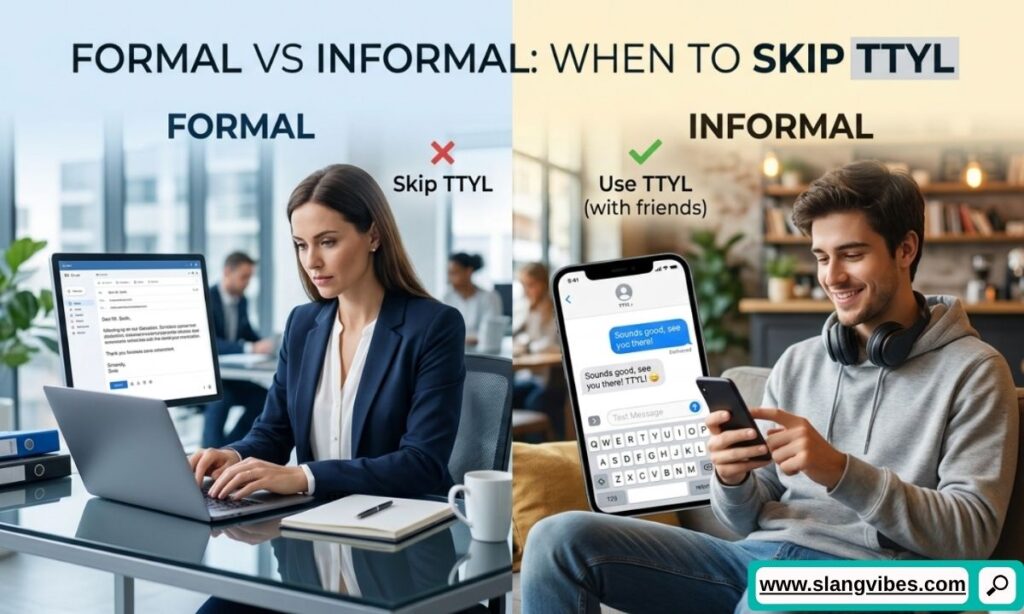
Knowing when to avoid TTYL mean in text writing matters as much as knowing how to use it. TTYL belongs firmly in casual territory. It’s built for friends, family, and easygoing group chats, not client emails, professional Slack threads, or job applications. In workplace messaging apps, “talk soon” or “chat later” reads far more polished while keeping a friendly tone.
Recruiters and hiring managers, in particular, tend to notice shorthand like this in application follow-ups or interview scheduling messages. A candidate texting “ttyl” to a recruiter risks coming across as underprepared, even if the intention was simply to sound relaxed and approachable.
Plenty of workplaces still have relaxed group chats where a quick “ttyl, heading to a call” between close teammates feels perfectly normal. The line usually comes down to the relationship and the platform, since a formal client email calls for spelled-out language, while a casual internal chat channel has more room for shorthand.
Read New Article: YH Meaning in Text Messages, TikTok, Snapchat & More
Frequently Asked Questions
The meaning stays the same regardless of who sends it. “Talk to you later” doesn’t shift based on gender. Only the tone around it, emojis, punctuation, timing, hints at whether it’s platonic, playful, or flirty.
Not typically. It usually signals a pause, not a fade-out. Reading too much into a short sign-off often leads to unnecessary overthinking.
Yes, and it’s fairly common there. On dating apps, TTYL often carries a light, flirty undertone, especially when paired with a winking emoji or a playful comment.
TTYL (talk to you later) usually implies a longer gap, hours or a full day. TTYS (talk to you soon) suggests a shorter break, often only a few minutes to an hour.
It’s best avoided in formal emails or professional documents. For casual internal messaging with close coworkers, it’s generally fine, though “talk soon” reads more polished if there’s any doubt.
Bottom Line
TTYL has stuck around for decades because it does exactly what it promises: a quick, friendly way to pause a conversation without sounding cold. Whether it shows up on WhatsApp, a TikTok comment, or a late-night group chat, the meaning barely changes, even as the platforms around it keep shifting. Next time this three-letter sign-off lands in an inbox, there’s no need to overthink it. It simply means someone will be back.

Alex Carter is a language enthusiast and internet culture expert at SlangVibes. He explains the latest slang terms and text meanings in simple, clear English so everyone stays in the loop.