Last month, my friend Dana texted me a photo of a $40 appetizer. The caption read, “yolo.” I stared at my screen for a full minute. Was she bragging, joking, or asking me to talk her out of it? I only knew the word as a 2012 relic. The moment sent me digging into the yolo meaning in text, and the answer turned out to be more interesting than the acronym. YOLO still shows up in chats, captions, and comments every day. Its tone shifts depending on who sends it. Here’s the plain-English breakdown, plus how to read it and reply. Stick around and you’ll know exactly what to type back.
Read Also: Soft Launch Meaning: Why Everyone Is Doing It on Social Media
YOLO Meaning in Text: The Short Answer
YOLO stands for “you only live once.” People type it to say life is short, so take the chance. It usually follows a bold, silly, or slightly impulsive choice.
Here’s the thing. The acronym is easy. The tone is where people get tripped up. A friend who texts “booked the trip, yolo” sounds thrilled. A friend who texts “stayed up till 4 a.m., yolo” sounds amused at their own bad decision.
The yolo meaning in text usually falls into one of three buckets:
- Encouragement: “Go for it, yolo.”
- Celebration: “Bought the concert tickets. yolo.”
- Joke: “Ate cereal for dinner. yolo.”
Think of it as a shrug with a smile. The sender is saying, “I know this looks unwise, but I’m doing it anyway.” The word packs a whole attitude into four letters, which is why it spread so fast.
You will usually see it in lowercase, often with a period or no punctuation at all. A bare “yolo” feels relaxed. Capital letters and extra exclamation points signal more energy. Sometimes they signal more sarcasm instead. Context decides which one you’re reading.
Sometimes YOLO stands alone as a full reply. A friend posts a photo of a wild purchase, and your whole answer is “yolo.” Nobody needs more. The word carries the cheer, the teasing, and the shared understanding in one short beat.
The short answer is simple: YOLO means seize the moment. Everything else is tone, and the rest of this guide breaks the tone down piece by piece.
Where YOLO Came From and Why It Stuck
Understanding the yolo meaning in text starts with a quick look at where the phrase began. The idea is much older than the acronym. People have urged each other to live fully for generations, and “carpe diem” is the classic example.
A 2006 song by The Strokes carried the exact words “You Only Live Once” in its title. The acronym reached a much bigger audience in 2011, when Drake released “The Motto.” The song’s chorus helped carry YOLO onto Twitter, Tumblr, and Instagram captions. Drake did not invent the phrase. He is the artist most people connect with its spread.
Soon the word showed up everywhere. People used it for road trips, haircuts, and extra fries. By 2013, The Lonely Island had released a parody song called “YOLO.” A parody usually signals a phrase has become a shared joke. A song title, a hit single, and a parody show how quickly a simple phrase travels.
Here’s why it stuck. The acronym is short, easy to type, and easy to say out loud. It also fits any situation, from a skydiving trip to a second helping of dessert. Those traits make slang travel fast.
Over time, the meaning softened. Based on how the term is typically used online, many people now say it with a wink instead of a straight face. This shift explains why one word hits so differently from one chat to the next.
Read Also: Sans Meaning in Text: Slang Definition & Examples
How People Use YOLO in Text Messages and DMs
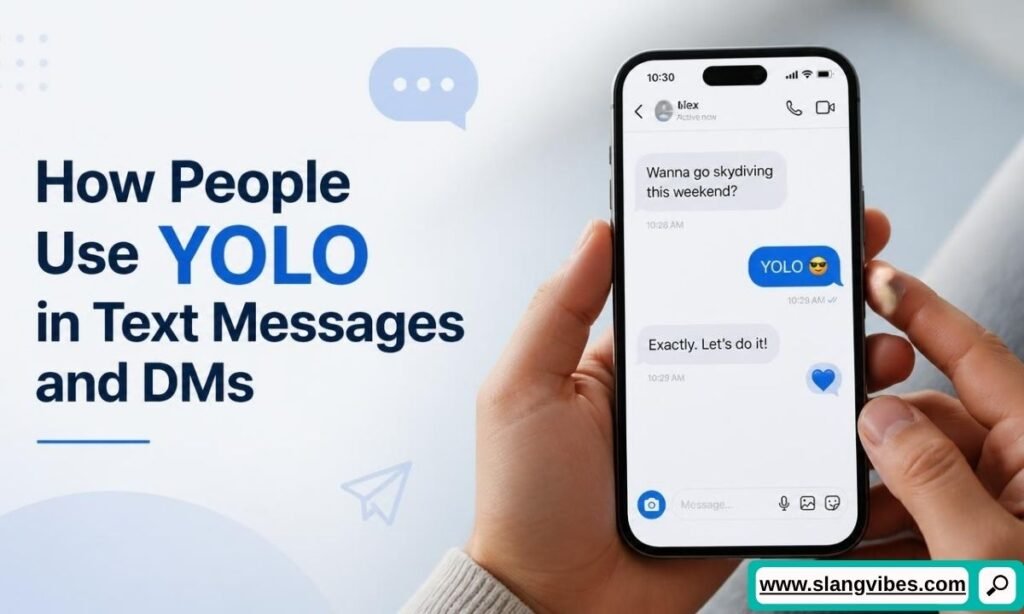
Most of the action happens in casual one-on-one chats and group threads. Someone shares a plan, a purchase, or a questionable idea. A friend replies with YOLO to cheer them on. The yolo meaning in text works as a quick vote of confidence.
Here’s a typical exchange between friends:
Jordan: Thinking about getting the tickets. They’re $180 each.
Sam: Do it. yolo.
Jordan: My bank account disagrees.
Sam: Your future self will thank you at the show.
Siblings tend to use it with extra teasing:
Maya: I cut my own bangs.
Leo: Bold. How bad is it?
Maya: Crooked. yolo.
Leo: Sending you my barber’s number.
Notice how the word works in each chat. In the first, it pushes someone toward a choice. In the second, it labels a choice already made.
Group chats add another layer. One person floats a last-minute plan, and three friends reply “yolo” in a row. The word turns into a group vote. Nobody needs it explained.
How to Reply to YOLO
Match the sender’s tone. A reply fitting the mood keeps the conversation easy. Answer quickly when the message is playful. Slow down when the sender sounds unsure.
- Playful: “Yolo until the bill shows up.”
- Supportive: “Go for it. Tell me how it goes.”
- Cautious: “Sleep on it first, then decide.”
Skip the lecture. A short reply lands better than a paragraph about risk.
YOLO Meaning on TikTok, Instagram, and Snapchat
The yolo meaning in text carries over to social media, but each platform adds its own flavor. Captions and comments run short, so the word often does more work.
On TikTok, picture a creator posting a clip of a spontaneous haircut. The caption reads “no plan, yolo.” Viewers reply in the comments with “yolo energy,” a phrase for bold, carefree behavior.
Instagram leans toward adventure. Imagine a travel carousel from a one-way trip, captioned “bought the ticket, yolo.” The word signals a willingness to leave the routine behind.
Snapchat keeps things looser. Think of a story showing a late-night drive-through run, captioned “second dinner, yolo.” The tone stays playful, and nobody expects a life lesson.
People also turn the term into a verb. Someone might write “I yolo’d the whole outfit” after skipping the planning stage. Others say “yolo mode” when they act without overthinking. Both versions keep the same spirit: act first, worry later.
Comment sections follow their own pattern. Someone posts a risky stunt, and the top replies pile on with “yolo.” Others answer with jokes about the odds. The tone stays light because everyone knows the format.
Reading the platform helps. A caption under a polished travel photo expects admiration. A comment under a chaotic video expects laughter. The same word earns two different reactions. Keep the caption short, and the joke lands faster.
Read More Articles: DRS Meaning in Chat: What It Really Means in Text, Snapchat & Social Media (2026)
YOLO Text Meaning: Sincere, Ironic, or Sarcastic?
The same four letters carry three different moods. Punctuation, emoji, and the size of the decision give you the clues you need. This table shows how the tone shifts.
| Example | Meaning | Tone/Vibe |
|---|---|---|
| “Quit my job today. yolo.” | A real brag or real encouragement | Sincere, bold |
| “Ate the whole pizza. yolo.” | Joking about a small indulgence | Playful, ironic |
| “Replied all by mistake. yolo 💀” | Laughing at an accident | Self-mocking |
| “Sure, yolo. Enjoy the debt.” | Mocking someone’s choice | Sarcastic |
| “yoloooo, see you at the airport” | Pure excitement | Hyped |
Spelling gives more clues. A stretched version like “yoloooo” signals excitement. A capitalized “YOLO.” with a full stop often sounds deadpan.
Emoji pairings help too. A sunglasses emoji points to confidence. A skull or crying-laughing emoji points to someone laughing at themselves. An upside-down smiley often signals sarcasm.
Size matters as well. A big decision paired with a sarcastic YOLO usually comes from a worried friend, not a cheerleader.
Here’s how it looks in a dating chat:
Priya: Should I text him first?
Ava: Do it. yolo.
Priya: Okay, sending it now.
Ava: Now put the phone down and breathe.
Ava means it sincerely, and the lowercase spelling keeps it light.
Now flip the scene. If Ava had typed “sure, yolo.” with a flat full stop, Priya would hear doubt. The words stay identical. Only the delivery changes, and delivery carries the mood.
YOLO Meaning in Text for Gen Z vs. Millennials
Age shapes how people hear the word. Millennials remember the yolo meaning in text from its first run in the early 2010s. Many of them use it with a nostalgic wink. Younger Gen Z readers often meet it as retro slang, and some find it a little cringe. This reaction is common, based on how the term is typically used online.
A few first-person scenarios show the gap:
- If I text my college friends “yolo” after splurging on dessert, they laugh because everyone remembers 2012.
- If my younger cousin sends it with a skull emoji, I assume she’s joking about how old the word sounds.
- If a coworker my age drops it in a Friday group chat, I read it as a joke about leaving early.
Parents, teachers, and older coworkers sometimes pick it up too. It’s common to see them use it with a self-aware grin, as if they know the word has a past.
Where you live matters less than your age. In both the US and the UK, the term usually reads as casual. People understand it, and nobody expects it in formal writing.
Is it outdated? The word feels dated, yet people still use it on purpose to sound playful. Think of it like a retro jacket. Some wear it seriously, others wear it as a joke, and both groups know exactly what they’re wearing.
Read New Articles: GL Meaning in Text: What Does GL Mean in 2026?
When Not to Use YOLO, and Mistakes to Skip
Some situations call for a different word. Skip YOLO when the topic is serious money, health, safety, or someone’s feelings. A friend weighing a loan does not want a slogan. They want real input.
Work chats need care too. The yolo meaning in text suits friends and group jokes. It reads as careless in formal emails or client messages.
Timing matters too. Avoid YOLO right after bad news, a loss, or an argument. The word sounds dismissive when the mood is heavy. Before you send it, ask one question. Will the reader laugh or wince?
Chris: Should I tell the client the deadline slipped?
Nora: Please don’t send “yolo” to the client.
Chris: Fair. I’ll write a real update.
Common Mistake: Replying “yolo” to a friend who is clearly nervous. Their message likely asks for support, not a cheer. Ask what’s worrying them first.
Overuse is another slip. One YOLO in a chat feels fun. Five in a row feel forced. A newer contact might also need a quick explanation, so keep the joke easy to follow.
YOLO vs. FOMO and Similar Slang
These terms sound alike but work differently.
- FOMO: fear of missing out. It describes anxiety, not a choice.
- Carpe diem: Latin for “seize the day.” It sounds formal and classic.
- No regrets: a calm, determined way to say you’d do it again.
- Send it: casual US slang for going all in without hesitation.
Read New Article: WBY Meaning in Text: What It Really Means in Chats & Social Media (2026 Guide)
YOLO Meaning in Text: FAQs
What does YOLO stand for in texting?
YOLO stands for “you only live once.” People type it to cheer on a bold choice or joke about a small one. It started as a catchphrase in the early 2010s and still shows up in chats today.
Is YOLO still used in 2026?
Yes, though mostly with a wink. Based on how the term is typically used online, many people say it ironically or nostalgically. You’ll mostly see it in jokes about small indulgences.
How do you reply when someone texts YOLO?
Match their tone. Try “go for it” for excitement, a joke for humor, or “sleep on it” for risky plans. A short, relaxed reply works better than a long one.
Is YOLO sarcastic or serious?
It might be either. Punctuation, emoji, and the size of the decision tell you which, so read the yolo meaning in text with all three in mind.
What’s the difference between YOLO and FOMO?
YOLO encourages action because life is short. FOMO is anxiety about missing something others are doing. YOLO is the push, and FOMO is the worry.
The Bottom Line on YOLO in Texts
Here’s the short version. YOLO means “you only live once,” and the yolo meaning in text comes down to one idea: take the chance while it’s in front of you. The acronym stays the same everywhere. The tone changes with the sender, the platform, and the size of the decision.
A friend celebrating a spontaneous trip means it sincerely. A friend admitting to a third slice of pizza means it as a joke. A coworker typing it in a client email likely needs a quick conversation.
Younger readers might see the word as retro, and older readers might remember its first run. Both groups still understand it, which says a lot about how far one catchphrase traveled.

Alex Carter is a language enthusiast and internet culture expert at SlangVibes. He explains the latest slang terms and text meanings in simple, clear English so everyone stays in the loop.