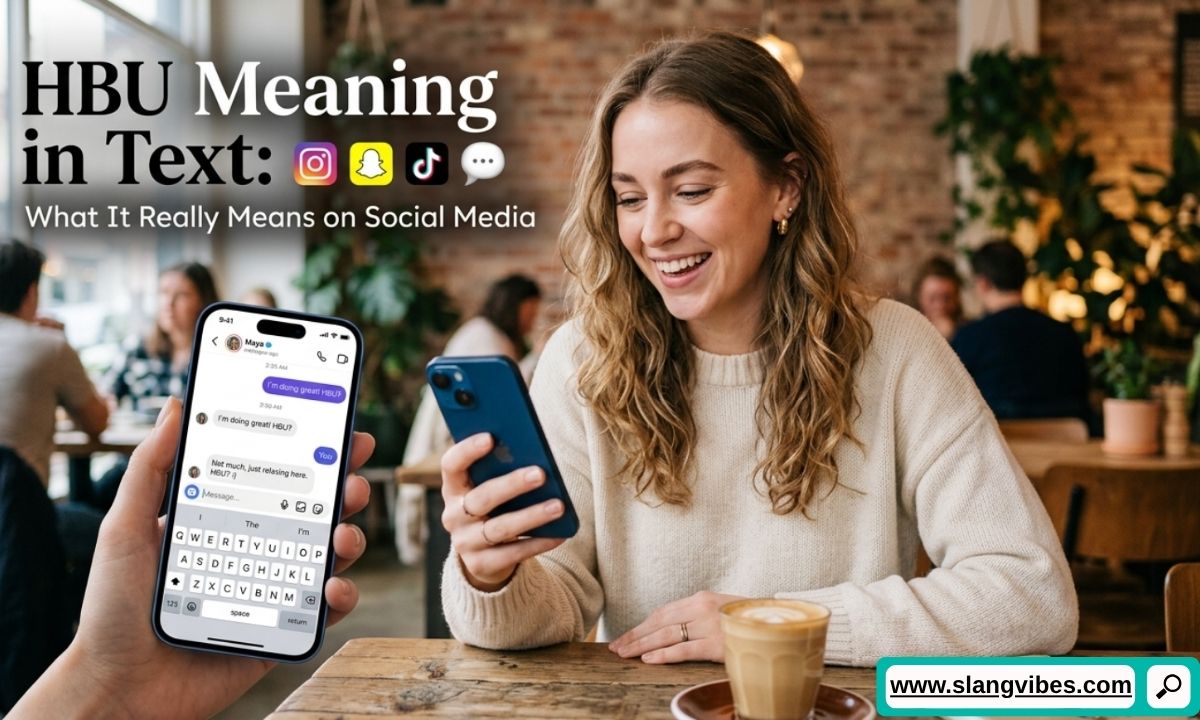
The first time I saw “HBU” pop up in a text, I froze. A friend had texted me about her weekend plans and ended it with “HBU?” I sat there for a solid minute, staring at my phone, wondering if it was a typo or some new phrase I’d completely missed. I didn’t want to look clueless, so I typed back something vague and hoped for the best. Sound familiar? If you’ve ever been confused by HBU meaning in text, you’re definitely not alone. This guide covers everything, from what it means and where it came from, to how to use it and when to skip it altogether.
What Does HBU Mean in Text? The Simple Definition
HBU stands for “How About You?” It’s one of those texting abbreviations that feels obvious once you know it, but completely baffling before you do. People use it to flip a question back to the person they’re talking to, keeping the conversation moving without typing out a full sentence.
Quick Answer: HBU = “How About You?” It’s a casual way to ask someone the same question they just asked you, or to check in on their thoughts and feelings.
So when someone says, “I’m having a great Monday, HBU?” they’re simply asking how your Monday is going. That’s it. No hidden meaning, no secret code.
HBU meaning in text fits perfectly into the modern texting culture built around speed and ease. Think of it this way: nobody wants to write “And how are you doing on this fine Tuesday?” when three letters do the same job. As digital communication became the norm, texting shortcuts like HBU spread fast because they keep chats feeling natural and light.
Here’s a quick look at what HBU means across different tones:
| Context | What It Feels Like |
|---|---|
| “Feeling great today! HBU?” | Friendly, casual check-in |
| “Just got back from the gym. HBU?” | Sharing an update, inviting conversation |
| “That movie was amazing, HBU?” | Asking for an opinion |
| “So stressed with work. HBU?” | Venting and seeking connection |
The short answer is that HBU works in almost any casual conversation where you want to turn the spotlight back on the other person.
Where Did HBU Meaning in Text Come From?
To understand HBU meaning in text, it helps to look at how internet slang terms got started in the first place. Back in the early days of SMS messaging, texting cost money per character. So people got creative fast. Shortened phrases like LOL, BRB, and OMG took over because they saved time and space on those tiny phone keyboards.
HBU followed the same path. As platforms like AIM (AOL Instant Messenger) took off in the early 2000s, online chat slang exploded. People wanted to keep conversations flowing without slowing down to write full sentences. HBU fit that need perfectly because it answered and asked at the same time.
When smartphones arrived and apps like WhatsApp, Snapchat, and Instagram became everyday tools, HBU meaning in text traveled right along with them. The phrase moved from SMS threads into social media DMs, comment sections, and story replies. By the time Gen Z started dominating TikTok, HBU was already a firmly planted part of modern internet language.
What’s interesting is that even as messaging apps added voice notes, GIFs, and reactions, people still kept typing HBU. Some online conversation abbreviations stick around because they feel human. HBU is one of them.
Read more : What Does KK Mean in Text? How People Use It on Snapchat and TikTok
How HBU Meaning in Text Shows Up in Real Conversations
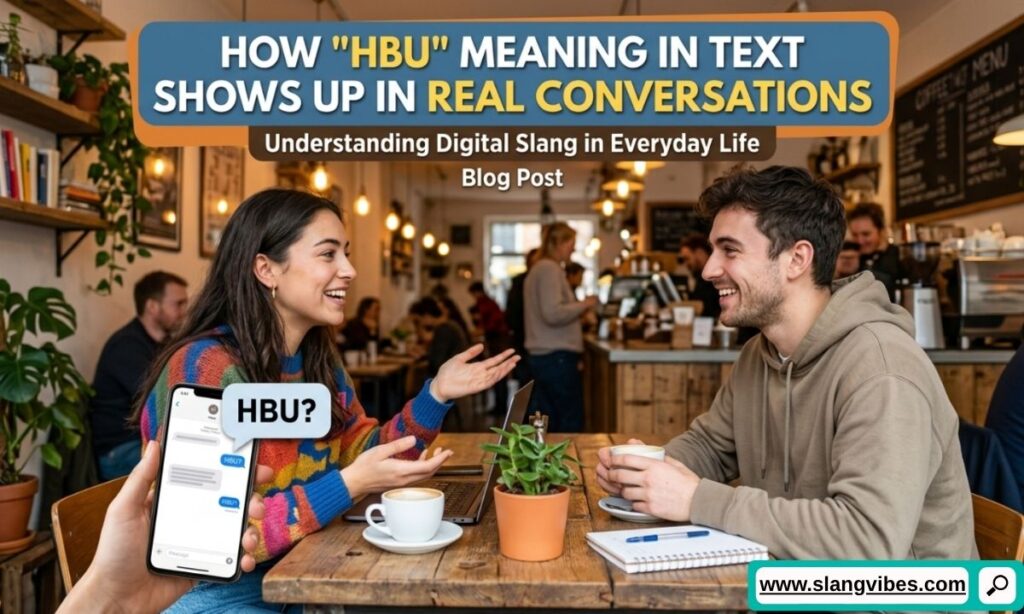
Seeing HBU in action makes it way easier to understand. The following examples show how naturally it fits into everyday chat exchanges. Notice how each one keeps the dialogue going without any awkward pauses.
Example 1: Catching Up with a Friend
Alex: “Finally finished that project I’ve been stressing about for weeks!” Jamie: “No way, that’s such a relief! HBU, anything exciting going on with you?”
2: A Simple Monday Check-In
Sam: “Honestly having the best coffee of my life right now. HBU?” Taylor: “Ha! I’m on my third cup and still half asleep.”
3: After Sharing News
Morgan: “Just booked flights to Mexico! HBU, any trips planned?” Riley: “I wish. Work has been nonstop. Living through you right now.”
4: Reacting to Something
Casey: “That episode completely wrecked me. HBU?” Jordan: “Same. I didn’t see that ending coming at all.”
Now Example 5: Low-Key Check-In
Pat: “Staying in tonight, ordering pizza. HBU?” Drew: “Same honestly. Let’s sync up and watch something.”
Each of these shows how HBU meaning in text works as a natural bridge. It invites the other person to share without putting pressure on them.
Read New Article: NGL Meaning in Text: What It Really Means + Examples (2026)
HBU Meaning in Text Across Social Media Platforms
HBU shows up slightly differently depending on which platform you’re on. While the meaning stays the same, the vibe shifts based on the app.
On Snapchat, HBU often appears in streaks or quick snap replies. Since Snapchat is built around fast, informal exchanges, it’s one of the most natural homes for Snapchat slang like HBU. Someone sends a selfie with a caption like “lazy Sunday, HBU?” and expects a similar quick response.
On Instagram, HBU pops up in DMs and story replies. Instagram texting slang tends to be a bit more polished than Snapchat, but HBU still fits right in. You’ll often see it in reply to someone’s story about their weekend or a food post.
On TikTok, HBU shows up in comments and DMs. TikTok slang terms move fast, and HBU has aged well there. Creators sometimes end captions with HBU as a way to spark comments. “I always cry at this part. HBU?” pulls people into the conversation.
On WhatsApp, HBU is a staple. WhatsApp abbreviations like HBU are everywhere in group chats and one-on-one threads, especially among friends and family catching up across time zones.
HBU Meaning in Text on Dating Apps and Flirty Chats
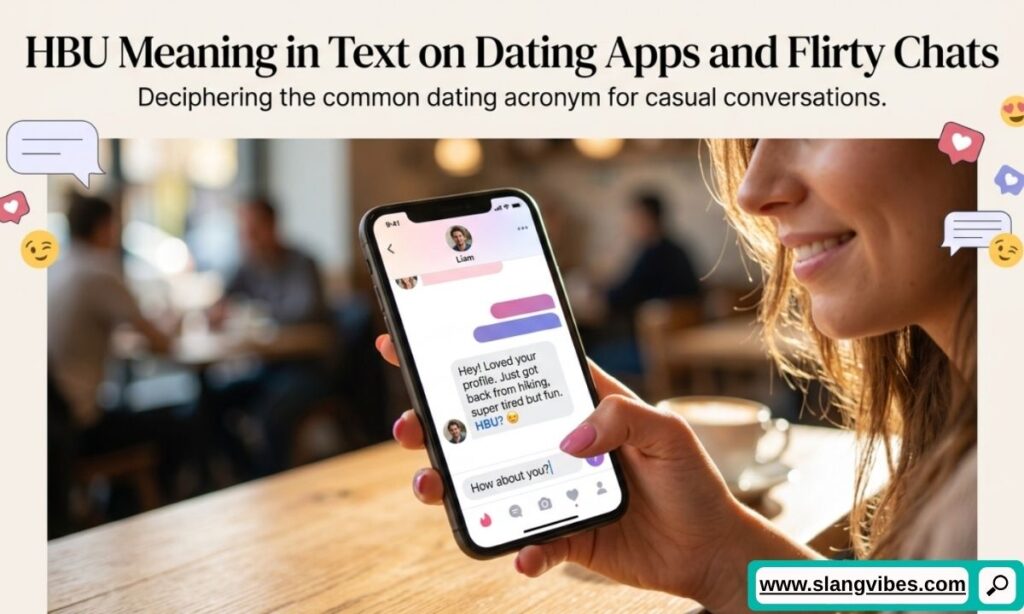
Here’s where things get a little more interesting. HBU meaning in text shifts slightly when it shows up on dating apps like Tinder, Bumble, or Hinge. On these platforms, it’s often used as a conversation opener or a way to show genuine interest after sharing something about yourself.
Say someone writes in their opening message: “I’m obsessed with hiking and bad reality TV. HBU?” That HBU isn’t throwaway. It’s an invitation to connect over shared interests.
The tone matters a lot here. Compare these two examples:
Read Also : PFP Meaning in Text: What It Means on Social Media
| Message | Feeling |
|---|---|
| “Just got out of work, exhausted. HBU?” | Casual, low-pressure, friendly |
| “Tonight is wide open. HBU? 😏” | Flirty, suggestive, inviting plans |
On dating apps, HBU works because it keeps the energy light. Nobody wants to answer a deep, intense question from a stranger right away. A quick HBU feels warm without being overwhelming. It says, “I’m interested in you,” without making things awkward.
HBU vs. WBU: What’s the Difference?
People mix these two up all the time, so it’s worth clearing up. HBU and WBU both invite the other person to share, but they feel slightly different in practice.
HBU (How About You?) is broader. You use it to ask about someone’s general situation, feelings, or day. WBU (What About You?) tends to be more specific. It often follows a preference or opinion and asks the other person to weigh in on the same thing.
Here’s how that plays out:
| Situation | Best Choice |
|---|---|
| “I’m doing well today, HBU?” | HBU: asking generally how they are |
| “I like pineapple on pizza. WBU?” | WBU: asking for their opinion on the same thing |
| “HBU, anything new going on?” | HBU: open-ended check-in |
| “I chose the blue one. WBU?” | WBU: asking what they chose |
Other similar chat acronyms include NMU (Not Much, You?), HWU (How Was/Were You?), and WDYT (What Do You Think?). Each one has its own lane, but HBU meaning in text stays the most versatile of the group. It works in almost every casual situation without sounding off.
Read More Articles: EVB Meaning in Text: What It Means and How People Use It (2026)
How to Reply to HBU in Text Without Sounding Awkward
So someone sends you HBU. Now what? Replying is easier than it seems once you know the formula. The goal is to keep the conversation going naturally.
The simplest approach is to answer the implied question and then reflect it back if you want to keep things going. You don’t have to use HBU in return though. Mix it up.
Here are some natural ways to reply:
- “I’m doing pretty well, thanks! Had a quiet day.”
- “Honestly, not great today. Work has been a lot. You?”
- “Good! Just got back from a run, feeling productive.”
- “Same as you, totally wiped. We should compare notes.”
- “Better now that you asked.”
If the context is flirty, your reply sets the tone. Keep it warm and open. If it’s a casual friend, match their energy. And if you’re not sure who the person is or the relationship is new, a short and friendly reply works every time.
What you want to avoid is leaving it on read or sending back a one-word “fine.” That kills the conversation. The whole point of HBU meaning in text is to keep things moving.
Read More Articles : What Does WSP Mean in Text? Real Meaning in Chat & Social Media
When HBU Meaning in Text Doesn’t Belong
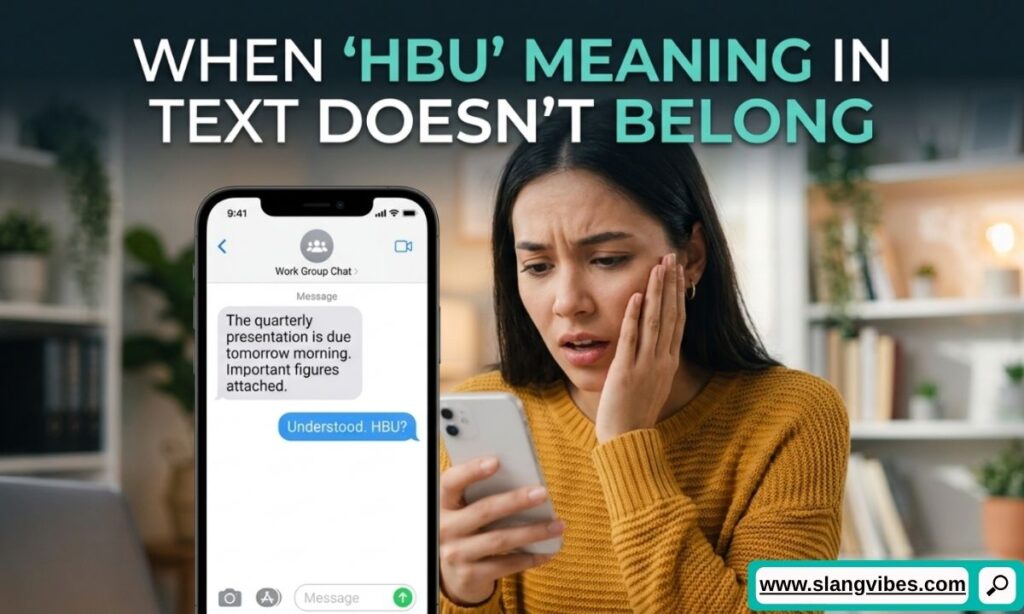
Even though HBU works great in casual digital communication, there are places where it sticks out like a sore thumb.
Professional settings are the clearest example. If you’re emailing a client, writing to your manager, or messaging someone in a formal work context, HBU has no place there. It makes you come across as unprepared or unaware of the context.
The same goes for sensitive conversations. If someone texts you that they’re going through something hard, replying with “HBU?” feels dismissive. In those moments, write it out. Show up fully.
Here’s a simple rule: if you’d say it in a meeting or a cover letter, skip HBU. If you’re texting a friend, a date, or a close colleague in a laid-back chat, HBU fits right in. Knowing when to use social media slang is part of good digital communication.
HBU in Pop Culture, Memes, and Gen Z Humor
HBU meaning in text has made its way well beyond private messages. It shows up in memes, Twitter jokes, and TikTok trends in ways that are equal parts funny and relatable.
One popular meme format involves someone describing a chaotic or dramatic situation and ending it with “HBU?” as if their life falling apart is a casual conversation starter. The joke lands because HBU implies normalcy while the situation described is anything but.
Gen Z humor loves this kind of contrast. It’s the same energy as replying “good” to someone asking how you are when you’re absolutely not good. HBU carries that same dry, self-aware tone when used in meme culture.
On TikTok, creators sometimes use HBU as a caption hook to pull comments. It’s a low-effort way to start conversation while making followers feel included. That’s part of why internet slang terms like HBU have real staying power. They’re functional and funny at the same time.
Read New Article: WTW Meaning in Text: What It Means on TikTok, Snapchat & Instagram (2026)
Frequently Asked Questions
HBU stands for “How About You?” People use it in casual texts and chats to ask the other person about their thoughts, feelings, or situation after sharing their own.
They’re similar but not identical. HBU is a general check-in, while WBU (What About You?) usually asks for a specific opinion or preference on the same topic being discussed.
Keep it simple and match the energy of the conversation. A short answer about how you’re doing, followed by a follow-up question or comment, keeps the chat flowing naturally.
No. HBU is informal and belongs in casual chats with friends, family, or close contacts. In professional emails or work messages, write out “How are you?” or “How about you?” in full.
The meaning stays the same, but the tone shifts. On dating apps, HBU often signals genuine interest and invites the other person to share about themselves, which helps build early conversation.

Alex Carter is a language enthusiast and internet culture expert at SlangVibes. He explains the latest slang terms and text meanings in simple, clear English so everyone stays in the loop.