Last spring, I spotted “MA (Cantab)” after a coworker’s name on a team page. I assumed someone had mistyped a software tool. So I asked her, and she grinned. The Cantab meaning is simple: she studied at the University of Cambridge. What surprised me was the backstory. This word started as casual student chatter in the 1700s, long before it landed on résumés, signatures, and Instagram bios. Now you’ll see it beside graduation caps and book emojis all over the internet. Here’s what it means, where it comes from, and how to use it without sounding like you’re bluffing. Stick around, because the truth behind those six letters is better than the myth.
Read Also: EMP Meaning in Text: Platform-by-Platform Guide
Cantab Meaning: The Short Answer
The Cantab meaning comes down to one idea: someone who studied at the University of Cambridge in England. The word covers current students and graduates alike. Say it KAN-tab, with the stress on the first syllable.
Cantab is a clipping, which means people chopped a longer word short. The long version is Cantabrigian, which comes from Cambridge’s Latin name. Cantabrigiensis is the Latin adjective for “of Cambridge,” and you’ll meet it in formal writing. Print often adds a period, as in “Cantab.” The tone stays proud but formal. Nobody treats it as an insult.
The word works two ways. As a noun, “a Cantab” means one person. As a tag, it follows a degree title.
Most people never say it out loud. You’ll spot it in writing, usually in a bio, a headline, or a signature line. Think of it as a tiny label for a school, like a college hoodie in text form. Two friends might puzzle over it like this.
Mia: Why does his bio say “Cantab 🎓”?
Leo: It means he went to Cambridge.
Mia: Oh, I thought it was a username.
Leo: Plenty of people guess the same thing.
Whoever uses the word wants to signal a background without a long explanation. It carries pride, and sometimes a little show-off energy too. Read the context, and you’ll catch the mood.
Where Cantab Comes From
Where Cantab comes from is a story about Latin and shortcuts. Medieval Latin called Cambridge Cantabrigia. English speakers turned the name into Cantabrigian, an adjective meaning “of Cambridge,” by the 1540s. Then somebody got tired of saying all those syllables.
The city’s own name has a tale too. Old English speakers called it Grontabricc, a bridge over the River Granta. Norman influence later shifted the sound toward Cante and then Cam.
The short form shows up in writing by 1750. One early example appears in a novel about a pet lapdog, where a young Cantab arrives in London. Lord Byron used the word too, in his long poem Don Juan, which he wrote in the early 1800s. Dictionaries label it colloquial, which tells you something. Cantab began as casual student talk.
Picture a student in the 1700s writing home to a cousin. He wouldn’t bother with the full Latin adjective in a chatty letter. He’d write Cantab and move on. Short words save ink and time, and students have always loved shortcuts. The Cantab meaning stayed steady for more than 270 years, but its setting changed.
Fun Fact: Byron used the word alongside “wooden spoons,” a joking name Cambridge students gave to the lowest honors in a degree.
It started with a wink, and some of the tone survives today.
Read More Articles: What Does WSP Mean in Text? Real Meaning in Chat & Social Media
How Cantab Works After a Degree
Formal writing gives the Cantab meaning its most official job. The word sits in parentheses after a degree, which tells readers where the degree came from. Oxford Learner’s Dictionary shows the pattern with “MA (Cantab)” after a name.
Here’s the thing about the MA. It surprises plenty of people. Cambridge lets BA holders receive the MA at least six years after their first term of residence. No extra coursework is required. Cambridge’s own library glossary says the MA isn’t a postgraduate qualification in the usual sense. So “MA (Cantab)” doesn’t always mean someone spent two more years in a classroom. Oxford and Dublin follow a similar custom, so the same waiting-period logic applies there.
The table below shows the common patterns.
| Written form | What it tells you |
|---|---|
| BA (Cantab) | A Cambridge bachelor’s degree |
| MA (Cantab) | A Cambridge MA, usually after a waiting period |
| PhD (Cantab) | A research doctorate from Cambridge |
Imagine reading a conference speaker bio with “MA (Cantab)” beside the name. You’d know the school. You wouldn’t know whether the person studied beyond a first degree. Some writers poke fun at the habit, but plenty of people simply follow the traditional format.
Casual use works differently. A bio might say Cantab with no parentheses and no degree letters at all. Formal pages keep the brackets. Social posts drop them.
Read New Articles: TT Meaning in Text Messages and Social Media (2026)
Cantab Meaning on TikTok, LinkedIn, and Instagram
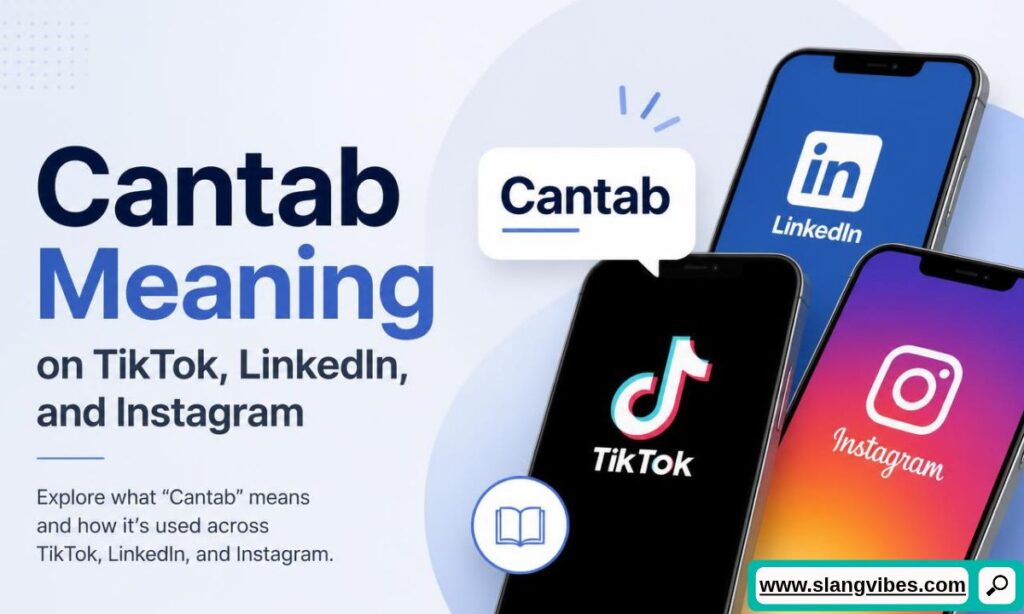
The Cantab meaning stays steady across platforms, but the tone shifts. On LinkedIn, Cantab shows up in headlines and name lines as a quick credential. On Instagram, it’s common to see it in graduation captions beside a cap emoji. TikTok bios often pair it with books and tea mugs, a nod to dark academia style. A short caption such as “Cantab, class of 2026” does the same job in far fewer letters than a full school name.
Gen Z and Millennial habits
Younger users tend to treat Cantab as an aesthetic tag. Millennials, based on how the term is typically used online, lean toward the professional version with degree letters. Both groups use it to save space, since six letters beat a full school name in a tight bio. Here’s a group chat example.
Ava: Did you see Noor’s new bio?
Dan: The “Cantab” thing?
Ava: Yep. She finally graduated.
Dan: I’m putting a 🎓 under her post.
UK and US readers
UK readers meet the word on CVs, staff lists in school prospectuses, and old family letters. US readers usually see it online first, so it often feels like a puzzle. A Brit might shrug at “MA (Cantab).” An American might stop and search.
Priya: Your email signature says MA (Cantab). Is it a typo?
Chris: Nope, it means Cambridge.
Priya: Wow, I’ve seen it for years and never asked.
Chris: Everyone asks eventually.
Read Also: HG Mean in Text: What It Really Means in Messages (2026)
Does Cantab Mean Harvard Too?
Does Cantab mean Harvard too? In older usage, yes. Green’s Dictionary of Slang and Wiktionary both list a second sense. It covers a student or graduate of Harvard, which sits in Cambridge, Massachusetts. The Cantab meaning in old American writing included both schools.
Green’s even cites a New York magazine, the Knickerbocker, describing a character who was made a cantab at Harvard. The hint shows how the nickname traveled across the Atlantic along with the town’s name.
The link has a clear history. Etymonline notes the Massachusetts town took the name Cambridge in 1638, after the founding of Harvard College there. John Harvard himself graduated from Cambridge in England. Early American writers had a reason to borrow the English nickname for their own scholars.
Modern speech has moved on. Based on how the term is typically used online, Cantab almost always points to England today. Harvard grads say Harvard, and nobody blinks. Picture yourself at a dinner party in Boston. You say “I’m a Cantab,” and half the table assumes Cambridge, England, while one guest wonders about Harvard. A quick clarification solves it.
Here’s a safe habit. Write out the school name the first time, then use Cantab later if you like. Readers outside the UK won’t guess the shorthand. It keeps every reader on the same page, whichever Cambridge you mean.
Read New Articles: NTY Meaning in Text (2026): What It Means and How to Use It ⭐
Cantab vs Oxon and Other Look-Alike Terms
Cantab has a few look-alikes, and mixing them up happens fast. The table below sorts them out.
| Term | Meaning | Tone/Vibe |
|---|---|---|
| Cantab | Cambridge student or graduate | Proud, formal |
| Oxon | Oxford graduate, short for Oxoniensis | Proud, formal |
| Cantabrigian | Full form of Cantab | Old-fashioned, polished |
| Cantabrian | Someone from Canterbury, New Zealand, or Cantabria, Spain | Neutral, geographic |
| CANTAB | A Cambridge computerized cognitive test battery | Technical |
The spelling trap is real. Two extra letters turn Cantab into Cantabrian, and the meaning jumps to a different place entirely. Gardeners even know Cantab as a blue-flowering Muscari variety. The all-caps CANTAB belongs to a research testing tool, so context usually settles which one you’re reading.
Cantabrigian, the long form, turns up in older prose and formal writing. Oxon is the Oxford twin, and it appears in the same spots, such as “MA (Oxon)” after a name. Oxbridge ties the two schools together, which explains why Cantab and Oxon often appear side by side. Siblings love to tease each other about it. Each term points to a different school, place, or tool.
Tess: My brother says “Oxon” sounds cooler than “Cantab.”
Ben: Of course he does. He went to Oxford.
Tess: And you went to Cambridge, so you’d disagree.
Ben: Obviously. Cantab wins.
The Cantab meaning always points back to Cambridge, so checking the school name settles any mix-up.
Read New Articles: ISTG Meaning in Text: How People Use It in Chats and Social Media
When Not to Use Cantab (and Common Mistakes)
Knowing the Cantab meaning also means knowing its limits. Skip the word in these situations.
- You didn’t attend the University of Cambridge.
- You’re chatting with friends at a party.
- You want to sound smart in a text thread.
- You’re writing for readers outside academic circles.
Each point comes down to honesty and tone. Using a degree tag you didn’t earn misleads people, and readers notice when a tag doesn’t match a person’s story. Saying “I’m a Cantab” out loud sounds stiff in most conversations, because the word belongs on the page. Context matters too. A tag built for a LinkedIn headline feels out of place in a casual text to your cousin.
Common mistakes with Cantab
Mistake one: stacking degree letters. Cambridge style drops the BA once someone holds the MA, so a name with both looks off. Mistake two: writing MA (Hons). Honors belong to the BA exam, and the MA has no exam. Mistake three: applying Cantab to other schools in the city, such as Anglia Ruskin University. The word refers to the University of Cambridge only. Mistake four: assuming Cantab proves postgraduate study, which the Cambridge MA often doesn’t. Mistake five: using the label after a campus tour. Visiting Cambridge doesn’t earn it.
Here’s a quick test. Ask yourself whether a plain “I studied at Cambridge” would work. If so, use it.
How to Respond When Someone Says They’re a Cantab
Most replies to a Cantab post are simple. Congratulate the person, ask about their subject, and keep the tone warm. Teasing works only between close friends. The Cantab meaning carries pride, so a sarcastic reply to a stranger lands badly. Group chats reward short replies, so a 🎓 reaction and a quick “congrats” does the job.
Emoji pairings show the tone at a glance. A graduation cap 🎓 signals pride or a new degree. Books 📚 point to study life. Sparkles ✨ add a playful note. A raised eyebrow 🤨 teases, so save it for people who’ll laugh.
Dating apps add another twist. Picture a first-date chat starting from a profile line.
Zoe: Your profile says Cantab. Are you secretly a genius?
Eli: Ha, no. Three years of library snacks and bad coffee.
Zoe: Which subject?
Eli: History. You?
Zoe: Biology, and now I’m intimidated.
Notice how Zoe asks a question instead of poking fun. A curious reply keeps the chat friendly. If a coworker mentions MA (Cantab) in a signature line, a simple “Nice, what did you study?” does the job. Unsure what the label means? Ask. Most people enjoy explaining their school. Under a stranger’s post, keep it simple and kind.
Bottom line: treat it as a conversation starter. The person chose to share a piece of their story, so meet it with interest.
Cantab Meaning FAQs
What does Cantab stand for?
It’s short for Cantabrigian, which comes from Cambridge’s Latin name, Cantabrigia. The Cantab meaning points to a student or graduate of Cambridge.
How do you pronounce Cantab?
Say KAN-tab, with the stress on the first syllable.
Is Cantab only for graduates, or for current students too?
Both. Dictionaries define it as a student or graduate of the University of Cambridge.
Is Cantab the same as Cantabrian?
No. Cantabrian refers to places like Canterbury, New Zealand, and Cantabria in Spain, not to Cambridge.
What does MA (Cantab) mean on a CV?
It marks a Cambridge MA. BA holders usually receive it at least six years after their first term, with no extra coursework.
The Bottom Line on Cantab
Cantab started as a casual nickname and grew into a formal tag. The Cantab meaning is simple: a student or graduate of the University of Cambridge. Dictionaries trace the short form to 1750, when it lived in chatty student writing. Over time, it moved into parentheses after degree titles, where it still sits today.
A few details make you sound informed. MA (Cantab) usually reflects a waiting period, not extra study. Older American writing also used Cantab for Harvard, though modern use points to England. So how should you use it? Use Cantab if you studied at Cambridge and want a compact label. Spell out the school name if your audience might not know the shorthand. If you meet it in someone’s bio, ask about their subject.

Alex Carter is a language enthusiast and internet culture expert at SlangVibes. He explains the latest slang terms and text meanings in simple, clear English so everyone stays in the loop.