My cousin dropped a single text into our family group chat last week. Three letters: FJB, under a screenshot of a gas station receipt. I stared at it for a solid minute. Then I typed “what does this mean” into Google, because I had zero clue what she meant. Turns out I wasn’t alone. The FJB Meaning in Text question pops up in search bars every day. Usually from someone who spotted the letters in a comment section, a meme caption, or a text from a friend, and felt left out of the joke. If you’re in this spot right now, you picked the right guide. Here’s the full breakdown: what it stands for, where it started, and whether it still holds weight in 2026.
What Does FJB Mean in Text? Full Form Explained
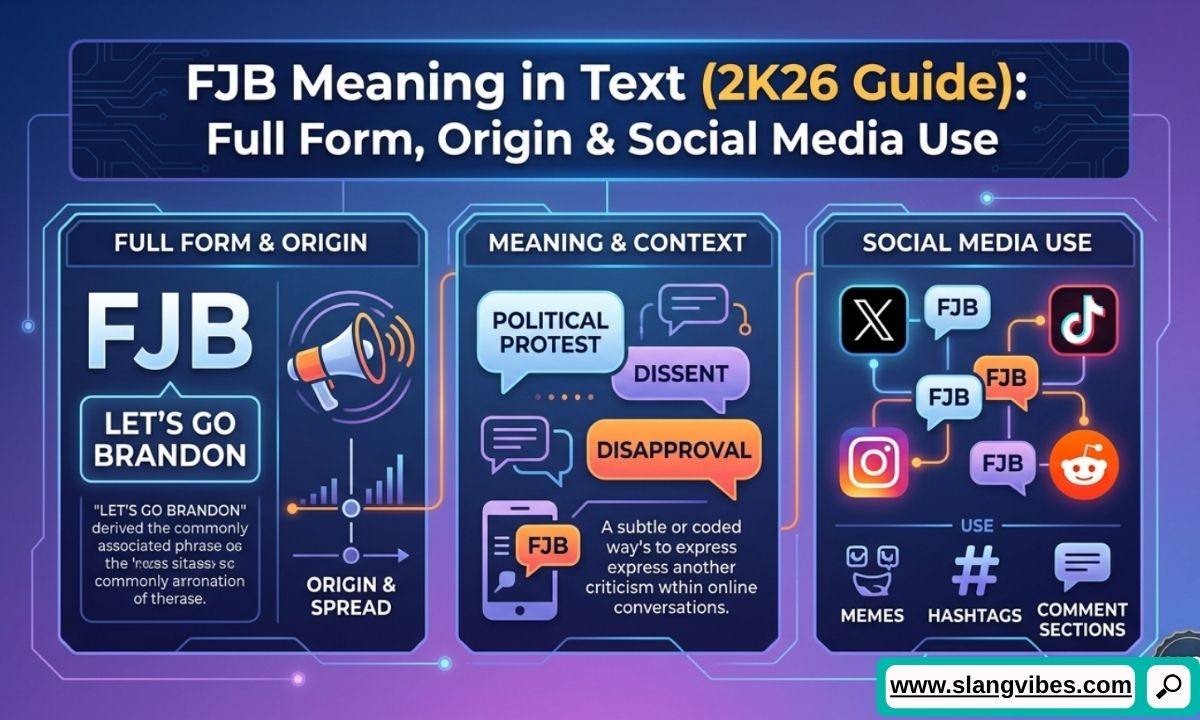
FJB stands for a crude political phrase: the F-word paired with the name of former U.S. President Joe Biden. People type the three letters instead of writing the phrase out because it contains profanity. Shortening it also lets the message slide past content filters, nosy relatives, and workplace monitoring software alike.
Quick Answer: FJB is a political slang abbreviation expressing anger or disapproval toward Joe Biden. It started as internet shorthand around 2021 and now shows up in texts, comments, hashtags, and memes across nearly every major platform.
The abbreviation isn’t neutral or playful. Unlike LOL or SMH, FJB carries a specific political stance built right into the letters. When someone sends it, they’re rarely being ambiguous about their opinion. Even a laughing emoji, a meme template, or a sarcastic caption only softens the delivery, not the point.
One thing worth clearing up early: FJB doesn’t have a widely used secondary meaning in texting. A handful of competitor sites claim it “sometimes” stands for initials or a business name. But in a text message or a social post, the political meaning dominates so heavily, a stranger typing FJB almost never means anything else. If you see it attached to initials in a private, non-political context, like a monogram or a project code, it’s a different situation. The surrounding text will usually make it obvious.
For UK readers scrolling through this: the phrase is rooted in American politics. It still travels well beyond U.S. borders through memes, comment sections, and viral clips. Don’t assume the letters only show up on American accounts.
The Origin Story Behind the FJB Meaning in Text
“The FJB meaning in text hasn’t changed since 2021, but the story behind it rarely gets told in full.”
Most articles covering this topic wave vaguely at “a NASCAR interview” without naming a single detail. Here’s what happened.
On October 2, 2021, NASCAR driver Brandon Brown won his first Xfinity Series race at Talladega Superspeedway in Alabama. During the post-race interview, broadcast live on NBC, the crowd behind him started chanting the exact profane phrase FJB now stands for. NBC Sports reporter Kelli Stavast told viewers the crowd was chanting “Let’s go, Brandon.” She either misheard it in the moment or smoothed it over for live TV.
Clips of the moment spread within hours. Within days, “Let’s Go Brandon” turned into a coded stand-in for the original phrase. People adopted it to express the same sentiment without saying, or writing, profanity out loud. FJB emerged alongside it as the blunter, unfiltered cousin. No code, no euphemism, only the initials of the phrase itself.
NASCAR distanced itself from the political use of the moment fairly quickly. Brandon Brown himself has said publicly he never set out to become a political symbol. This detail rarely makes it into other guides, but it matters. The phrase attached itself to a real event and a real person who had little say in how it got used afterward.
By late 2021, both phrases had moved from live sports broadcasts into ordinary text threads, comment sections, bumper stickers, and merchandise. The abbreviated version, FJB, caught on hardest in spaces where character limits and content moderation made three letters more practical than a full phrase.
Read More: TMI Meaning in Text: How Gen Z Uses It on Social Media
FJB Meaning in Text vs. “Let’s Go Brandon”: What’s the Difference?
People use these two phrases as if they’re interchangeable, and in spirit, they are. The difference comes down to bluntness.
“Let’s Go Brandon” works as a euphemism. It sounds harmless out of context, and this is the whole point. It lets someone broadcast a political opinion in a family-friendly wrapper, on a T-shirt, a yard sign, or a radio show. No content warnings, no awkward explanations to kids in the room.
FJB skips the wrapper entirely. It’s a direct abbreviation of the original profane chant, so anyone who knows the reference reads it as the unfiltered version of the same sentiment.
| FJB | Let’s Go Brandon | |
|---|---|---|
| Tone | Blunt, unfiltered | Euphemistic, coded |
| Where it shows up most | Comments, texts, hashtags | Merchandise, public signage, media |
| How obvious the meaning is | Immediate to anyone who knows it | Requires knowing the backstory |
| Moderation risk | Higher (reads as veiled profanity) | Lower (reads as a name) |
Both phrases point at the same underlying sentiment. Someone choosing FJB over LGB is usually making a deliberate choice. They want to sound sharper and more direct, not softer.
FJB in Texting and On Social Media: TikTok, X, Instagram, Snapchat, WhatsApp
The FJB meaning in text stays consistent everywhere it shows up. How people deploy it, though, shifts a bit by platform.
On X (formerly Twitter), FJB shows up constantly in reply threads under political news. It often works as a one-word reaction rather than part of a full sentence. The hashtag version, #FJB, gets attached to political posts, memes, and news clips.
On TikTok, the letters usually show up in captions or comment sections under political content, audio trend videos, or reaction clips. TikTok’s content moderation pushes some users toward disguised spellings. Spacing the letters out, or adding a period between each one (F.J.B.), helps dodge automated filters.
On Instagram, expect it in comments under political posts, in Story text overlays, or occasionally in a bio as a quick political statement.
Snapchat and WhatsApp lean more private. FJB shows up there in one-on-one or small group conversations rather than public posts, usually assuming the other person already gets the reference.
A few real-world text examples:
Group chat, siblings:
Mia: did you see gas prices again 😭 Jordan: FJB fr Mia: 💀💀
Friend catching up on news:
Sam: my uncle posted another FJB meme lol Priya: still at it huh Sam: every single day
The consistency across platforms comes down to this: wherever FJB shows up, it’s doing the same job. It signals a political stance quickly, without spelling anything out in full.
Is FJB Still Relevant in 2026?
Here’s something almost no other guide on this topic mentions clearly. Joe Biden’s presidential term ended in January 2025. So what happens to a slang term built entirely around criticizing a sitting president once he isn’t one anymore? “The FJB meaning in text stays the same either way. What shifts is when and why people reach for it.”
Short answer: the term hasn’t disappeared, but its function has shifted. FJB now works less like a live political jab and more like a legacy reference. Think of it as a way of recalling a specific era of political tension, or a general shorthand for anti-establishment sentiment outliving the news cycle it started in. People still use it in throwback memes, in arguments about Biden-era policy, and in ongoing culture-war banter, even with someone else in office.
Usage rises whenever Biden’s name comes back into the news, through interviews, documentaries, retrospectives, or comparisons to the current administration. It also shows up in nostalgia-driven meme formats, the same way older internet slang gets recycled once it’s tied to a specific cultural moment.
What’s changed is the urgency. In 2021 and 2022, FJB carried the weight of an active, ongoing political fight. In 2026, it reads more like a reference to an already-closed chapter. It’s still meaningful to the people who lived through it, but it’s no longer tied to a daily news cycle. If you’re seeing it in a fresh 2026 post, check the context. Is someone talking about current events, or looking back?
The FJB License Plate Fights: When Slang Meets the Law
This part rarely makes it into slang guides, but it’s one of the more interesting threads tied to this abbreviation. People have gone to court over it.
Several state DMVs rejected vanity license plate applications built around FJB and its variants. Officials argued the plates counted as profanity or, in some cases, disrespect toward a sitting president. In Delaware, a DMV official reportedly described a “FJOEB” plate application as “defamation to our current sitting president” before rejecting it. This case became part of a broader lawsuit challenging Delaware’s vanity plate rules. A federal judge later found the rules allowed for viewpoint discrimination, meaning officials were rejecting plates based on the opinion expressed rather than a neutral standard.
Similar disputes played out elsewhere. A man in Ohio filed a federal lawsuit after officials denied his application for a plate combining FJB-adjacent letters and numbers. In Alabama, officials initially blocked a gun store owner’s “LGBFJB” plate before reversing course and allowing it.
None of these cases center on the phrase itself. They center on a bigger question: how much control does a state government hold over speech on a plate it technically owns but a private citizen pays for? Courts have leaned in different directions depending on the state. Several found vague “offensive” standards give officials too much discretion to reject plates they simply disagree with.
None of this counts as legal advice, and plate rules vary widely by state. Anyone considering one should check their local DMV’s current policy rather than relying on a slang guide. Here’s what it does show, though: FJB stopped being ordinary internet shorthand a while ago. It became a real free-speech test case in multiple states, which says something about how far a three-letter abbreviation travels.
Read New Article: FB Meaning in Text: What It Really Means on Snapchat, TikTok & Instagram (2026)
When NOT to Use FJB (Context and Audience Matters)
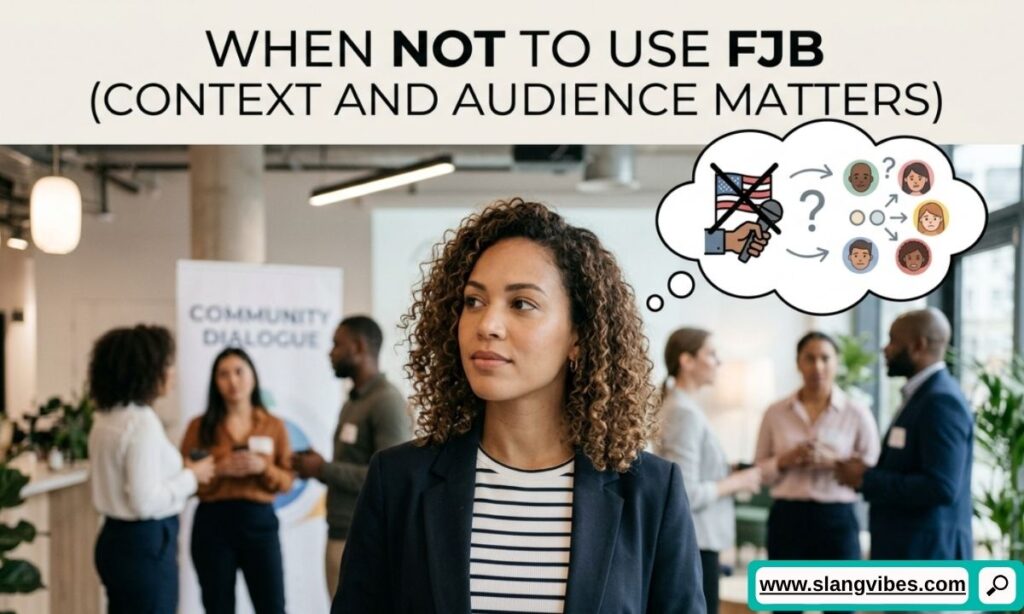
The FJB meaning in text doesn’t change by setting, but the reception does. It reads fine in a group chat with people who share your politics, or at minimum won’t take offense. It reads badly almost everywhere else.
Avoid it in:
- Work emails, Slack messages, or any professional chat, even a casual one with coworkers you like
- School assignments, class group projects, or messages to teachers
- Customer service interactions or public-facing brand accounts
- Mixed political company where you don’t know how people lean
- Formal introductions or first conversations with someone new
A quick example of how this plays out badly:
Coworker Slack thread:
Dana: ugh the new expense policy is so annoying Theo: FJB honestly Dana: lol what does this have to do with our expense policy
Theo’s reply lands as a non sequitur at best. At worst, it’s an unwanted political statement in a space where nobody asked for either.
The safest rule: treat FJB the way you’d treat any explicit political statement, not a neutral abbreviation like OMW or IDK. If you wouldn’t say the full phrase out loud there, don’t type the shortened version either. The letters change, the intent behind them doesn’t.
How to Respond When Someone Sends You FJB in a Text
Getting an unexpected FJB from someone doesn’t require a debate, a lecture, or an argument, unless you want one. Here are a few realistic ways to handle it, depending on who sent it.
From a close friend who shares your politics:
Friend: FJB 😂 You: lmaooo you’re not wrong
From a family member you’d rather not argue with:
Aunt: FJB, unbelievable right You: yeah gas prices are rough for sure
This kind of response acknowledges the underlying frustration, gas prices, inflation, whatever sparked it, without engaging with the political label itself. It keeps the conversation from sliding into a fight nobody wanted.
From someone you’re dating, testing the waters politically:
Match: lol FJB right? You: not my thing tbh, but tell me more about you
From a stranger in a comment section:
Stranger: FJB You: (often best left unanswered)
Online, replying to a random FJB comment rarely changes anyone’s mind. It usually invites more of the same. In person, or in a private chat with someone you know well, a light redirect like the aunt example above tends to keep things friendly without pretending you agree.
The main thing to remember: nobody owes a response to political bait, in text or online. Silence, a topic change, or a neutral one-liner all work fine.
Similar Political Slang Terms Compared to FJB
The FJB meaning in text sits alongside plenty of other political shorthand floating around group chats and comment sections. A quick comparison helps place it next to its closest relatives.
| Term | Full Meaning | Tone Compared to FJB |
|---|---|---|
| LGB | Let’s Go Brandon | Softer, coded version of the same sentiment |
| MAGA | Make America Great Again | Broader political identity, not an insult |
| SMH | Shaking My Head | Non-political, general frustration |
| IYKYK | If You Know You Know | Non-political, references inside jokes |
| RINO | Republican In Name Only | Political, but aimed within a party rather than at one person |
FJB stands apart from most of this list. It’s built directly around a specific person and a specific profane phrase, rather than a broader identity label or a general expression of frustration. Terms like MAGA describe a political movement. FJB targets one individual instead. This distinction matters for reading tone: MAGA in a bio reads as an identity statement, while FJB in a comment reads as a direct jab.
Common Mistakes People Make With the FJB Meaning in Text
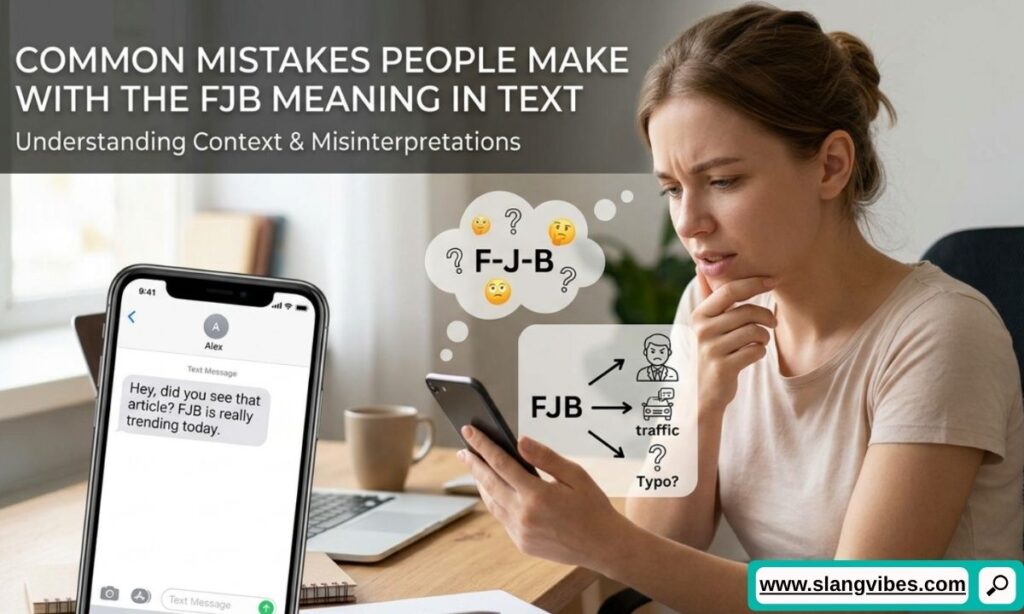
A handful of misunderstandings show up again and again around this term, worth clearing up directly.
Mistake 1: Assuming it’s friendly or neutral. FJB isn’t a greeting, an inside joke, or a harmless abbreviation. It’s a political statement first, wrapped in three letters second.
Mistake 2: Treating FJB and LGB as identical in tone. They point at the same sentiment, but FJB is the blunter, more direct version. Swapping one for the other changes how strong the message lands.
Mistake 3: Assuming everyone recognizes it. Plenty of people, especially outside the U.S. or outside politically active circles, have no idea what the letters mean. UK readers in particular might see it attached to American political content without the cultural context making it click instantly for U.S. audiences.
Mistake 4: Using it in a setting where it doesn’t belong. Work chats, school assignments, and customer service threads are not the place for it, regardless of personal politics.
Mistake 5: Assuming it’s still tied to a sitting president. Biden’s term ended in January 2025. Anyone encountering FJB in 2026 content is likely looking at a retrospective reference rather than commentary on current events.
Getting the FJB meaning in text right comes down to reading it the way it’s intended. It’s a deliberate, unmistakably political three letters, not a casual abbreviation like the rest of your group chat’s shorthand.
Read More Articles: MK Mean in Text: What It Really Means on Snapchat, TikTok & Instagram (2026)
Frequently Asked Questions
FJB stands for a profane political phrase directed at former President Joe Biden. People shorten it to avoid writing the full phrase out and to slide past content filters.
It traces back to an October 2021 NASCAR race at Talladega Superspeedway. A crowd’s chant during driver Brandon Brown’s post-race interview got reframed on live TV as “Let’s Go Brandon,” and FJB spread online shortly after as the more direct version.
They point at the same sentiment. FJB is the blunt, unfiltered version, while “Let’s Go Brandon” works as a coded, family-friendly stand-in for the same phrase.
No. It’s a political statement with profanity built into its meaning, which makes it a poor fit for work chats, school settings, or any public-facing communication.
It’s still around, but it now functions more as a legacy reference to the Biden era than an active jab at a sitting president. Biden’s term ended in January 2025.
Conclusion
FJB started as a chant at a NASCAR race. It turned into one of the most recognizable political abbreviations of the early 2020s, and somehow ended up as the subject of actual court cases over license plates. It’s a strange arc for three letters. Once you know the full form, the origin story, and how differently it lands depending on who’s reading it, decoding a text reading “FJB” gets a lot easier. It isn’t neutral slang. It’s a political statement condensed into shorthand. Treat it accordingly, and read the room before you use it or respond to it. Doing both keeps you out of conversations you never wanted to have in the first place. Slang like this moves fast, but context always tells you more than the letters alone ever will.

Alex Carter is a language enthusiast and internet culture expert at SlangVibes. He explains the latest slang terms and text meanings in simple, clear English so everyone stays in the loop.