Picture this: you match with someone on Instagram who’s clearly from Mexico City. Two texts in, he calls you güey. You laugh, unsure whether it’s friendly or an insult. A week later, a coworker from Guadalajara ends the shift with “nos vemos, carnal,” and you wonder if you got promoted to family status or if he’s messing with you. Mexican slang for homie works exactly this way. It’s warm, layered, and impossible to fake with a textbook. Mexico has more casual words for “friend” than most languages bother to invent, and each one carries its own history, tone, and unspoken rules. This guide breaks down 19 real words people in Mexico use for homie, plus the ones foreigners usually get wrong.
Read New: BBL Slang Meaning (2K26 Guide): What BBL Really Means in Text, TikTok & Social Media
What Does Mexican Slang for Homie Mean?
Homie in English signals closeness and loyalty. It says this person belongs to my circle. Mexican Spanish has a long list of equivalents, and the sheer number says something about Mexican culture itself.
Friendship in Mexico often works like an extension of family. Close friends get called brother, cousin, or even godfather, even when there’s no blood relation at all. Words like carnal (from the word for blood) and compadre (originally a godparent term) show up in daily conversation because closeness gets treated as a family bond, not only a social one.
Regional history shapes the list too. Some words trace back to Nahuatl, the language spoken across central Mexico before Spanish arrived. Others came from Caló, the street language born in border cities and Chicano communities in the early 1900s. A few are newer, shaped by internet culture, corridos, and Spanglish crossing back and forth between Mexico and the US.
This is why no single definition covers Mexican slang for homie. The word someone reaches for depends on their age, their state, their relationship with the listener, and whether they’re texting a friend or talking with an uncle. Understanding the range matters more than memorizing one word and using it everywhere.
Quick Reference Table: Mexican Slang Words for Friend
Here’s a fast cheat sheet before the full breakdown. Use it to check tone and safety level at a glance, then jump to the word you want more detail on.
| Word | Simple Pronunciation | Meaning | Tone | Safe for Foreigners? |
|---|---|---|---|---|
| Güey | why | dude, bro | highly casual | Yes, with friends |
| Carnal | kar-NAL | brother-level friend | loyal, warm | Careful, close friends only |
| Compa | KOM-pah | buddy | friendly | Yes |
| Cuate | KWAH-teh | close friend | warm | Yes |
| Amigo | ah-MEE-goh | friend | neutral | Always |
| Hermano | er-MAH-noh | brother | emotional | Yes |
| Mano / Manito | MAH-noh | bro | warm | Yes |
| Vato | BAH-toh | guy, dude | streetwise | Careful |
| Ese | EH-seh | homie, guy | streetwise | Careful |
| Chavo / Chava | CHAH-voh / vah | young guy/girl | casual | Yes |
| Morro / Morra | MOH-rroh / rrah | kid, young friend | casual | Yes |
| Banda | BAHN-dah | crew, squad | social | Yes |
| Broder | BROH-der | bro | chill | Yes |
| Compadre | kom-PAH-dreh | close friend | respectful | Yes |
| Camarada | kah-mah-RAH-dah | comrade | old-school | Yes |
| Socio | SOH-syoh | partner, buddy | casual/business | Yes |
| Cabrón | kah-BROHN | dude (or jerk) | risky, playful | Careful |
| Primo | PREE-moh | cousin-friend | friendly | Yes |
| Colega | koh-LEH-gah | work friend | polite | Yes |
Notice how many of these shift meaning based on tone alone. Cabrón sounds like an insult or a compliment in the same afternoon, depending on who’s saying it. Keep this in mind as you read the breakdown below.
Read More: Hood Slang Meaning (2K26 Guide): Popular Street Terms & Their Real Meanings
The Full List: Mexican Slang for Homie, Word by Word
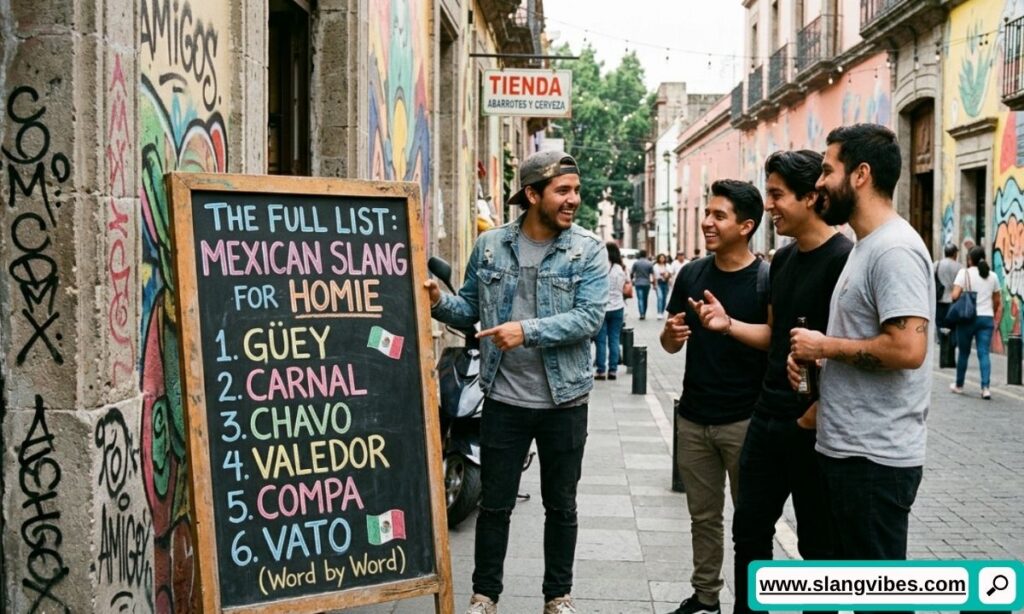
These are the 19 words people in Mexico reach for most when they mean homie. Each entry includes a simple pronunciation guide, the real meaning, and a quick example so you know how it sounds in a real sentence.
Güey
Güey started as an insult, short for buey, meaning ox or foolish guy. Today it functions like dude or bro among Mexican Gen Z and millennials. Friends use it constantly in texts and in person. Example: “Güey, ya llegué” (Dude, I’m here). Skip it with strangers or elders; it stays strictly for people you already know.
Carnal
Carnal comes from carne, meaning flesh or blood. It signals a friend who feels like family, not a friend from school or work. Mexicans and Chicano speakers both use it heavily. Example: “Eres mi carnal desde niños” (You’ve been my brother since we were kids). Save it for people you’d genuinely call family.
Compa
Compa is short for compadre or compañero. It sounds relaxed and works in almost any friendly setting, from a construction site to a group chat. Example: “¿Qué onda, compa?” (What’s up, buddy?). Age or region rarely limits it, which makes it one of the safest words on this list for a learner.
Cuate
Cuate traces back to the Nahuatl word cóatl, meaning twin. Mexicans use it for a friend who feels like a second self, someone who’s been around for years. Example: “Mi cuate me ayudó con la mudanza” (My buddy helped me move). It sounds warm without sounding overly intense.
Amigo
Amigo is standard Spanish for friend, not slang in the strict sense, but it works casually in conversation the same way English speakers use buddy. Example: “Amigo, gracias por venir” (Friend, thanks for coming). It’s the safest default word on this entire list.
Hermano
Hermano means brother, and Mexicans use it emotionally for close friends, not only biological siblings. Example: “Te quiero, hermano” (Love you, man). It sounds sincere rather than playful, so save it for moments calling for real warmth.
Mano / Manito
Mano is a shortened form of hermano, and manito adds “little” for extra warmth. Both sound affectionate between close friends. Example: “Oye, manito, ¿todo bien?” (Hey bro, everything good?). It’s common across generations and rarely sounds forced.
Vato
Vato comes from Caló, the street slang born in border cities and Chicano neighborhoods. It means guy or dude, and it carries a tougher, streetwise edge. Example: “Ese vato es mi amigo” (He’s my friend). Foreigners should hear it used correctly before trying it themselves.
Ese
Ese is a way of pointing someone out in standard Spanish, close to saying “hey you.” In Chicano and Mexican street slang, it works as a term of address, close to homie. Movies and TV exaggerated it into a stereotype, but real speakers still use it, mostly among men who already know each other well.
Chavo / Chava
Chavo and chava mean young guy and young girl. The classic sitcom El Chavo del Ocho made the word a household name across Latin America. Example: “Ese chavo es mi amigo del gym” (He’s my friend from the gym). It sounds casual and works well for people under 30.
Morro / Morra
Morro and morra mean kid or young friend, and depending on context, they also mean boyfriend or girlfriend. Example: “Mi morra me está esperando” (My girl is waiting for me). Context decides the meaning fast, so listen before assuming.
Banda
Banda means crew or squad, not a single friend. Mexicans use it for the whole friend group. Example: “La banda va a llegar tarde” (The crew’s going to be late). Don’t use it to describe one person; it only works for a group.
Broder
Broder borrows straight from the English word brother, reshaped with Spanish pronunciation. Younger speakers use it online and in texts constantly. Example: “¿Todo bien, broder?” (Everything good, bro?). It sounds playful and fits well in casual DMs.
Compadre
Compadre technically describes the relationship between a parent and their child’s godfather. Mexicans stretch it to mean any close, trusted friend, especially among adults. Example: “Compadre, cuánto tiempo” (Buddy, it’s been a while). It sounds respectful, not childish, which sets it apart from newer slang.
Camarada
Camarada means comrade, and it carries a slight political or old-school flavor from earlier generations. Older speakers use it more than teenagers do. Example: “Nos vemos pronto, camarada” (See you soon, comrade). It sounds formal enough for a work friendship too.
Socio
Socio means partner, originally in business, but Mexicans use it loosely for a close friend or collaborator. Example: “Vamos a hacer esto juntos, socio” (Let’s do this together, partner). It fits both friendly and professional situations.
Cabrón
Cabrón translates to billy goat, and on the street it usually means jerk or bastard. Among tight friend groups, though, it flips into an affectionate way to say dude. Example: “¡Qué onda, cabrón!” (What’s up, man!). Tone and relationship decide everything here; get it wrong, and it lands as an insult.
Primo
Primo means cousin, and Mexicans use it jokingly for a friend who feels like family. Example: “Primo, vamos por tacos” (Cousin, let’s grab tacos). It sounds playful and works well with people you already know.
Colega
Colega means colleague, and it shows up more in Spain than in Mexico, though Mexican adults use it too for a work friend. Example: “Mi colega me ayudó con el reporte” (My colleague helped me with the report). It sounds professional, so save the more playful words for after hours.
Read Here: FJB Meaning in Text (2K26 Guide): Full Form, Origin & Social Media Use
How Mexican Women Say Homie in Spanish
Female friendship in Mexican Spanish comes with its own set of words, built specifically for women talking about women, not borrowed from the male versions above.
Amiga is the direct, safe word for female friend, and it works everywhere. Comadre carries the same weight as compadre; it started as a godmother term and now covers close female friendships, especially among mothers. Cuata is the female form of cuate, used the same warm way. Amigacha is a playful, slightly rougher version of amiga, closer to “my girl” in English. Morra and chava both work for young women too, the same way morro and chavo work for young men.
Here’s how it sounds in a real group chat:
Sofia: Oye amiga, ¿vienes al cumpleaños?
Valeria: Obvio, ahí estaré con mi comadre.
Sofia: Perfecto, le aviso a la banda.
These words don’t sound like a stretch or a direct translation from English. They grew inside Mexican culture on their own, the same way the male versions did. A Mexican woman calling her best friend comadre carries the same warmth a man gets from calling his friend carnal.
If you’re learning Mexican Spanish slang for friend, start with amiga and cuata. Amigacha and comadre carry more closeness, so save them for people you already know well.
When Mexican Slang for Friend Turns Into an Insult
Several words on this list work as compliments in one context and insults in another. Tone, relationship, and setting decide which one you get.
Güey is the clearest example. Its root word, buey, means ox, and it used to insult someone as slow or irrational. Among friends today, it means nothing more than dude. Say it to a stranger on the street, though, and it sounds aggressive instead of playful.
Cabrón follows the same pattern, and it swings even harder. On its own, with a hostile tone, it means jerk or bastard, close to the harshest options in English. Between close friends, the exact same word turns into an affectionate greeting. The difference lives entirely in tone and relationship, not spelling.
Vato and ese carry a smaller version of this risk. Used correctly among friends, they sound streetwise and normal. Used by an outsider imitating a movie stereotype, they sound mocking instead of natural.
Pinche works differently. It’s a modifier, not a friend word by itself, and Mexicans drop it in front of almost anything to add emphasis, similar to how English speakers use certain words as intensifiers. Pinche güey adds punch to an already casual word.
Common Mistake: Learners often assume every word on a slang list stays friendly no matter who says it. Cabrón and güey both depend on the relationship between speaker and listener. The exact same sentence lands as a joke with a friend and an insult with a stranger.
Before using any word from this guide with someone new, watch how locals use it first. Context teaches this faster than any list.
Read Also: Type Meaning in Slang: What It Really Means in Text (2026)
Border and Chicano Twists on This Slang
Mexican slang for homie changes shape once it crosses into border cities and Chicano communities in the US. Words like vato, ese, and carnal got much of their modern flavor from Caló, a mixed street language born in cities like El Paso and Los Angeles during the 1900s.
Chicano rap, lowrider culture, and film exported this version of Mexican slang around the world, which is part of why English speakers already recognize vato and ese even without speaking Spanish. The downside: movies often exaggerated these words into gang stereotypes, so some Mexicans in central and southern Mexico use them less, or with a slightly different flavor.
Northern Mexico, especially near the US border, tends to favor vato, carnal, and güey heavily. Mexico City leans more on güey, compa, and cuate. Southern states like Oaxaca and Chiapas often keep more formal words like compadre and camarada in everyday speech, alongside their own regional expressions.
Here’s a text exchange between a Mexican-American reader and a friend visiting from Sonora:
Diego: Ese vato que conociste ayer es mi carnal.
Jake: Wait, insult or compliment lol
Diego: Compliment, güey. Ese simply means “hey you” here.
If you grew up hearing this slang through music or Mexican-American family members, you likely already know half these words without realizing where they came from.
How to Use This Slang Without Sounding Off
Knowing the words is one step. Using them naturally takes a bit more care.
Match the closeness level first. Amigo, compa, and cuate work broadly, even with someone you met recently. Carnal, hermano, and cabrón need real history behind them. Drop one of these on a stranger, and it sounds forced instead of friendly.
Watch the setting too. A word fitting a group chat or a party rarely fits a work email or a formal introduction. Colega and socio work in professional settings; güey and cabrón don’t.
Age plays a role as well. Broder, banda, and morro/morra skew younger, and an older speaker using them constantly around teenagers sometimes sounds like they’re trying too hard. Compadre and camarada skew older, and a teenager using them nonstop sounds a little old-fashioned by comparison.
Foreigners tend to make one of two mistakes: using slang too much, or avoiding it completely out of fear of getting it wrong. Both stand out. The better approach is listening first. Notice which words a specific friend group uses, then match it instead of importing words from a different region or generation.
One more tip: don’t translate Mexican slang for homie word for word in English conversation. Calling someone “my goat” because cabrón technically means billy goat misses the entire point. Slang works through tone and relationship, not literal translation.
Gen Z vs Millennial: Who Says Which Word

Age changes which word feels natural, even within the same family.
Gen Z leans into shorter, punchier options: güey, broder, banda, morro, and morra dominate group chats and captions. These words move fast online too, showing up in TikTok comments and Instagram captions as much as in speech.
Millennials mix older slang with newer internet habits. Cuate, compa, and carnal still show up constantly, layered with a bit of the vocabulary picked up from social media and memes.
Older generations tend to reach for compadre, camarada, and socio, all carrying more formality and history. These sound respectful rather than trendy, which fits how many older Mexican speakers approach friendship in general.
Here’s a Gen Z group chat:
Mateo: Alguien va al concierto??
Luis: Yo voy con la banda completa
Mateo: Ese wey siempre organiza todo lol
And here’s a Millennial exchange over WhatsApp:
Ana: Oye cuate, ¿sigues en pie para mañana?
Roberto: Claro, ahí te veo compa
Ana: Perfecto, avísale a los demás
The gap between these two conversations shows how fast Mexican slang for homie shifts across a single generation. A word sounding completely normal to one group sounds slightly dated, or slightly too casual, to another.
Read More Articles: DMV Slang Meaning (2K26 Guide): 24 Popular Words & Phrases You Need to Know
Quick Quiz: How Well Do You Know Mexican Slang for Homie and friends?
Test what you picked up so far. Answers sit right below, no scrolling required.
- Which word means dude and comes from an old insult meaning ox?
- Which word translates to billy goat but often sounds friendly among close friends?
- Which word specifically describes a friend group, not one person?
- Which word comes from Nahuatl and means twin?
- Which word works safely in almost any setting, formal or casual?
Answers: 1. Güey, 2. Cabrón, 3. Banda, 4. Cuate, 5. Amigo
Score yourself: five right means you’re ready to use Mexican slang for homie in a real conversation. Three or four right means you’ve got the basics down, and a bit more listening will finish the job. Anything lower, and reading through the list one more time helps more than memorizing it in one sitting.
Frequently Asked Questions:
What’s the most common Mexican slang word for homie?
Güey wins by a wide margin. Mexicans across nearly every age group use it constantly, in person and in texts, though it stays strictly casual and works best among people who already know each other.
Is cabrón an insult or a compliment?
Both, depending on tone and relationship. Among strangers or during an argument, it means jerk. Among close friends, the same word turns into a playful greeting.
What do you call a female friend in Mexican slang?
Amiga works everywhere. Cuata, comadre, and amigacha add more warmth or closeness, and morra and chava cover younger women casually.
Is it okay for a non-Mexican to use this slang?
Yes, with a bit of care. Start with safer words like amigo, compa, and cuate. Save carnal, cabrón, or vato for after you’ve built real friendships in Mexican Spanish, since these depend heavily on established closeness.
What’s the difference between carnal and compa?
Carnal signals deep, almost family-level loyalty. Compa sounds lighter and more casual, closer to buddy than brother. Both work as Mexican slang for homie, at different intensity levels.
Final Thoughts
Mexican slang for homie covers far more ground than a single word like dude or bro in English. Some terms, like carnal and hermano, borrow the language of family to describe deep loyalty. Others, like banda and broder, sound light and made for a group chat. A few, like cabrón and güey, flip between friendly and offensive depending entirely on tone.
The safest path forward: start with amigo, compa, and cuate, since all three work broadly and rarely land wrong. Add carnal, vato, or cabrón once you understand the friendship and the room well enough to use them with confidence.
Slang like this grows and shifts every year, picking up new flavor from music, border culture, and social media along the way. The words on this list represent Mexican Spanish as it sounds in 2026 right now, not a frozen textbook version from decades ago. Listen more than you speak at first, and the right word will start to feel obvious.

Alex Carter is a language enthusiast and internet culture expert at SlangVibes. He explains the latest slang terms and text meanings in simple, clear English so everyone stays in the loop.