My friend Dana texted me last month: “Dinner Saturday, 8 PM, place TBC.” I stared at my phone for a full minute. Was TBC a restaurant? A neighborhood? A name I should know? I felt silly asking, so I nodded along and waited. Turns out the TBC meaning is simple once you’ve seen it a few times. It stands for “to be confirmed,” and it shows up everywhere from group chats to work invites. Sometimes it stands for “to be continued” too. Here’s the thing: context tells you which one you’re reading. Let’s walk through both, with real examples, so you never have to guess again.
Read More: GL Meaning in Text: What Does GL Mean in 2026?
TBC Meaning in Text: The Short Answer
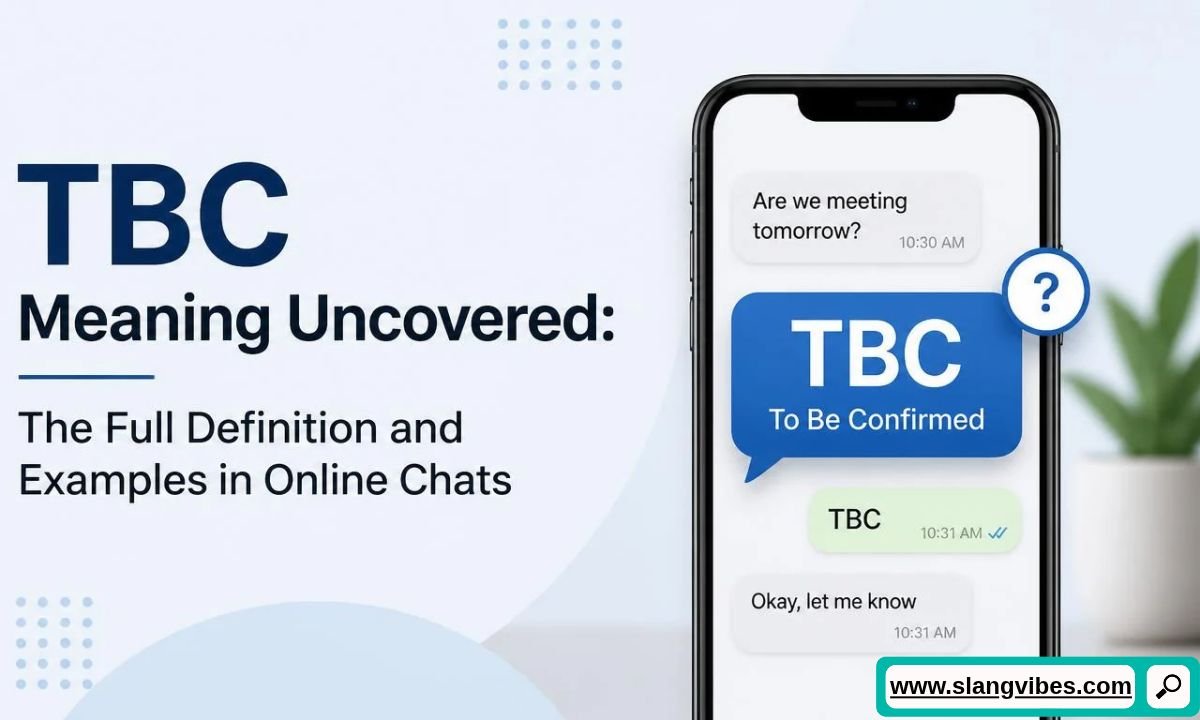
The TBC meaning in text is “to be confirmed.” Someone sends it when a plan exists but one detail isn’t final. The time, the place, the price, or the guest list might still be open. Everything else is settled.
Think of it as a polite flag. The sender says, “Hold this loosely, I’ll lock it in soon.” You get the main idea now and the details later.
Here are a few one-line scenarios:
- Your cousin posts, “Family brunch Sunday, restaurant TBC.”
- A teammate writes, “Kickoff call Tuesday, time TBC.”
- A friend texts, “Concert in March, tickets TBC.”
In each case, the event is real. Only one piece is waiting on an answer. The detail might be confirmed in an hour or in a week, depending on who’s waiting for what.
You might be wondering whether TBC means the plan might fall through. The short answer is no. A shrug-style message sounds unsure about the whole plan. TBC sounds confident about the plan and open about one detail. Someone who sends “Saturday hike, start time TBC” expects to go hiking.
You’ll also see it in lowercase as “tbc.” Both versions carry the same meaning. The lowercase version feels quicker and more casual, the way people type when they’re moving fast on their phones. Both are plain abbreviations, and most readers recognize them instantly.
TBC Meaning in Chats: Real Text Examples
The TBC meaning in chats shows up most in plan-making. Watch how it works in a group thread.
Maya: Are we still on for Friday?
Jordan: Yes, 7 PM. Restaurant TBC.
Maya: Cool, ping me once it’s locked.
Jordan: Will do. Booking tonight.
Jordan gives the time and holds back the venue. Maya knows to wait, not to panic.
Dating chats use it too, with a lighter tone.
Chris: Want to grab coffee this weekend?
Leah: Love to. Saturday afternoon, time TBC?
Chris: Works for me. I’ll wait for your text.
Leah: Perfect. I’m sorting my shift schedule first.
Notice the question mark. Leah turns TBC into a question, which invites Chris to help confirm the plan. Many people notice this move in casual chats. It sounds friendly and keeps the plan open without any pressure.
In both examples, the abbreviation saves a long explanation. Nobody types “I’m waiting to confirm the venue with the restaurant” when three letters do the job. Short messages keep the conversation moving, and the other person still gets the full picture.
Group chats lean on it even more. One person posts “Birthday dinner for Sam, Friday, venue TBC,” and everyone replies with a thumbs up. Nobody needs to ask questions yet, because the sender has already promised an update, and everyone settles in to wait.
Read More: WBY Meaning in Text: What It Really Means in Chats & Social Media (2026 Guide)
Sometimes the TBC meaning changes completely. Online, it also stands for “to be continued.” Think of the end of a TV episode, when the screen says the story picks up next week. Fans of series and comics know the feeling. The phrase promises more, and readers come back for part two.
People borrow the same idea for posts and texts. Here are a few one-line examples:
- A TikTok caption reads, “Storytime about my worst date. Part one. TBC.”
- A friend texts, “You won’t believe what happened at the airport. TBC.”
- An Instagram story ends with, “Big announcement coming. TBC.”
Here, the writer builds suspense. Nothing is waiting on a confirmation. The story simply isn’t finished.
So how do you tell the two meanings apart? Look at what comes before the letters. A detail like a time, place, or price points to “to be confirmed.” A story, a joke, or a cliffhanger points to “to be continued.”
Tone helps too. The confirmed version sounds practical and calm. The continued version sounds playful and teasing, often with an emoji or a dramatic pause.
Some writers add a clue to avoid confusion. They type “TBC soon” for a story or “TBC, will confirm” for a plan. If you’re unsure, ask. A quick “Confirmed or continued?” gets a clear reply, and most people enjoy the question.
Read Here: What Does GMT Mean in Text? Social Media and Chat Guide
TBC vs TBD vs TBA: Spot the Difference
Three similar abbreviations cause most of the mix-ups, so the difference is worth learning. The TBC meaning sits closest to a finished plan. The other two sit earlier in the process.
Quick Answer: TBC means a plan exists and awaits a final yes. TBD means nobody has decided yet. TBA means an announcement is coming.
This table lays out all three with examples.
| Term | Meaning | Example |
|---|---|---|
| TBC | To be confirmed. A choice exists and needs a final yes. | “Dinner at 8, venue TBC.” |
| TBD | To be decided. No choice exists yet. | “Summer trip destination TBD.” |
| TBA | To be announced. Details will be shared publicly later. | “Guest speaker TBA.” |
A quick test helps. Ask yourself, “Has anyone picked an answer yet?” If someone has, and a final check is pending, choose TBC. When nobody has picked, choose TBD. Once the answer is chosen and kept quiet for now, choose TBA.
Mixing them up happens a lot. Still, the right choice makes your message clearer. Send “Venue TBD” to a friend, and you’ve said no restaurant is chosen. Send “Venue TBC,” and you’ve said one is chosen and pending. Your friend reads the second message and relaxes, because a decision already exists. Precision like this saves a follow-up question, and it makes you look organized. Small word choices carry real weight in planning chats.
Using TBC at Work: Formal or Informal?
Using TBC at work is perfectly normal, and the TBC meaning stays the same in an email. It fits calendar invites, agendas, and project plans. Many managers like it because it shows honesty about gaps in the schedule.
Priya: Draft agenda is attached. Speaker slot TBC.
Tom: Thanks. When will you confirm it?
Priya: By Wednesday noon.
Tom: Great. I’ll hold the room until then.
Priya names a deadline, which makes the abbreviation feel responsible. A bare TBC with no date leaves everyone hanging.
Capitalization and punctuation shift the tone. Uppercase TBC feels standard and professional. Lowercase “tbc” feels casual, better for quick chats with teammates you know well. Dotted “T.B.C.” feels formal and a little old-fashioned, so you’ll rarely see it in modern messages.
For clients and executives, consider spelling it out the first time. Write “to be confirmed (TBC)” and then use the short version afterward. This small step protects readers who haven’t seen the abbreviation before.
Remote teams lean on it heavily. A shared calendar entry reading “Offsite, hotel TBC” tells everyone the trip is real while the booking is pending. People plan their weeks around entries like this, so a clear update date helps everyone.
Subject lines work well with it too. “Q3 Review, Location TBC” tells the reader what’s coming and what’s pending in five words.
Read Also: Type Meaning in Slang: What It Really Means in Text (2026)
The TBC meaning is understood on both sides of the Atlantic, but habits differ. Based on how the terms are typically used online, UK writers reach for TBC often. Event listings, invitations, and travel plans carry it all the time. Fixture lists for sports in Britain often show dates as TBC too.
American writers tend to pick TBD in the same spots. A New Yorker might write “Location TBD” where a Londoner writes “Location TBC.” Both messages get understood, and neither sounds wrong.
Picture a group trip planned across two countries. The Londoner posts “Hotel TBC.” The New Yorker posts “Flights TBD.” Everyone reads both correctly, and the plan keeps moving. When in doubt, mirror the words your readers already use. It builds quick trust and avoids needless confusion.
Age shapes usage as well. It’s common to see Gen Z users type lowercase “tbc” in quick chats and use the abbreviation for “to be continued” in story posts. Millennials often keep the uppercase version for work emails and event invites.
If your audience spans both countries, here’s a safe approach. Use TBC for confirmation and TBD for open decisions, and add a short date for the update. Clear structure matters more than regional habit. Readers in the US and UK will follow along either way, because both abbreviations are everyday shorthand.
Read New Articles: Ghetto Slang Meaning (2K26 Guide): 30 Popular Terms, Origins & Real Usage
When Not to Use TBC (and Common Mistakes)
Knowing the TBC meaning helps, but knowing when to hold it back matters equally.
When Skipping It Works Better
Skip TBC when nothing is planned. Writing “Vacation next year, TBC” suggests a plan exists. If no plan exists, use TBD or say “no plans yet.”
Skip it when the answer is a firm no. A cancelled event deserves a clear message, not a vague abbreviation.
Urgent requests call for a real time, never a placeholder. If someone needs an answer by noon, say so plainly.
Personal conversations call for extra care. Using TBC to dodge a direct question about a relationship or a promise sounds evasive.
Mistakes People Make
The most common mistake is stacking TBC on every detail.
Alex: Movie Saturday? Time TBC, place TBC, movie TBC.
Sam: So what’s confirmed?
Alex: Saturday, I think.
Sam: Text me when you know more.
Sam is confused, and fairly so. When every detail carries TBC, the message holds no plan. Confirm at least one item.
Another slip is leaving TBC with no follow-up. Open items need a date for the update. Honesty works better here: say what’s decided, then say when the rest will follow. A third slip is mixing up TBC and TBD, which the table above clears up. People who see an endless TBC often assume the plan is flaky.
Once you know the TBC meaning, replying gets easy. Match your tone to the sender and ask for a timeline when it helps.
Casual replies work for friends:
- “Sounds good, keep me posted 👍”
- “Cool, ping me once it’s locked.”
- “Fingers crossed it works out 🤞”
Playful replies suit group chats with a joke-friendly vibe:
- “TBC? Suspense is killing me 👀”
- “Plot twist loading…”
- “Okay, I’ll wait with snacks.”
Polite replies fit work and new acquaintances:
- “Thanks for the update. I’ll watch for confirmation.”
- “Understood. Please share details when finalized.”
- “No rush. Let me know when it’s set.”
A gentle nudge is fine when the plan affects your schedule. Try “Any update on the venue? I’d like to plan my day.” or “Would you confirm by Thursday?”
Emoji pairings follow tone. A thumbs up signals calm agreement. Crossed fingers signal hope. Eyes signal curiosity. Skip emojis in formal email.
Timing matters in replies too. A quick acknowledgment feels warm, while a reply three days later feels distant. Even a short “Got it, thanks” shows you saw the message and plan to wait. Adding your own availability helps too, like “I’m free after 6 whenever you know.”
If the sender never follows up, wait a reasonable window and ask once more with a specific deadline. Many people appreciate the reminder because they’re juggling several plans at once.
Frequently Asked Questions
What does TBC mean in a text message?
TBC stands for “to be confirmed.” The TBC meaning points to a plan with one detail still pending.
Is TBC the same as TBD?
No. TBC means a choice exists and awaits a final yes. TBD means nobody has decided yet.
Does TBC mean “to be continued”?
Sometimes. In story posts and cliffhanger texts, it stands for “to be continued.” Context tells you which one applies.
Is TBC formal or informal?
It works in both. UK writers use it often in invites and emails, while US writers lean toward TBD.
How do I politely ask someone to confirm a TBC detail?
Send a short message with a date, like “Would you confirm the venue by Thursday?” A deadline keeps the tone friendly.
The Bottom Line on TBC
The TBC meaning comes down to two ideas. Most often, it stands for “to be confirmed,” which tells readers a plan exists and one detail is still open. In story posts and playful texts, it stands for “to be continued,” which builds suspense. Context tells you which one you’re reading.
Remember the neighbors too. TBD means nobody has decided. TBA means an announcement is coming. TBC sits closest to a finished plan, so it carries the most confidence of the three.
Tone matters as much as the letters. Uppercase fits work emails, lowercase fits quick chats, and a short reply keeps things friendly. Avoid stacking TBC on every detail, and never use it to dodge a direct question.

Alex Carter is a language enthusiast and internet culture expert at SlangVibes. He explains the latest slang terms and text meanings in simple, clear English so everyone stays in the loop.