My cousin texted me one word last week: IDE. I stared at my phone for a full minute. Was it a typo for IDK? A coding term? A joke I missed? I finally asked her, and she replied with three crying emojis and a short explanation. The IDE slang meaning is “I don’t even,” a shorthand for feeling too shocked, annoyed, or stunned to finish the sentence. Once I knew, I started spotting it in group chats and comment sections everywhere. This guide covers what IDE means, where the longer phrase comes from, how people use it, and how to reply without sounding lost.
Read Also: FOB Meaning Explained: Definition, Origin, Examples & Cultural Significance
IDE Slang Meaning in Plain English
The IDE slang meaning boils down to three words: I don’t even. Someone types it when a situation leaves them speechless. The sentence stops on purpose, because the feeling is too big, or too silly, to explain. Based on how the term is typically used online, the mood is usually shock, frustration, or disbelief.
Think of it this way. You tell a friend your landlord raised the rent again, two weeks after ignoring a broken heater. Your friend replies with “IDE.” No extra words needed. You both understand the message.
Here are a few more quick scenarios:
- Your roommate eats your leftovers and puts the empty container back in the fridge. You text: “IDE.”
- A series you loved ends with a baffling twist. You type: “The finale. IDE.”
- Your team loses by one point after leading all game. A friend sends: “IDE.”
Notice how short each message is. The abbreviation does the heavy lifting, and the other person fills in the emotion from context. Tone, timing, and the earlier messages all steer the reading.
It helps to know IDE is a niche shorthand. Reputable dictionaries cover the longer phrase, while the three-letter version lives mostly in casual chats and slang sites. So the safest move is reading the surrounding messages before deciding how the sender feels.
Where the IDE Slang Meaning Comes From
Tracing the IDE slang meaning starts with a longer phrase, “I can’t even.” Dictionary.com places it on Tumblr and Twitter by at least early 2009. By July 2010, it had its own Urban Dictionary entry. Wiktionary describes it as a cut-off sentence, a shorthand for something like “I can’t even believe it.”
Did You Know? Dictionary editors presume the broken sentence is meant to copy the feeling of being rendered speechless. The missing ending is the whole point.
Over time, people trimmed the phrase into initials, the same way LOL and SMH happened. “I don’t even” is the longer form behind IDE. Here’s the honest part. No major dictionary lists IDE itself, so nobody has a firm date for when the abbreviation started. Any exact birthday you read online is a guess.
Why trim it? Texting rewards speed, and shock hits fast. Typing three letters takes less effort than explaining a bad day. The meaning stays the same whether someone types the full phrase or the shorthand. Both versions leave the sentence unfinished, and the reader fills in the blank. It’s common to see the full phrase with extra pauses, like “I don’t even… no.” The ellipsis mimics a trailing thought, and the three-letter version skips the pause entirely. Both signal the same stunned silence.
Read MOre: Innuendo Meaning: The Hidden Messages Behind Words and Why People Use Them
How People Use IDE in Texting
People use IDE in texting as a quick reaction, usually after someone shares surprising or annoying news. It works best as a one-word reply or as the last word of a short message. The IDE slang meaning stays the same on every app, though the style shifts a little between platforms.
Here’s how it looks in an Instagram DM:
Maya: She canceled the trip again.
Jordan: Seriously? IDE.
Maya: Fourth time this year.
Group chats move faster, so the reaction often lands as a single line:
Sam: Did you see the price of those concert tickets?
Alex: $400 for the cheap seats. IDE.
Priya: Same. I’m closing the tab.
Notice how neither reply explains the feeling. The sender trusts the reader to fill the gap, and the chat keeps moving. Comment sections work the same way, with IDE often landing as a first reaction under a surprising post.
How Gen Z and Millennials Use It
Based on how the term is typically used online, younger Gen Z users tend to drop it into TikTok comments and Snapchat chats, often in lowercase. Millennials who remember the early meme days often type the full phrase, “I don’t even,” with a trailing period. Many people notice the shorthand under viral videos, where speed matters more than spelling. Neither group owns the term, and plenty of people use both versions without thinking about it.
Read Here: DLS Meaning in Text: Definition, Examples, and How to Use It in Chats (2026 Guide)
IDE vs IDK vs IDEK: Don’t Mix Them Up
Three look-alike abbreviations cause most of the confusion. This table shows the difference at a glance.
| Term | Meaning | Tone |
|---|---|---|
| IDE | I don’t even | Shock, disbelief, frustration |
| IDEK | I don’t even know | Confusion, overwhelm |
| IDK | I don’t know | Plain uncertainty |
| IDC | I don’t care | Indifference |
| SMH | Shaking my head | Disappointment |
IDK answers a question. IDE reacts to a situation. If a friend asks where the party is, you reply IDK. If the friend announces the party moved to 6 a.m. on Tuesday, you reply IDE. IDEK sits between them. The extra word “know” turns speechless into confused.
Tone separates the pair even more. IDEK often carries a shrug, since the speaker admits confusion. The IDE slang meaning carries a gasp, since the speaker reacts to something already clear. A friend who types IDEK wants help understanding. A friend who types IDE usually wants company in the frustration.
Autocorrect adds another wrinkle. Phones sometimes swap letters, so a stray message might be a typo for IDK. When a reply makes no sense, ask the sender.
Stacking is common too. Someone might type “IDE, SMH” to pair shock with disappointment in one line. The two abbreviations work well together because each one covers a different part of the feeling. Spotting the difference early saves you from awkward replies.
IDE Slang Meaning and Tone: Shock, Frustration, or Joy
The IDE slang meaning stays steady, but the mood shifts with context. Dictionary.com describes the longer phrase as a reaction to something too amazing, frustrating, or surprising to handle. The shorthand carries the same range, which explains why one reaction covers so many situations.
Here’s how the mood changes:
- Frustration: a friend flakes on plans for the third time.
- Disbelief: a celebrity makes an odd announcement.
- Delight: your favorite band announces a surprise tour.
- Sarcasm: a coworker “forgets” a deadline again.
Emojis tell you which way to read it. A crying face or skull often signals something funny or devastating. A flat period after IDE suggests annoyance. Capital letters and extra punctuation point to louder feelings.
Siblings show the range well. One sends a quick complaint, and the other answers in kind:
Dana: They moved my flight to 5 a.m.
Chris: IDE.
Dana: Right? I’m not sleeping tonight.
Chris: Pack a pillow.
When the mood stays unclear, look at the message before it. The sender’s last few lines usually reveal whether the feeling is anger or amusement. If you still feel stuck, a quick “Good IDE or bad IDE?” gets a clear answer and a laugh. Asking costs nothing, and most senders enjoy explaining their own drama in full detail.
Read Also: STD Meaning in Texting: The Truth Behind This Abbreviation
When IDE Slang Doesn’t Belong
Slang works when everyone shares the same context. Work chats rarely do. Suppose your manager announces a delayed launch and you reply “IDE.” Your manager might read it as a joke, a complaint, or a typo. Each reading hurts your image.
Formal settings call for full sentences. Skip IDE in these places:
- Client emails and proposals
- School or job applications
- Customer support replies
- Messages to people who don’t use internet slang
Swap the shorthand for a clear line instead. “I’m surprised by this update. Let’s find out what happened.” works in most offices. So does “I need a moment to process this news.”
Age and culture matter too. A teenage cousin reads IDE instantly, while a grandparent or a new boss might wonder if your keyboard slipped. Writing “I don’t even know what to say” costs a few extra seconds, and it keeps everyone on the same page. When you’re unsure how your reader sees slang, choose the longer wording. A slightly stiff message beats a confusing one every time.
Serious moments deserve extra care, even in casual chats. If a friend shares a loss, a health scare, or a family problem, IDE sounds flippant. Choose words with a little warmth. The IDE slang meaning leans playful and dramatic, so it fits small annoyances better than real pain. Short, warm messages like “I’m here” land better.
Common Mistakes With IDE Meaning in Text
Short abbreviations invite wrong guesses. These four mistakes show up most often:
- Assuming a typo. Many people see three letters and decide the sender meant IDK. Check the situation before correcting anyone.
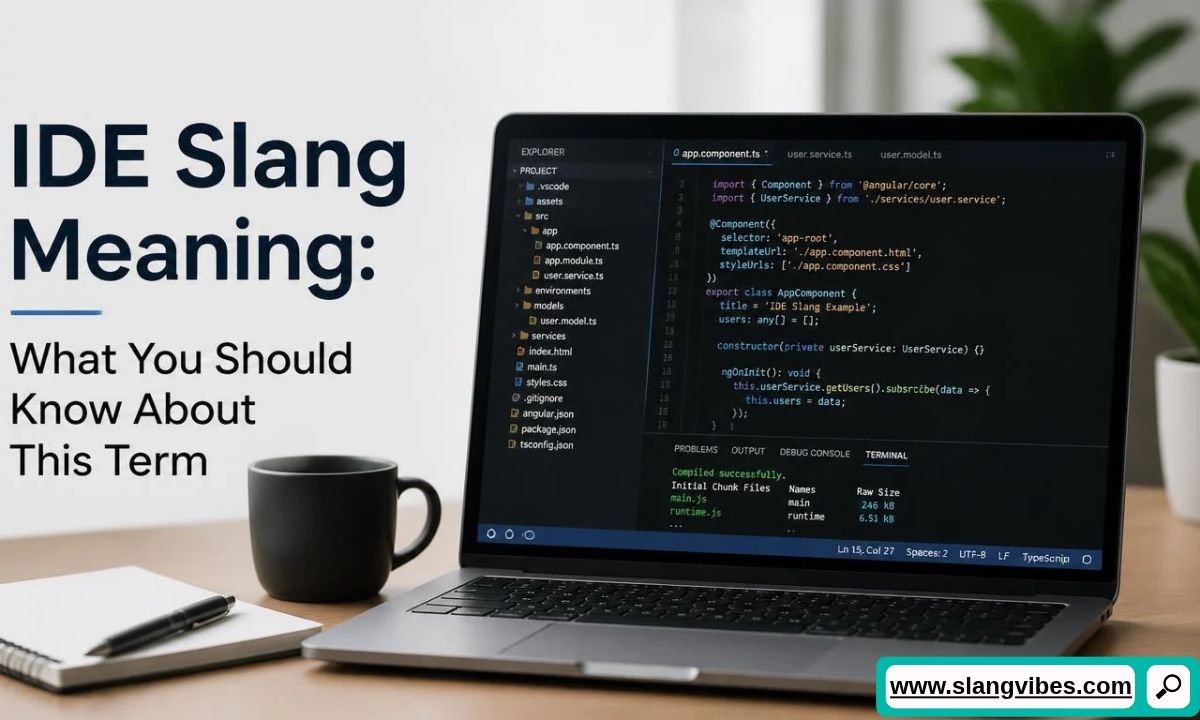
- Mixing up the software term. IDE also stands for Integrated Development Environment, the app programmers use to write and test code. A message like “Which IDE do you prefer?” is about coding tools, not shock.
- Using it for plain uncertainty. If you don’t know an answer, type IDK. IDE answers a situation, not a question.
- Over-explaining. Adding three sentences after IDE drains the effect. The point is leaving the sentence unfinished.
A fifth mistake is assuming every reader knows the term. Because the abbreviation is niche, newer friends or older relatives might ask what it means. Replying with “I don’t even” clears it up in seconds.
Picture a developer group chat where someone writes “IDE?” with a question mark. Nobody there is speechless. They want to know which editor you use. Context decides everything, so read the room before you answer.
One more wrinkle involves capitalization. Writing “ide” in lowercase looks relaxed, while “IDE” in capitals reads as louder. Neither choice changes the IDE slang meaning, but both change the volume. Match the style of the person you’re chatting with, and the message lands softly.
Read New Articles: Crank Slang Meaning (2K26 Guide): What “Crank” Really Means in Modern Conversations
How to Reply When Someone Texts IDE
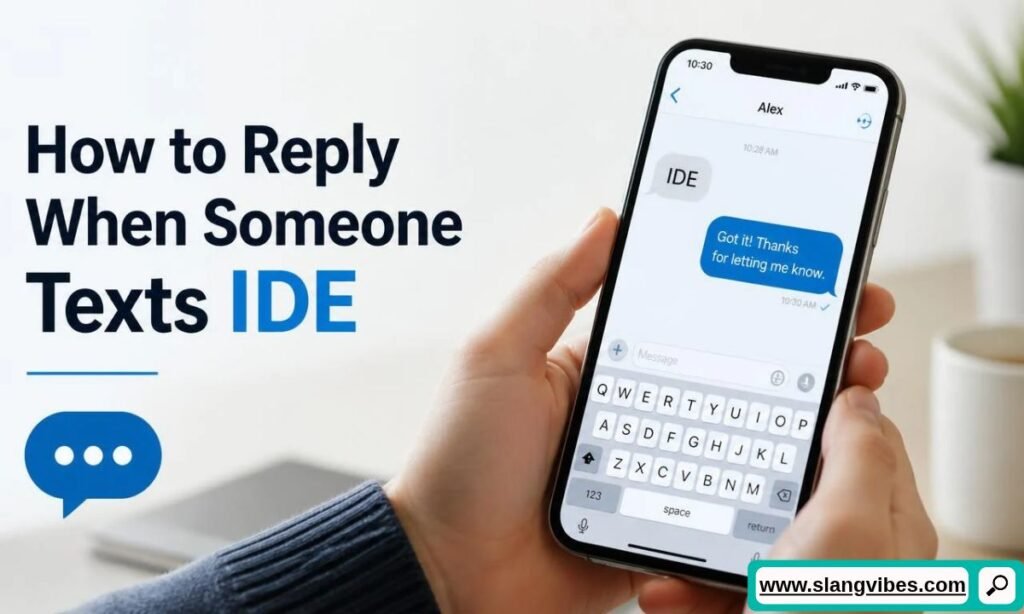
Your reply depends on the sender’s mood and your relationship. Match the energy first, then add a helpful line. Here’s a dating example:
Chloe: He showed up an hour late with no text. IDE.
Riley: Ouch. Want me to call with a fake emergency?
Chloe: Yes. Please.
A coworker version sounds calmer:
Marcus: The client changed the whole brief again. IDE.
Taylor: Coffee at three? We’ll sort it out together.
Marcus: Deal.
Here are quick reply ideas by mood:
- Casual: “Same,” “I get it,” or “Wild.”
- Funny: “Your brain left the chat.”
- Supportive: “Want to talk about it?”
- Serious moments: “Take your time. I’m here.”
If the sender sounds hurt, skip jokes and ask a gentle question. If the sender sounds amused, send a laughing emoji and keep the energy up. Reading the mood takes two seconds, and it keeps the chat friendly.
Group chats need a lighter touch. One short reaction, like a laughing emoji or “same,” keeps the thread moving. Long advice buried under five other messages gets lost. Save the detailed reply for a private message if the sender seems upset.
When the mood stays hidden, ask a short question. “Is this a funny IDE or a serious one?” works with close friends. With acquaintances, try “Everything okay?” instead. Both replies show you noticed, and neither forces the sender to explain.
Read Also: FTW Meaning in Text: What Does It Really Stand For?
Common Questions About IDE Slang
What does IDE mean in texting?
IDE stands for “I don’t even,” a reaction to something shocking, annoying, or unbelievable. The sender is too stunned to finish the sentence.
Is IDE the same as IDK or IDEK?
No. IDK means “I don’t know,” IDEK means “I don’t even know,” and IDE reacts to a situation instead of answering a question.
Is IDE rude or negative?
Not by default. Among friends it reads as a dramatic reaction, and the emojis around it set the tone.
Does IDE mean something different in tech?
Yes. In programming, IDE stands for Integrated Development Environment, a software tool for writing and testing code. The setting tells you which meaning applies.
Is it okay to use IDE at work?
Skip it in formal messages. Keep it for casual chats where everyone understands the IDE slang meaning.
Final Thoughts on IDE in Texts
The IDE slang meaning is simple once you see the pattern. It stands for “I don’t even,” a shortened reaction to news too shocking, annoying, or ridiculous to explain. The longer phrase has a documented history on Tumblr and Twitter, while the three-letter version stays a niche shorthand without a firm origin story. Context does most of the work. A crying emoji, a flat period, or the situation itself tells you whether the sender feels angry, amused, or thrilled.
Keep the neighbors straight, too. IDK answers a question, IDEK admits confusion, and IDE reacts. In coding circles, the same three letters name a software tool, so check the setting before replying. Save the abbreviation for friends and group chats. Use plain sentences at work.

Alex Carter is a language enthusiast and internet culture expert at SlangVibes. He explains the latest slang terms and text meanings in simple, clear English so everyone stays in the loop.