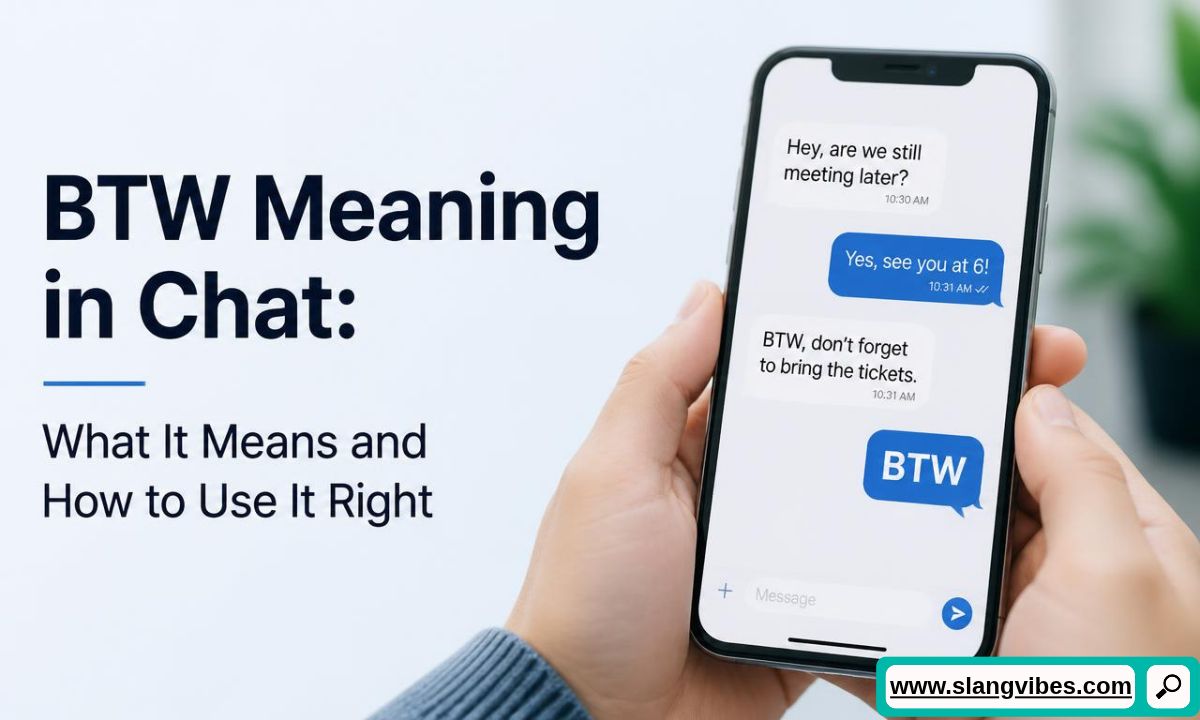
A friend once texted me a long message about weekend brunch plans. I replied about pancakes for ten minutes. Then I noticed the last line: “btw, I got the job.” I felt terrible. Nobody warned me a tiny abbreviation was hiding big news. Plenty of readers skim right past it, as I did. If you’ve wondered about the BTW meaning in chat, here’s the short version. It stands for “by the way,” and people use it to add a side thought. Tone, timing, and context decide how it lands, though. Below, you’ll see how people use it, when to skip it, and how to reply.
Read Also: Brat Meaning in Slang: The Truth Behind This Popular Word
BTW Meaning in Chat: The Short Answer
The BTW meaning in chat is simple. It stands for “by the way.” People type it before an extra thought, a reminder, or a quick change of subject.
Think of it as a verbal nudge, typed fast. The sender is saying, “Here’s something related, and I want you to see it.” Most readers treat it as a soft signal, not a headline.
You’ll also see it written as btw or Btw. All three versions mean the same thing. Capitalization changes the vibe more than the meaning.
Writers place it at the start of a message, in the middle, or at the end. Position matters less than the information after it.
Here’s what it usually points to:
- An extra detail tied to the topic
- A friendly reminder
- A side question
- A smooth shift to something new
Each one feels casual and low pressure. This is why BTW shows up so often in texts, DMs, and group threads. A quick exchange between friends shows it in action.
Maya: Dinner at seven?
Chris: Sounds good. btw, I’m bringing my brother.
Maya: Great, I’ll book a bigger table.
Notice how Chris slips the news in without making a big deal of it. The part after BTW is sometimes tiny, like a snack recommendation. Other times it’s huge, like a deadline change. Read the whole line, not only the abbreviation.
Read Also: Cantab Meaning in Slang: The Surprising Truth Explained
Where BTW Comes From
The BTW meaning in chat has roots in plain spoken English. The full phrase “by the way” is much older than any phone. People said it in conversation long before anyone owned a smartphone.
The abbreviation came later. Based on how the term is typically used online, BTW grew up alongside email, forums, and early chat rooms. Typing full phrases took time, so people trimmed the ones they used most. “By the way” came up constantly, which made it an easy pick for a three-letter shortcut.
Phones carried it further. Typing on a small screen made short forms even handier. BTW moved into text messages, WhatsApp, Instagram, and Discord with no trouble.
Readers still tend to hear BTW as spoken words. Your brain fills in the full phrase automatically, so the abbreviation keeps a friendly, conversational feel. This explains why it sounds natural even from people who barely use other slang.
Picture a coworker saying, “By the way, I moved the meeting,” in the hallway. You’d hear a helpful heads-up. Typed as BTW, the line keeps an easy tone.
Newer terms come and go. BTW stays put. Many people notice it appears in English chats even when the rest of the conversation uses another language, such as Hinglish, Spanglish, or Arabic written in Latin letters. It’s a useful shortened phrase, and useful phrases rarely disappear.
How People Use BTW in Chat Across Apps
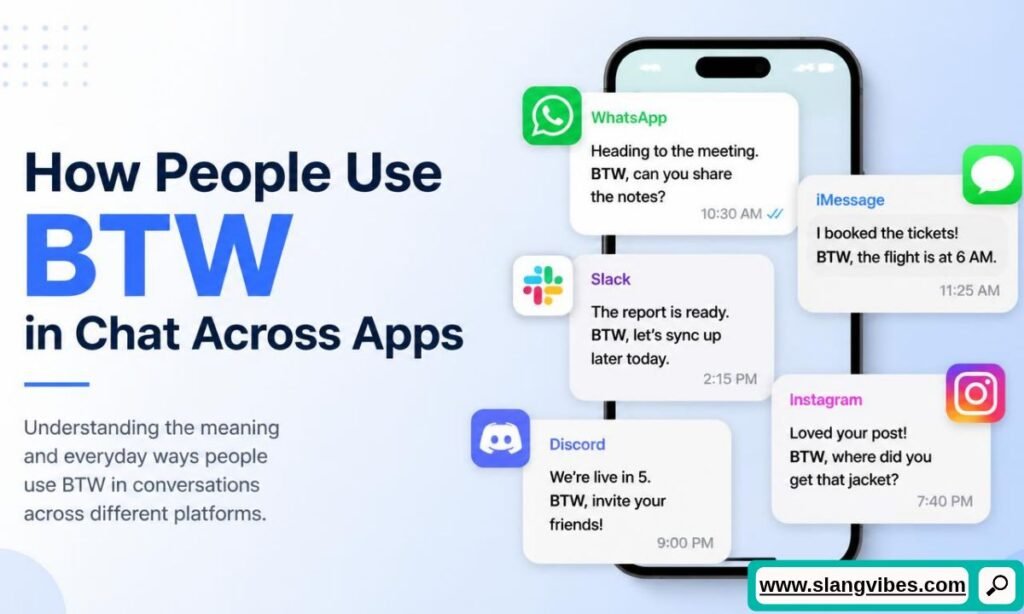
BTW in chat looks a little different on every app. The BTW meaning in chat stays fixed, but the setting changes the feel.
On WhatsApp and iMessage, people use it for quick reminders between friends and family. A quick sibling chat shows the pattern.
Zara: Are you home tonight?
Ali: Yep. btw, Mom wants us both at dinner Sunday.
Zara: Got it. I’ll tell her I’m in.
On Instagram, BTW often sits in DMs and comment replies. A creator might write “btw, the link is in my bio” under a post. On TikTok, commenters use it to add tips or corrections.
Workplace chat tools, such as Slack or Teams, follow a slightly more careful pattern. People use BTW to add a secondary detail without starting a new thread. A coworker thread looks like this.
Nora: Report’s done.
Dev: Thanks. btw, the client approved the budget.
Nora: Perfect, I’ll update the slides.
On Discord and in group chats, BTW works as a quick aside. It keeps a fast-moving conversation on track while still sharing one extra fact.
Tone shifts with the platform too. Casual apps welcome lowercase “btw” and relaxed punctuation. Work tools tend to favor “BTW,” with a comma and a complete sentence after it. Pay attention to what others write, then mirror it.
CNC Meaning in Slang: What the Term Really Stands For
BTW in Chat for Gen Z, Millennials, and Older Users
BTW in chat gets typed differently depending on who’s typing. The BTW meaning in chat holds steady across age groups. Generation shapes the style more than the meaning.
It’s common to see Gen Z users write a quiet lowercase “btw” with no comma or period. It reads like a thought drifting in mid-scroll. Some drop it into the middle of a message, or tack it on after the main point.
Millennials often write “BTW,” with capitals and a comma. This version feels a bit more structured, like a polite heads-up. Many people notice it shows up in emails and work chats more than in memes.
Older users tend to type “by the way” in full, or “Btw” with a capital first letter. Habits formed around full sentences tend to stick. Neither choice is wrong.
Here’s a quick first-person scenario. My aunt texts, “BTW, call your grandmother,” and I hear her warm, slightly bossy voice. My classmate sends “btw u left your charger,” and I hear a shrug. Same abbreviation, different texture. Neither sender means anything unfriendly.
Reading the style helps you reply in kind. If the sender writes lowercase and fast, match the energy. If they write full sentences, answer in full sentences. You don’t need to decode a generation. You only need to notice the pattern.
The Sarcastic BTW: When Its Meaning in Chat Changes
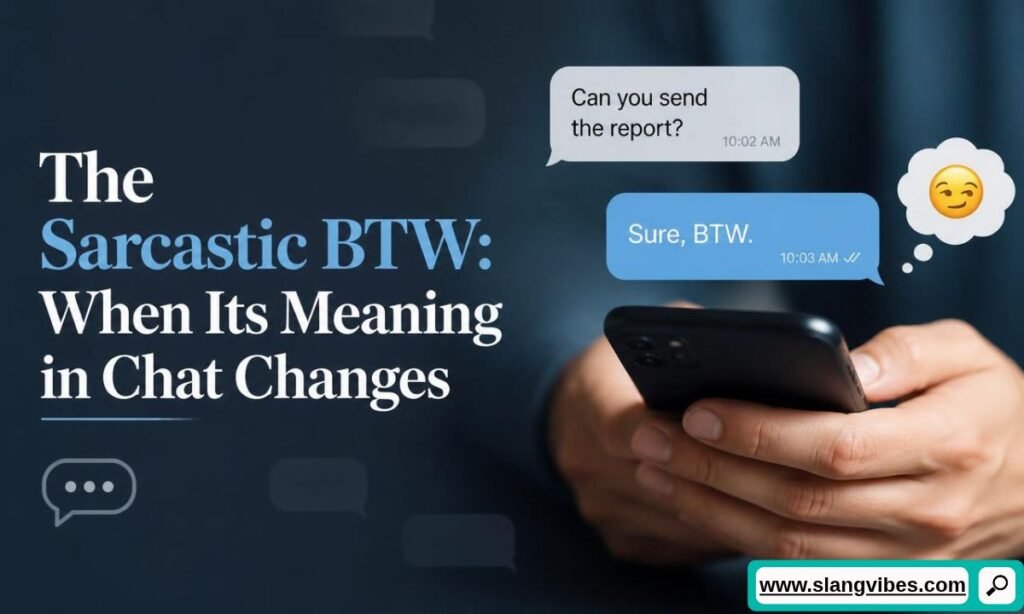
Most of the time, BTW is friendly. Sometimes it carries a sting. Passive-aggressive texts often borrow the abbreviation because it sounds casual while delivering a complaint.
Tone is hard to hear in text. Without a face or a voice, small signals carry extra weight. Punctuation, timing, and word choice fill the gap. Many people notice one tiny period changes a message from kind to cold. No wonder some readers brace themselves when a BTW lands after an argument.
The BTW meaning in chat shifts when the line after it contains criticism. Compare “btw, loved your photos” with “btw, you never replied to my last three messages.” The first one warms the room. The second one chills it. A dating example shows how this plays out.
Leo: Sorry I’m late.
Priya: It’s fine. BTW, you said six, and it’s nearly seven.
Leo: Ouch. I’m leaving now.
Priya: Cool.
Watch for these signals:
- A period right after BTW, like “BTW.”
- A complaint or correction after the abbreviation
- Short, flat replies around it
- A long silence before the message arrives
Context decides everything. A warm friend writing “btw, you forgot your jacket” is helping. A frustrated partner writing the same line after an argument is not. When you’re unsure, ask. A simple “Everything okay?” clears the air faster than guessing.
Read More Articles: SYFM Meaning in Slang: What Does It Stand For?
When Not to Use BTW in Chat (and Common Mistakes)
Knowing the BTW meaning in chat also means knowing when to skip it. Light, low-stakes additions suit it best. Serious moments need full sentences and a steady tone.
Skip it in these situations:
- Bad news. “BTW, I’m leaving the company” buries a major announcement under a casual label.
- Apologies. “BTW, sorry about yesterday” shrinks a real apology into a footnote.
- Formal emails. A hiring manager or professor expects “by the way” or no transition at all.
- Official documents. Contracts, reports, and school papers need complete wording.
Common Mistake: Using BTW to deliver your main point. If the news matters most, lead with it in a clear sentence. BTW belongs to side notes, not headlines.
Overuse is another slip. A message with three BTWs reads like a rambling list. Pick one extra thought, keep it short, and move on.
A third mistake involves audience. Not everyone knows internet abbreviations, including some older relatives and newer English learners. When in doubt, spell it out. Full words rarely confuse anyone.
Timing matters too. A BTW dropped into a tense discussion feels dismissive, as if the topic doesn’t deserve full attention. Wait for a calm moment, then write the thought out properly.
Work chats deserve a quick check as well. If your manager writes in full sentences, mirror that style.
BTW vs FYI, PS, and OTOH
Several short terms look alike, so mix-ups happen. Here’s how the BTW meaning in chat compares with similar terms.
| Term | Meaning | Tone/Vibe |
|---|---|---|
| BTW | By the way | Friendly, casual |
| FYI | For your information | Neutral, informative |
| PS | Postscript | Personal, afterthought |
| OTOH | On the other hand | Thoughtful, contrasting |
FYI shares information for awareness. It shows up often in work emails and carries a neutral, professional tone. BTW feels softer because it connects to the conversation already happening.
PS comes from the Latin phrase post scriptum, which means written after. People add it at the end of a message for an afterthought. BTW sits anywhere in a message, while PS belongs at the end.
OTOH means “on the other hand” and introduces a contrasting point. Swapping it for BTW changes your meaning completely.
You’ll also see TBH, which means “to be honest.” It introduces a candid opinion. Someone writing “tbh, the first draft was stronger” is sharing a view. Someone writing “btw, the first draft is attached” is adding a detail.
Try this simple test. Sharing a heads-up? Use FYI. Adding a friendly side thought? Use BTW. Weighing two options? Use OTOH. A quick check like this saves you from awkward mix-ups.
Read New Articles: DTI Slang Meaning: What Does DTI Mean on Social Media?
How to Reply When Someone Sends BTW in Chat
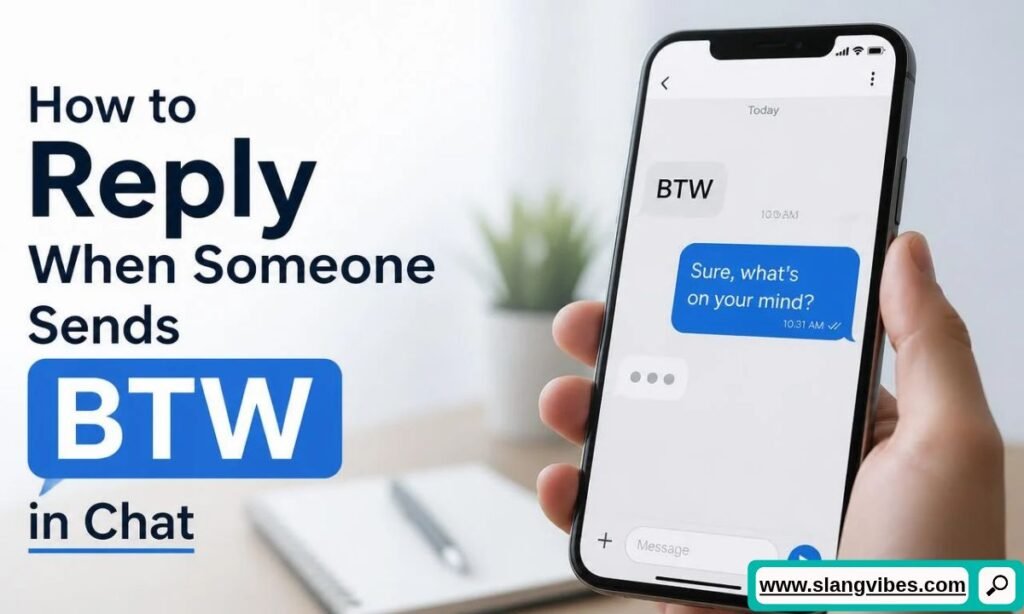
The BTW meaning in chat tells you what to do next. Read the extra thought, then respond to it. Replying to the abbreviation itself rarely helps.
Picture a group chat planning movie night.
Tasha: Movie night is on.
Omar: btw, the theater changed the start time to 8:30.
Tasha: Thanks for the heads-up.
Jules: Plot twist, I already bought snacks for 7.
Omar: Bring them anyway.
Notice how Tasha acknowledges the update, and Jules adds humor. Both replies fit the information.
Pick a reply style based on the message:
- Casual: “Good to know,” “Thanks for the heads-up,” or “Oh, I had no idea.”
- Funny: “Plot twist!” or “Well, that changes my evening.”
- Professional: “Thanks for the update,” or “Noted. I’ll adjust the schedule.”
- Warm: “Aw, thank you for telling me.”
If the BTW feels sarcastic, slow down. A calm reply such as “Fair point, I’m sorry about that” often settles the moment. Another option is asking, “Did something bother you?” Direct questions beat silent guessing.
Last, answer questions hidden inside the BTW. If someone writes “btw, are you free Friday?” respond to the question first. Skipping it leaves the sender waiting, and the extra thought was often the whole reason they messaged.
Keep replies short unless the topic deserves more. A quick acknowledgment shows you saw the message.
Read Also: BBFS Meaning in Slang: Definition, Texting Uses, Examples & More (2026 Guide)
FAQs About BTW in Chat
What does BTW mean in chat?
The BTW meaning in chat is “by the way.” People use it to add an extra thought, reminder, or side question.
Is BTW rude or passive-aggressive?
Not by default. BTW usually sounds friendly. A complaint, a period after the abbreviation, or flat replies give it a sharper edge.
Is BTW fine for work emails or Slack?
In team chats, yes. In formal emails to clients, professors, or hiring managers, write “by the way” in full.
What is the difference between BTW and FYI?
BTW adds a related side thought. FYI shares information for awareness, usually in a neutral tone.
Should BTW be uppercase or lowercase?
Both work. Lowercase “btw” feels relaxed, while “BTW” looks more structured.
The Bottom Line on BTW in Chat
The BTW meaning in chat comes down to three letters and one friendly job. It stands for “by the way,” and people use it to add a reminder, a side question, or a small update without derailing the conversation.
Context shapes everything else. Gen Z often types a quiet lowercase “btw,” Millennials lean toward “BTW,” and older users sometimes write the full phrase. Each style carries a slightly different mood, yet the meaning stays put.
Watch the tone. A friendly BTW feels like a nudge from a good friend. A sarcastic BTW, especially with a period or a complaint attached, lands like a poke. Reading the surrounding messages tells you which one you’re facing.

Alex Carter is a language enthusiast and internet culture expert at SlangVibes. He explains the latest slang terms and text meanings in simple, clear English so everyone stays in the loop.