My friend Dana texted me last spring: “imao this movie is overrated.” I stared at my screen for a full minute. Was it a typo for LMAO? Did she laugh at her own review? I felt silly asking, so I typed “lol” and moved on. Later, I looked it up. The IMAO meaning is “in my arrogant opinion,” and Dana was joking about her own hot take. Here’s the thing: this tiny acronym trips up plenty of people, and I wasn’t alone. This guide explains what it stands for, where it came from, and how to use it without sounding like a jerk.
Read Also: EMP Meaning in Text: Platform-by-Platform Guide
IMAO Meaning: What It Stands For
The IMAO meaning is easy to state. It stands for “in my arrogant opinion.” People type it as an internet acronym, usually in lowercase, and attach it to a take they know sounds bold.
Think of it this way: you’re announcing a strong opinion while winking at the reader. You’re saying, “Yes, I know I sound confident here, and I’m choosing to be playful about it.” The wink does most of the work.
Here are a few examples of how the acronym shows up in real messages:
- IMAO, pineapple on pizza is a crime.
- Best sequel ever, IMAO.
- IMAO, nobody needs more than one pair of white sneakers.
Notice the placement. IMAO sits at the start or the end of the sentence, much like its cousin IMHO. The opinion itself tends to be lighthearted, such as food, movies, music, or sports. Heavy topics rarely get this label, and serious arguments about money or politics almost never do.
Some people hear “arrogant” and assume an insult. In most chats, IMAO signals humor instead. The speaker pokes fun at their own certainty, and friends usually laugh along or argue back for fun.
You might see capital letters, as in IMAO, or lowercase, as in imao. Both mean the same thing. Text messages favor lowercase, while forum posts lean toward capitals.
IMAO Meaning and Origin: Where It Comes From
The IMAO meaning grew out of an older acronym. IMHO, short for “in my humble opinion,” came first, and IMAO flipped its tone. Where IMHO sounds polite, IMAO sounds proud on purpose.
The flip made sense for early internet culture. Online debate was already a sport, and writers loved a good joke at their own expense. Swapping “humble” for “arrogant” gave people a quick way to say, “Yes, I’m showing off.”
Dictionary.com’s entry on the term traces early use to Usenet discussion groups. Those were text-only forums where people argued about everything from computers to movies. One poster even added a postscript explaining the acronym to head off a flood of questions.
Did You Know: Dictionary.com counted only eight uses of IMAO in Usenet groups through 1989. Every one showed up in an argument or debate.
Nobody has confirmed a single inventor or exact coinage date, so treat any claim of one with caution. The tone is clear, though. From the start, people used IMAO with irony and a bit of force, and the same mix shows up today.
Based on how people typically use the term online, the acronym moved from forums into chat apps, texting, and social feeds. Short, punchy phrases travel well in those spaces, and IMAO fits right in.
Read More: What Does WSP Mean in Text? Real Meaning in Chat & Social Media
IMAO vs LMAO: Why the Mix-Up Happens
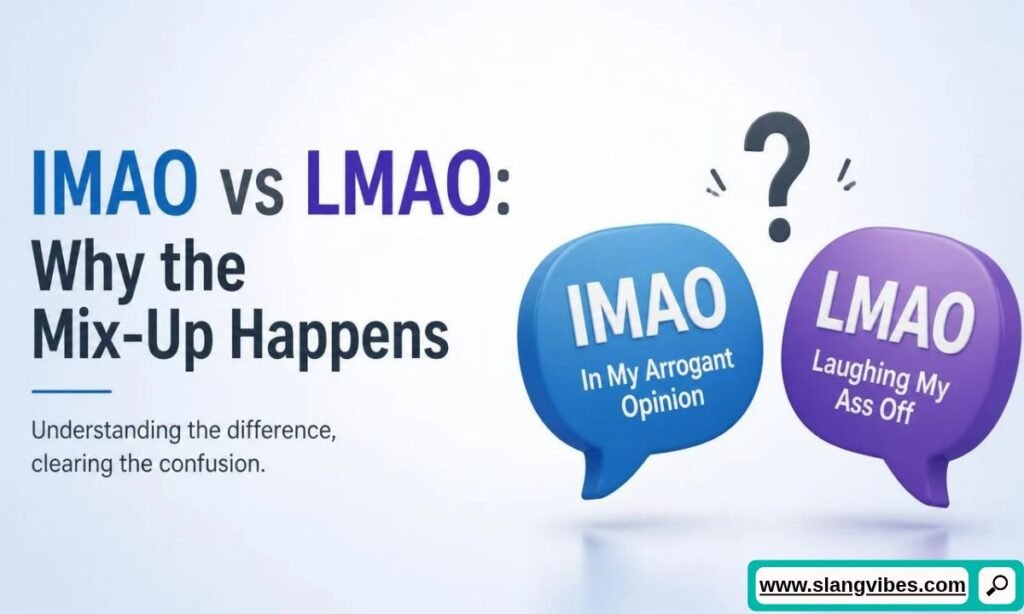
Here’s the thing: the IMAO meaning often disappears under a common typo. The two acronyms share three of four letters, so mix-ups happen all the time. Dictionary.com notes IMAO frequently appears as a misspelling of LMAO, the shorthand for laughing hard.
Picture this. A coworker texts you, “I dropped my phone in the sink imao.” No opinion appears anywhere in the message. Nobody is claiming to be right about anything. Your coworker is laughing at a mishap, and the L turned into an I by accident.
Now take a second text: “Imao, the book was better than the movie.” This time, a clear opinion follows. The writer is sharing a take and teasing themselves for sounding sure.
A quick check settles most cases. Look at what surrounds the acronym:
- If it follows a joke, a mishap, or a funny story, read it as a typo for LMAO.
- If it comes with a judgment such as best, worst, overrated, or underrated, read it as “in my arrogant opinion.”
Both readings look identical on screen, so context does the heavy lifting. When you’re still stuck, ask. A quick “wait, is this a laugh or a hot take?” costs nothing and keeps the conversation friendly.
Fast thumbs and autocorrect add to the mess. If your own texts keep sending the wrong one, reread before hitting send.
What IMAO Means in Text and How to Use It
Knowing the IMAO meaning is half the job. The other half is using it well. Good usage comes down to tone, topic, and timing.
Start with tone. IMAO works best when your opinion is low-stakes and your attitude is playful. You’re teasing yourself, so the reader should feel invited to tease back.
Here’s a friendly exchange between two friends planning dinner:
Jordan: IMAO, tacos beat pizza every time
Sam: Bold move. Pizza fans are typing already
Jordan: Let them. I stand by it
Sam: Fine, tacos it is
Notice how Jordan states a strong view and signals humor at once. Sam plays along. Nobody gets defensive.
Dating chats work the same way, with a little extra flirting:
Maya: IMAO, you’re the worst at picking movies
Eli: Rude. You loved the last one
Maya: Fair. Still the worst
Eli: Next pick is yours, then
Maya’s message teases without stinging. The acronym softens a jab and shows she’s kidding.
A few usage habits help:
- Place IMAO at the start or end of the sentence.
- Pair it with a lighthearted topic.
- Skip it when your opinion is already humble or tentative, since the joke needs confidence to land.
- Use it sparingly. One per chat is plenty.
Short phrases land best. A rambling paragraph followed by IMAO loses the wink.
TT Meaning in Text Messages and Social Media (2026)
IMAO vs IMHO vs IMO: Quick Comparison
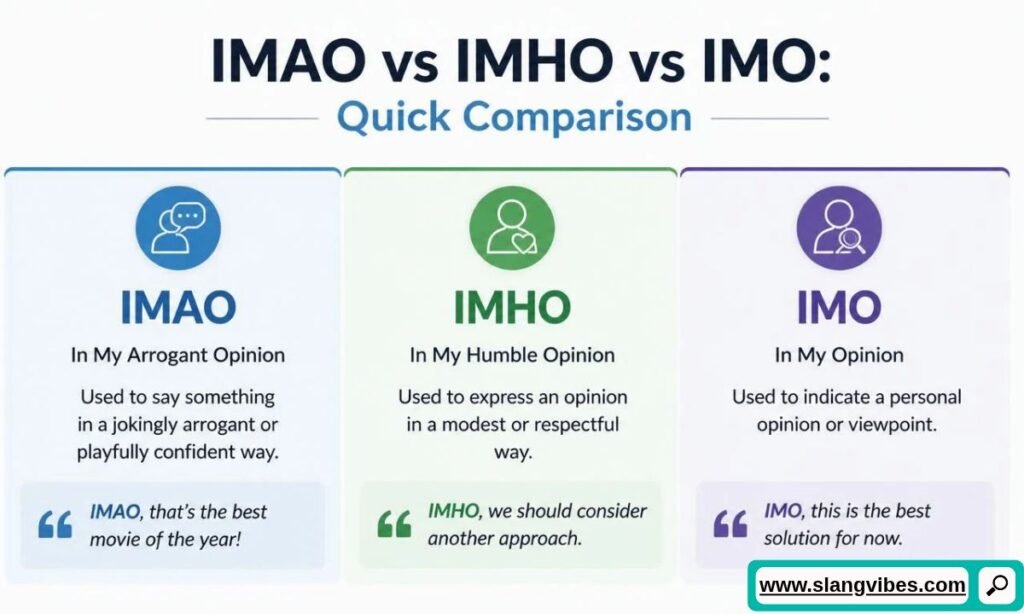
Opinion acronyms form a small family, and each member sets a different mood. Here’s how they compare:
| Acronym | Meaning | Tone/Vibe |
|---|---|---|
| IMO | In my opinion | Neutral and direct |
| IMHO | In my humble opinion | Polite, sometimes ironic |
| IMAO | In my arrogant opinion | Playful and self-teasing |
| IMNSHO | In my not so humble opinion | Subtly proud |
| IMMAO | In my most arrogant opinion | Extra dramatic |
The IMAO meaning sits near the bold end of this spectrum. It’s stronger than IMHO, yet lighter than a flat statement of fact.
IMO is the plain default. You state a view, and nobody reads anything into it. IMHO adds politeness, though it’s common to see it used ironically, which blurs the line. Merriam-Webster notes some usage evidence reads the H as “honest” instead of “humble.”
IMNSHO and IMMAO are the dramatic cousins. Merriam-Webster describes IMMAO as an inflated version of IMAO and IMNSHO as a way to sound subtly arrogant. Both appear less often in everyday chats, based on how people typically use these terms online.
Choosing the right one saves you from sounding too stiff or too cocky. Pick based on the room. Group chats full of friends welcome IMAO. Neutral settings suit IMO. If you need to sound gracious, IMHO still works.
IMAO Meaning on Social Media and in Group Chats
The IMAO meaning shifts a little depending on where you read it. Based on how people typically use the term online, you’ll spot it in replies on X, Reddit threads, Discord servers, and group texts. Each place has its own flavor.
On X and Reddit, IMAO often appears next to a hot take. Readers expect the joke and respond with their own. Discord and group chats move faster. People type in lowercase and skip punctuation, so imao slips into a message like any other word. Short replies keep the thread moving, so expect quick jokes instead of long explanations.
Age plays a role, too. It’s common to see Millennials, who grew up around forums and instant messengers, write IMAO in capitals. Gen Z users tend toward lowercase and pair it with emoji or a laughing reaction. Neither style is wrong. Both carry the same wink.
Here’s a typical group chat debating a snack:
Chloe: IMAO, hot Cheetos are overrated
Dev: Delete your account
Priya: Seconding Dev
Chloe: I said what I said 😂
Chloe delivers the take, and the group erupts on cue. The acronym works like a small flag. It tells everyone the argument is for fun.
US and UK readers use it the same way, since the acronym doesn’t depend on regional spelling or slang.
Read New Articles: HG Mean in Text: What It Really Means in Messages (2026)
When IMAO Is the Wrong Choice
The IMAO meaning works for banter. It backfires in the wrong setting. Text strips out your tone of voice, so a joke about arrogance sometimes reads as the real thing.
Take a work email to your manager: “IMAO, the new schedule is a mistake.” Your boss won’t see a wink. They’ll see a blunt criticism with a label admitting you’re arrogant. Skip the acronym and write, “In my view, the new schedule needs another look.”
Consider a serious debate about politics, health, or someone’s personal choices. Adding IMAO to a heavy topic trivializes the other person’s feelings. They might feel dismissed, and the conversation gets worse.
Then there’s the message to someone who doesn’t know the term. A parent, a grandparent, or a new acquaintance might read IMAO as a typo or, worse, as an insult. Spelling out “in my opinion” costs only a few extra seconds.
Here are the settings where plain wording wins:
- Work emails and performance reviews
- Customer support replies
- School papers and formal essays
- Messages to people you don’t know well
- Conversations about sensitive or painful subjects
A good rule of thumb: if you wouldn’t tease the reader in person, don’t tease them in text. When doubt creeps in, drop the acronym and write the full phrase. Your opinion lands fine without it.
How to Respond When Someone Uses IMAO

Once you know the IMAO meaning, replying gets easy. Match the playful energy, and you’re set. The sender wants a reaction, so give one.
You have three good options. Play along with a joke of your own. Push back with a friendly counter-take. Or agree and add your own spin. All three keep the mood light.
Here’s a sibling exchange over a movie night pick:
Nora: IMAO, the original movie is better than the remake
Ben: Bold take from someone who hasn’t seen the remake
Nora: I watched the trailer. The trailer was enough research
Ben: Wow. We’re watching both tonight
Ben teases back, and Nora doubles down. Both keep the banter alive.
Avoid two common reply mistakes. First, don’t treat IMAO as a real insult and fire back angrily. Second, don’t ignore the joke and lecture the sender on facts. Either reply kills the mood.
If you honestly disagree, say so with a smile. A line like “Respectfully, no” keeps things friendly. If the topic matters to you, move the talk to a voice call or a longer message where tone comes through.
Not sure whether someone is joking? Look at their other messages. It’s common to see emoji, exclamation points, or a follow-up laugh alongside a playful IMAO. When in doubt, a quick “ha, fair” is a safe response.
Read Also: NTY Meaning in Text (2026): What It Means and How to Use It ⭐
FAQs About IMAO
What does IMAO stand for in text?
IMAO stands for “in my arrogant opinion.” People use it to share a bold take with a playful wink.
Is IMAO the same as LMAO?
No. LMAO expresses laughter, while IMAO introduces an opinion. Many people type IMAO by mistake when they mean LMAO, so context matters.
Is IMAO rude or offensive?
Rarely. The IMAO meaning is playful and self-teasing, so most friends read it as a joke. Text often strips away tone, though, so skip it with people who don’t know you.
What’s the difference between IMAO and IMHO?
IMHO means “in my humble opinion” and sounds modest or polite. IMAO flips the tone and sounds boldly proud on purpose.
Is it OK to use IMAO at work?
Skip it in emails, reports, and messages to managers. Casual chats with close teammates are usually fine, but plain wording is safer.
The Bottom Line on IMAO
The IMAO meaning comes down to four words: in my arrogant opinion. People use it to share a bold take while teasing themselves for sounding so sure. It grew out of IMHO, appeared in early Usenet debates, and now lives in texts, group chats, and social feeds.
Remember the main points. Context separates IMAO from the LMAO typo. Tone stays playful, so low-stakes topics work best. Work emails, heavy conversations, and messages to people who don’t know the term call for plain wording instead. When someone sends you an IMAO, match their energy with a joke, a counter-take, or friendly agreement.

Alex Carter is a language enthusiast and internet culture expert at SlangVibes. He explains the latest slang terms and text meanings in simple, clear English so everyone stays in the loop.